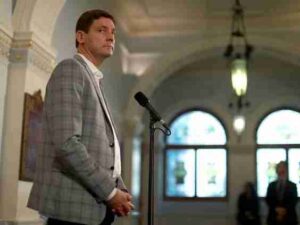
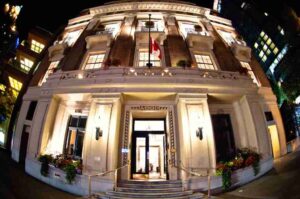
Prime Minister Mark Carney held a press conference in Vancouver alongside British Columbia Premier David Eby on June 25, announcing innovative measures to create affordable housing in B.C.
The June 25th announcement by Mark Carney on behalf of the federal government, and British Columbia Premier David Eby should have been a triumph.
Instead, it became a communications debacle.
When Prime Minister Mark Carney stood alongside federal Housing Minister Gregor Robertson, B.C. Premier David Eby and B.C. Housing Minister Christine Boyle to announce that the federal and provincial governments would work together to purchase approximately 2,200 unsold condominiums and convert them into rent-to-own housing, the promise was immediately overshadowed by confusion.
The questions that came were entirely predictable.
- Where were these condominiums?
- Who owned them?
- Would taxpayers be paying full market value?
- Would they be located in Metro Vancouver, where housing shortages are most acute?
Neither Mr. Carney nor Mr. Eby provided answers during their announcement.
Instead of controlling the narrative, the governments allowed a vacuum to develop, one that was quickly filled by speculation, criticism and political attacks. Journalists demanded details that were not forthcoming, while federal Conservative leader Pierre Poilievre seized upon the uncertainty as evidence that the announcement was little more than political theatre.
 Federal Conservative Party Leader Pierre Poilievre speaks out against the federal government’s proposal to purchase vacant condos, during a town hall meeting in Duncan, B.C.
It was, without question, one of the poorest communications roll-outs either the Carney government or the Eby government has experienced.
And yet, buried beneath the muddled messaging was an idea that deserves considerably more attention than it has received.
In the days following the announcement, Mr. Eby provided the missing details.
Contrary to widespread assumptions, the condominiums would not be concentrated in Metro Vancouver, or even in British Columbia’s largest urban centres. Rather, they would largely be acquired in smaller communities throughout the province where residential developments have stalled or failed altogether.
Many of these homes would be what the real estate industry describes as “distressed properties.”
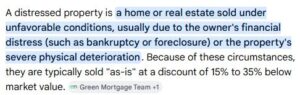
These are condominiums sold under unfavourable financial circumstances because developers have encountered severe financial difficulties, entered receivership, declared bankruptcy or been forced into foreclosure, with licensed insolvency trustees disposing of assets well below their original market value.
Such circumstances create unusual opportunities for public acquisition.
Rather than paying retail prices, governments can often acquire these units at discounts ranging from 15% to 35% below market value.
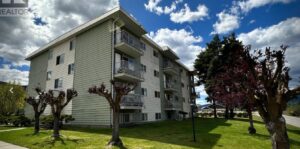 Completed, distressed vacant condo building ready for sale below market value in Grand Forks, B.C.
Communities such as Grand Forks, and other smaller centres throughout the Okanagan, the Kootenays and Vancouver Island — including Duncan, Port Alberni and Campbell River — contain developments that fit this description.
These are not speculative purchases. They are existing homes. Completed homes. Vacant homes. Homes waiting for occupants.
That distinction matters enormously.
 A typical condo construction timeline spans 2.5 to 5 years from initial sales launch to final move-in, a timeline that can stretch even longer due to complex excavation, permitting, and labour demands.
Governments have become accustomed to announcing ambitious affordable housing projects that require years of planning, environmental reviews, permitting, financing and construction before a family receives keys to a front door.
Typically, that timeline stretches three to four years, often longer.
Premier David Eby has argued that purchasing distressed condominium developments offers a dramatically different proposition.
- The homes already exist;
- The infrastructure is already built;
- Water, sewer, electrical service and roads are already in place;
- Families could move in almost immediately;
- The economics are equally compelling.
Constructing affordable rental housing has become extraordinarily expensive. Labour shortages, escalating material costs, financing expenses and municipal development charges have pushed construction costs to unprecedented levels.
Acquiring completed condominiums at significant discounts represents substantially better value for taxpayers while simultaneously rescuing developments that otherwise risk remaining empty for years.
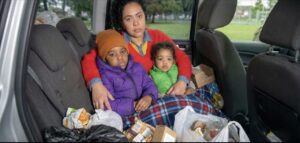
The most important aspect of this initiative has received the least attention.
Behind every vacant condominium sits the possibility of a family whose life could be transformed. Not every homeless family sleeps on sidewalks. Many spend months couch surfing between relatives and friends. Some move weekly from one borrowed bedroom to another. Others sleep in aging recreational vehicles parked wherever municipal bylaws permit. Still others live in automobiles, desperately trying to shield children from the instability surrounding them.
For these families, housing is not merely shelter. Housing restores routine. It restores childhood. It restores educational stability, better physical health and improved mental health. It restores dignity.
The proposed rent-to-own model carries particular promise because it offers something beyond secure tenancy. It offers ownership.
Families who have spent years believing home ownership had become permanently unattainable may finally possess a realistic pathway toward building equity and long-term financial security. That possibility should not be underestimated.
If governments can purchase distressed condo developments substantially below replacement cost, rapidly convert them into affordable rent-to-own housing, and provide stable homes for thousands of families who otherwise face years of uncertainty, then taxpayers receive genuine value, while vulnerable British Columbians receive something infinitely more important than political messaging.
They receive hope.
In an age when political discourse increasingly rewards outrage over solutions, this initiative reminds us that governing still matters. It reminds us that budgets are, ultimately, moral documents reflecting the choices society makes about who deserves opportunity and who deserves security. Governments exist not merely to balance ledgers or score partisan victories, but to solve problems that markets alone cannot resolve. Housing is one of those problems.
We live in anxious times, when too many families have begun to wonder whether stability itself has become a luxury. Against uncertainty, both the B.C. and federal governments are attempting — however imperfectly — to meet the moment.

If vacant homes become places where children sleep safely, parents regain hope, and families begin building lives instead of merely surviving them, then history will remember not the fumbling announcement, but the quiet dignity of thousands of front doors opening onto a better future.