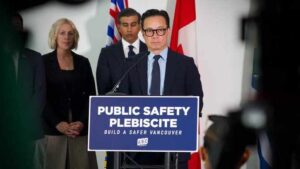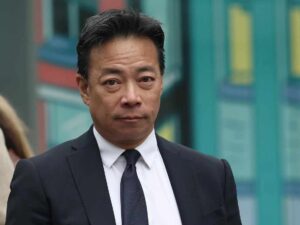

Kareem Allam, 47, Vancouver Liberals’ Mayoral candidate | Photo credit: Katie Hyslop, The Tyee
For over two decades, Kareem Allam has been the man behind the curtain in Canadian politics.
Kareem Allam is a typical Vancouver story. Parents who immigrated to Canada, a career in public service and policy, and a belief in our ability to make our communities better.
Watch part 1: pic.twitter.com/sLy1UpJIbb— Vancouver Liberals (@vanliberals) October 16, 2025
Kareem is a self-described “policy nerd” and a master campaign strategist who has navigated the highest corridors of municipal, provincial, and federal power.
Yet, for all his time spent steering others to victory, in 2026 Kareem Allam has stepped out from the shadows of backroom strategy to mount his own campaign.
Vancouver deserves a more accountable and representative City Hall.
The Vancouver Liberals will hold a referendum on a ward system in the following election, after the recommendations of a citizens’ assembly. pic.twitter.com/rSCFFH5FvX
— Kareem Allam (@kareemformayor) April 7, 2026
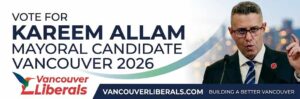
As the founder, leader, and Mayoral candidate for the newly formed municipal party, the Vancouver Liberals, Kareem Allam is running a well-funded, high-stakes campaign to unseat Mayor Ken Sim, in the October 2026 civic election.
Investing in parks, libraries, and community spaces is how we reduce crime.
That’s why we’re committing 400 new frontline workers and a historic $1.35B investment in parks, recreation, and pools. pic.twitter.com/Q1mgs6SGAJ
— Kareem Allam (@kareemformayor) April 3, 2026
Kareem Allam’s transition from kingmaker to candidate marks a massive shift in Vancouver’s civic landscape.
View this post on Instagram
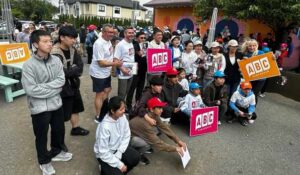
In 2022, Kareem Allam was the mastermind who successfully guided Ken Sim and the ABC Vancouver party to a historic sweep of City Hall, the Park Board, and the School Board. After steering ABC Vancouver to a sweeping majority at all three levels of civic government, he served briefly as Mayor Sim’s Chief of Staff before a highly publicized falling-out led to his departure in February 2023.
@jessforvancouverWe are still in a housing crisis – but we have a real solution to get Vancouver out of crisis mode. #vanpoli @vancouverliberals♬ original sound – jessforvancouver
Now, disillusioned by what he views as a broken social contract and a deeply divided city, Kareem Allam has built a political vehicle of his own.
With a platform focused on a massive infrastructure injection, an aggressive front line service plan, and a return to consensus-driven, big-tent governance, Kareem Allam aims to execute an activist civic agenda not seen since the 1970s.
Upbringing, Roots, and the Great Canadian Social Contract
To understand Kareem Allam’s political philosophy, one must look to his family history, which he frequently cites as the bedrock of his world view.
Born in Vancouver and raised in Richmond, Kareem is the son of an Egyptian colonel — who spent 11 months as an Israeli prisoner of war — and a Sudanese mother whose family was expropriated during a revolution. His mother spent two grueling years living in a refugee camp in Lebanon before arriving in Canada.
View this post on Instagram
Though his father, Mahmoud Allam, would eventually return to Egypt to manage the Al Ahly football club, the family’s formative years in the Lower Mainland left an indelible mark on Kareem.
Speaking with reporter Katie Hyslop for an extensive feature profile in The Tyee, Kareem Allam reflected on how Vancouver served as a safe harbour where his family could heal, plant roots, and ultimately thrive:
“My family history defines a lot of how I perceive this place… [Vancouver] was a welcoming place, a place of refuge and a place where they were able to thrive, raise their children. It wasn’t always prosperous. But over the arc of time, the family has done well.”
This personal history forged Allam’s deep belief in what he terms the “great Canadian social contract” — the idea that a booming economy must directly fund world-class social programming, and that each generation bears a strict responsibility to build winning conditions for the next.
Happy Canada Day! @vanliberals @kareemformayor pic.twitter.com/PLdV7E7eRr
— Mark Halyk (@mark4Vanparks) July 1, 2026
Kareem Allam’s formal education took him away from the West Coast for high school and graduate studies, including a stint in Ottawa where he cut his political teeth working on Parliament Hill for the federal Canadian Alliance party.
But the pull of Vancouver was permanent.
View this post on Instagram
Outside of politics, his career spanned public, private, and non-profit sectors. He served as the Director of Public Policy for the Vancouver Board of Trade, sat on the Fraser Health Authority’s Board of Directors, worked with major energy corporations like TransCanada and FortisBC, and served on the TransLink screening panel and the College of Massage Therapists of B.C.
View this post on Instagram
Professionally, his primary focus for the last two decades has been as a partner at Richardson Strategy Group (formerly Richardson Strategies), working closely alongside prominent Indigenous leaders like Haida nation leader Miles Richardson on complex title, rights, and economic development negotiations.
The Campaign Veteran: 40 Races and the Road to Kingmaker
Before launching his own mayoral bid, Kareem Allam compiled a legendary résumé as a political strategist, managing or advising on roughly 40 political campaigns across the ideological spectrum.
Kareem specializes in taking complex policy ideas and distilling them into simple, powerful promises that resonate with everyday voters.

His track record as a backroom general is elite:
- The 2005 Surrey Municipal Race: He helped guide Dianne Watts to an upset victory as Mayor of Surrey, reshaping the politics of BC’s fastest-growing city;
- Federal Conservative Leadership (2020): Kareem Allam played a critical role in successfully securing the federal Conservative Party leadership for Erin O’Toole, navigating a complex, multi-ballot ranked voting system.;
- Provincial BC Liberal Leadership (2022): He served as the campaign manager who secured the leadership of the provincial Liberal party (later renamed BC United) for Kevin Falcon;
- ABC Vancouver Municipal Sweep (2022): In his most (in)famous local victory, Mr. Allam masterminded Ken Sim’s mayoral campaign. He engineered the easily digestible pledge to hire “100 police officers and 100 nurses,” a message that fundamentally shifted public safety discourse and handed ABC a total majority.
However, Kareem Allam’s political alignment experienced a dramatic shift.
Vancouver’s Values Matter. pic.twitter.com/IzTt1a6tSP
— Kareem Allam (@kareemformayor) February 28, 2026
In the 2024 British Columbia provincial election, the lifelong conservative strategist publicly broke ranks to endorse and re-organize and energize the BC NDP campaign — steering the party and their moribund campaign for re-election, from an almost certain defeat to majority status — stating to The Tyee’s Katie Hyslop that the modern center-right movement had abandoned its traditional values of climate action, reconciliation, and social cohesion, veering instead toward populism.
“I’m not sure that I left the center-right movement,” Kareem Allam observed. “I think the center-right movement left me.”
The Vancouver Liberals and the Fight for a Council Majority

The Vancouver Liberal Electors Association — commonly known as the Vancouver Liberals — was officially founded on July 3, 2025. The Vancouver Liberals are a strictly municipal political party, entirely independent of both the federal Liberal Party of Canada and the former provincial B.C. Liberals.
Some time off the campaign trail today…. pic.twitter.com/DvVyV1Ddw2
— Kareem Allam (@kareemformayor) June 21, 2026
Kareem Allam’s strategy for the 2026 election hinges on building a true coalition party that rejects extreme polarization. He has intentionally recruited high-profile candidates from across the political spectrum to build a team capable of seizing a majority on the 11-member Vancouver City Council.
Vancouver Liberals 2026 Civic Team (Key Figures)

├── Mayoral Candidate: Kareem Allam

City Council Candidates:
Dr. Moira Stilwell, a Vancouver Liberals Council candidate, one of VanRamblings two favourites in 2026
│ ├── Dr. Moira Stilwell (Physician; former B.C. provincial cabinet minister)
│ ├── Jessica Walton (Front line government worker, socialist, NDP stalwart)
│ ├── Michael Wu (30-year entrepreneur & former RCMP Auxiliary Constable)
│ ├── Devin Clemens (UBC Graduate Programs Manager, School of Economics)
│ └── Armor Valor (South Vancouver community advocate, front line worker)
│ ├── Victoria Jung (current Vancouver School Board Chair)
└── Park Board Candidates:
Welcome to the team, Shayla Bird. pic.twitter.com/xhilSD8zgW
— Kareem Allam (@kareemformayor) May 20, 2026
Shayla Bird, Vancouver Liberals candidate for Vancouver Park Board
├── Brennan Bastyovanszky (Sitting Park Board Commissioner)
├── Scott Jensen (Sitting Park Board Commissioner; first Indigenous Chair)
├── Mark Halyk (transformed Park Boards concession services for the better)
└── Shayla Bird (Educator, consultant, Black public Historian)
By bringing over sitting heavyweights like Victoria Jung, Scott Jensen, and Brennan Bastyovanszky — who actively opposed Ken Sim’s efforts to dismantle the democratically elected Park Board — Kareem Allam has positioned the Vancouver Liberals as protectors of civic democracy and neighbourhood infrastructure.
The Mayoral Platform: From Infrastructure to Pest Control
Kareem Allam’s platform represents a highly activist approach to municipal government. Rather than scaling back, Kareem proposes using the city’s financial levers to aggressively address long-ignored public deficits.
Service to the People of Vancouver: Rebuilding Civic Infrastructure
The centre-left anchor of Kareem Allam’s platform is a monumental $1.35 billion capital fund commitment aimed at thoroughly renovating 11 Vancouver community centres.
These facilities were explicitly flagged by City Auditor General Mike McDonnell as being in an advanced state of disrepair. Kareem Allam argues that by neglecting neighbourhood pools, libraries, and community hubs, the current administration is eroding the literal spaces where social cohesion is formed.
From the beginning the Vancouver Liberals have been fighting for students, seniors, small business, and families. The whole other time Ken Sim has been fighting for his friends and crypto cronies. pic.twitter.com/czXtReahyp
— Kareem Allam (@kareemformayor) June 23, 2026
As part of this infrastructure push, Kareem Allam has rejected “half-measures,” pledging to build brand-new hockey rinks and aquatic facilities — headlined by a premium 50-meter Olympic-standard swimming pool designed to train future Canadian athletes, rather than standard 25-meter alternatives.
Ridding Vancouver of Rats That Are Infecting Every Neighbourhood
View this post on Instagram
On the public works front, Kareem Allam has targeted a quality-of-life crisis that many politicians avoid: the city’s exploding rodent population.
With regional data frequently placing Vancouver among the most rat-infested cities in Canada, Kareem Allam has made a firm mayoral commitment to implement coordinated, science-based eradication strategies across all city neighborhoods, treating pest control as a core public health responsibility of City Hall.
Core Policy Positions: Decentralization, Compassion, and Anti-Laundering
View this post on Instagram
Kareem Allam has carved out distinct, highly detailed policy positions on the most polarizing crises facing Vancouver today:
Homelessness and the Downtown Eastside (DTES)
Kareem Allam has been a vocal critic of the encampment clearances on East Hastings Street executed by the current administration.
In an interview with CBC, Kareem Allam publicly apologized for his own past role as Chief of Staff during the early stages of those policy discussions, noting that the final execution violated a fundamental commitment to not decamp vulnerable residents without providing adequate, permanent housing.
View this post on Instagram
From the beginning the Vancouver Liberals have been fighting for students, seniors, small business, and families. The whole other time Ken Sim has been fighting for his friends and crypto cronies. pic.twitter.com/czXtReahyp
— Kareem Allam (@kareemformayor) June 23, 2026
Kareem Allam argues that forced decampments simply push the crisis into surrounding neighborhoods and sever the vital connections between unhoused individuals and healthcare workers. His strategy shifts away from displacement, focusing instead on collaborating with non-profits and utilizing surplus city land to build supportive housing networks.
Mr. Allam’s deep ties to the front lines are underscored by his volunteer work on the Board of the Overdose Prevention Society (OPS) in the Downtown Eastside.
Countering Our City’s Food Security Crisis | Kareem’s Civic Food Strategy
View this post on Instagram
To counter the food security crisis, Kareem Allam has proposed a municipal food strategy modeled directly after the UBC Food Hub.
Rather than using taxpayer funds to purchase commercial grocery stores, Kareem Allam’s plan involves donating unused city buildings and surplus municipal land to non-profit organizations to distribute low-cost, high-quality groceries directly into underserved communities.
Crypto, Bitcoin, and Money Laundering
Kareem Allam has positioned the Vancouver Liberals firmly against alternative financial systems that complicate public safety.
Labeling money laundering as the financial engine of international drug cartels operating out of luxury downtown penthouses, Kareem Allam’s platform includes an outright ban on Bitcoin ATMs across Vancouver.
His policy pledges to gradually eliminate unchecked private currency exchanges and actively replace predatory payday loan shops with trusted, community-focused institutions like Pigeon Park Savings.
Furthermore, Kareem Allam has explicitly mocked what he terms “ridiculous, tech-bro ideas” championed by political opponents, such as attempting to heat public swimming pools using commercial Bitcoin servers, arguing that public spaces must remain focused entirely on community utility.
Prose Poetry: A Fit for Activist Office | The Architect of Change
To look upon Kareem Allam is to see a man forged in the crucible of institutional statecraft, an operative whose life has been an extended masterclass in the levers, gears, and quiet pulleys of Canadian governance.
Kareem Allam does not approach City Hall as a starry-eyed idealist or a corporate outsider fluent only in the language of balance sheets; he arrives as an architect who knows exactly where the foundational pillars are buried.
His decades spent navigating the fierce currents of federal ministries, provincial cabinets, and complex Indigenous title negotiations have granted him a rare, battle-tested wisdom. He understands a city is not a business to be managed down to the lowest dividend, but a profound, living trust that must be fiercely protected.
Should Kareem Allam emerge as Mayor on the evening of October 17th, Vancouver will witness its most radical, activist executive since Art Phillips and the TEAM movement revolutionized local politics in the 1970s.
Like Art Phillips — who created the south False Creek neighbourhood of co-operative and social housing, watefront parks and pedestrian pathways; introduced neighbourhood planning and advisory committees, public consultation, and community involvement in major planning decisions; protected parks and public waterfronts; restructured municipal governance by making elected officials — not unelected administrators—the primary drivers of policy, Kareem Allam possesses the rare, panoramic vision required to build a grand coalition from a fractured electorate, drawing voices from the left, the right, and the forgotten centre into a unified civic project.
Kareem Allam is the only Mayoral candidate in the current Vancouver civic election, who recognizes that true strength lies not in top-down edicts or institutional closures, but in rebuilding the public squares — the community centres, the Olympic pools, the local libraries — where citizens of every race, age, and economic station cross paths and recognize their shared humanity.
Kareem Allam stands uniquely equipped to wield the power of City Hall as an instrument of profound social repair.
Kareem Allam is a leader who wakes up hungry for the complex, grinding work of structural reform, ready to deploy a billion-dollar capital fund with the precise, sweeping ambition of a true city-builder.
In an era defined by division and retreat, Kareem Allam’s Mayoral bid represents an audacious return to bold, interventionist municipal leadership — a promise to restore the fracturing social contract and ensure that Vancouver remains, above all else, a sanctuary where future generations can truly belong.
For the remainder of the summer through until Labour Day, VanRamblings will publish Mondays and Thursdays only — unless there is breaking news demanding our attention — and on Fridays, Saturdays and Sundays on an occasional basis.
Enjoy your summer!
![]()
#VanPoli | City Politics, Development and Scandal on the Near Horizon
The Politics of Development, Corruption and Vancouver House. Thank you Robert Renger.The story of Vancouver House is, depending on one’s perspective, either a triumph of architectural ambition or a cautionary tale about the dangers of a city becoming too closely aligned with the interests of powerful developers.
Today, the twisting glass tower at the foot of the Granville Bridge stands as one of Vancouver’s most recognizable landmarks. Designed by the internationally acclaimed Danish architect Bjarke Ingels and developed by Ian Gillespie’s Westbank Corp., Vancouver House has appeared in architectural journals around the world. Its dramatic form rises from a narrow triangular base before expanding into a rectangular tower as it climbs 58 storeys and 155 metres into the skyline.
Yet behind the celebrated architecture lies a political and financial controversy that has lingered for more than a decade and has now been reignited by findings from Vancouver Auditor General Mike Macdonell. What began as an ambitious redevelopment of awkward land beneath the Granville Bridge has evolved into one of the most contentious examples of Vancouver’s developer-driven era under former mayor Gregor Robertson and his governing party, Vision Vancouver.
Westbank Corp.’s Vancouver House, on Howe Street leading to the Granville Street bridge
For supporters, Vancouver House transformed a neglected urban void into a world-class architectural destination.
For critics, it exposed how City Hall bent rules, discounted public assets and abandoned promised public benefits in order to accommodate a politically connected developer.
The controversy stretches back to the late 2000s.
The triangular parcel beneath the Granville Bridge had long been considered difficult to develop. Previous proposals had failed.
The City of Vancouver eventually entered into negotiations with Westbank, which proposed an ambitious mixed-use development featuring luxury residential units, retail space and extensive public realm improvements.
What followed became one of the most controversial land transactions in modern Vancouver history.
Critics argued that Vision Vancouver effectively removed the site from the open market for approximately six years while Westbank assembled financing and refined its proposal. Opponents contended that the city was no longer acting as a neutral steward of public land, but had become a partner in realizing a specific developer’s vision.
One of the most persistent criticisms was that the city failed to test the market adequately and did not seek competing bids that might have generated significantly greater value for taxpayers.
In 2014, Glen Chernen, Cedar Party candidate for Mayor, who following days of day and night research of Vancouver City Hall was the first to expose the “corruption” associated with Vancouver House
These concerns were amplified by the work of Glen Chernen, who ran for Vancouver City Council in 2014 with the Cedar Party. During that election campaign, Chernen examined city documents and negotiations surrounding Vancouver House and raised questions about what he characterized as preferential treatment afforded to Westbank. His research helped bring public attention to agreements that had largely escaped broader scrutiny and contributed to growing concerns about the relationship between Vision Vancouver and major developers.
At the heart of the controversy was the price Westbank paid for the city-owned land.
Critics argued that Westbank acquired the property for approximately $32 million despite assessments and valuations suggesting a substantially higher market value. Over the years, opponents have repeatedly cited figures indicating the land’s value was closer to $119 million, arguing that taxpayers effectively subsidized the project through an undervalued transaction.
Whether those valuations can be directly compared remains disputed. Nevertheless, questions about whether the city maximized value from the sale have never fully disappeared.
Vancouver Auditor General, Mike Macdonell who in his 2026 scathing report to Vancouver City Council found concerning irregularities in the Vancouver House development process, in 2014 through 2026
Those concerns gained renewed legitimacy in February 2026 when Vancouver Auditor General Mike Macdonell released a major audit examining city land sales and exchanges. The report found that city staff did not consistently provide Council with all relevant information needed to determine whether land sales reflected market value. In some cases, land was sold for less than assessed value, and documentation supporting valuation decisions was incomplete.
While the audit was broader than Vancouver House alone, critics immediately connected its findings to long-standing concerns about the Westbank transaction.
Even more damaging was a separate whistleblower investigation that examined community amenity contributions associated with Vancouver House.
Community amenity contributions, known as CACs, are intended to ensure that when rezonings dramatically increase land values, the public receives a share of that value through amenities, infrastructure or cash contributions. According to city policy, rezonings are expected to capture a significant portion of the resulting “land lift” for public benefit.
The Vancouver House rezoning ultimately secured approximately $4 million in cash contributions and roughly $6 million in promised in-kind public improvements.
The problem, according to Macdonell’s investigation, is that many of those promised benefits either were never properly defined, were reduced, or were not adequately tracked and enforced by the city. The auditor found that the city’s management of these commitments fell below a reasonable standard and constituted “waste” under the city’s whistleblower framework.
Among the promised public improvements were enhanced pedestrian connections between Granville Street and the bridge structure above, upgraded public spaces, landscaping, seating areas, special lighting, event infrastructure and other public realm features. Over time, several elements were altered, reduced or abandoned. The auditor found evidence that city staff excused some obligations without ensuring equivalent public benefits were delivered in return.
The findings were particularly significant because they reinforced a criticism that had existed since the project’s approval: Vision Vancouver’s enthusiasm for landmark architecture overshadowed its responsibility to protect the public interest.
Critics argue that Vancouver House became emblematic of a broader governing philosophy that dominated City Hall during the Robertson years. Vision Vancouver promoted density, urban design excellence and partnerships with the private sector. Many of the city’s most ambitious projects emerged during this period.
Yet opponents increasingly argued that City Hall had become too close to the development industry.
The Vancouver House negotiations appeared, to many observers, to confirm those fears.
Retired planner Robert Renger brings the Vancouver House controversy to the fore
Retired Burnaby planner Robert Renger became one of the most persistent voices raising concerns about the project. Renger, who had extensive experience negotiating major development agreements, filed complaints and provided information that ultimately contributed to the Auditor General’s investigations. He argued that Vancouver House represented a failure to maximize public value and a failure to enforce negotiated public benefits.
Renger’s concerns were not focused primarily on architecture. Rather, they centred on governance.
His argument was straightforward: if developers receive enormous increases in land value through rezonings, the public should receive commensurate benefits. When those benefits are reduced, deferred or abandoned without compensation, taxpayers effectively absorb the loss.
The Auditor General’s findings did not conclude that bribery, fraud or criminal corruption occurred. In fact, the report explicitly noted that the circumstances did not meet the threshold for serious wrongdoing in the legal sense and found no evidence of fraud.
Nevertheless, the report painted a troubling picture of weak oversight, poor documentation and inadequate protection of public interests.
That distinction is important.
Political scandal does not necessarily require criminal conduct.
A city can follow legal procedures and still make decisions that produce poor outcomes for taxpayers.
In the eyes of many critics, that is precisely what happened with Vancouver House.
The irony is that the project itself is, in many respects, a success.
Vancouver House has become an internationally recognized architectural icon. It transformed an awkward and neglected site. It helped redefine the southern entrance to downtown Vancouver. The building’s engineering and design innovations have been celebrated globally.
But success in architecture does not automatically translate into success in public policy.
The project was also controversial because of how it was marketed. During Vancouver’s housing affordability crisis, luxury condominiums in Vancouver House were aggressively promoted overseas, particularly in Hong Kong and mainland China. Many Vancouver residents viewed the marketing strategy as symbolic of a city increasingly designed for global wealth rather than local residents.
The optics were especially damaging during a period when housing prices were accelerating beyond the reach of many middle-class families.
To critics, Vancouver House represented not merely a building but a broader economic model: public land converted into luxury housing marketed internationally while affordability worsened at home.
The lingering question is why subsequent city councils have done so little.
A photo of the newly elected, or re-elected, members of the 2022 Vancouver City Council
Since Vision Vancouver’s defeat in 2018, two entirely different governing administrations have controlled Vancouver City Hall. First came the minority Council elected in 2018. Then came the ABC Vancouver administration under Ken Sim.
Neither administration has aggressively pursued remedies related to Vancouver House.
There are several possible explanations.
First, many of the agreements were legally finalized years ago, limiting available remedies.
Second, governments are often reluctant to reopen complex development contracts because doing so can trigger litigation and financial risk.
Third, Vancouver remains heavily dependent on private-sector development to finance infrastructure, amenities and housing construction. Political leaders may fear that aggressively challenging major developers could undermine future investment.
And finally, there is the uncomfortable reality that municipal governments of every political stripe often inherit decisions they would prefer not to revisit.
Yet the Auditor General’s findings have ensured that the controversy will not disappear.
The central question remains remarkably simple.
An elevator connecting the Granville Street Bridge and Granville Island was proposed as a way to improve access to the often gridlocked island that could have, in part, met Westbank’s obligations
Did Vancouver receive fair value for public land, public density and public approvals?
The architectural success of Vancouver House cannot answer that question.
The beauty of the building cannot answer it.
The prestige associated with Bjarke Ingels cannot answer it.
The Auditor General’s reports suggest that documentation was inadequate, public benefits were poorly managed and opportunities to maximize value may have been missed.
For critics such as Robert Renger and Glen Chernen, those findings validate concerns they have been raising for years.
For defenders of the project, Vancouver House remains a remarkable example of what ambitious city-building can achieve.
Perhaps both interpretations contain elements of truth.
Vancouver House is simultaneously one of Vancouver’s greatest architectural achievements and one of its most enduring political controversies. It stands as a glittering monument at the gateway to downtown —a building that transformed the skyline while raising difficult questions about governance, accountability and the relationship between public institutions and private power.
Long after debates about its twisting form have faded, those questions may prove to be the building’s most lasting legacy.
![]()
#VanPoli | Backgrounder on Vancouver’s 2026 Municipal Civic Election
As is almost always the case, the 2026 race for power at Vancouver City Hall is shaping up as one of the most consequential elections in the city’s history.
Four years ago, voters handed a sweeping mandate to current Mayor, Ken Sim.
In 2026, the central question of this year’s civic election is a simple one: has Vancouver become a better, more affordable, more livable city under Ken Sim?
For Mayor Ken Sim and ABC Vancouver, the answer is yes. For many others — and certainly members of the opposition parties — the answer is an emphatic NO.
In 2022 Mayor Ken Sim’s party, ABC Vancouver, campaigned on public safety, housing approvals, reducing street disorder, and delivering major civic projects.
Mayor Sim has repeatedly highlighted the city’s efforts to hire 100 additional police officers — ABC Vancouver has, in fact, hired well more than 100 new police officers — and 100 mental-health nurses — the latter commitment would have to be considered an abject failure, with Business in Vancouver reporting that 41 mental health workers were brought on to staff various response teams … as of June 2026, only about half of those hires were registered nurses — to accelerate housing construction approvals, and prepare Vancouver for the current FIFA World Cup.
ABC Vancouver has argued that it has brought a business-oriented approach to City Hall after years of political fragmentation.
Yet for many Vancouverites, the Ken Sim years have been anything but smooth.
Housing affordability remains the defining issue in Vancouver.
Despite record levels of housing approvals, rents remain high if not the highest in Canada, while home ownership continues to be out of reach for most young families and workers.
Public safety, homelessness, addiction, and visible street disorder remain persistent concerns, particularly in the DTES and surrounding neighbourhoods.
Concerns about transportation, climate policy, development pressures, and the spiraling costs associated with hosting FIFA World Cup matches have also entered the civic conversation. Polling released earlier this year suggested Vancouver residents remain sharply divided in their assessment of the ABC administration, with many polls registering ABC Vancouver at 10% support among Vancouverites.
Those divisions have fueled a broad anti-Sim movement on the political left.
The most visible expression of that opposition has been COPE’s “Evict Ken Sim” campaign.
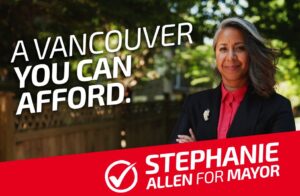
Led by COPE Mayoral candidate Stephanie Allen, the Coalition of Progressive Electors (COPE) has framed the election as a referendum on what it describes as an increasingly corporate and developer-friendly City Hall. The slogan has become a rallying cry among activists who believe Sim’s administration has failed renters, marginalized residents, and neighbourhood communities. COPE’s fundraising appeals openly ask supporters to help “evict Ken Sim” as Mayor.
But make no mistake, COPE is not alone in its criticism of the Mayor.
Recognizing that vote splitting helped ABC achieve its landslide victory in 2022, Vancouver’s progressive parties have once again attempted something unusual.
COPE, OneCity Vancouver, and the Green Party of Vancouver have negotiated an electoral co-operative agreement intended to reduce competition among progressive candidates and maximize their chances of defeating ABC candidates. Sadly, the agreement has not proved entirely successful at the centre-left unity goal.
As we wrote last week, the Mayoral field itself remains crowded.
Ken Sim is seeking a second term and remains the clear front-runner — at least according to civic election commentators, lawyer Kyla Lee and This is Vancolour’s Mo Amir, a sentiment the two have expressed in their role as civic affairs panelists on CBC Vancouver’s On The Coast afternoon programme — in part because he benefits from name recognition, an established — if broken, in the eyes of many — political machine, and the advantages of incumbency.
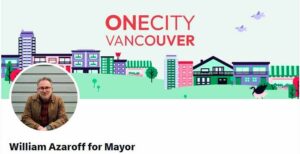
OneCity Vancouver has nominated William Azaroff, an affordable housing advocate whose campaign has not only emphasized affordable housing, but protections for tenants (provincial jurisdiction), climate action, and expanding public services.
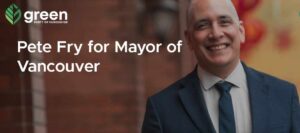
The Green Party has nominated popular incumbent Vancouver City Councillor Pete Fry, who has positioned himself as a pragmatic progressive focused on neighbourhood planning, sustainability, and balancing growth with livability.
COPE has put forward Stephanie Allen, whose campaign has focused on renters’ rights, social and affordable housing, labour issues — including re-instating the Livable Wage Programme jettisoned by Mayor Sim early in his term of office — working with the provincial and federal governments to implement an affordable $40 a month transit pass for those whose incomes fall below $40,000 a year — which is an laudable environmental initiative, as well — and challenging what Ms. Allen describes as the monied backers of ABC Vancouver, and the elites influence over civic politics that ill-serves the interests of most citizens.
Meanwhile, Councillor Rebecca Bligh has launched the new Vote Vancouver party, creating another centrist option that could attract voters dissatisfied with both ABC and the traditional left.
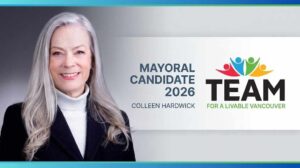
Colleen Hardwick, and her TEAM for a Livable Vancouver civic party, have also launched a campaign for elected office, focused on neighbourhood empowerment, and transparency in decision-making at Vancouver City Hall.
Perhaps the most hopeful campaign for office in 2026 comes in the form of Kareem Allam and his Vancouver Liberals party, whose platform is centred on fiscal discipline; a socially progressive approach to governance that is focused on making the city affordable again for working and middle-class families; addressing the drug crisis on the DTES by ridding our city of the cryptocurrency ATMs so well loved by Mayor Ken Sim and the offshore drug lords who fuel the drug crisis that has taken so many lives in our city and our region; ridding Vancouver of our city’s disturbing rat infestation; working collaboratively with opposition Councillors; requiring fewer managers while hiring more front line workers; strengthening the role of the City’s Integrity Commissioner, and funding Vancouver’s Park Board properly in order that Park Board Commissioners might work to repair and renovate Vancouver’s increasingly dilapidated community recreation centres.
The controversies surrounding Ken Sim are likely to dominate much of the coming Vancouver municipal election campaign.
Critics have accused ABC of excessive centralization of power, a lack of transparency in decision-making, and governing in a manner that has marginalized opposition Councillors. Debates over policing, housing policy, encampment responses, development approvals, and FIFA-related expenditures have all generated political friction. Former allies have occasionally become critics, and opposition parties have attempted to portray the Mayor as increasingly disconnected from ordinary Vancouver residents.
Mayor Ken Sim’s re-election strategy will likely emphasize stability, competence — it is but to laugh — and the argument that major reforms require more than a single four-year term.
The mechanics of the 2026 Vancouver civic election are already taking shape.
Vancouver has announced expanded voting opportunities for 2026, including more advance voting locations, larger voting sites, and more than 2,200 election workers. Election Day is Saturday, October 17, 2026.
While the city has not yet finalized all advance voting dates, advance polls are expected to open in the weeks leading up to Election Day, continuing Vancouver’s recent practice of offering multiple opportunities for early voting.
Voters will elect not only a Mayor but also 10 City Councillors, 7 Park Board Commissioners, and 9 school trustees. We will also decide several capital borrowing questions that could shape municipal infrastructure spending for years to come.
In many ways, Vancouver’s 2026 election has become a contest between competing visions of the city itself.
One vision, represented by Ken Sim and ABC emphasizing growth, public order, and managerial governance. The other, represented by the city’s progressive parties, argues for stronger social programmes, requiring landlords to repair pest infested and rundown SROs, legislating deeper affordability measures, taking an activist approach to rebuilding infrastructure, opening up City Hall to citizens, and adopting a community-driven approach to development in our city.
By the evening of October 17, Vancouver voters will have decided whether Ken Sim’s sweeping victory in 2022 marked the beginning of a new political era — or is merely an unfortunate interlude, a one and done for Mayor Sim’s right-of-centre civic party — in the city’s long tradition of progressive municipal politics.
The answer will determine not only who occupies the Mayor’s office through autumn 2030, but what kind of city Vancouver hopes to become in the decade ahead.
#VanPoli | Frances Bula | A Must-Elect Candidate for Vancouver City Council
Frances Bula, running as a OneCity Vancouver Council candidate in the 2026 civic electionAfter a career spent observing Vancouver City Hall from the press gallery, journalist Frances Bula is attempting something entirely different.
In 2026, Ms. Bula is seeking a seat on Vancouver City Council, as a candidate with OneCity Vancouver. As is stated on OneCity’s website, “Frances’s candidacy marks one of the most significant transitions in recent Vancouver civic politics — a reporter who spent years scrutinizing elected officials is now asking voters to entrust her with public office.”
VanRamblings wholeheartedly supports Frances Bula’s candidacy for Vancouver City Council. We believe Frances Bula, who we have long known and respected, to be a must-elect at the polls, in our upcoming October civic election.
As Frances has written — the information also to be found in OneCity Vancouver literature — Ms. Bula’s career in journalism spans more than four decades.
According to her own biography, Frances Bula began her reporting career in southeastern B.C. in 1983, the very day a province-wide general strike began. From those beginnings in community journalism, she gradually developed a lifelong fascination with cities, and the political systems that shape them.
The Journalist Who Helped Interpret Vancouver City Politics
Frances Bula has spent so many years explaining Vancouver to itself that, for many residents, it is difficult to imagine the city’s civic conversation without her.
For more than three decades, Ms. Bula has occupied a unique place in Vancouver public life: part journalist, part historian, part urban anthropologist, and part translator of the often bewildering language of municipal politics.
Frances Bula’s career in journalism spans more than four decades.
The defining chapter of her career began in 1994, when she started covering Vancouver municipal politics and urban affairs.
Over the course of the following years, Ms. Bula became one of the most respected and recognizable civic-affairs reporters in British Columbia. At the Vancouver Sun, where she spent approximately two decades as a staff reporter, she covered City Hall, education, housing, transportation, homelessness, development, infrastructure, drug policy, and nearly every other issue that defines urban life.
One pivotal moment in Frances Bula’s life came in 1998-99 when she received the prestigious Atkinson Fellowship in Public Policy, after which she spent a year studying housing and homelessness issues, producing a major series and a documentary project that deepened her understanding of urban poverty and housing policy. Housing would become a central theme of her journalism.
Frances Bula Leaves the Vancouver Sun, to Re-Invent Her Journalism
In 2008, Ms. Bula left the Vancouver Sun, to become one of British Columbia’s most prominent freelance journalists, writing extensively for The Globe and Mail, as well as contributing to publications ranging from BCBusiness, Canadian Architect, Canadian Business, Western Living to The Guardian, and more.
Among Ms. Bula’s most influential post-Sun work was her column Urban Fix in Vancouver Magazine where from 2008 through 2015 she explored the challenges facing Vancouver as it grappled with growth, affordability, transportation, density, neighbourhood change, and urban planning, all while profiling a broad cross-section of political leaders, planners, community advocates, developers, architects, and the overlooked civic actors who influence how cities evolve, her work examining those in power and how power operates in urban environments.
Vancouver. Culture, Diversity, and Civic Life
Ms. Bula has long championed the idea cities are fundamentally about the citizens who reside in the city, and the communities in which they live.
Ms. Bula’s writing has highlighted Vancouver’s multicultural character, examining how immigrant communities shaped Vancouver neighbourhoods, transforming the city over time, reporting on Chinatown, the Punjabi Market, Richmond’s Asian communities, and Metro Vancouver’s changing demographics.
Similarly, Frances Bula has long possessed a deep interest in, and consistent supporter of, Vancouver’s cultural institutions and artistic life, her writing regularly exploring the connections between culture, public space, and civic identity.
Ms. Bula is also a supporter of the Vancouver International Film Festival, reflecting a broader interest that extended beyond politics, as she focused on film, the arts, and cultural expression, over the years emphasizing and prioritizing the importance of cultural institutions in creating vibrant, livable cities not solely about infrastructure, but about creativity, diversity, public life, and community.
Why Politics? What Frances Bula Hopes to Accomplish in Elected Office
The obvious question surrounding Frances Bula’s candidacy is simple: Why leave journalism for politics? Ms.Bula has offered a straightforward answer.
As she recently told journalist Kenneth Chan in the Daily Hive …
“Journalism was my service to the public for decades. Now I want to do public service more directly.”
After decades documenting problems and analyzing solutions, in 2026 Frances Bula has decided that she wants a direct role in civic decision-making.
In her run to secure a seat on Vancouver City Council, in her campaign literature Frances Bula has emphasized housing, livability, transparency, and effective governance, as well as fighting for civic improvements that will make Vancouver function better for residents. Few candidates in Vancouver history would arrive at Vancouver City Hall with as deep an understanding of municipal governance and the institutional knowledge about how Vancouver City Hall operates.
Based on her writing and public statements, several priorities appear likely to define Frances Bula’s approach to public office.
- Housing will almost certainly be central. Throughout her career she has treated housing affordability as Vancouver’s defining challenge;
- Advocating for evidence-based policy making, drawing lessons from successful initiatives elsewhere;
- Ms. Bula has also expressed an interest in improving the efficiency and effectiveness of municipal government. Her own experiences navigating the permitting process while building a laneway house provided first hand exposure to the frustrations many residents experience when dealing with City Hall;
- Balancing growth with livability, recognizing Vancouver must accommodate more residents while preserving the qualities that make neighbourhoods attractive;
- Strengthening public trust in local government through transparency, accountability, and thoughtful decision-making.
For 30-plus years, Frances Bula sat inside Council Chambers, notebook in hand, watching elected officials wrestle with the complexities of governing a rapidly changing city, observing the administrations of multiple mayors, political parties, planning movements, housing booms, and civic controversies, chronicling their triumphs and failures, ambitions and unintended consequences.
Few people understand Vancouver’s civic history as comprehensively as she.
Now, Frances Bula wants in, to step into the story she once covered.
For decades, Vancouver residents relied on Ms. Bula to explain City Hall.
In 2026, VanRamblings endorses the candidacy of Frances Bula for Vancouver City Council, as she asks the residents of our city for the opportunity to serve.
The journey — from reporter to candidate, from observer to participant — may prove to be one of the most intriguing civic stories Vancouver has seen in years.
VanRamblings asks you to vote for Frances Bula for Council this October.


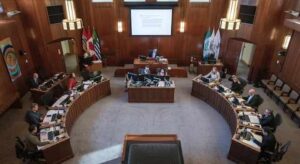
A photo of the newly elected, or re-elected, members of the 2022 Vancouver City Council