Category Archives: #VanPoli Civic Politics

#VanPoli | An Introduction to Kareem Allam, Vancouver’s Next Mayor

Charismatic, achingly articulate and eloquent in a way we have never experienced in a member of Vancouver’s political class seeking municipal office, a bold, historic, near revolutionary and unapologetically progressive political figure who represents a generational shift in our civic politics, who also possesses a vigorous commitment to fiscal prudence, and the next Mayor of the City of Vancouver come the evening of Saturday, October 17th, 2026: Kareem Allam, a transformative leader for our times who will modernize city government with an emphasis on inclusion and democratic engagement that will well serve your family’s interests.


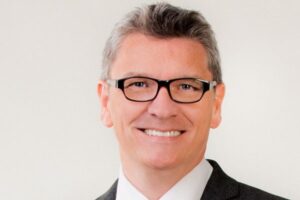
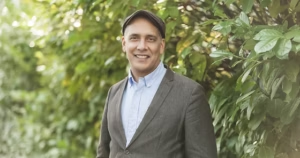
Kareem Allam, the next Mayor of Vancouver

“Whether you’re on the left or on the right, as a citizen of Vancouver you have the right to expect service from your municipal government, clean streets, beautiful boulevards, ready access to City Hall, low taxes and a responsive and responsible civic government that will always put you first,” Kareem Allam recently told VanRamblings.

“In my first term of office, I commit to hiring 400 CUPE workers to provide service to all the people who call Vancouver home, while also conducting a core review of city programmes. In 2004, the city of Vancouver had 2000 employees in our civic government. Today that figure is 9500, and growing. Just last year, the City of Vancouver hired 900 middle management, “excluded” employees. In 2016, soon after he was appointed City Manager, Sadhu Johnston in his first year in that role hired 1100 highly paid “excluded” management employees. Civic governance in our city has grown unwieldy over the past 20 years, an issue in these punishing economic times that must be addressed, but in a humane and strategically compassionate manner.”

Today’s VanRamblings column is meant to give you a brief introduction to Kareem Allam, a well schooled political strategist who has never lost a race he has run, who will out raise every other party seeking office in Vancouver in 2026, has seemingly garnered the endorsement of the Vancouver & District Labour Council — although there is an active movement being led to unseat current VDLC President Stephen von Sychowski that, if successful, could throw a kink into the works respecting Mr. Allam’s political ambitions — as well as the provincial New Democratic Party which, although they will not formally endorse Mr. Allam (provincial governments do not interfere in municipal electoral politics) will make it abundantly clear that Kareem Mahmoud Abbas Allam is their preferred candidate for Mayor of Vancouver in 2026.

(Note: Mr. Allam formally endorsed and worked hard to re-elect the David Eby led New Democratic Party in 2024, bringing an energy to the almost moribund provincial NDP campaign that prior to his involvement found itself on a losing track)

Apparently, OneCity Vancouver and the Green Party of Vancouver, in the days to come, will formally endorse Kareem Allam for Mayor of Vancouver. At this point in time, COPE is less certain of its support for Mr. Allam, but these are still early days.

In the time to come you will see that Kareem Allam is Vancouver’s Sadiq Khan, the popular Mayor of London, since 2016 — the first Muslim Mayor of a major western capital city. Naheed Nenshi, the most popular Mayor in Canadian history, who throughout his three terms in office as Calgary’s transformative Mayor was celebrated with approval ratings consistently above 80%. Zohran Mamdani, the Democratic candidate for Mayor of New York City, representing a generational shift in American politics, and a bold voice for change in the interests of everyday working people, over corporate interests and the political elite. Barack Hussein Obama, the most eloquent orator of his generation, and one of the most inspirational and consequential figures of the 21st century, and the coolest President in modern history, highlighted by his composure, charisma, and cultural fluency. And Port Coquitlam Mayor Brad West, who has consistently kept property tax increases in his city to under 2%, while building social housing and community centres to serve families and the interests of the public, the first Mayor in our region to ensure that potholes are filled in the early spring, and unlike every other Metro Vancouver city, has succeeded in providing the services PoCo residents have now come to expect.

With the next Vancouver civic election 423 days away, VanRamblings will have ample opportunity to present a broader picture of Kareem Allam, and why it is we are endorsing his candidacy for Mayor of Vancouver, our halcyon city by the sea.


Vancouver 2026 Mayoral Aspirant List Winnows

One month ago, the number of heavyweight pretenders to the throne that is the seat of power in the City of Vancouver, the head honcho so to speak, numbered 8.

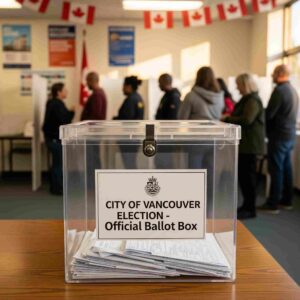
Today, the number of serious-minded contenders to become Vancouver’s next Mayor come the evening of October 17th, 2026 has winnowed considerably.

    • Ken Sim. Vancouver’s incumbent Mayor, elected with a record 85,732 votes, favoured by a plurality of 50.9% of those who cast a ballot in 2022, Mr. Sim’s popularity has waned significantly since the days of his first being elected to office. That is, if the internal poll recently conducted by his electoral party, ABC Vancouver, is to be believed. From closing the Renter’s Office at Vancouver City Hall to jettisoning the Fair Wage Programme implemented by the previous Council, to “scandals” respecting his tenure as Chairperson of Vancouver’s Police Board — a post he no longer holds — as well as converting a City Hall meeting room into a personal gym, and for the first three years of his term rarely turning up at Council meetings, and arriving at Council dressed in a T-shirt and sweat pants in the few times he did, any good will Mr. Sim generated in the early part of his term of office has all but evaporated. Mayor Ken Sim will have one heckuva time getting re-elected as Vancouver Mayor come late 2026 — not an impossibility, but a highly improbable outcome for the current Mayor.
    • George Affleck. First elected to office as a Vancouver City Councillor on Saturday, November 19th, 2011 as a candidate with the now moribund but once powerful Non-Partisan Association (NPA), Mr. Affleck won a second term of office on November 15, 2014, before retiring from civic politics in 2018. Mr. Affleck, a centre-right politician, one month ago had high hopes of displacing Ken Sim as the conservative voice at Vancouver City Hall, as Vancouver’s next Mayor, before — in recent days — deciding that Vancouverites were probably not open to electing another centre-right politician as Vancouver Mayor, given the fiasco that Ken Sim’s term in office has turned out to be. Buh-bye, George.
    • John Coupar. The former Chair of the Vancouver Park Board, and in 2018 — at least for a time — the NPA Mayoral candidate, Mr. Coupar was looking to challenge Mr. Affleck for the Mayoral nomination with a reinvigorated Non-Partisan Association, which held office at Vancouver City Hall from 1937 through 1972, and again from 1976 through 2002, and finally from 2005 to 2008. Saner heads prevailed, though, and the ineffable John Coupar decided instead to focus on provincial politics, to hold the NDP government’s feet to the fire.

    • Rebecca Bligh. First elected to office under the banner of the Non-Partisan Association, before leaving the party with her other elected NPA colleagues — save Melissa De Genova — the first sitting Councillor to join the nascent, Ken Sim-head ABC Vancouver municipal party (the two were members of Landmark, a sort of cultish betterment organization) when she was elected for a second time (Mr. Sim dumped Ms. Bligh unceremoniously mid-term this term, which speaks highly of Rebecca Bligh’s integrity, given that she had consistently challenged the Mayor, and other sitting, elected members of his caucus), and recently re-elected to another term as President of the Federation of Canadian Municipalities), Ms. Bligh has long been one of our favourite politicos (her partner, Laura, is the first person we’ve run across in 50 years who, appropriately, with wit and a high degree of caring, keeps us in line … and boy oh boy, do we need that!), Rebecca Bligh is making a serious bid to become Vancouver’s next Mayor, with fundraising for her upcoming campaign well underway (note to readers: we apologize for the run-on sentence, but it is  part of VanRamblings’ writing stock and trade, as well). Ms. Bligh, then, is the third serious candidate to become Vancouver Mayor in 2026 we’re writing about today. We will write more about Ms. Bligh another day. For now, we wish her well.

    • Kennedy Stewart. A political ghost from Vancouver’s recent past, Dr. Stewart (Mr. Stewart teaches in Simon Fraser University’s School of Public Policy), Kennedy Stewart served an undistinguished term in office as Vancouver Mayor, first elected municipally on October 20, 2018, but handily defeated by Ken Sim in his bid for re-election, on Saturday, October 15, 2022. A lifelong member of the New Democratic Party, Mr. Stewart served as a member of Parliament in Ottawa, with the New Democratic Party (NDP) of Canada from 2011 through 2018, when he announced his resignation in order that he might run for the Mayor’s office in Vancouver, where he emerged victorious. Sadly, though, Mr. Stewart garnered only 49,593 votes, or 29.48% of the vote, in 2022, losing to novice politico Ken Sim by a whopping 36,139 votes. Nonetheless, up until recently, Mr. Stewart believed that with the support of the provincial New Democratic Party and the unpopularity of incumbent Vancouver Mayor Ken Sim, in 2026 he could rise from the ashes, phoenix like, to once again emerge victorious as Vancouver Mayor, on Saturday, October 17, 2026. Although Mr. Stewart is right on the first count — Mr. Sim’s rampant unpopularity — on the second count, Mr. Stewart will find that provincial NDP support for his candidacy will not materialize (our provincial NDP has a preferred candidate for Vancouver Mayor, and it ain’t him). Neither will Mr. Stewart garner the support of the Vancouver & District Labour Council, who prefer the same candidate as B.C.’s New Democrats. Mr. Stewart’s candidacy is over before it’s begun.

    • Pete Fry. Just two months ago, the two term Green Party of Vancouver City Councillor was being urged to put his hat in the ring to become Vancouver’s next Mayor … until it became clear that support from the Vancouver & District Labour Council for his candidacy would not be forthcoming, that another, preferred and very well funded and experienced Mayoral aspirant — who VanRamblings will write about tomorrow — had emerged, making a Pete Fry run for Vancouver Mayor, challenging, with victory a near impossibility. In 2026, Mr. Fry will run for a third term as Councillor, with the support of the VDLC.

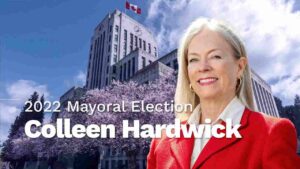
    • Colleen Hardwick. In 2018, Ms. Hardwick was elected to Vancouver City Council, coming in a respectable fifth with 47,747 votes, while running with the Non-Partisan Association. By the time 2022 rolled around, Ms. Hardwick had “switched” parties to TEAM (The Electors’ Action Movement) — TEAM for a Livable Vancouver, the Vancouver-based centrist political party that was formed in 1968 and held office for two elections, from 1972 to 1976, co-founded by Ms. Hardwick’s father, UBC Urban Geography professor Dr. Walter Hardwick, the party rekindled for the 2022 Vancouver municipal election. Ms. Hardwick ran for Mayor with TEAM in 2022, coming in a distant third with 16,769 votes, or 9.97% of the vote. Ms. Hardwick also ran in this year’s by-election, securing 17,352 votes, approximately half the votes of the two winning candidates, COPE’s Sean Orr (34,448) and OneCity Vancouver’s Lucy Maloney (33,732). In 2026, it is Colleen Hardwick’s intention to run for Mayor for a second time.  We will write about Ms. Hardwick at length, another day.

Reviewing the above, there are three serious-minded candidates left in the running for the Mayor’s chair in 2026: Ken Sim, Rebecca Bligh and Colleen Hardwick.

However, there is another serious candidate who has come forward and announced his candidacy for Vancouver Mayor, a candidate VanRamblings endorsed two months ago, a candidate who formally announced his candidacy for Mayor of Vancouver on July 3rd, a well schooled candidate with an enviable war chest, with a campaign manager already in place, a candidate VanRamblings believes will be overwhelmingly elected as Vancouver’s next Mayor on Saturday, October 17, 2026.


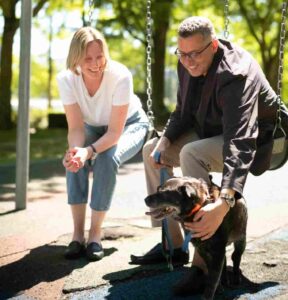
Ya just gotta vote for a married candidate for Vancouver Mayor who loves dogs (and parks)

VanRamblings will write about this well funded, well organized, energized mystery candidate for Vancouver Mayor tomorrow, who would seem to have the support of the Vancouver & District Labour Council as well as our provincial New Democratic Party, making him the odds on favourite to become Vancouver’s next Mayor in ’26.

VanRamblings Makes Its Triumphant Return, Again

After an interregnum of some 284 days since VanRamblings published last, today — Monday, August 18th, 2025 — marks VanRamblings inglorious return.

In the coming days, weeks and months, as per usual, most Mondays, Tuesdays, Wednesdays and Thursdays, we will publish our thoughts on all things municipal, provincial and federal politics, interspersed with columns on cinema (such as this Friday’s column on film festival season), and on the occasional Saturday, return to our semi-regular feature, Stories of a Life, and on Sundays, Sunday Music, where we will continue writing about our favourite 100 albums of all time.

Most of the next two weeks will be given over to writing about Vancouver’s municipal political scene, this week and part of next focusing on the probable Mayoral aspirants seeking office in order that they might install themselves in the spacious offices and luxurious living quarters located on the third floor at Vancouver City Hall (thank you, Dr. Penny Ballem), a home away from home for the Mayor.

In tomorrow’s column, VanRamblings’ focus will be on who, only a month ago, seemed to be the serious-minded Mayoral aspirants. Much has changed, though, over the past month, and the list of Mayoral aspirants has winnowed considerably, although a few of the usual suspects for Vancouver Mayor remain serious about making a bid for office on Saturday, October 17th, 2026.

A major focus of VanRamblings’ writing beginning next week through until October 12th will be, what for us, is the première arts event of the autumn season, the 44th Vancouver International Film Festival, which this year will run, in a somewhat truncated form, from Thursday, October 2nd through until Sunday, October 12th.

As far as we are able, we’ll attempt to keep the columns short, pithy, informational and full of our somewhat out on the edge opinions, bound to make some folks (usually the ones being written about) unhappy, while enlightening others in what we hope is an entertaining and provocative manner. As far as possible — given our advanced age (we’re 75 years of age now) and our general ill state of health (alas) — we’ll try to stay away from what once was our stock and trade: hyperbole, always fun to write but, perhaps now, a thing of VanRamblings’ ignominious past.

With the exception of Friday, September 5th — when, in the first person, we’ll write about our various health travails — we’ll continue to employ the third person voice on VanRamblings, which we know drives some people crazy, but there it is.

We look forward to your return tomorrow, and in the days, weeks and months hence, as we once again seek to build our loyal, and just plain great, readership — who want to know just what is going on in our municipal, provincial and federal governance, and the who, what and why of the decisions that impact our lives.

#BCPoli | BC NDP Will Implement a Dignified Province-Wide Supportive Housing Agenda

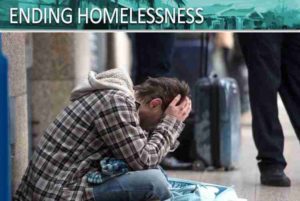
In British Columbia, Single Room Occupancy (SRO) units have long served as a last resort for many of the province’s most vulnerable individuals, including low-income residents, those with mental health challenges, and people grappling with homelessness.

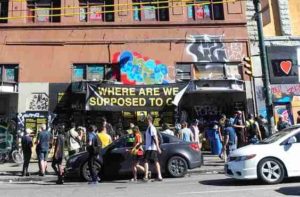
However, these aging, often dilapidated buildings are increasingly unfit for human habitation. As such, there is an urgent need for the British Columbia government to transition vulnerable populations out of rundown SROs in Vancouver, Victoria and elsewhere, toward sustainable, supportive housing models.

By providing care similar to the successful systems used in European countries like Finland, B.C. can address the root causes of homelessness, poverty, and social marginalization while promoting long-term well-being and social integration.

In a 2022 interview with B.C. Legislative reporter Katie DeRosa, then with the Vancouver Sun and now in the same role with the CBC, B.C.’s New Democratic Party Attorney General and Minister Responsible for Housing, David Eby — who was running to replace Premier John Horgan, who had resigned as Premier for health reasons, as leader of the BC NDP — had the following to say about the need for government to provide dignified supportive housing for members of British Columbia’s vulnerable populations living in communities across the province, and move these abandoned individuals out of rundown SROs …

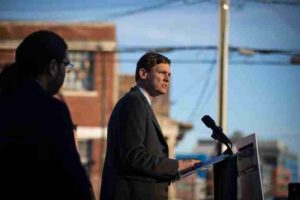
Premier David Eby addresses need to transition people out of SROs

“There really hasn’t been a co-ordinated strategy or a plan about how we get out of the problems of Vancouver’s Downtown Eastside, Victoria and elsewhere. I think … putting an invisible fence around neighbourhoods and saying ‘this is the best we can do’ and just hope that things work out, it’s a strategy that will no longer carry us forward.” Eby said if he’s successful in his bid to replace Premier John Horgan … he’ll co-ordinate a long-term response to homelessness issues across the province, with the support and assistance from the federal government, our province’s towns and cities, and concerned groups.

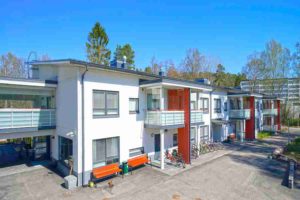
In point of fact, Premier David Eby has committed to just that, copying the Finnish model that provides supported and affordable housing.

Juha Kaakinen, Finnish CEO of the Y-Foundation, providing low-cost housing to the homeless

“We had to get rid of the night shelters and short-term hostels we still had back then. They had a very long history in Finland, and everyone could see they were not getting people out of homelessness. We decided to reverse the assumptions,” says Juha Kaakinen, CEO of Finland’s Y-Foundation, which provides low-cost flats to homeless people across Finland.

The Deplorable Conditions of SROs

SROs, originally constructed as affordable housing for the working class, have deteriorated significantly over the decades. Many SRO units in cities like Vancouver, Victoria and Kelowna are plagued by chronic disrepair, pest infestations, poor heating and ventilation systems, inadequate plumbing, and a lack of basic sanitation. These environments are not only uncomfortable but dangerous, often exacerbating the mental and physical health challenges faced by their residents.

Research shows a strong correlation between poor living conditions and poor health outcomes, including increased rates of addiction, infectious diseases, and mental health crises. Furthermore, many SRO buildings are located in areas with high crime rates, compounding the risks for residents already facing social vulnerabilities. In essence, SROs have become a symbol of the failure to provide adequate housing and services to the people who need them most. Moving vulnerable individuals out of these dangerous environments is not only a moral imperative, but also a matter of public health and safety.

The Case for Supportive Housing

Supportive housing offers a more sustainable solution to the complex needs of the vulnerable populations currently residing in SROs. Unlike SROs, which often serve as temporary, stop-gap measures, supportive housing provides stable, permanent accommodations where individuals have access to social, medical, and psychological services on-site. This model addresses not only the need for safe and secure housing but also the underlying issues that contribute to homelessness and instability, such as mental health disorders, addiction, and unemployment.


The Globe and Mail’s Kerry Gold on how Finland is solving the problem of homelessness.

In European countries like Finland and Austria, supportive housing has proven to be remarkably successful. Finland, for instance, has implemented the “Housing First” model, which provides stable housing to homeless individuals as the first step toward addressing other social issues. This approach has reduced homelessness by over 50% since its introduction in 2008, with most formerly homeless individuals remaining housed long-term. Austria follows a similar model with an emphasis on affordable, long-term housing paired with social services, which has also led to positive outcomes for at-risk populations.

For B.C., adopting a comparable approach would mean transitioning away from crisis management in the form of emergency shelters or rundown SROs and toward long-term solutions that focus on stability, health, and empowerment.

Supportive housing projects, when coupled with services such as healthcare, employment training, and mental health support, help individuals reintegrate into society, reduce their dependence on public services, and lead more fulfilling lives.

Note should be made that Premier David Eby’s government alone has a long term strategy — that they have committed to implement in their next term of government —  to transition members of our vulnerable population out of rundown SROs and substandard accommodation into supportive housing

Cost Efficiency and Long-Term Benefits of Building Supportive Housing

One of the most compelling arguments for supportive housing is its cost-effectiveness. Studies from both Europe and North America demonstrate that investing in supportive housing ultimately saves governments money in the long run. Homelessness and inadequate housing impose significant costs on public systems, including healthcare, law enforcement, and emergency services.

For instance, individuals living on the streets or in unstable environments are more likely to require emergency medical attention, experience police interactions, or become involved in the criminal justice system. In contrast, when people are find safe haven and community in supportive housing, they use fewer emergency services and are better able to manage chronic health conditions, or avoid encounters with law enforcement. Finland’s Housing First model has shown that for every dollar spent on housing and support, the government saves approximately $2 in costs related to homelessness.

B.C., with its high cost of living and significant homeless population, faces similar challenges. Building and maintaining supportive housing units may initially require significant investment, but it will result in long-term savings by reducing strain on public health, criminal justice, and social services systems. Moreover, the social and economic benefits of helping individuals regain stability, employment, and health far outweigh the upfront costs.

In a government publication titled Lost in Transition, the cost of construction of thousands of supportive housing units would be made possible in part by the savings that would accrue from merging the 277 social services agencies on the DTES into 30 umbrella organizations.

Each of the 277 social agencies employs an Executive Director — at an average annual salary of $500,000 — Directors of Finance, Directors of Human Resources, Managers of Supported Housing, Property Managers and other senior administrative staff — each of these 247 individuals earning up to $375,000 annually — a duplication of services and administration funded by the province, Merging agencies would save more than $1 billion dollars annually that would helo to pay for the cost of building supportive housing on the DTES, and across the province.

The Lost in Transition report questioned if such duplication of services properly serves the interests of those who are resident, and cared for, on the DTES.

There was also recommendation in the Lost in Transition report that argued for the provincial appointment of a Commissioner who would oversee the reformation of the provision of services on the DTES, a person with the authority of a Deputy Minister who would report only to a provincially appointed Board of Directors, which would oversee the transition of the current service model, reporting as well as to the office of the Premier.

A Moral and Social Imperative of Providing Dignified Supportive Housing


Eby government planning to take co-ordination of housing provision for B.C.’s most vulnerable citizens

Finally, there’s a moral dimension to the issue.

In a society as wealthy and resource-rich as British Columbia, allowing vulnerable members of our population to languish in unsafe, unsanitary SRO units reflects poorly on social priorities.

The government has a responsibility — a responsibility recognized by those within the B.C.  New Democrat government — to protect its most vulnerable citizens, ensuring that these individuals have access to the basic necessities of life, including safe housing, healthcare, and social support.

Housing is not just a commodity; it is a human right.

By moving away from the outdated, harmful practice of relying on SROs & instead investing in supportive housing, B.C. can take a meaningful step toward ending homelessness and improving the quality of life for our most marginalized citizens.

Relocating vulnerable populations out of rundown SROs and into supportive housing is not just a practical solution; it is an ethical and economic necessity.

In adopting the supportive housing model, British Columbia can — and will, with the re-election of an NDP government — address homelessness more effectively, reduce the long-term social, moral and medical costs associated with inadequate housing, while promoting a more inclusive and caring society.

The time to act is now, with the re-election of a David Eby-led government.

The benefits of the B.C. New Democrats’ approach to building dignified housing for our most vulnerable population will be felt for generations to come.