Tag Archives: city council

Bill McCreery: The Architect Who Helped Build Vancouver’s Soul

Bill McCreery, architect, planner, housing advocate and civic reformer working to build Vancouver

Few individuals have left their fingerprints on Vancouver as indelibly as Bill McCreery. Over more than half a century, Bill McCreery has helped shape not only the city’s skyline but also its philosophy of urban living.

Architect, planner, housing advocate, civic reformer, and former Vancouver Park Board Commissioner, he belongs to a remarkable generation that transformed Vancouver from an inward-looking west coast port into one of the world’s most admired livable cities.

His buildings are important. His planning work is even more significant.

While many architects can point to individual towers or neighbourhoods, Bill McCreery’s influence extends across entire communities.

Bill McCreery was among the generation of designers and planners responsible for the creation of North False Creek and South False Creek — projects that fundamentally altered how North America thought about urban housing.

Throughout British Columbia, Alberta and the United Kingdom, Bill’s work contributed to thousands of units of market, public and social housing, always emphasizing the relationship between architecture, people and public space.

Yet, Bill McCreery’s greatest contribution may not be measured in concrete or glass. It lies instead in an enduring belief that cities belong first to their citizens.

Born into an era when Vancouver was still emerging from its provincial adolescence, Bill McCreery entered architecture at a time when modernism promised endless possibilities. The post-war decades were filled with confidence. Governments were building. Universities were expanding. New ideas about planning were replacing nineteenth-century assumptions about cities.

Unlike many architects who concentrated solely on buildings, Bill McCreery quickly became fascinated by the broader civic questions.

How should neighbourhoods function?

  • Who gets to decide what is built?
  • What responsibilities do governments have toward affordable housing?
  • How can density improve rather than diminish community life?

Those questions would define much of Bill’s professional career.

Working on major housing developments in the United Kingdom, and throughout British Columbia and Alberta, Bill McCreery became known as an architect who understood that successful communities required more than attractive buildings.

Streets, parks, schools, public spaces and neighbourhood identity mattered just as much as architectural form. Housing, in his view, was never simply about construction; it was about creating places where families could flourish.

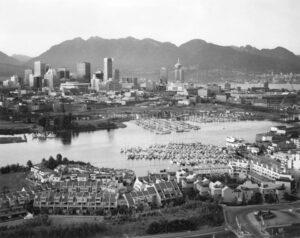
Photo of False Creek, circa 1980, showing False Creek & Ondine’s restaurant, designed by Bill McCreery. The bottom part of the photo shows south False Creek, including the Heather Street marina.

That philosophy reached perhaps its fullest expression in False Creek.

False Creek transformed from an industrial wasteland into a livable, diverse waterfront neighbourhood

Today, North and South False Creek are celebrated internationally.

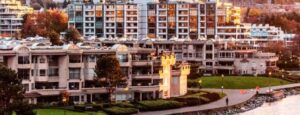
Mid-rise buildings front generous parks. Walkways connect neighbourhoods to the waterfront. Families, seniors and young professionals share communities that balance density with human scale.

In the early 1970s, however, these ideas were revolutionary.

At a time when many North American cities were demolishing neighbourhoods for expressways and high-rise towers, Vancouver chose another path.

Mixed-income housing, accessible waterfronts, pedestrian-friendly streets and integrated parks became the guiding principles.

Bill McCreery was among the architects and planners who made that vision real.

The result became one of the defining planning achievements of twentieth-century Vancouver, influencing urban design far beyond British Columbia.

His public service unfolded alongside a consequential political transformation.

The Long Watch: Bill McCreery’s Five Decades in Vancouver’s Civic Life

There’s a particular kind of Vancouverite who never quite leaves City Hall, even after the votes are counted and the title expires.

Bill McCreery is one of them.

An architect by training and a civic conscience by temperament, Bill McCreery’s public life stretches from the reformist fever of the early 1970s to the housing fights still playing out in Council chambers today — more than fifty years of showing up, in one capacity or another, to argue about how Vancouver should be built and who should get to decide.

Bill McCreery served as a Vancouver Park Board Commissioner during one of the most remarkable periods in the city’s history.

Bill McCreery’s entry into Vancouver municipal politics first occurred in 1970, when Bill became involved in the freeway debate — a proposal to build a freeway, an extension of Highway 1, through downtown Vancouver, including through the Strathcona and Chinatown neighbourhoods.

Meeting in Bill’s apartment on Beach Avenue, a block away from the Park Board offices, this working group of planning and marine architectural professionals together developed two alternatives to the freeway plan, that included rapid transit and Seabus solutions that would better serve the interests of Vancouverites, while preserving the livability of the city for all citizens.

Elected as part of the reform movement associated with TEAM (The Electors’ Action Movement), he joined an extraordinary collection of civic leaders determined to modernize how Vancouver governed itself. Early in his term, Bill was appointed as the Park Board representative on the False Creek Planning Committee of Council.

That appointment was unique, in that Bill was the only non-Council person in the history of Vancouver who had a vote on a Council committee.

TEAM emerged in opposition to the old Non-Partisan Association establishment that had dominated city politics for decades.

Rather than treating municipal government as merely administrative, TEAM believed City Hall should actively shape the quality of urban life.

Its leaders included Mayor Art Phillips, whose vision of participatory government redefined civic politics, and Dr. Walter Hardwick, the geographer and planner whose intellectual influence remains visible across the city.

Bill McCreery fit naturally within that movement.

A TEAM (The Electors’ Action Movement ) Player

Bill McCreery’s entry into civic office came at Vancouver’s most consequential political inflection point. In 1972, TEAM – The Electors’ Action Movement, a coalition of Liberals, Conservatives, reform-minded professionals and New Democrats — swept the long-governing Non-Partisan Association from power, carrying Art Phillips into the Mayor’s chair, alongside eight TEAM Councillors.

TEAM – The Electors’ Action Movement re-imagining Vancouver as a livable urban paradise

The new administration set about dismantling decades of NPA-era governance almost immediately, firing the city’s powerful commissioner, opening up public hearings, and killing the freeway plan that would have gutted Chinatown and Strathcona. It was, by every account, one of the more sweeping reinventions of municipal government in a Canadian city’s history — anchored by Phillips and by Walter Hardwick, the UBC geography professor who served as TEAM’s intellectual architect and the driving force behind transforming the industrial wasteland of South False Creek into mixed-income housing.

Bill McCreery joined that movement’s governing apparatus as a TEAM-affiliated Vancouver Park Board Commissioner, serving from 1973 to 1974. It was a smaller stage than Council, but not a trivial one — the Park Board has run as its own elected body since the 1880s, with real authority over the city’s parks and recreation system, answerable directly to voters rather than to council or the mayor.

To sit on it during the TEAM years was to be inside the machinery of a government self-consciously remaking how Vancouver made decisions, at the moment the city was deciding whether development or livability would set its priorities.

Bill’s experience as an architect made him aware decisions about parks, neighbourhoods and public land could not be separated from broader planning policy.

The Vancouver Park Board during that era became much more than an agency responsible for lawns and playgrounds.

It became one of the principal guardians of Vancouver’s emerging philosophy that public space should serve everyone.

Together, Art Phillips, Dr. Walter Hardwick, Bill McCreery and their TEAM colleagues fundamentally altered Vancouver’s civic governance.

Their greatest achievement was changing who participated in decision-making.

Prior to TEAM’s arrival, planning decisions often occurred behind closed doors with relatively little public involvement. Developers, bureaucracies and political insiders largely determined the city’s future.

TEAM insisted on something radically different.

  • Neighbourhood consultation became an expectation rather than an exception;
  • Community planning gained legitimacy;
  • Citizen advisory committees became influential;
  • Public hearings assumed greater importance.

The planning process itself became more transparent.

This transformation permanently altered the relationship between City Hall and Vancouver residents.

Instead of viewing citizens as obstacles to development, the new governance model treated them as partners in shaping neighbourhoods.

Bill McCreery: The Architect’s Eye

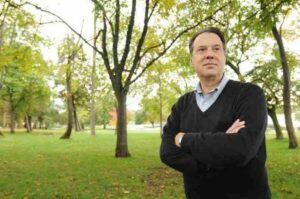
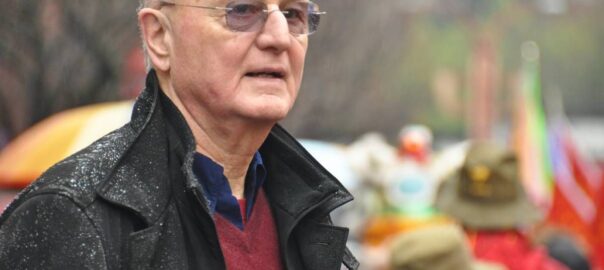
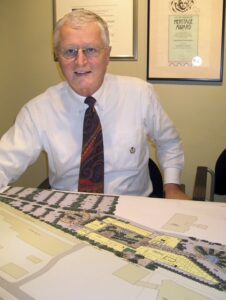
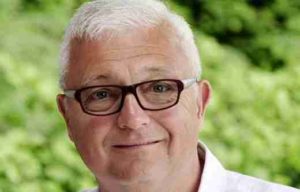
Bill McCreery, the architect, circa 2006 | Photo credit, Malcolm Parry, the Vancouver Sun.

Bill McCreery brought a working architect’s credentials to that civic role — he held professional registration with both the Architectural Institute of British Columbia (AIBC) and the Alberta Association of Architects (AAA).

During the course of his career, Bill McCreery has been credited with helping create North and South False Creek and with contributing to thousands of units of developer, public, and social housing across British Columbia, Alberta, and the United Kingdom, alongside several Vancouver residential projects of his own.

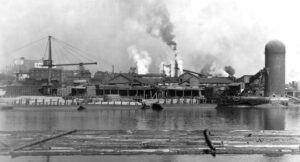
Southeast False Creek, once the waterfront particulate smoke spewing ‘heart’ of Vancouver, circa 1950

False Creek South is a body of work that placed him, professionally, inside the same era-defining project — the reclamation of False Creek’s derelict industrial shoreline into one of the templates North American cities would study for a generation — that his political colleagues were shaping through policy.

That philosophy eventually evolved into Vancouver’s celebrated “CityPlan” consultation model and neighbourhood planning processes that attracted international attention decades later.

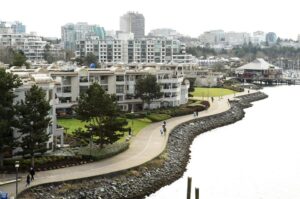
Mid-rise buildings and parks front the walkways connecting southeast False Creek to the waterfront

Bill McCreery has remained one of the strongest defenders of those principles, arguing public consultation remains essential to successful urban planning.

Bill McCreery’s advocacy has continued long after leaving elected office.

Even in retirement from architectural practice, Bill McCreery has remained one of Vancouver’s most thoughtful voices on housing and urban development.

Bill has frequently argued that planning must balance density with neighbourhood character, insisting that growth should occur through genuine collaboration rather than imposed solutions.

Writing and speaking publicly, he has warned against abandoning the community-based planning traditions established during the 1970s.

In his view, Vancouver’s international reputation rests not simply on beautiful buildings but on decades of patient civic engagement that gave residents a meaningful voice in shaping their communities.

His critiques have never been nostalgic.

Rather, they reflect a conviction formed over decades of professional practice: cities function best when architects, planners, politicians and citizens work together instead of competing for influence.

That belief explains why Bill McCreery has continued participating in debates surrounding housing policy, planning reform and neighbourhood development well into the twenty-first century. He has joined fellow architects, planners and urban thinkers in advocating for approaches that combine increased housing supply with careful urban design and democratic accountability.

Architecture often celebrates individual genius.

Bill McCreery’s career tells a different story.

His work reminds us that cities are collaborative achievements.

Successful neighbourhoods reflect countless conversations between architects, elected officials, planners, engineers, community organizations and residents.

Collaboration became a Vancouver hallmark during its most innovative decades.

Today, visitors admire False Creek, the city’s waterfront neighbourhoods, its network of parks, and its human-scaled urban design without always knowing the names of those responsible.

Bill McCreery is one of those names.

Life After Bill McCreery’s Tenure on The Vancouver Park Board

Bill McCreery’s civic instincts didn’t retire when his term did.

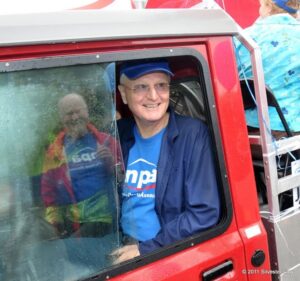
Bill McCreery running for civic office in the 2011 Vancouver municipal election under the NPA banner

Decades later, he re-emerged as a candidate for City Council under the NPA banner — the party TEAM had unseated in 1972, a small irony that says something about how thoroughly the city’s political alignments had scrambled by the 2010s.

Running for Council gave him a public platform to argue “city hall democracy” had suffered under the Vision Vancouver administrations then in power.

Drawing on his own memory of the job — the stack of reports, sometimes a foot high, that landed on a Commissioner’s desk each Friday for study before Monday’s meeting — he made the case that transparency and direct access between citizens, reporters, and city staff had eroded, and that the public was worse informed for it.

That advocacy has continued well past his own campaigns.

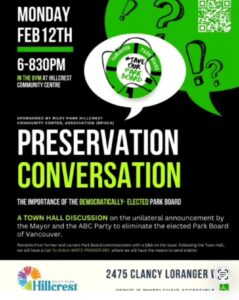
Bill McCreery has stood among the coalition of former Park Board commissioners publicly opposing efforts to dissolve Vancouver’s elected park board — a fight rooted in the same principle that shaped his TEAM years: decision-making over civic institutions belongs in the hands of people directly accountable to voters, not folded into the broader authority of City Council or the Mayor’s office.

As recently as February of this year, he was among the signatories of an open letter to Mayor Ken Sim and Council challenging the city’s housing “Villages Plan,” identifying himself in that document as a former registered architect who helped build False Creek — still, after half a century, making his case in writing rather than letting the record speak for itself.

Bill McCreery: A Consistent Thread in Bill’s Civic Life

What runs through Bill McCreery’s public life isn’t a single ideology so much as a recurring instinct: a belief that how a city governs itself — who gets consulted, which bodies hold power, how transparently decisions get made — matters as much as what gets built.

Bill arrived in civic office on the wave of a movement built on that premise, spent a career as an architect inside one of that movement’s landmark projects, and spent the decades since defending the governance structures TEAM left behind.

Few figures in Vancouver’s civic history have stayed at that post for quite so long

Bill belongs to a generation that refused to accept that cities must choose between growth and livability, density and beauty, or development and democracy.

Instead, he helped demonstrate that thoughtful architecture and enlightened governance could reinforce one another.

His buildings continue to house thousands.

His planning principles continue to influence generations of architects.

Bill’s work on the Park Board and alongside Art Phillips, Walter Hardwick and the TEAM reformers helped reshape Vancouver’s civic institutions, embedding public participation into the city’s political culture in ways that continue to define municipal government today.

Few architects can claim to have transformed both a city’s physical landscape and its democratic institutions.

Bill McCreery is one of them.

#SaveOurParkBoard | The Saga of the Abolition of Vancouver’s Elected Park Board Continues

Despair reigns across our land, as the inexorable move towards the dissolution of an independent, elected Park Board proceeds relentlessly, calamitously forward.

In today’s VanRamblings post, we’ll attempt to reason why Mayor Ken Sim and his super majority ABC Vancouver team of City Councillors arrived at the decision to eliminate the 133-year-old Vancouver Park Board, the role the administration of the David Eby government will play, why the provincial government supports the seemingly arbitrary initiative of the Mayor, and why we believe that it is inevitable that in months, Vancouver’s beloved, elected Park Board will fade into history.

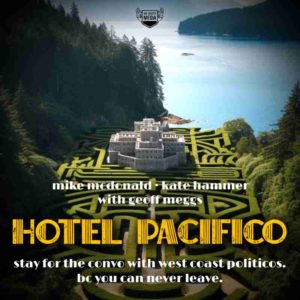
On an episode of the Air Quotes Media podcast, Hotel Pacifico, that aired just before Christmas, former Vancouver City Councillor / Chief of Staff to Premier John Horgan , Geoff Meggs, posited that the move to abolish the Vancouver Park Board was part of a dastardly plot by B.C. United Party leader Kevin Falcon.

Apparently, Mr. Falcon had convinced the Mayor and his ABC Vancouver Councillors — all of whom are members and supporters of B.C. United — that a move to eliminate the elected Park Board would create discord within David Eby’s New Democratic Party caucus, heading into this year’s October 19th provincial election.


Vancouver’s 9 duly-elected New Democrat Party Members of the Legislature in Victoria

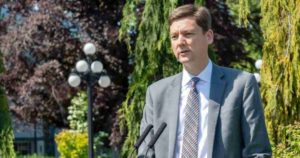
Given the likelihood many in the NDP caucus would be opposed to the Mayor’s initiative to have the provincial government amend the Vancouver Charter to allow the dissolution of an elected Park Board — a move that could jeopardize the re-election chances of many of the New Democratic Party government’s Vancouver-based members of the legislature — working hand in hand, Kevin Falcon and Ken Sim devised a plan to turn the tables on the re-election chances of Vancouver’s NDP MLA’s, which very much includes Premier David Eby himself, who is in his 11th year as the elected representative in the riding of Vancouver Point Grey.


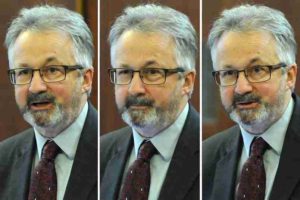
Geoff Meggs, Vancouver City Councillor 2008 – 2017 | Chief of Staff to Premier John Horgan, 2017 – 2022

Alas. As much as VanRamblings enjoys a good conspiracy theory, in point of fact, privately, Mr. Meggs was telling his intimates that he had proposed the Kevin Falcon “theory” arising from his concern that, given the polling that has the NDP riding high in the polls and seemingly undefeatable, he is concerned that NDP supporters very well may not volunteer at their MLA’s campaign offices once the writ is dropped this upcoming September, and further that New Democratic Party voters will stay home, and not vote at the advance polls or cast a ballot on election day.

Every vote counts. New Democratic Party supporters will have to work as hard as ever in the lead up to, and during the course of British Columbia’s 43rd provincial election, if we wish to ensure the re-election of the David Eby NDP government.


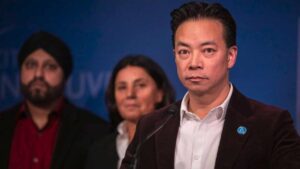
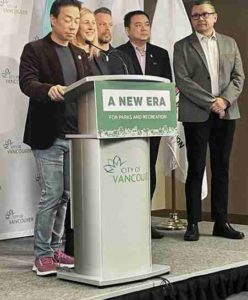
Mayor Ken Sim announces Park Board transition working group

The story of the decision of the Ken Sim-led majority ABC Vancouver administration to eliminate Vancouver’s independent, elected Park Board goes back to March of last year, when Premier David Eby made a proposal to Vancouver’s Mayor to move B.C. Place from its current home adjacent to Rogers Arena to Hastings Park.

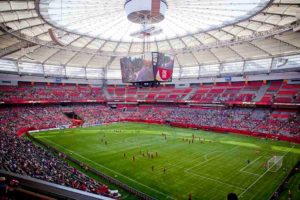
While it is true that David Eby has stated that it is probable his government will spend between $300 and $400 million dollars on a renovation of B.C. Place to meet the requirements of the bodies bringing the Invictus Games to British Columbia in 2025, and the FIFA World Cup to Vancouver in 2026, in fact reliable sources have told VanRamblings that the long term plans for B.C. Place involves moving the aging stadium to Hastings Park, over which the City of Vancouver has jurisdiction.

As you might well expect, development and growth — and an expansion of our transit system — is at the heart of the decision by the Premier.

In addition, in eliminating the independent, elected Park Board, ABC Vancouver’s financial backers’ fondest wishes will be realized, as whole tracts of previous park / open green space will be available for development, to build, build, build

And, of course, the mega-developer Aquilini family is very much involved, as well.

Here’s the plan: a David Eby government would work closely with the members of Vancouver City Council, and the Aquilini development corporation, to redevelop the B.C. Place site where, conceivably, the 7 hectare / 17-acre site would become home to three or more 70-to-95 storey towers in a newly designated “downtown village”, providing more than 3,000 residential condominium units in what will soon become, as planned, the heart of the downtown core of Vancouver.

The monies derived from the sale of the 3,000 luxury condominium units — in which the government would co-develop the B.C. Place site with the Aqualini family, where the completed condominium units would sell for up to $125 million on the top floors, many of the condominium units sold offshore, with the provincial government realizing billions of dollars in profit — would not only pay for the construction of a new stadium on the race track grounds at Hastings Park — a covenant prevents the construction of housing at Hastings Park, but not a sports facility — but for a new light rail system, as well, from Vancouver’s city core, along Hastings, down Renfrew to McGill / Hastings Park,  and over to the North Shore.

ABC Vancouver Mayoral candidate Ken Sim pledged support for a North Shore rapid transit line less than two weeks before the 2022 Vancouver civic election.

Late last year, on October 4, 2023, Vancouver City Council endorsed making a formal request to TransLink’s Mayors’ Council to perform a rapid transit study of Hastings Street between downtown Vancouver and Hastings Park /PNE. Following up on his pre-election pledge to support rapid transit to the North Shore, newly-elected Mayor Ken Sim met with North Shore Mayors last February to re-state and reinforce the pledge he had made during his 2022 campaign to support a long-sought-after rapid transit line to the North Shore.


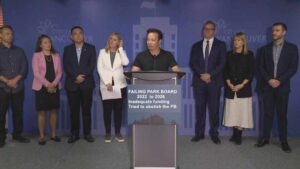
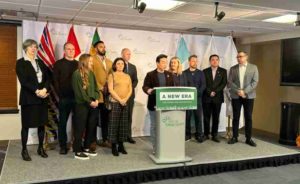
Park Board transition working group: Catherine Evans, Gregor Young, Jordan Nijjar, Shauna Wilton, Jennifer Wood

The person on the left in the photo above is Catherine Evans, former Library Board Chair, Vision Vancouver Park Board Commissioner, most recently the senior constituency assistant in federal MP Joyce Murray’s Vancouver Quadra office, and although Ms. Evans is a card carrying member of the federal Liberal Party,  provincially she is a staunch supporter of David Eby, and his NDP administration in Victoria.

In the past, Catherine Evans has worked on David’s Eby’s campaigns for office and, in fact, on E-Day, while working in Mr. Eby’s campaign office, has been VanRamblings’ no nonsense Get Out The Vote “boss”.

A story — a digression and and an aside — to help explain why Catherine Evans has joined Mayor Ken Sim’s Park Board Transition Working Group.


George Puil, 14 years as a Park Board Commissioner, then for 26 years, a Vancouver City Councillor

In 2001, B.C. Liberal leader Gordon Campbell won an overwhelming victory at the polls, securing 77 of 79 seats in the Legislature, leaving the NDP with two seats: Joy McPhail in Vancouver Hastings, and Jenny Kwan in Vancouver Mount Pleasant.

As is always the case with a change of government, there are 5,000 or more positions to be filled by the winning party’s supporters, with positions on college and university boards, regulatory authorities, as well as Crown agencies and commissions, and much more. Having retired from his job as an educator at Kitsilano Secondary School, and after 40 years in elected office, Mr. Puil — a man of experience, and a mentor to Gordon Campbell — following his ignominious defeat at the polls in the 2002 Vancouver municipal election, found himself at loose ends.

Within six months of taking office, Premier Gordon Campbell appointed his good friend George Puil to three regulatory bodies in his government, not requiring too much from Mr. Puil in respect of time, certainly much less time than had long been the case when Mr. Puil  sat as a Vancouver City Councillor. Annual compensation for these “out of the public eye” regulatory bodies came in at $250,000, a pretty penny that came in addition to Mr. Puil’s healthy teachers’ pension.

Catherine Evans, one of the loveliest persons of VanRamblings’ acquaintance

As Ms. Evans lives in VanRamblings neighbourhood, we run across one another frequently, and chat volubly and at length about the state of the world, and more often than not federal politics (as it happens, VanRamblings is a Justin Trudeau fan).

If you know David Eby, you know that he likes to have “his people” in place — thus, Ms. Evans’ placement on Mayor Sim’s Park Board transition working group. David Eby wants a close eye kept on the machinations of that contentious Park Board working group.

In our various conversations, Ms. Evans has made it clear — arising from a tragic personal circumstance — that she wants out of politics, has no interest in seeking political office, and would find solace and peace travelling with her husband to various locales across the globe, far away from the political maelstrom.

Why has Catherine Evans joined Mayor Ken Sim’s Park Board transition working group? Quite simply, because her good friend David Eby asked her to.

To know Catherine Evans — who is exceptionally bright, one of the strongest, most principled and hardest working women we know — is to know that her role as a low key change maker for the better is how she brings herself to the world.

Enter David Eby, who should he be re-elected to government in October, will set as a priority the appointment of his confidante Catherine Evans to the provincial bodies of her choice, where she can make a difference, out of the public eye, compensated fairly for her contribution, and for her many many gifts.

The word VanRamblings is hearing out of Victoria is that David Eby will not move forward this spring on the request of ABC Vancouver to amend the Vancouver Charter, to eliminate an independent, elected Vancouver Park Board.

Which means that those of us who love the Vancouver Park Board, live Park Board deep in our soul, and cherish Park Board, although we have our work cut out for us this next year, we may have an outside chance of moving the David Eby government away from making the fatal decision to dissolve the Vancouver Park Board.

#SaveOurParkBoard | The Genesis of the ‘Movement’ to Abolish Park Board


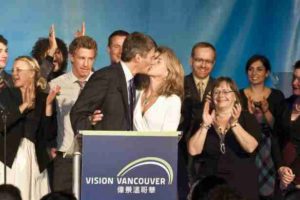
Vision Vancouver celebrates their overwhelming victory at the polls on November 19, 2011

Developers have long run the City of Vancouver, with various of the elected City Councils over the years acting as their all-too-willing handmaidens.


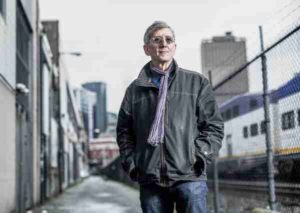
Joel Solomon, Vision Vancouver founder, standing outside, near his home in Railtown

The godfather and founder of the Vision Vancouver municipal party in 2004 was financier / philanthropist / real estate developer, and heir to a capitalist fortune, Tennessee émigré Joel Solomon, a political organizer who cut his teeth working on Jimmy Carter’s successful U.S. presidential campaign in the mid-1970s.

In the early 1990s, Solomon found his way to British Columbia, as he sought refuge on Cortes Island, while recovering from a serious health issue. In 1993, Solomon  met a young organic farmer named Gregor Robertson. Their views aligned, especially on the urgent need to address climate change. The two became fast friends.

In 2002 Solomon made a decision to form a Vancouver civic party, which in time came to be called Vision Vancouver.

Recruiting Mike Magee from Stratcom —  a strategic communications company dedicated to progressive causes — working with Magee, Solomon promised the then Coalition of Progressive Electors (COPE) Councillors Raymond Louie, Tim Stevenson and Jim Green their political futures lay with his newly-formed Vision Vancouver civic party, committing to them that he would dedicate substantial financial resources to their re-election in 2005’s Vancouver municipal election.

Long story short — following the untimely death of Jim Green, who was Vision Vancouver’s Mayoral candidate in the 2005 civic election — in 2006, Joel Solomon recruited his friend Gregor Robertson to seek the nomination to become the Mayoral candidate for Vision Vancouver in our city’s 2008 municipal election.

The rest is history: Vision Vancouver became government, from 2008 through 2018.


Gregor Robertson, Mayor in the City of Vancouver, from November 15, 2008 through October 20, 2018

Upon assuming government at Vancouver City Hall in 2008, Joel Solomon was quick to establish a secretive, behind-the-scenes “Mayoral advisory Board” — most members of which were not only longtime friends of Solomon’s dating back to his days in Tennessee, but were, as well, extremely successful real estate developers.


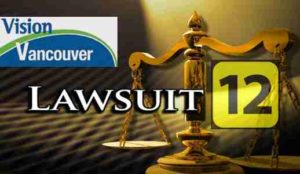
During their time in government, 12 development-related lawsuits were filed against Vision Vancouver

Over the course of their years in power, there were a number of development-related lawsuits that were filed against Vision Vancouver.

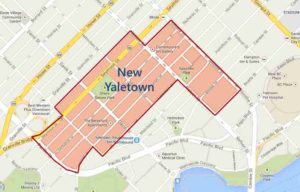
Perhaps the most egregious — and many thought, corrupt — development-related failing by Vision Vancouver involved a legal petition filed with the BC Supreme Court on May 6, 2014, by the Community Association of New Yaletown, to prevent a mega-tower development on the city block containing Emery Barnes Park.

The legal petition alleged the City, in approving development of the 36-storey tower at 508 Helmcken St. and a related building across the street at 1099 Richards Street violated the Downtown Official Development Plan (DODP) bylaws in in numerous and significant ways, while thwarting the long-planned expansion of Emery Barnes Park “to help reduce the City’s significant shortfall in meeting its own green space targets in the area.”


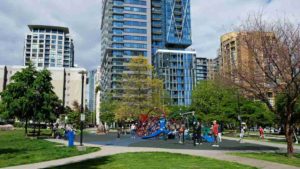
Emery Barnes Park, in the heart of New Yaletown, adjacent to Davie and Seymour streets

That Vision Vancouver had not consulted with the community, nor even made any mention of their plans to build yet another mega-tower in the New Yaletown neighbourhood — a “favour” to the Tennessee-based developer, Brenhill Development, who just happened to be friends with Joel Solomon, and members of the Mayoral Advisory Board — exacerbated not only the ire of residents of New Yaletown, but esteemed British Columbia Supreme Court Justice Mark McEwan, who ruled in favour of the New Yaletown residents, “killing the New Yaletown development”, even though it was already under construction.

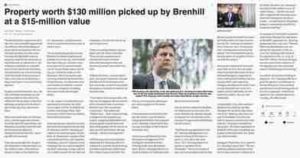
Read the Vancouver Sun article on Brenhill Development’s “sweet deal” here.

Some months later, the City of Vancouver prevailed at the B.C. Court of Appeals.


Peter Armstrong, owner of the Rocky Mountaineer, and founder / financier of ABC Vancouver

Now Peter Armstrong — who we know and very much like, who has pulled our behind out of the fire on more than one occasion, and who refers to us as his “favourite socialist” — will not be happy that we’re writing about him (reasonably, we can expect an irate call from Peter at some point today, as in “Why didn’t you call me to confirm with me what you’re writing about today?”).

But a man’s gotta do what a man’s gotta do (also, we hate to risk being lied to).


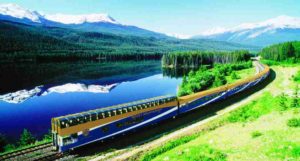
Founder Peter Armstrong’s Rocky Mountaineer offers unsurpassed luxury travel to discerning travelers

Now, Peter Armstrong — a pulled himself up by his bootstraps east end kid made good (we share a history as ‘east end kids’) — for many years was president of Vancouver’s oldest and most successful civic party, the Non-Partisan Association.

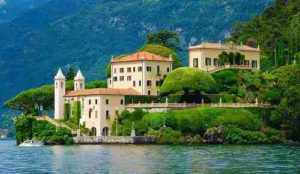
That is, until some dastardly folks staged a coup, taking over Peter’s beloved Non-Partisan Association in his absence, as he sailed his yacht to visit his good friend, Lululemon founder Chip Wilson, at his luxurious, well-appointed villa in Italy.

The consequence of the coup? Four of five NPA electeds resigned from the party.

And what became of the now former Non-Partisan Association Board members, who succeeded in killing the NPA, which party secured only, a paltry, unimaginably small 2.3% of the vote, when voters went to the polls in October 2022?


“Raymond, do you really think I’ll win re-election in Point Grey when we go to the polls in October?”

Premier David Eby will be heartened to know that these same far-right-of-centre nimrods are currently running the show with the nascent B.C. Conservative Party.

VanRamblings readers won’t be surprised to learn that ABC Vancouver founder, financier and Ken Sim backer, Peter Armstrong — as was the case with Joel Solomon, Vision Vancouver, and Mayor Gregor Robertson — has also created a secretive, behind-the-scenes Mayoral Advisory Committee, said committee comprised of developers, but mostly Peter and his very good friend, Chip Wilson.

A narrative, related to us recently by a very reliable VanRamblings source …

“Ken Sim ‘disappeared’ for a week this past autumn.

No one, save his family, knew where he was. In fact, Ken Sim was on board Peter Armstrong’s yacht, sailing up the west coast of British Columbia.

When Sim arrived back in town, returning to the Mayor’s office, he consulted with his Chief of Staff, Trevor Ford, after which the Mayor called in the ABC Park Board electeds to inform them of his decision to abolish the independent, elected Vancouver Park Board, leaving his now former ABC Park Board Commissioners in the room with Mr. Ford and David Grewal to explain details, and what would happen going forward.

Soon after, now former ABC Vancouver Park Board Commissioners Scott Jensen, Brennan Bastyovanszky and Laura Christensen made the decision to sit on Park Board as independents.

Subsequently, Sim called a press conference to announce his intention to eliminate the 133-year-old elected body, the much cherished, independent, and beloved Vancouver Park Board.”

The more things change, the more things stay the same.

Whether it’s developer Mayor Tom Campbell in the late 60s, or Joel Solomon and Gregor Robertson for a 10-year period when Vision Vancouver was at the seat of power at Vancouver City Hall, or in these latter days, with an avuncular — but dare we say, avaricious — Peter Armstrong and Chip Wilson, we who call Vancouver home are reminded yet again, and much to our consternation, this is not our city, for Vancouver is owned lock, stock and barrel by the developer class.

#SaveOurParkBoard | 80s Redux | Greed is Good

Tom Campbell, Mayor of Vancouver, 1966 - 1972
Tom ‘Not So Terrific’ Campbell, controversial Vancouver mayor, in office from 1966 to 1972

In 1966, running as an independent, a brash Tom Campbell defeated sitting Non-Partisan Association Mayor Bill Rathie to become Vancouver’s 31st mayor.

From the outset, Campbell’s ascension to the Mayor’s office heralded a pro-development ethos that would make even our current ABC Vancouver-dominated City Council blush, with Campbell — and his now ‘on board’  NPA colleagues — advocating for a freeway that would cut through a swath of the Downtown Eastside, require the demolition of the historic Carnegie Centre at Main and Hastings, and bring about the construction of a luxury hotel at the entrance to Stanley Park.

Vancouver's West End, 1960s, pre high-rise development
Vancouver’s West End neighbourhood, 1960, pre-high-rise construction. Photo, Fred Herzog.

In the West End, where Campbell owned substantial property — a wealthy, successful developer, Campbell was reputed to own one-third of the land located between (south to north) Davie and Georgia streets, and east to west, Denman Street and Stanley Park — the newly-elected Mayor all but ordered the demolition of almost the entirety of the well-populated West End residential neighbourhood — housing mostly senior citizens in their single detached homes — as he set about to make way for the rapid construction of more than 200 concrete high-rise towers.

In six short years, Mayor Tom Campbell and the Non-Partisan Association transformed a single family dwelling West End neighbourhood, irrevocably and forever.

That all of these “changes” augered controversy among large portions of the populace was a given, leading to regular, vocal and sometimes even violent protests throughout Campbell’s treacherous tenure as Mayor, finally lead to his overwhelming defeat at the polls in the November 1972 Vancouver “change” civic election.


Oct. 22, 2022 | Newly-formed civic party, ABC Vancouver, wins an overwhelming victory at the polls

Why raise ancient history now?

Not since the late 1960s / early 70s have Vancouver voters — seemingly, unknowingly — elected a more greed-inspired (this, on behalf of their financial backers), and wildly pro-development slate of lock step Vancouver City Councillors to office, at the heart of our city’s seat of municipal government at 12th and Cambie.

In early 2024, Vancouver sits on the wary edge of massive tower development, as promulgated by the “super majority” ABC Vancouver civic administration installed by Vancouverites at City Hall only 15 short months ago today. If Tom Campbell’s greed was able to destroy a single family-oriented West End neighbourhood 50+ years ago over six short years in power, imagine what the current ABC Vancouver-led municipal government can achieve over the course of the next 32 months?


Vancouver Park Board Commissioner at Vancouver City Hall, holding her new, month old baby

Click on this link to hear (former, and now independent) ABC Vancouver Park Board Commissioner Laura Christensen address the whole of Vancouver City Council on December 13, 2023 —  including her ABC Council running mates —  on the initiative of the political party she ran with to eliminate the elected Vancouver Park Board.

In her address to Council, Ms. Christensen pointed out to her now former ABC Vancouver City Council colleagues that there are 242 parks in the City of Vancouver, only 142 of which are designated as parks — leaving these latter non-designated “parks” open for development, including such beloved parks as Burrard Inlet’s Sunset Beach, Locarno Park, and Spanish Banks East and West.


Fans enjoy the Vancouver Canadians at Nat Bailey Stadium. Could the city-owned stadium be put up for sale? A report suggests sport & cultural venues should be shed by the city. Photo: Jason Payne /PNG

In an article published in the Vancouver Sun on Saturday, the Sun’s civic affairs reporter Dan Fumano writes that a …

“… budget task force assembled last year by ABC Vancouver Mayor Ken Sim delivered its report with 17 recommendations on how the city could improve its financial health while reducing pressure to increase on property taxes.

One recommendation suggests the city look at divesting some of its “non-core assets.”

When Fumano asked ABC Vancouver Councillor Brian Montague, one of two ABC Councillors who served on the task force’s advisory panel, if the “non-core assets” in the report would include include community centres, libraries, civic theatres, and sports facilities, Montague replied …

“I think it’s something we need to talk about, because there might be assets where divestment is the best approach.”

Former Vancouver Park Board Chairperson John Coupar clarified the matter on X:

Former Vancouver City Councillor Colleen Hardwick, and 2022 TEAM Mayoral candidate writes …

So, that’s it.

The reason for dismantling an elected Park Board?

A cynical and egregious land grab, a decision demanded by ABC Vancouver’s avaricious financial backers, who fancy adding billions of dollars more to their already ungainly wealth, all at the cost of: environmental devastation and climate change unchecked, a degraded quality of life in Vancouver for decades to come, reduced access to our public beaches — or, in some cases, no access at all to what were once but would no longer be “public beaches”— and long dark corridors of black towers lining the arterials and Vancouver’s beach fronts, all across the city.


Click / tap on the graphic above to sign  the Save Our Park Board Petition started by Sarah Blyth