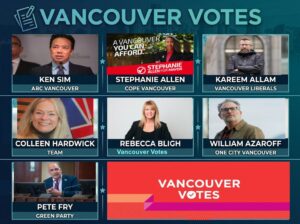

There are only three serious-minded candidates seeking to become Vancouver’s next Mayor in the 2026 Vancouver civic election: COPE’s Stephanie Allen, the Vancouver Liberals’ Kareem Allam, and the Green Party of Vancouver’s Pete Fry.
Today we’ll turn our focus to those three outstanding candidates for civic office.
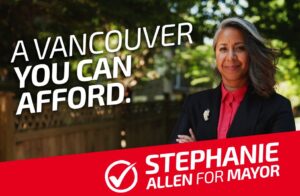
First up, the true change candidate in 2026, COPE’s Stephanie Allen, who is running on a platform committed to re-establishing the Renters Office; increasing the Empty Homes Tax; set to follow the lead of Montréal’s municipal government in establishing a programme that would — with the aid of senior levels of government — purchase purpose-built rental apartment buildings across the city, converting these buildings into permanently affordable public housing and housing co-operatives; in an age of increasingly powerful storms, forest fires, heat domes, and other extreme weather events, develop and implement a climate defense strategy; work towards fully-funded and free-to-ride public transit for all, starting with the expansion of free public transit for youth under the age of 18; support the expansion of active transportation and Vancouver’s cycling infrastructure; establish a lobbyist registry; protect and empower the office of the Integrity Commissioner; prioritize citizen participation in decision-making at City Hall; expand and democratize the City’s Advisory Committees; make public access to City Council chambers easier; improve livestreams of City Council meetings; and, overall, improve and transform transparency of governance at Vancouver City Hall, because democracy matters.

Given her years of service to the people of British Columbia in her role as a well-respected, ‘can do / get ‘er done‘ Vice-President of BC Housing — committed to the construction of social and affordable housing across our province — a Mayor Stephanie Allen would hit the ground running on her first day in office, as she works with Council towards transforming civic governance by putting power back into the hands of those of us who call Vancouver home, and not the billionaire class all Mayors of Vancouver this century have dedicated their political lives to bringing to fruition, at your expense and amoral degradation.
Just wait till you see and hear Stephanie Allen at next month’s and October’s Mayoral debates, those must-attend civic forums set to take place in neighbourhoods across our city. We guarantee Stephanie Allen — that mesmerizing voice, a powerful and resonant voice that envelops you — will simply knock your socks off, as the candidate of change you have longed for at the head of Vancouver’s civic government, ready to serve you each and every day, to make your life easier, better and more fulfilling — because that’s what an elected Mayor and Vancouver City Council committed to change for the better can and will do for you.
 Make sure you read the Vancouver Liberals’ platform of change that will enhance your quality of life
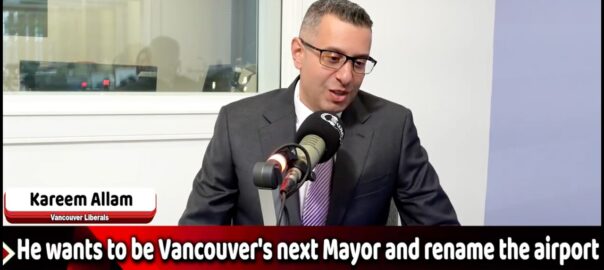
What is the change that the Vancouver Liberals’ candidate for Mayor, Kareem Allam, the peerless, achingly intelligent and capable beyond all human understanding candidate for Mayor of our fair city, and his first rate slate of Council and Park Board candidates — and soon to announce School Board candidate slate — are committing to you, should the Vancouver Liberals form government following election night, this upcoming autumn evening, Saturday October 17th.
 Kareem Allam and the Vancouver Liberals are committed to extending the Millennium Line to UBC
In a century when very little of consequence has occurred in Vancouver — other than serving the avaricious interests of developers and their unwholesome, phallocentric commitment to building unlivable towers across our city while displacing residents from their affordable homes — finally, in Kareem Allam, we have a candidate for Vancouver Mayor whose sole interest is serving your interests, and the interests of your family, neighbours, friends and associates, your extended family, your co-workers and everyone, every single person you care about.
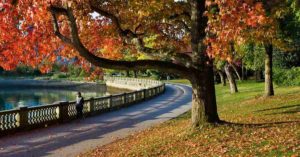
Investing in parks, libraries, and community spaces is how we reduce crime.
That’s why we’re committing 400 new frontline workers and a historic $1.35B investment in parks, recreation, and pools. pic.twitter.com/Q1mgs6SGAJ
— Kareem Allam (@kareemformayor) April 3, 2026
The Vancouver Liberals have committed to making $1.35 billion available through Vancouver’s well-funded capital budget — citizen approved monies that are readily available for construction purposes — in an investment over the next four years of a Vancouver Liberals-led civic administration that would renew the city’s aging parks and neighbourhood community recreation centres, reverse an unconscionable Park Board funding decline that began with the election of a Vision Vancouver civic administration in 2008 — monies that have never been restored to the Park Board budget — protect Vancouver’s elected, independent Park Board, build a new aquatics infrastructure, including a 50-metre Olympic size pool, as well as construct community pools in neighbourhoods across our city, and finally — after citizen capital expenditure approval at the polls in 2008, 2011, 2014, 2018 and 2022 — build the long-awaited, egregiously overdue Marpole Community Centre, which would be the first new community centre approved by a Vancouver civic administration in more than 20 years.
Having worked with the federal and provincial governments in senior policy implementation positions, as well as working in Metro Vancouver regional civic governments in a ‘can do’ administrative capacity, there is no individual seeking the Mayor’s office in 2026 who is more qualified, who better understands the intricacies of civic government decision-making and implementation strategy than the achingly bright and monumentally well-qualified Kareem Allam.
When Kareem Allam tells you he’s going to get something done you’ve been longing to see done at the municipal governance level, you can take it to the bank Kareem Allam is 100% guaranteed going to deliver for you, to get that project completed on time and under budget, for all the citizens of Vancouver.
A Kareem Allam-led Vancouver City Council will: restore public library hours; keeps annual property tax increases to 3.8%, or less — rather than the 26% property tax increase implemented by Ken Sim and ABC Vancouver over the past four years; ban foreign travel for Councillors and staff; focus on accountability, affordability, public safety, by delivering results people can actually see in their communities; promote transparency at City Hall by reducing the cost of Freedom of Information requests; put a referendum before the people of Vancouver at the next civic election, asking us if we want neighbourhood representation (sometimes called a ‘ward system’) at City Hall — as is the case with every village, town and city in every province and territory outside of British Columbia.
Remove all parking meters in front of beaches and community centres throughout the city; crack down on Bitcoin ATMs that are commonly linked to money laundering, fraud, organized crime, and drug trafficking; support proper staffing, long-term funding, and transparent deployment planning to ensure firefighters have the resources they need to keep Vancouver safe; work to ensure the Millennium line extension to UBC begins construction next year; protect local businesses during transit expansion by reducing property taxes by 50% during construction; deliver an effective food security programme in Vancouver (which VanRamblings will write about next Monday); and, reduce taxes on medical clinics.
On Day One, a Vancouver Liberals’ administration commits to reversing Ken Sim’s cruel ban on supportive housing to ensure our most-vulnerable citizens receive the supports they need to live a safe, secure and fulfilling life; tackle Vancouver’s rat problem, because rats are a major reason for the spread of disease and are a public health risk to citizens; introduce a tree canopy strategy in every neighbourhood across our city that is not treed, where our city’s west side is treed, and our east side neighbourhoods are not.
Bring back our city’s once thriving Festivals scene by legislating affordable policing for all community events; stop Ken Sim’s cynical plan to sell off our parks; protect Vancouver’s industrial land to keep jobs in Vancouver; create North America’s first Artist Land Reserve; modernize zoning and business rules to support small businesses, and the next generation of Vancouver’s economy, building a city where innovation is encouraged, not regulated out of existence.

Maybe this whole hopey changey thing that both COPE’s Stephanie Allen and the Vancouver Liberals’ Kareem Allam are promising is just a bit too much.
Maybe, the people of Vancouver don’t want a woman as Mayor — uh, yeah, we do! — or, maybe, the people of Vancouver don’t want some random Muslim-appearing guy, no matter how qualified he seems to be, as our city’s next Mayor.
Again, uh, yeah, we do!
Maybe we just want another white-appearing guy sitting in the Mayor’s chair.
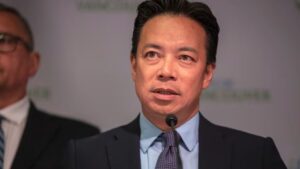
After all, Vancouver has had 41 Mayors since it’s founding, and only one of those Mayors — and man, oh man did the first non-white guy to be elected Mayor of our city prove to be a bust (yeah, we’re talkin’ about you, Ken Sim) for those of us who give a good gall darn about our city.
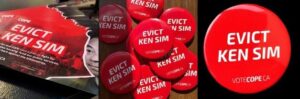
What a walking disaster this Sim guy turned out to be.
Maybe Vancouver voters want to play it safe, maybe we don’t want change, maybe we have no interest in getting things done, maybe we could give a good gall darn about the state of our parks and recreation system, and we don’t care at all about the unhoused — yeah, that’s the ticket (not!) … like, get a job, will ya — maybe we simply want another kind of good lookin’ white-appearing guy.
How bad could it be, really?
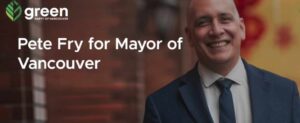
No question: Pete Fry has name recognition. Eight years on Council, on the evening news almost every night, a good-spirited guy.
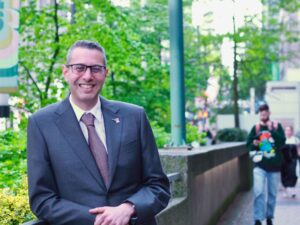
Look at the reassuring picture of the smiling Green guy in the photo above. Like, who wouldn’t want to cast their ballot for this warm-hearted guy?
Plug-in solar panels on your balcony to offset your electricity bills and power the myriad electrical devices in your home. Licensing mini electric shuttles in the downtown area. Bring back the Renter’s Office. Restore lifeguards at key Vancouver beaches. Hire a city comptroller to ensure transparent budget efficiency, and asset management. Enact a landlord licensing by-law to flush out bad landlords.
Restore essential postal services in Chinatown. Amend the Vancouver Charter to allow 16- and 17-year-olds to vote in municipal elections. Protect the Champlain Heights forest trail network. Bring back the Stanley Park bike lane. Strengthen Vancouver’s code of conduct legislation to restore public trust in decision-making at Vancouver City Hall. Phase out in-sink garbage disposals. Build more public washrooms across the city. Build a Japanese Canadian interpretive centre at Hastings Park. Re-introduce a Vancouver by-law that would forbid the use of methane gas to heat new buildings. A lobbyist registry. Climate action.

The decision is yours to make.
Come early October when Vancouver’s municipal election advance polls open, or during the course of Election Day on Saturday, October 17th, cast your ballot for the Mayoral candidate — and a few of the folks s/he is running with — who you believe represents your best interests, who will build the city in which you want to raise your children, make a living for yourself and your friends and neighbours, and when the time comes, retire in, to live out your life in peace.
Take back your power! Your vote is critical to building the city you love!