Tag Archives: kareem allam

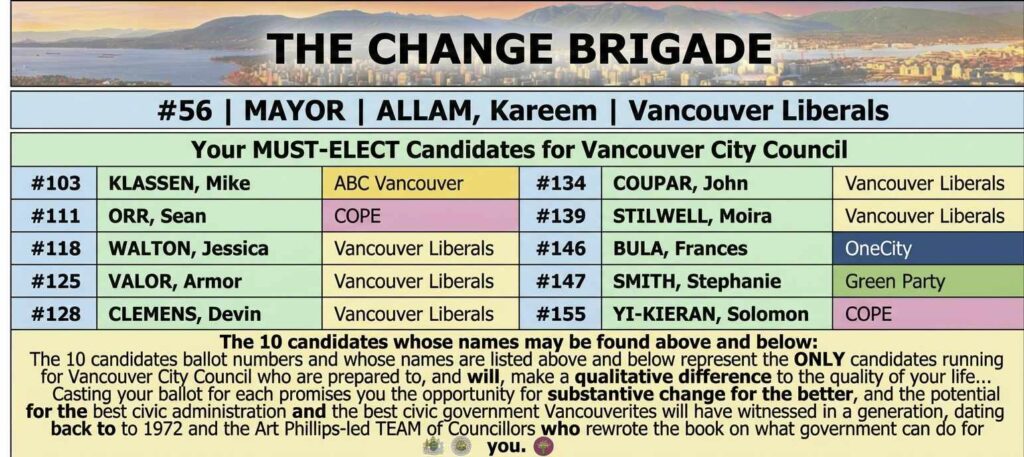
#VanPoli | Vote for The MUST-ELECT Change Brigade At the 2026 Polls

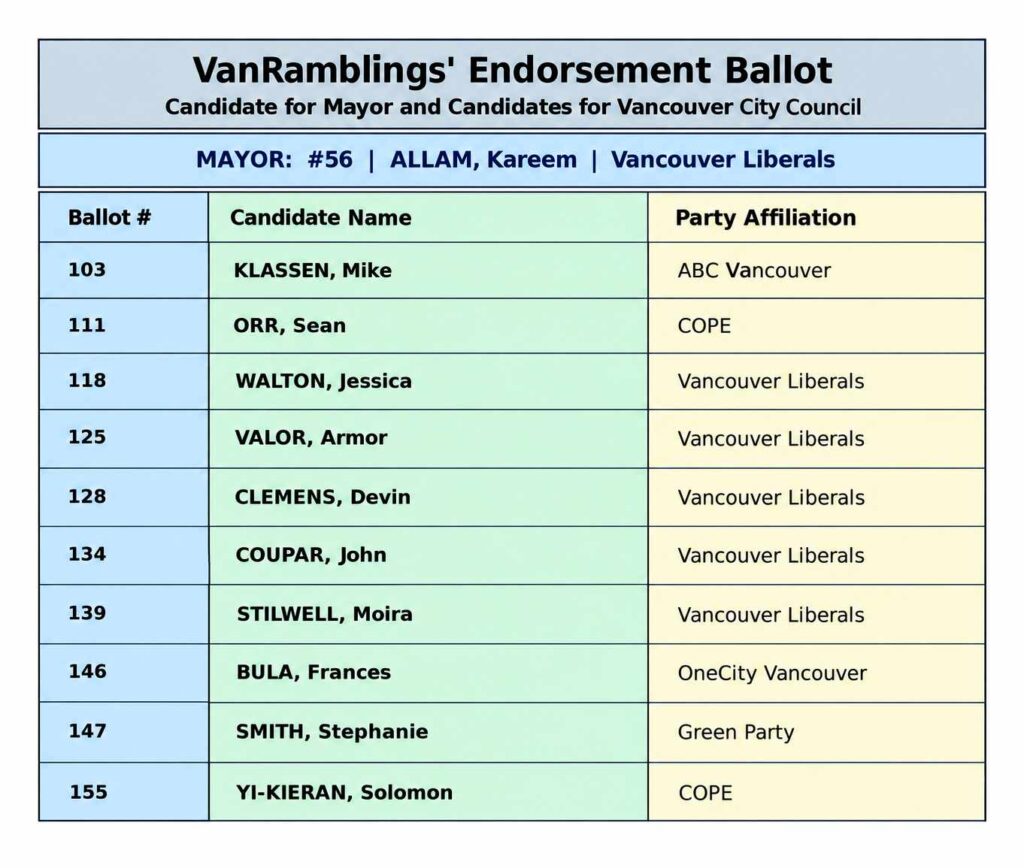
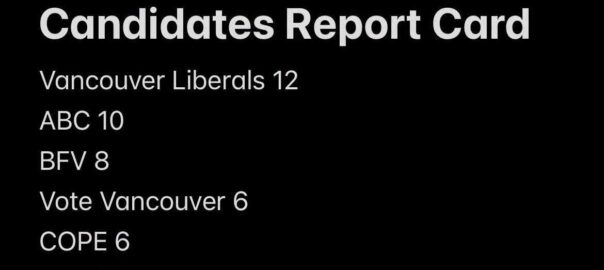
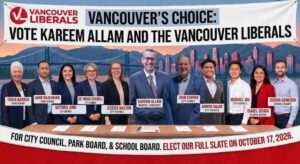
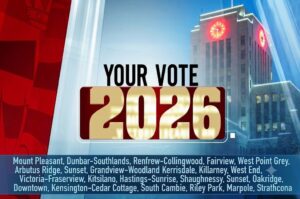
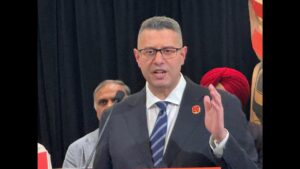
Kareem Allam as the Vancouver Liberals Mayoral candidate, and the 10 Vancouver City Council candidates whose names appear above represent Vancouver’s only hope for better; for an action-oriented government that will relieve your tax burden; build our city’s parks and recreation system; downsize the “managers managing managers” bloated bureaucracy at Vancouver City Hall; establish a blue ribbon panel to address the pestilence of the rat problem that bedevils our city, that is of so much concerns to residents in every neighbourhood across Vancouver; address street disorder and an out-of-control drug problem on the DTES in a humane, yet efficient and effective manner; spend money on our sidewalks that makes life difficult for seniors and persons with disabilities to traverse, and so very much more that is on the agenda of THE CHANGE BRIGADE asking for your vote.

Thinking of voting for Pete Fry for Mayor? Expect the same old, same old do nothing government that has defined every Vancouver civic administration this century. Rebecca Bligh. Same thing. Won’t achieve any more than a high single digit come Election Day. Colleen Hardwick. Puh-leeze. In a word, nightmare. Ken Sim. Undeserved second term.

You know what the difference is between Kareem Allam, and the 10 Councillors endorsed by VanRamblings? Every other person running for Council — although they might believe what they’re saying — are driven by ego, and what’s good for them, and not us.

The members of The Change Brigade are the only candidates for Vancouver City Council seeking a Council seat, because they believe in the good, that collectively as members of a Vancouver City Council committed to a civic administration of reconciliation that there is much good to be achieved.

In other words, The Change Brigade is in it for us, not for themselves.

Only the collaborative, achingly brilliant, ready to hit the ground running, man of vision who is a natural leader, Kareem Allam, possesses the wisdom and experience to be the best Mayor of Vancouver since the days of the Art Phillips.

Vancouver’s Government of Municipal Reconciliation Working for You

The 10 candidates whose names are listed above, the Vancouver Liberals’ achingly bright Kareem For Mayor and the 10 Council candidates endorsed by VanRamblings represent the 𝗮𝗴𝗲𝗻𝘁𝘀 𝗼𝗳 𝗰𝗵𝗮𝗻𝗴𝗲 we have waited more than 25 years for, the ‘can do’ Zohran Mamdani crew who mean to make a difference …

• Remove pay stations from parks, beaches and in front of and nearby community centres, pools and hockey rinks, which means that the City of Vancouver will — with The Change Brigade in charge — finally get around to spending some of those billions of dollars that languish in the capital budget, monies that we approved in referendums in 2008, 2011, 2014, 2018 and 2022, election after election as the money just sits in the capital budget unspent, instead of being spent on us; • Broken Promises and Rising FOI Fees, means transparency and accountability is needed at City Hall. Vancouverites are facing rising Freedom of Information fees while trust in City Hall continues to decline;

• Reinstate the Livable Wage Programme at City Hall, that mandates suppliers of goods and services to the City must pay their workers a livable wage (approximately $28 today), that doesn’t cost the city a penny, but helps workers;

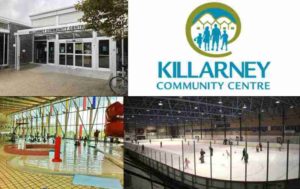
• Renew Vancouver’s 24 community centres, most of all, the 11 community centres identified by Vancouver Auditor General Mike Macdonell in his scathing report to Council on the “severe state of disrepair” of 11 of those community centres; • Cancel Ken’s $800m Second City Hall, wherein Ken Sim and ABC want to spend $800 million just to build more office space for managers;
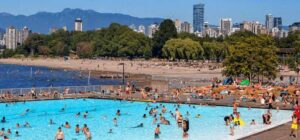
• Build community pools in neighbourhoods across the city, water parks and hockey rinks;

Luxury Yacht Tax (40ft+), to protect essential services without burdening everyday Vancouverites, The Change Brigade will implement a tax on luxury yachts over 40 feet;

• Faster, Cheaper Housing Construction, because Vancouver is the only city in BC with its own building code — an unnecessary extra step for people seeking to build more housing in our city. The Change Brigade, led by Kareem Allam and the Vancouver Liberals — working in concert with COPE’s Sean Orr and Solomon Yi-Kieran, One City’s Frances Bula, and the Greens’ Stephanie Smith — will remove the Vancouver Building Code and align our city with the rest of the province, simplifying the process for housing construction;
• Hold developers feet to the fire, by insisting Wesgroup finally get around to building the community centre they are contracted to build in the River District, or QuadReal to build their contracted Oakridge Park community centre, or Concert Properties, to build a much needed SE False Creek community centre they said they’d build ages ago; Build affordable housing, focusing on democratically run housing co-ops, built on City land, working with Thom Armstrong, Executive Director of both BC’s Co-operative Housing Federation and the Community Land Trust, with child care centres built into the newly-constructed co-ops;
Protect Good Jobs and Industrial Land, because Vancouver needs more good-paying jobs, not policies that put them at risk. Ken Sim’s plan to eliminate the city’s remaining industrial land threatens to push businesses and well-paying jobs out of Vancouver; • A Ward System for Vancouver, because Vancouver’s current at-large voting system makes campaigns expensive and leaves many neighbourhoods without direct representation at City Hall. The Change Brigade support exploring a ward system that would divide the city into local districts, each electing their own dedicated Councillor;
• Ban Bitcoin cryptocurrency ATMs on the DTES and take the fight to the drug dealers, not the street-level drug dealers, but their suppliers; • Work to rid our city of the pestilence of rats, that are of concern to residents in every neighbourhood across our city;
• Address homelessness in a humane and caring manner, consistent with the values of the vast majority of us who call Vancouver home; • The Change Brigade Noise Policy, because we’re tired of noisy hot rods and motorcycles revving up at 3 a.m. in our neighbourhoods. So are the members of The Change Brigade;
• Downsize a bloated middle management bureaucracy, at Vancouver City Hall, because do we really need 95 people working in Vancouver’s communications department, or employ more middle managers in our development services and planning departments than on the ground CUPE workers — like plan checkers — who do the real work?; • Reduce Taxes on Medical Clinics, because The Change Brigade means to cut property taxes in half for family doctors and walk-in clinics in the City of Vancouver;
• Build UBC-style Food Hubs across our city, to address food insecurity;

Build More Public Bathrooms, because Vancouver’s chronic lack of public washrooms not only fails to provide basic facilities to residents but could cause even bigger public health problems;

• Build Supportive Housing for Seniors & Veterans, because supportive housing is a lifeline for seniors, veterans, and those with disabilities. On Day One, The Change Brigade will reverse Ken Sim’s cruel ban on supportive housing and ensure that our most-vulnerable citizens receive the supports that they need;
• Restore strong fiscal management, at City Hall; • Stop the Sale of Vancouver Parks, because Ken Sim and ABC’s Councillors who tried to eliminate the Park Board, Sim who is all about putting Vancouver’s parks up for sale. The Change Brigade strongly supports our elected Park Board, a democratic institution that protects our parks from being chopped up and sold off;
• Develop a methamphetamine strategy — the leading cause of violent incidents that puts people at risk — just like Premier Wab Kinew has done in Manitoba (a plan that is working!); • Establish an Industrial Land Reserve, because keeping jobs in the city and surrounding them with affordable housing so that people can build their careers and keep their families in our city;
• Protect local businesses during transit expansion, by reducing property taxes by 50% for the duration of construction;

Build more public washrooms, including within our parks (I mean, when the kids have gotta pee, they’ve gotta pee);

• Support taxation on land value, by capturing the land-owner windfalls caused by proximity to public amenities, speculation, and zoning;
• Reinstate library funding and hours, cut by a heartless and cruel Ken Sim administration that have so weakened these vital public spaces and community services; • Bring back the Renters Office, with teeth this time to give tenants an advocate who is empowered to fight for them;
• Better Front-Line Services, which means across the board, city services are failing: more potholes, missed garbage pickups, dirty streets, and so much more. • Identify why progress towards city goals of affordability, families, renters, and climate has stalled or reversed under Ken Sim, and get back on course;
• Fight for campaign finance reform, to close the loopholes the wealthy can use to, effectively, buy politicians and elections; • Fight for a fast and free public transit system in Vancouver, and take steps on that path immediately;
• Bring in a municipal lobbying registry, because the public deserves to know how and when the wealthy are influencing decisions made by the city government; • Half of bus stops in Vancouver have no bus shelters or benches, so work toward changing that circumstance.
• Expand VanWifi across the city, to allow for more free and open internet access, prioritizing currently under-served areas; • Train and hire lifeguards and swim instructors, because we need to keep pools open and staffed, stop line-ups, offer swimming lessons to meet demand, and keep people safe at Vancouver’s beaches.

#VanPoli | Kareem Allam | Unifying Vancouver

According to the last census, there are 662,248 citizens who call Vancouver home.

54.5% of Vancouver’s population, or 354,615 people, belong to one of Vancouver’s 201 visible-minority communities.

The Chinese community is by far Vancouver’s largest single ethnic/cultural-origin group, with 159,080 people — roughly one Vancouver resident in four. The latest census puts the Chinese population at 168,385, or 25.9% of the long-form population.

There are another 378,000 citizens in Vancouver whose ethnic origins are not part of the visible minority population: with the largest of these non-visible minority  populations represented by the English (84,370), Scottish (69,200) and Irish (65,695).

Taken together, those four origins account for more than 378,000 reported origins, although, again, many people report more than one origin.

According to the latest census, as above, Vancouver has 354,615 people identified by Statistics Canada as belonging to a visible-minority population, again (as reported above) representing 54.5% of Vancouver’s 662,248-person overall population.

The disparity in numbers between Vancouver’s Census Canadian population of  662,248 Vancouver citizens, and the 742,615 figure that is a combination of the visible and non-visible ethnic populations may be accounted for by the fact that many Vancouverites who reported out in the most recent Statistics Canada census identified as being members of more than one ethnic community.

Chinese residents accounted for 159,080; South Asians 44,850; Filipinos 38,605; Southeast Asians 20,585; Latin Americans 18,080; West Asians 12,100; Koreans 10,895; Japanese 10,990; and Black residents 8,515.

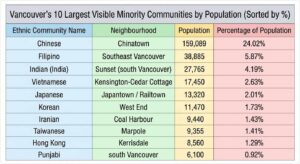
The chart below shows Vancouver’s visible minority populations by ethnic group, the Vancouver neighbourhoods where most reside, the population numbers, and the percentage of the population each community comprises within the City of Vancouver.

Rank Ethnic/cultural origin Population % of Vancouver
1 Chinese 159,080 24.02%
2 English 84,370 12.74%
3 Scottish 69,200 10.45%
4 Irish 65,695 9.92%
5 German 45,215 6.83%
6 Filipino 38,885 5.87%
7 Canadian 33,685 5.09%
8 French, n.o.s. 30,625 4.62%
9 Indian (India) 27,765 4.19%
10 British Isles, n.o.s. 21,545 3.25%
11 Italian 21,155 3.19%
12 Ukrainian 20,000 3.02%
13 Vietnamese 17,450 2.63%
14 Polish 15,900 2.40%
15 Russian 14,135 2.13%
16 Dutch 13,330 2.01%
17 Japanese 13,320 2.01%
18 European, n.o.s. 11,990 1.81%
19 Spanish 11,605 1.75%
20 Jewish 11,555 1.74%
21 Korean 11,470 1.73%
22 Asian, n.o.s. 11,330 1.71%
23 Caucasian (White), n.o.s. 11,105 1.68%
24 Norwegian 10,125 1.53%
25 Iranian 9,440 1.43%
26 Taiwanese 9,355 1.41%
27 Welsh 9,255 1.40%
28 Hong Konger 8,560 1.29%
29 Swedish 8,270 1.25%
30 Mexican 7,855 1.19%
31 American 7,565 1.14%
32 Portuguese 6,535 0.99%
33 Punjabi 6,100 0.92%
34 Hungarian 5,615 0.85%
35 Greek 5,475 0.83%
36 Danish 4,890 0.74%
37 Austrian 4,710 0.71%
38 French Canadian 4,070 0.61%
39 Croatian 3,580 0.54%
40 Persian 3,510 0.53%
41 Romanian 3,370 0.51%
42 Sikh 3,225 0.49%
43 Finnish 2,775 0.42%
44 Hindu 2,685 0.41%
45 African, n.o.s. 2,660 0.40%
46 Icelandic 2,525 0.38%
47 South Asian, n.o.s. 2,460 0.37%
48 Turkish 2,350 0.35%
49 Belgian 2,160 0.33%
50 Eastern European, n.o.s. 2,065 0.31%

In 2022, turnout at the polls in the last civic election, 36.3% of eligible Vancouver voters cast a ballot at the polls during the last municipal election.

Looking specifically at Vancouver civic elections using the City’s/BC CivicInfo’s reported turnout among eligible or registered voters, the trend is quite clear: turnout rose sharply from 2011 to 2014, fell in 2018, and fell again in 2022.

Election Ballots cast Eligible/registered voters Turnout
2022 171,494 472,665 registered 36.3%
2018 176,450 448,322 estimated eligible 39.4%
2014 181,707 429,390 estimated eligible 43.4%
2011 144,823 — 35.0%

In 2022, The City of Vancouver’s official final results report 171,494 ballots cast from 472,665 registered voters, producing a 36.3% turnout. The City’s subsequent election review confirms the 36.3% figure.

If you’re looking at this in the context of the 2026 Vancouver election, the really interesting question is what the turnout would look like if members of the city’s 201 visible minority ethnic/cultural communities voted at anything approaching the participation rates of the broader electorate. That could materially change the electoral math.

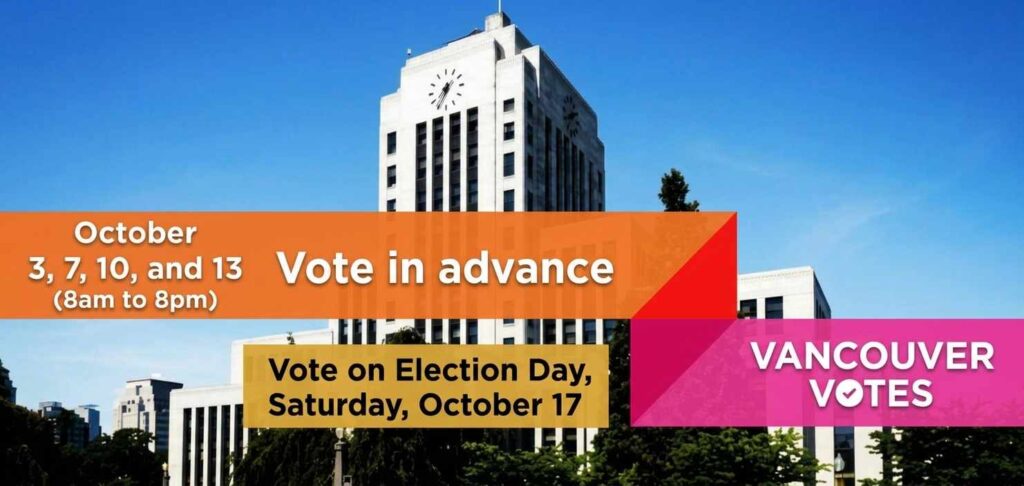
That is the subject matter of today’s VanRamblings post: in 2026, what would the election outcome in the City of Vancouver look like were members of the alienated, disenfranchised visible minority population of our city to cast their ballot at the advance polls on October 3rd, 7th, 10th and 13th, and on Election Day, Saturday, October 17th?

Which is not to say that Kareem Allam and the Vancouver Liberals have not reached out to members and Vancouver citizens in all 264 distinct ethnic communities, as can be seen in the chart above, from persons whose heritage hails from Great Britain / the British Isles / Scotland / Wales / and Ireland. Not to mention, France, the western European countries, Poland and the other countries in the Eastern Bloc, as well as citizens who lives originated in South America, Australia,  and across the globe.

Kareem Allam and the Vancouver Liberals want  your vote next month!

East Vancouver Voter Turnout in 2022

Defined by the City of Vancouver local areas east of Ontario Street, where most of the visible minority ethnic populations reside — Strathcona, Grandview-Woodland, Hastings-Sunrise, Downtown Eastside, Mount Pleasant East, Kensington-Cedar Cottage, Renfrew-Collingwood, Riley Park East, Sunset, and Victoria-Fraserview — voter turnout, on average, was anywhere from 22% to 28%, with some polls reporting voter participation, ranging from 38% to 42%.

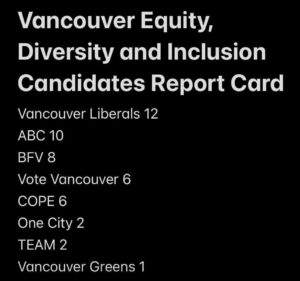
The list of Vancouver political candidates drawn from minority communities seeking elected office in Vancouver in 2026, by party affiliation, was compiled by the Coalition Against Bigotry-Pacific

Kareem Allam and the Vancouver Liberals are working towards getting out the vote on Vancouver’s east side, and in south Vancouver, setting a new record for voter participation in these neighbourhoods, to give every community a voice at Vancouver City Hall. That is the solemn commitment the Vancouver Liberals are making to the citizens of Vancouver in the 2026 municipal election, as they reach out to members of the 264 distinct ethnic communities who live across Vancouver, to young people, to seniors, to folks who are members of the New Democratic Party, the Conservatives, the Green Party, and more.

West Side of Vancouver Turnout in 2022

The lowest participation rate on Vancouver’s West Side occurred in Fairview and Marpole, where voter turnout drops to 31%–35%. This reflects lower homeownership rates and a higher proportion of transient renters compared to the single-family enclaves further west.

As reported in The Georgia Straight, based on data provided by the City of Vancouver, in the 2022 Vancouver municipal election, the single highest voter participation percentage on the West Side recorded occurred in Shaughnessy and Dunbar-Southlands, peaking at 52%–55% on average in each Vancouver municipal election since 2011.

In 2022, a full 63.7% of eligible voters failed to cast a ballot in that year’s Vancouver municipal election.

What would happen if a Vancouver municipal party, and a candidate for Mayor of the City of Vancouver, set out 15 months ago to meet with representatives of the alienated and disenfranchised voters in these communities, specifically on Vancouver’s East Side, meeting with members of each of these 201 visible minority communities who, traditionally, have not voted in Vancouver’s civic elections?

Well, that is exactly what Kareem Allam, the Vancouver Liberals Mayoral candidate in the 2026 Vancouver municipal election set out to do 15 months ago.

Over the course of the past 457 days, Kareem Allam and his Vancouver Liberals campaign staff have met with representatives of these alienated, disenfranchised 201 visible minority communities, in their homes and at their community gatherings, and have built a Get Out The Vote (GOTV) army of more the 2,000 Vancouver citizens — across all 264 distinct ethnic communities — who have committed to Kareem Allam and the Vancouver Liberals that each will get 10 or more members of their nuclear and extended families, as well as their friends, neighbours and work colleagues who constitute members of their community, to the polls to cast a ballot for Kareem Allam and the Vancouver Liberals.

Which means that in 2026, Vancouver could see the highest turnout / voter participation rate ever in a Vancouver civic election, emerging as the difference maker in 2026 that will thrust Kareem Allam and the Vancouver Liberals into civic power at Vancouver City Hall, post this year’s October 17th Vancouver municipal election.

In 2015, in the Canadian federal election, 17,711,983 Canadian voters out of a total of  25,939,742 eligible voters — or 68.3% of eligible Canadian voters cast a ballot in that critical federal election — thrust Justin Trudeau into office as the 43rd Prime Minister of Canada, and the Liberal Party of Canada into comfortable majority government status, dramatically defeating Stephen Harper and the Conservatives after 10 years in power.

Average percentage voter turnout over Harper’s 10 years in power was 58.8%.

Justin Trudeau’s Liberals were elected to 184 seats in Parliament in 2015, while Stephen Harper’s Conservatives secured only 99 seats, 67 fewer seats than when the Conservatives won 166 seats in 2011 and Stephen Harper won a majority government.

According to Research Co., Angus Reid and other polling companies, 62.7% of Vancouver voters want change.

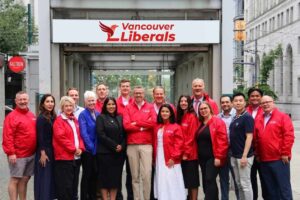
Vancouver Liberals | The most ethnically and politically diverse group of candidates in Vancouver

Change. VanRamblings believes, as was the case in the 2015 federal election, that is exactly what we’re going to get come the evening of Saturday, October 17, when the percentage of eligible voter participation rate in this year’s Vancouver municipal election will rise from the 36.3% turnout rate in 2022, to more than a record 45% voter participation rate in the 2026 Vancouver civic election — based on a radically increased turnout of previously alienated and disenfranchised voters in Vancouver’s visible minority population, who will flood to the polls to elect a Vancouver unity government of civic reconciliation, thrusting Kareem Allam into the Mayor’s office and electing a majority Vancouver Liberals civic government at Vancouver City Hall come the evening of Saturday, October 17, a responsible and responsive, activist civic administration, delivering services for the people of Vancouver, while keeping taxes low.

Vancouver, then, may look forward to a Kareem Allam-led “let’s get ‘er done” Vancouver Liberals civic administration serving the interests of all of us who call Vancouver home, a Kareem Allam-led government delivering for us, holding power and gaining the respect of Vancouver residents in every one of Vancouver’s 23 neighbourhoods through until Vancouver’s next municipal election in 2030 — and, perhaps, beyond.


#VanPoli | The Election is Over | Meet Vancouver’s Next Mayor: Kareem Allam

There are moments in the political life of a city when an election becomes about more than choosing a Mayor.

October 17, 2026, is one of those moments.

Vancouver is not simply deciding whether to give Ken Sim and ABC Vancouver another four years. Vancouver is deciding what kind of city it wants to become — and, more importantly, who the city is actually going to work for.

For the past four years, City Hall has too often appeared preoccupied with grand announcements, expensive projects, political theatre and the interests of the well-connected while the everyday infrastructure of neighbourhood life has deteriorated.

Libraries have faced cuts. Community facilities are aging. Swimming pools are disappearing. Parking meters have appeared around community amenities. Families are struggling with the cost of living. Seniors are wondering where affordable recreation opportunities are going to come from. Young people increasingly question whether they can afford to remain in the city in which they grew up.

Kareem Allam, Vancouver Liberals | The next Mayor of Vancouver

Into that vacuum comes Kareem Allam and the Vancouver Liberals.

There  is a compelling case to be made that Kareem Allam could become Vancouver’s most progressive Mayor in more than half a century.

Not because he comes from the traditional left.

Not because he comes from the traditional right.

But precisely because he doesn’t fit neatly into either category.

Kareem Allam’s political proposition is something Vancouver has desperately needed: a government organized around people rather than ideology.

The Vancouver Liberals’ stated goal is refreshingly straightforward: create a Vancouver where young people can stay, work, build a career and raise a family. Their platform combines affordability, public investment, stronger frontline services, parks and recreation, public safety, accountability and neighbourhood infrastructure.

That is progressive municipal government in its most practical form.

Kareem Allam: The Vancouver Mayor Who Will Get To Work on Day One

For Vancouver voters looking for a Mayor who can begin governing on the morning after the 2026 civic election, rather than spending the first year learning how City Hall works, Kareem Allam presents a compelling case.

The Vancouver Liberals’ Mayoral candidate is not simply a political newcomer with an attractive platform. He is a lifelong Vancouverite who has spent more than 25 years working in and around municipal, provincial and federal government, public policy, Indigenous relations, health care, transportation and infrastructure.

Kareem’s career has given him something that is extraordinarily rare among candidates for municipal office: an understanding of government not merely from the outside, but from inside the machinery of government itself.

Kareem Allam is not entering Vancouver’s 2026 Mayoral race as a political novice. Far from it. Kareem has worked for elected politicians, inside government, in public institutions, on political campaigns and, critically, inside Vancouver’s Mayor’s office itself.

There is no other Mayoral candidate in 2026 who can match his breadth of experience.

Over his 25-year professional life, Kareem Allam has worked in government relations and public affairs, holding positions involving consequential policy areas facing British Columbia: energy, health care, transportation, infrastructure and Indigenous relations.

Kareem Allam worked with the Fraser Health Authority. He served on public and advisory boards. He became Director of Public Policy at the Vancouver Board of Trade. He developed extensive relationships with First Nations and worked on Indigenous economic-development issues.

Vancouver Magazine placed Kareem Allam among British Columbia’s 50 most powerful people, recognizing him as one of the province’s most sought-after political minds.

A Mayor must understand municipal bureaucracy, the Vancouver Charter, budgeting, procurement, zoning, permitting, capital budgets, collective agreements, infrastructure financing, development approvals, labour relations, intergovernmental negotiations, civic infrastructure, regional government, provincial jurisdiction and the relationship between elected officials and the professional bureaucracy.

Kareem Allam has spent his entire professional career learning precisely those systems.

Indeed, it is difficult to identify another 2026 Mayoral candidate who has worked so extensively across the federal, provincial and municipal spheres while also gaining experience inside Vancouver’s own Mayoral office. His career has included government-relations positions, senior policy work, public boards and direct municipal executive experience. He has served on the TransLink screening panel, and other public and advisory bodies. He currently serves on advisory bodies associated with the University of Victoria and Kwantlen Polytechnic University.

The Mayor of the City of Vanncouver has to interact with Metro Vancouver.

With TransLink.

With the provincial government.

With Ottawa.

With developers.

With unions.

With neighbourhoods.

With First Nations.

With a bureaucracy employing thousands of people.

And then the Mayor has to get 10 Councillors to agree on what should actually happen.

This is not theory. It is governing.

And Kareem Allam has spent decades learning how to do it.

Kareem Allam’s political career is unusual because he has worked across ideological and partisan boundaries. Conservatives, Liberals, New Democrats, civic politicians, business leaders, public servants and Indigenous governments have all been part of his professional world.

It means Kareem Allam understands that government is not about finding people who agree with you.

It is about finding a way to get things done among people who don’t.

Former B.C. cabinet minister Michelle Mungall has joined his campaign as an honourary co-chair, while Arminder Randhawa, a former B.C. NDP executive member and former Vancouver Board of Variance member, has described Kareem Allam as a thoughtful and pragmatic leader who brings people together.

Those are precisely the qualities Vancouver should be looking for.

Vancouver doesn’t need a Mayor who believes governing means announcing initiatives.

Vancouver needs a Mayor who understands implementation.

Consider housing.

Kareem Allam’s approach is revealing. Rather than simply promising to build more housing, he has focused on the regulatory machinery that determines whether housing actually gets built — including municipal permitting, building codes and bureaucratic duplication.

That is the language of someone who understands government.

The problem isn’t always that government doesn’t know what Vancouver needs.

The problem is that government often makes it extraordinarily difficult to deliver it.

Kareem Allam knows where the levers are.

He knows which government controls which lever.

He knows who has to be at the table.

And, having spent years dealing with senior governments, he knows how to pick up the telephone and get the right people on the other end.

Imagine a Mayor walking into City Hall on the first day of his administration already familiar with the bureaucracy, already understanding municipal government, already possessing relationships with provincial and federal officials, already knowing the political terrain and already having spent time inside the Mayor’s office.

That is a fundamentally different proposition from electing someone who will spend the first year learning the job.

The choice facing Vancouver voters is larger than a choice between political parties.

It is a choice between experience and apprenticeship.

Between knowing what government should do and knowing how to get things done.

Between another four years of political theatre and the possibility of a Mayor who can walk into the Mayor’s office on Day One and immediately begin governing.

Vancouver voters can rest assured that Kareem Allam understands the machinery required to turn an idea into policy, policy into a decision, and a decision into something residents can actually see, touch and use.

After the experience of the past four years, that distinction should matter enormously.

Kareem Allam may not be the loudest candidate in the 2026 Vancouver Mayoral race.

He may not be the candidate with the largest political organization.

But he may very well be the best-informed.

And when the doors of City Hall open on the morning after October 17, Vancouver doesn’t need another Mayor learning how to govern.

We need someone who already knows how.

An Affordability Agenda That Actually Reaches People’s Daily Lives

Of all the Mayoral campaigns seeking Vancouver’s vote, Kareem Allam and the Vancouver Liberals have put forward one of the most comprehensive affordability agendas.

Consider something as mundane — and as revealing — as parking.

The Vancouver Liberals would remove parking meters in front of beaches and community centres throughout Vancouver within their first year in office.

That may sound like a small issue.

It isn’t.

For a senior taking a child to a community centre, a parent bringing children to a neighbourhood programme, a family visiting the beach, or someone using a recreation facility because they cannot afford a private gym, another municipal fee can be the difference between participating and staying home.

Public spaces should actually feel public.

Vancouver’s parks and beaches are, for hundreds of thousands of residents, the closest thing they have to a backyard. They are playgrounds, fitness centres, meeting places, swimming areas, outdoor classrooms and places of refuge.

They should not be treated as revenue opportunities.

That philosophy runs through the Vancouver Liberals agenda.

Kareem Allam and the Vancouver Liberals are proposing an historic $1.35 billion investment in parks, recreation, pools and community infrastructure, accompanied by 400 new unionized frontline workers. The party explicitly argues that investing in parks, libraries and community spaces is part of creating safer neighbourhoods.

This is an important departure from the simplistic notion that public safety begins and ends with policing.

Of course Vancouver needs police.

But a child who has a safe place to play, a teenager who has somewhere to go after school, a senior who has an affordable fitness programme, a family with a functioning community and recreation centre nearby, and a neighbourhood with a well-maintained park with facilities in the park are all components of a safer city.

Community infrastructure is crime prevention infrastructure.

Fix The Community Centres — And Stop Governing Through Neglect

The Auditor General has already identified a serious problem.

A 2025 audit by Vancouver’s auditor general, Mike Macdonnell, found that Vancouver’s 46 recreation facilities face an infrastructure funding deficit of approximately $33 million a year, with many building systems already extended beyond their intended useful life.

That is not an abstract accounting problem.

It is what happens when a city delays maintenance until maintenance becomes reconstruction.

Kareem Allam understands this.

The Vancouver Liberals are proposing major investment in community centres, pools and parks rather than allowing these facilities to continue deteriorating. Kareem Allam has argued that failing to invest in capital infrastructure actually drives up operating costs because aging buildings become more expensive to maintain.

That is precisely the kind of municipal economics Vancouver needs.

Spend money where it makes people’s lives better.

Repair what is broken.

Build what communities need.

And stop confusing expensive government with effective government.

Vancouver Needs Community Pools — Not Smaller Ambitions

Perhaps nowhere is the difference between the Vancouver Liberals vision and the ABC vision more obvious than swimming pools.

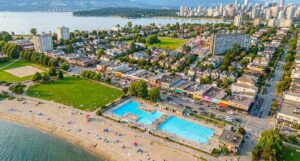
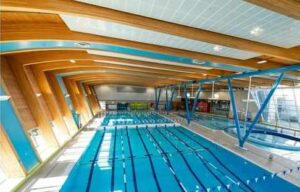
The Vancouver Liberals have committed to a 50-metre pool, rather than accepting a 25-metre replacement for the Vancouver Aquatic Centre. Their platform argues that Vancouver already has among the lowest levels of public swimming-pool provision per capita in Canada.

Why should Vancouver settle for less?

A city of more than 600,000 people should be building recreation infrastructure for the next generation, not shrinking its ambitions to fit yesterday’s budget.

Kareem Allam’s agenda also envisions additional neighbourhood pools and water facilities, including a long-overdue community pool in Mount Pleasant.

This is what a “programme for the people” actually looks like.

It looks like children learning to swim.

It looks like seniors exercising.

It looks like families having somewhere affordable to spend an afternoon.

It looks like hockey rinks, libraries, community centres and parks that are maintained, accessible and welcoming.

It looks remarkably like the kind of people-centred municipal agenda that New York Mayor Zohran Mamdani has brought to the international political conversation.

Save the Park Board, Restore the Park Board, Fund the Park Board

The Vancouver Liberals unapologetically defend Vancouver’s elected Park Board.

They argue that Vancouver needs a strong, independent and properly funded Park Board — not its elimination.

That is about more than institutional nostalgia.

The Park Board represents an important democratic principle: Vancouver’s parks belong to Vancouverites.

Restoring stable funding for parks and recreation means acknowledging that these services are not luxuries.

They are municipal necessities.

And the $1.35-billion Vancouver Liberals commitment would give the city an opportunity to address the accumulated infrastructure deficit while creating better parks, pools, community centres and recreational opportunities across all 23 neighbourhoods.

Finish What Vancouver Civic Governments Have Already Promised

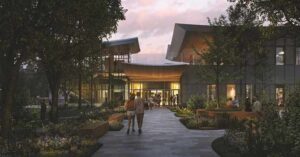
A re-imagined Marpole Community Centre approved in a 2008 Capital Expenditure referendum. Not complete more than 18 years later. Only the Vancouver Liberals will complete the project.

There is another essential principle here: if government makes a commitment to a neighbourhood, government should keep it.

The long-planned renewal of the Marpole Community Centre is finally under construction, with completion expected early to mid 2027. The project will provide a renewed centre, childcare, a field house and new outdoor amenities.

But Vancouver’s broader history is filled with promises that have taken far too long to become reality.

A Vancouver Liberals administration would adopt a rule:

No more indefinite delays.

Where projects have been approved, promised or negotiated — as they were when voters went to the polls to approve the proposed Capital Expenditure budget, in 2008, 2011, 2014, 2018 and 2022 — residents deserve a clear timetable, transparent financing and a government prepared to get the work done.

That includes ensuring that the community amenities associated with major developments actually materialize.

At Oakridge Park, QuadReal and Westbank are responsible for a major redevelopment that includes a community centre, library, performance area and childcare.

At River District, Wesgroup’s long-term plan includes a community centre as an important public amenity.

A government led by Kareem Allam would insist developers honour those commitments.

That is not anti-development.

It is pro-community development.

Food Security is Affordability, and Necessary in the City of Vancouver

Perhaps one of the most innovative elements of the Vancouver Liberals agenda is the proposed Food Hub Programme.

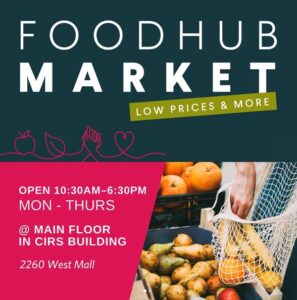
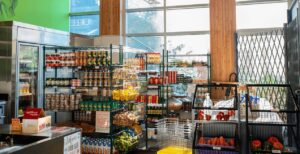
As VanRamblings has previously reported, Kareem Allam’s food-security vision draws inspiration from the University of British Columbia’s Community Food Hub, where the Food Hub Market operates as a not-for-profit community space offering affordable groceries and culturally diverse foods.

The concept is deceptively simple.

Use public resources and partnerships to make nutritious food more affordable.

Create neighbourhood-based food hubs.

Connect residents with community organizations.

Make food security part of a civic affordability policy rather than treating hunger exclusively as a charitable problem.

That matters because food insecurity is not confined to people without jobs.

It increasingly affects working families, students, seniors and people whose incomes simply cannot keep pace with Vancouver’s extraordinary cost of living.

Food security is affordability.

And affordability is the defining municipal issue of 2026.

A Vancouver Liberal Commitment: Taxes People Can Actually Afford 

Kareem Allam has committed to limiting annual property-tax increases 3.8%, or less, per year.

That is an important commitment because Vancouver citizens deserve predictability.

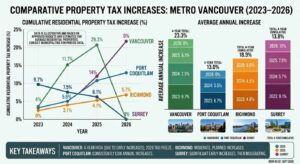
Under Ken Sim’s ABC Vancouver, the Vancouver Liberals point out, property taxes have risen by 23.3%. Kareem Allam has argued that the city’s budget grew from approximately $1.7 billion when Sim inherited it to approximately $2.4 billion, without a corresponding improvement in frontline services.

The question Vancouver voters should be asking is simple:

If taxes keep rising, where is the improvement in our daily lives?

Kareem Allam’s answer is to redirect spending toward frontline workers and core services.

Four hundred new frontline employees.

Better garbage collection.

Better road maintenance.

Better parks.

Better recreation facilities.

Better basic services.

No property taxes levied on medical centres.

Fewer managers and more people doing the work Vancouverites pay City Hall to do.

That is not austerity.

It is prioritization.

A City Hall That Isn’t Afraid of But Actually Welcomes the Public

A progressive government must also be a transparent government.

The Vancouver Liberals have proposed cheaper public access to government records, a stronger Integrity Commissioner and greater accountability at City Hall.

That should include reducing or eliminating Freedom of Information fees for journalists and members of the public wherever possible.

Government records belong to the public.

Journalists should not have to fight City Hall to discover what City Hall is doing.

And citizens should not have to pay excessive fees to learn how their own government spends their money.

Transparency isn’t an administrative courtesy.

It is democracy.

Even The Rats Living in Our Neighbourhoods Are Telling us Something

And then there is the rat problem.

Yes, the rat problem.

The Vancouver Liberals have made tackling Vancouver’s growing rodent infestation a public-health priority, proposing a blue-ribbon panel of experts to develop a comprehensive strategy.

It might sound almost comical.

It isn’t.

A city that cannot keep its streets, parks and public spaces clean and safe cannot call itself well governed.

The rat problem is about sanitation, waste management, infrastructure, construction practices and public health.

Sometimes the most progressive thing government can do is simply do the basics properly.

The Remarkable Coalition Allam’s Vancouver Liberals Have Built

Perhaps the strongest argument for Kareem Allam is not simply his platform.

It is the coalition he has built.

The Vancouver Liberals are attempting something Vancouver civic politics has rarely seen: bringing together people from dramatically different political traditions around a shared municipal agenda.

Their candidates include people with labour and NDP backgrounds, progressive activists, businesspeople, academics, former BC Liberals and former Conservatives.

Jessica Walton, for example, brings years of feminist, environmental, labour and political activism to the campaign, along with experience as a BCGEU shop steward and frontline government worker.

John Coupar brings 11 years of Park Board experience and a long record of advocacy for Vancouver’s parks and cultural institutions.

And the coalition continues to expand.

On August 27, former BC NDP cabinet minister Michelle Mungall and former BC NDP executive member Arminder Randhawa were announced as honorary co-chairs of the campaign. Ms. Mungall served as B.C.’s Minister of Energy, Mines and Petroleum Resources under John Horgan, while Ms. Randhawa has extensive experience in municipal politics and advocacy concerning intimate-partner violence, policing and women’s and children’s safety.

Their presence says something important.

This isn’t simply another ideological faction fighting another ideological faction.

It is an attempt to build a unity government for Vancouver.

As Ms. Mungall put it, she was impressed by Kareem Allam’s emphasis on frontline workers and by the work ethic of the candidates.

Ms. Randhawa described Mr. Allam as a pragmatic leader who brings people together.

And that may be precisely what Vancouver needs.

A Municipal Government of Civic Reconciliation and Unity

Vancouver is an extraordinarily diverse city.

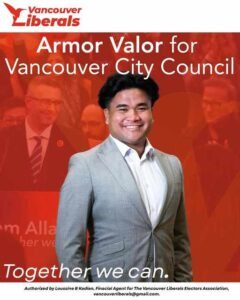
Vancouver Liberal Armor Valor of Filipino descent running for a seat on City Council

The 2021 Census counted 38,605 Filipino residents in the City of Vancouver alone, while Filipino Canadians represented the third-largest racialized group in the Vancouver census metropolitan area.

That diversity deserves political representation.

But reconciliation also means something larger than ethnicity.

It means reconciling competing political traditions.

Labour and business.

Progressives and conservatives.

Social democrats and Liberals.

Immigrants and people whose families have lived here for generations.

Young people and seniors.

Renters and homeowners.

Downtown residents and suburban neighbourhoods.

People who disagree profoundly about politics but agree that Vancouver should be affordable, safe, clean, vibrant and welcoming.

That is the Vancouver Liberals experiment.

And it is a worthwhile experiment.

Why Kareem Allam Needs a Majority at Vancouver City Hall

But there is a final point Vancouver voters need to understand.

Electing Kareem Allam as Mayor will not be enough.

If Vancouver wants the programme described above — the pools, community centres, parks, food hubs, frontline workers, public-space investments, tax discipline, transparency reforms and neighbourhood improvements — Kareem Allam needs Councillors and Park Board Commissioners who share that agenda.

A Mayor Kareem Allam cannot govern alone.

A Mayor Kareem Allam needs a Council capable of passing budgets.

A Mayor Kareem Allam needs Park Board Commissioners committed to rebuilding Vancouver’s recreation system.

A Mayor Kareem Allam needs School Board trustees who understand the needs of families and children.

And a Mayor Kareem Allam needs a political team capable of turning campaign promises into municipal policy.

That is why Vancouver needs to elect a majority Vancouver Liberal civic administration on October 17.

This is not about giving Kareem Allam a blank cheque.

Quite the opposite.

It is about giving Vancouver voters the opportunity to hold an entire governing team accountable for a coherent programme.

For too long, Vancouver has been governed through fragmented politics, institutional conflict and competing agendas.

Kareem Allam is offering something different.

A plan.

A team.

A coalition.

And, most importantly, a willingness to govern.

Vancouver’s Choice: Vote Kareem Allam and the Vancouver Liberals

The choice facing Vancouver on October 17 could hardly be clearer.

One path leads back to four more years of the politics and priorities of the past four years.

The other asks Vancouver to try something fundamentally different.

A city where parks are treated as public assets rather than revenue opportunities.

A city where libraries are strengthened rather than diminished.

A city where community centres are repaired before they become catastrophes.

A city where children have swimming pools.

A city where seniors have affordable recreation.

A city where families can buy groceries without being pushed to the edge.

A city where property taxes are predictable.

A city where developers are required to deliver the amenities they promised.

A city where City Hall welcomes scrutiny rather than resists it.

A city where public safety means police, yes — but also clean streets, functioning neighbourhoods, recreation, mental-health services, public spaces and communities in which people actually know one another.

A city where government works for the people who live here.

That is why Kareem Allam represents something larger than another Mayoral candidacy.

Kareem Allam represents the possibility of a progressive, pragmatic, people-first government that breaks with the politics of the past half-century.

The Vancouver Liberals are not perfect. No political party is.

But in 2026, they have something increasingly rare in municipal politics:

An Action Plan That Will Transform Vancouver Into a Livable City

And on October 17, Vancouver voters have an opportunity to put that plan into action.

If Vancouver wants the change we so desperately need, we cannot settle for changing the Mayor while leaving the political machinery of City Hall essentially unchanged.

Vancouver needs a government capable of delivering.

We need a government willing to invest in people.

We need a government willing to listen.

We need a government willing to cross partisan boundaries rather than deepen them.

We need a government that believes public spaces belong to the public.

We need a government that understands that affordability is not a slogan but something measured in grocery bills, parking fees, property taxes, recreation fees and whether a family can afford to stay in the city it calls home.

And above all, Vancouver needs a Mayor who understands that government exists to serve the public — not the other way around.

That Mayor of Vancouver, in 2026, should and must be Kareem Allam.

And the government he needs with him is a majority Vancouver Liberal administration.

October 17 is Vancouver’s opportunity to choose a different future.

Vote for Kareem Allam.

Vote Vancouver Liberal. And give Vancouver the government we have all been waiting for.
#VanPoli | Mayoral Candidate Kareem Allam To Address Food Insecurity

Each month, the Greater Vancouver Food Bank supports 15,000 families directly and another 20,000+ families through 119 community partner agencies (shelters / transition houses) in Vancouver, Burnaby, New Westminster, and the North Shore.

Separate organizations handle outer cities, such as the Friends in Need Food Bank serving Maple Ridge and Pitt Meadows, and local groups covering Surrey, Langley, and Richmond independently.

Food Banks BC reported that over 113,000 unique individuals utilize food banks across British Columbia in a single month, marking a sharp 44% surge compared to pre-pandemic levels.

  • Children: Make up roughly 25% to 31% of direct food bank clients in the region;
  • Seniors: Account for about 16% to 17% of individuals seeking food assistance;
  • Employment: Up to 30% of urban food bank clients in Vancouver report being currently employed, struggling with high housing and living costs.

Should they win power on October 17th, the Vancouver Liberals have committed to implementing a food security programme in the City of Vancouver.
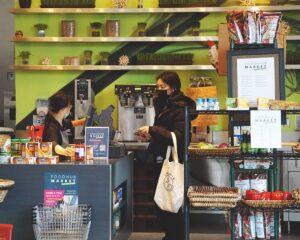
This programme would address the issue of food insecurity for the thousands of families in need across Vancouver who make regular use of the Greater Vancouver Food Bank, a programme not unlike the food security programme currently being implemented by New York Mayor Zohran Mamdani, and the University of British Columbia’s Community Food Hub Programme.
That is what today’s VanRamblings column is all about. Good on the Vancouver Liberals for addressing a critical need for so many families across our city.

Vancouver Liberals’ Mayoral candidate Kareem Allam sits down with Will Lich, founder of UBC’s Community Food Hub, to discuss food insecurity, and what might be done to address the issue

Vancouver Liberals’ candidate for Mayor, Kareem Allam, has developed a full-fledged plan to address food insecurity in the City of Vancouver.

Development of the Vancouver Liberals’ Food Insecurity Relief Plan would include implementation of a Community Food Hub with, over time, more than one such Food Hub Market to be located in neighbourhoods throughout Vancouver.

The development of Food Hub Markets across the city is but one facet, or feature, of the Vancouver Liberals’ Food Insecurity Relief Plan, about which VanRamblings will write at greater and in-depth length on another day.

At the University of British, the Community Food Hub is a campus-wide initiative designed to tackle student food insecurity through affordable groceries, educational workshops, and community-building.

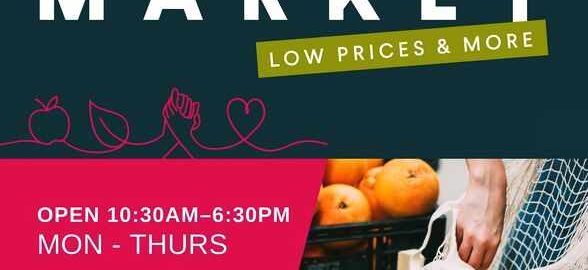
The primary feature of the Community Food Hub is the UBC Food Hub Market, which operates out of the Centre for Interactive Research on Sustainability building, located on the UBC campus.

The programme offers several key resources and initiatives:

  • The Food Hub Market: A low-cost, at-cost grocery store for the campus community;
  • Workshops & Outreach: Educational sessions on food literacy, nutrition, and hands-on food skills.;
  • Food Prescription Programme: A pilot programme running at the Gateway Health Building allowing healthcare providers to screen for food insecurity and prescribe personalized food support.;
  • The Acadia Food Hub: Located in the Acadia Park Residence, this location offers food and baby supply distribution for families on campus.

The Food Hub Market is a not-for-profit community space offering affordable grocery essentials while fostering community social connection.

The Market is dedicated to improving access to affordable and culturally diverse grocery staples that support food security and meet the everyday needs of those who make use of the facility within a welcoming and inclusive environment.

The Community Food Hub also provides hands-on food skills workshops, community events and educational outreach on food literacy and nutrition. These programmes promote food literacy and food skills, helping the community navigate available food security resources, and strengthen community connections.

The Vancouver Liberals’ Food Security Programme is woven into the party’s broader agenda on affordability, economic opportunity, neighbourhood services, and community well-being.

Food Security Through Affordability

In part, the Vancouver Liberals approach to the issue of food insecurity emerges as a consequence of the rising cost of living. Throughout the Vancouver Liberals’ platform, Vancouvers’s newest civic party argues that Vancouver City Hall must focus on restoring affordability so families have more disposable income available for necessities such as groceries.

Kareem Allam has repeatedly framed the Vancouver Liberals’ broader objective as creating “a city where young people are able to stay and raise a family,” arguing that municipal government should measure every policy against that standard.

Within that framework, food security becomes one key element of overall household affordability. If housing costs, transportation costs, and municipal taxes consume less of a family’s income, residents will be better able to afford nutritious food.

The Principal Tenets of the Vancouver Liberals Platform

  • 1. Lower the cost pressures on households 

    The Vancouver Liberals argue that controlling property tax increases and improving fiscal management will leave residents with more money available for everyday expenses, including groceries. They contend that City Hall should concentrate on efficient delivery of core services rather than expensive capital projects that do not directly improve residents’ quality of life;
  • 2. Build an economy that supports working families 

    Kareem Allam frequently links food affordability with employment. His speeches emphasize attracting better-paying jobs and ensuring young people can remain in Vancouver rather than being forced to leave because of living costs. In the party’s view, food security is strengthened when residents have stable employment and rising incomes;
  • 3. Strengthen neighbourhood infrastructure 

    The party proposes significant investment in community centres, parks, libraries, and other neighbourhood facilities. While these proposals are not described specifically as food security initiatives, such facilities often serve as locations for community kitchens, seniors’ meal programmes, food distribution initiatives, and neighbourhood support services;
  • 4. Improve frontline municipal services 

    The Vancouver Liberals propose hiring 400 additional frontline unionized employees to improve municipal services. Their argument is a better-functioning city creates healthier neighbourhoods and stronger communities capable of supporting vulnerable residents.

Vancouver Liberals’ Mayoral Candidate Kareem Allam’s Perspective

Kareem Allam consistently argues that municipal government should concern itself with whether ordinary families can successfully build their lives in Vancouver.

Kareem’s public messaging repeatedly returns to several themes:

  • Vancouver must once again become affordable for young families;
  • Municipal spending should prioritize essential public services;
  • Economic growth is necessary to sustain strong social programmes;
  • Public investment should focus on practical improvements rather than prestige projects.

Vancouver Liberals’ Council Candidate Jessica Walton’s Contribution

Jessica Walton brings perhaps the strongest personal connection to food affordability within the Vancouver Liberals.

Her candidate biography highlights several experiences directly related to food insecurity and rising living costs:

  • Working retail jobs from the age of 15 while helping support a family member living in poverty;
  • Experience in restaurants and service-sector employment;
  • Advocacy for a fair and livable wage;
  • Concern that rising food costs are forcing students and young people to leave British Columbia;
  • Frontline government work connecting residents with public services.

Jessica’s biography specifically identifies “rising food costs” as one of the major pressures facing younger generations. Rather than presenting food insecurity solely as a charitable issue, Jessica Walton frames it as part of a broader affordability crisis affecting students, workers, and young families.

Ms. Walton also emphasizes accessibility, inclusion, and ensuring government programmes are understandable and reachable by those who need them most. Her experience helping residents navigate government services informs her belief that municipal programmes should be practical and accessible.

Relationship With Existing City Policy

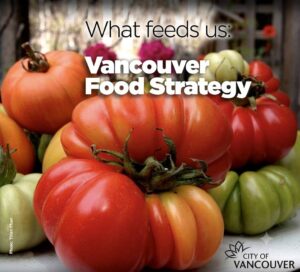
The Vancouver Liberals’ emerging approach differs from the City of Vancouver’s long-established food policy framework. Vancouver already operates a comprehensive food strategy supporting community food networks, urban agriculture, food access programs, and local food system planning.

The Vancouver Liberals have not proposed eliminating these initiatives.

Instead, their emphasis has been on improving affordability, strengthening neighbourhood infrastructure, and restoring confidence in municipal governance.

As the October 17th Vancouver Municipal Election Approaches

Kareem Allam presents food security as inseparable from creating a city where working families can afford to remain and prosper. Vancouver Liberals’ candidate for Vancouver City Council Jessica Walton reinforces that message from personal experience, speaking about poverty, rising grocery costs, fair wages, and the barriers confronting students and young families.

The Vancouver Liberals are dedicated to publishing  a definitive food security platform in the lead up to this autumn’s civic election campaign that will expand on the provision of specific municipal initiatives and measurable policy commitments.