Tag Archives: onecity vancouver

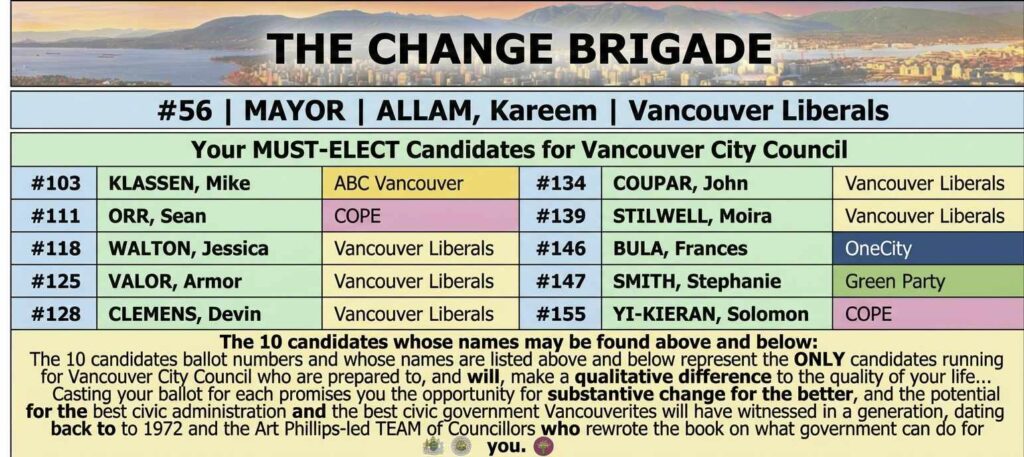
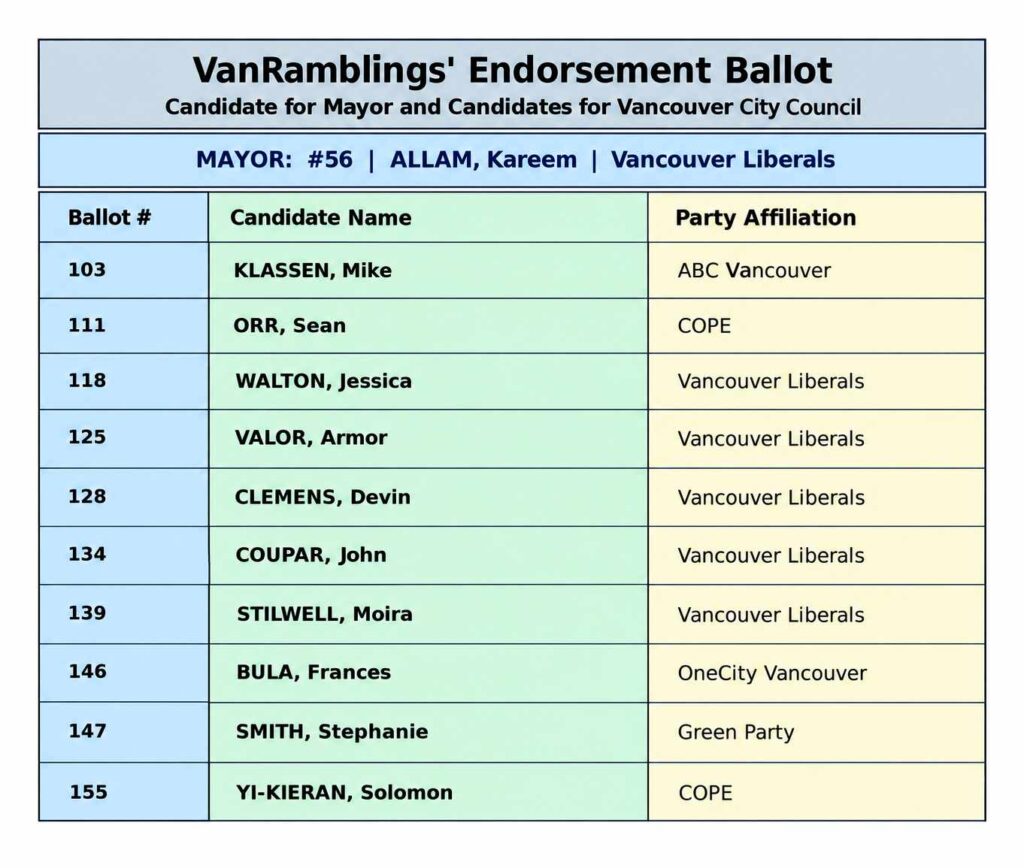
#VanPoli | Vote for The MUST-ELECT Change Brigade At the 2026 Polls

Kareem Allam as the Vancouver Liberals Mayoral candidate, and the 10 Vancouver City Council candidates whose names appear above represent Vancouver’s only hope for better; for an action-oriented government that will relieve your tax burden; build our city’s parks and recreation system; downsize the “managers managing managers” bloated bureaucracy at Vancouver City Hall; establish a blue ribbon panel to address the pestilence of the rat problem that bedevils our city, that is of so much concerns to residents in every neighbourhood across Vancouver; address street disorder and an out-of-control drug problem on the DTES in a humane, yet efficient and effective manner; spend money on our sidewalks that makes life difficult for seniors and persons with disabilities to traverse, and so very much more that is on the agenda of THE CHANGE BRIGADE asking for your vote.

Thinking of voting for Pete Fry for Mayor? Expect the same old, same old do nothing government that has defined every Vancouver civic administration this century. Rebecca Bligh. Same thing. Won’t achieve any more than a high single digit come Election Day. Colleen Hardwick. Puh-leeze. In a word, nightmare. Ken Sim. Undeserved second term.

You know what the difference is between Kareem Allam, and the 10 Councillors endorsed by VanRamblings? Every other person running for Council — although they might believe what they’re saying — are driven by ego, and what’s good for them, and not us.

The members of The Change Brigade are the only candidates for Vancouver City Council seeking a Council seat, because they believe in the good, that collectively as members of a Vancouver City Council committed to a civic administration of reconciliation that there is much good to be achieved.

In other words, The Change Brigade is in it for us, not for themselves.

Only the collaborative, achingly brilliant, ready to hit the ground running, man of vision who is a natural leader, Kareem Allam, possesses the wisdom and experience to be the best Mayor of Vancouver since the days of the Art Phillips.

Vancouver’s Government of Municipal Reconciliation Working for You
The 10 candidates whose names are listed above, the Vancouver Liberals’ achingly bright Kareem For Mayor and the 10 Council candidates endorsed by VanRamblings represent the 𝗮𝗴𝗲𝗻𝘁𝘀 𝗼𝗳 𝗰𝗵𝗮𝗻𝗴𝗲 we have waited more than 25 years for, the ‘can do’ Zohran Mamdani crew who mean to make a difference …

• Remove pay stations from parks, beaches and in front of and nearby community centres, pools and hockey rinks, which means that the City of Vancouver will — with The Change Brigade in charge — finally get around to spending some of those billions of dollars that languish in the capital budget, monies that we approved in referendums in 2008, 2011, 2014, 2018 and 2022, election after election as the money just sits in the capital budget unspent, instead of being spent on us; • Broken Promises and Rising FOI Fees, means transparency and accountability is needed at City Hall. Vancouverites are facing rising Freedom of Information fees while trust in City Hall continues to decline;

• Reinstate the Livable Wage Programme at City Hall, that mandates suppliers of goods and services to the City must pay their workers a livable wage (approximately $28 today), that doesn’t cost the city a penny, but helps workers;

• Renew Vancouver’s 24 community centres, most of all, the 11 community centres identified by Vancouver Auditor General Mike Macdonell in his scathing report to Council on the “severe state of disrepair” of 11 of those community centres; • Cancel Ken’s $800m Second City Hall, wherein Ken Sim and ABC want to spend $800 million just to build more office space for managers;
• Build community pools in neighbourhoods across the city, water parks and hockey rinks;

Luxury Yacht Tax (40ft+), to protect essential services without burdening everyday Vancouverites, The Change Brigade will implement a tax on luxury yachts over 40 feet;

• Faster, Cheaper Housing Construction, because Vancouver is the only city in BC with its own building code — an unnecessary extra step for people seeking to build more housing in our city. The Change Brigade, led by Kareem Allam and the Vancouver Liberals — working in concert with COPE’s Sean Orr and Solomon Yi-Kieran, One City’s Frances Bula, and the Greens’ Stephanie Smith — will remove the Vancouver Building Code and align our city with the rest of the province, simplifying the process for housing construction;
• Hold developers feet to the fire, by insisting Wesgroup finally get around to building the community centre they are contracted to build in the River District, or QuadReal to build their contracted Oakridge Park community centre, or Concert Properties, to build a much needed SE False Creek community centre they said they’d build ages ago; Build affordable housing, focusing on democratically run housing co-ops, built on City land, working with Thom Armstrong, Executive Director of both BC’s Co-operative Housing Federation and the Community Land Trust, with child care centres built into the newly-constructed co-ops;
Protect Good Jobs and Industrial Land, because Vancouver needs more good-paying jobs, not policies that put them at risk. Ken Sim’s plan to eliminate the city’s remaining industrial land threatens to push businesses and well-paying jobs out of Vancouver; • A Ward System for Vancouver, because Vancouver’s current at-large voting system makes campaigns expensive and leaves many neighbourhoods without direct representation at City Hall. The Change Brigade support exploring a ward system that would divide the city into local districts, each electing their own dedicated Councillor;
• Ban Bitcoin cryptocurrency ATMs on the DTES and take the fight to the drug dealers, not the street-level drug dealers, but their suppliers; • Work to rid our city of the pestilence of rats, that are of concern to residents in every neighbourhood across our city;
• Address homelessness in a humane and caring manner, consistent with the values of the vast majority of us who call Vancouver home; • The Change Brigade Noise Policy, because we’re tired of noisy hot rods and motorcycles revving up at 3 a.m. in our neighbourhoods. So are the members of The Change Brigade;
• Downsize a bloated middle management bureaucracy, at Vancouver City Hall, because do we really need 95 people working in Vancouver’s communications department, or employ more middle managers in our development services and planning departments than on the ground CUPE workers — like plan checkers — who do the real work?; • Reduce Taxes on Medical Clinics, because The Change Brigade means to cut property taxes in half for family doctors and walk-in clinics in the City of Vancouver;
• Build UBC-style Food Hubs across our city, to address food insecurity;

Build More Public Bathrooms, because Vancouver’s chronic lack of public washrooms not only fails to provide basic facilities to residents but could cause even bigger public health problems;

• Build Supportive Housing for Seniors & Veterans, because supportive housing is a lifeline for seniors, veterans, and those with disabilities. On Day One, The Change Brigade will reverse Ken Sim’s cruel ban on supportive housing and ensure that our most-vulnerable citizens receive the supports that they need;
• Restore strong fiscal management, at City Hall; • Stop the Sale of Vancouver Parks, because Ken Sim and ABC’s Councillors who tried to eliminate the Park Board, Sim who is all about putting Vancouver’s parks up for sale. The Change Brigade strongly supports our elected Park Board, a democratic institution that protects our parks from being chopped up and sold off;
• Develop a methamphetamine strategy — the leading cause of violent incidents that puts people at risk — just like Premier Wab Kinew has done in Manitoba (a plan that is working!); • Establish an Industrial Land Reserve, because keeping jobs in the city and surrounding them with affordable housing so that people can build their careers and keep their families in our city;
• Protect local businesses during transit expansion, by reducing property taxes by 50% for the duration of construction;

Build more public washrooms, including within our parks (I mean, when the kids have gotta pee, they’ve gotta pee);

• Support taxation on land value, by capturing the land-owner windfalls caused by proximity to public amenities, speculation, and zoning;
• Reinstate library funding and hours, cut by a heartless and cruel Ken Sim administration that have so weakened these vital public spaces and community services; • Bring back the Renters Office, with teeth this time to give tenants an advocate who is empowered to fight for them;
• Better Front-Line Services, which means across the board, city services are failing: more potholes, missed garbage pickups, dirty streets, and so much more. • Identify why progress towards city goals of affordability, families, renters, and climate has stalled or reversed under Ken Sim, and get back on course;
• Fight for campaign finance reform, to close the loopholes the wealthy can use to, effectively, buy politicians and elections; • Fight for a fast and free public transit system in Vancouver, and take steps on that path immediately;
• Bring in a municipal lobbying registry, because the public deserves to know how and when the wealthy are influencing decisions made by the city government; • Half of bus stops in Vancouver have no bus shelters or benches, so work toward changing that circumstance.
• Expand VanWifi across the city, to allow for more free and open internet access, prioritizing currently under-served areas; • Train and hire lifeguards and swim instructors, because we need to keep pools open and staffed, stop line-ups, offer swimming lessons to meet demand, and keep people safe at Vancouver’s beaches.

#VanPoli | Vancouver Needs a Ward System: Democracy Begins Where People Live

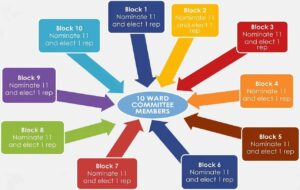
Vancouver Liberals Mayoral candidate Kareem Allam’s proposal to place a plebiscite before voters in the 2030 Vancouver municipal election asking voters / Vancouver residents — should he become Mayor on October 17 2026 — whether they would like to see the adoption of a “ward” system / that is, elect a Councillor to represent their neighbourhood or geographic area, rather than electing 10 City Councillors at-large, deserves more than a passing mention in the 2026 Vancouver municipal campaign.

This issue goes to the heart of what democracy at the municipal level is supposed to accomplish: Is a Councillor primarily accountable to an entire city, or should there be a Councillor whose first responsibility is to the people and neighbourhoods of a particular part of that city?


Kareem Allam, the Vancouver Liberals’ Mayoral candidate, has proposed establishing a Citizens’ Assembly to examine the adoption of a ward system in Vancouver.

The assembly would make recommendations and develop the question that could go before voters in 2030, with a ward system potentially taking effect for the 2034 civic election. The Vancouver Liberals say the present at-large system makes campaigns expensive and can leave neighbourhoods without direct representation.

Wards / geographic neighbourhood representation is an idea whose time has come.

Vancouver Needs a Ward System: Democracy Begins Where People Live

Vancouver is an extraordinary city, but electing City Councillors at-large is an anachronism.

Today, Vancouverites elect the Mayor and 10 Councillors at-large.

Every voter can vote for every Councillor, and every Councillor is theoretically responsible for every resident of the city.

On paper, that sounds wonderfully democratic.

In practice, it can mean the opposite.

When everyone represents everyone, no one necessarily represents you.

That is the fundamental weakness of Vancouver’s at-large electoral system.

Imagine a resident in Killarney confronting a serious neighbourhood issue: a proposed development, traffic problems, inadequate pedestrian infrastructure, a community facility under threat or a local planning decision. Under the current system, that resident has 10 Councillors to whom she or he can appeal — and, paradoxically, no single Councillor whose political job is to be that neighbourhood’s representative.

Under a ward system, there would be one.

That distinction matters.

A Councillor Who Knows, Lives In and Cares About Your Neighbourhood

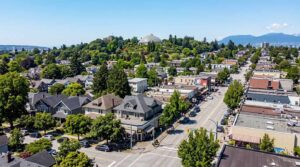
In the heart of the city, Vancouver’s Mount Pleasant neighbourhood, looking north towards the mountains

Consider what happens in federal and provincial politics.

If you have a problem with a federal matter, you know who your Member of Parliament is.

If you have a provincial concern, you know who your MLA is.

You may not agree with that person politically. You may never have voted for them. But you know that person is your representative.

There is a geographical relationship between citizen and elected official.

Municipal government should work the same way.

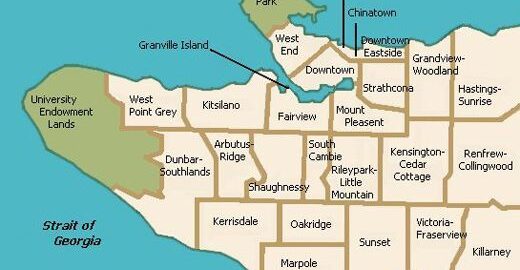
A Councillor representing, for example, a ward encompassing Hastings-Sunrise and Renfrew-Collingwood would have an obvious political responsibility to understand those communities: their transportation problems, housing pressures, parks, schools, businesses, community centres, development proposals and neighbourhood concerns.

That Councillor could hold regular constituency meetings, maintain an office, attend community-association meetings and become known to the people who live there.

Most importantly, residents would know exactly who to call.

That is accountability.

Vancouver is The Outlier: Every Other Major City in Canada Has Wards

Located in the NE part of Vancouver, the Killarney neighbourhood where ABC Councillor Mike Klassen grew up

The argument for a ward system is strengthened by looking beyond Vancouver.

Toronto elects 25 ward Councillors, with the Mayor elected city-wide.

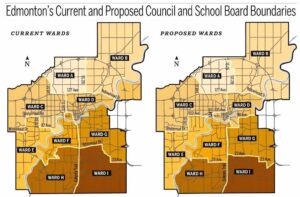
Edmonton has 12 wards and one Councillor per ward. Winnipeg has 15 wards, again with one Councillor representing each. Ottawa has 24 wards, with one Councillor elected from each and the Mayor elected at-large.

These are not small communities experimenting with an untested democratic theory. They are some of Canada’s largest municipalities.

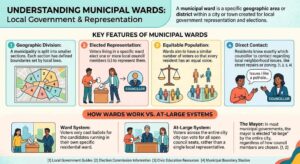
And the principle is straightforward: the Mayor represents the entire city; Councillors represent both their communities and the city as a whole.

That is precisely the model Vancouver should consider.

It is worth correcting one point, however. It would be inaccurate to say that British Columbia is literally the only Canadian province in which large municipalities lack ward systems. Canadian provincial legislation permits different electoral arrangements, and some municipalities outside B.C. also use at-large or hybrid systems.

But Vancouver is unquestionably unusual among Canada’s major cities in continuing to elect its entire Council at-large.

And there is no compelling reason why Vancouver should remain an exception.

The At-large Election System Favours The City-Wide Political Machine

The almost always sunny Vancouver Point Grey neighbourhood, located in the western part of the city

There is another argument for wards that should not be ignored: money.

Running for one of 10 city-wide Council positions is enormously different from campaigning in a defined geographical constituency.

An at-large candidate must communicate with hundreds of thousands of voters across Vancouver. That requires money, organization, name recognition, volunteers and often the support of a political party or electoral slate.

A ward campaign would be different.

A candidate could concentrate on 50,000 or 60,000 residents rather than the entire city.

That opens the door to people who do not have the financial resources, political connections or city-wide name recognition required to mount an effective at-large campaign.

It could make civic politics more accessible to community activists, small-business owners, renters, neighbourhood advocates, younger candidates and people who have spent years working in their communities but have never contemplated a city-wide campaign.

In that respect, wards could actually democratize Vancouver politics.

Every Vancouver Councillor Must Have a Neighbourhood Constituency

Vancouver’s east side Grandview-Woodland neighbourhood, home to a thriving retail Commercial Drive

Critics of ward systems argue that Councillors should think about the entire city.

Of course they should.

A ward Councillor would still vote on the city budget, transportation policy, housing, policing, parks, taxation, climate policy and every other issue before Council.

But representing a ward does not mean abandoning the city.

It means bringing a particular community’s perspective into the debate.

Indeed, a Council composed of geographically accountable representatives could arguably produce better city-wide decisions, because Councillors would arrive at the table with a deeper understanding of the communities affected by those decisions.

Vancouver is not one homogeneous city.

The concerns of Downtown are not identical to those of Kerrisdale.

Killarney is not Kitsilano.

Marpole is not Mount Pleasant.

Renfrew-Collingwood is not the West End.

That diversity should be reflected in the composition of City Council.

Elect a Mayor At-Large + 10 Councillors Representing Wards Makes Sense

Osler Street in the Shaughnessy neighbourhood, Vancouver’s richest and most well-heeled neighbourhood

Kareem Allam has not proposed simply drawing 10 arbitrary lines across Vancouver. His proposal is to establish a Citizens’ Assembly that would examine the question and make recommendations.

That is precisely the right approach.

The neighbourhood groupings suggested for discussion provide a starting point:

  • Hastings-Sunrise / Renfrew-Collingwood
  • Grandview-Woodland / Kensington-Cedar Cottage
  • Riley Park / Mount Pleasant
  • Chinatown / Strathcona / Downtown / West End
  • Fairview / Kitsilano
  • Point Grey / Dunbar-Southlands
  • Arbutus Ridge / Shaughnessy
  • South Cambie / Oakridge
  • Kerrisdale / Marpole
  • Sunset / Victoria-Fraserview / Killarney

These should not be treated as predetermined boundaries. Population equality, communities of interest, natural boundaries, transportation patterns, neighbourhood identities and future population growth would all have to be considered.

Toronto’s ward-boundary process, for example, explicitly considered population equality, communities of interest, neighbourhoods, history and physical or natural features.

That is precisely the kind of independent, evidence-based process Vancouver needs.

Creating a Citizens’ Assembly is Critical to Adopting a Ward System

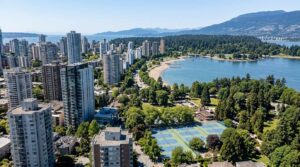
Vancouver’s West End neighbourhood, incorporating towers, tennis courts, English Bay and Stanley Park

The beauty of Kareem Allam’s proposal is that he is not saying: Elect me and I will impose 10 wards.

He is saying: let Vancouverites study the question first.

That distinction matters.

A Citizens’ Assembly could hear from constitutional and municipal-government experts, community associations, Indigenous representatives, political scientists, former Councillors, election administrators and ordinary residents.

It could examine ward sizes, boundaries, the number of Councillors, campaign financing, representation of renters and homeowners, population growth and whether a hybrid system might work better than a pure ward system.

Then, in 2030, Vancouverites could decide.

That gives the proposal democratic legitimacy.

Electing  Vancouver’s Mayor Through The At-Large System Should Remain

Vancouver’s welcoming, family friendly east side Riley Park neighbourhood, bounded by 16th Avenue to the north, 41st Avenue to the south, Cambie Street to the west, and Fraser Street to the east

There is a strong argument for retaining a city-wide Mayor.

The Mayor is the one elected official whose mandate should encompass the entire city.

The Councillor’s job is different.

The Mayor should speak for Vancouver.

The Councillor should speak for Vancouver, and for their respective neighbourhoods.

That creates a healthy balance between city-wide leadership and local accountability.

It is already the model used in Edmonton and Ottawa, among other cities. Edmonton explicitly describes its system this way: the Mayor is elected by all Edmontonians, while Councillors are elected by voters in their individual wards.

Why shouldn’t Vancouver do the same?

Changing the Vancouver Charter: The Province Can Accommodate Wards

Vancouver’s east side Victoria-Fraserview neighbourhood, current home to ABC Councillor Mike Klassen and the love of his life, Stacey, Mike’s lovely bride, who together celebrated 28 years of marriage in July

There is an important misconception about this debate.

The Vancouver Charter already contemplates Councillors being elected on a neighbourhood-constituency basis.

Section 138 currently provides that Councillors are elected at-large unless Council adopts a by-law establishing neighbourhood constituencies. Such a by-law must receive approval from the Lieutenant Governor in Council before it can take effect.

In other words, the idea of geographically based representation is not foreign to Vancouver’s governing legislation.

The Province ultimately has the authority to approve the change.

The Vancouver Charter is provincial legislation, and the Province describes it as the statute that governs Vancouver’s structure, elections and principal municipal powers.

So, Kareem Allam’s proposal would ultimately require co-operation between Vancouver and Victoria.

That is entirely appropriate.

A Better, More Representative Democracy in Vancouver is Worth Pursuing

Dunbar, one of Vancouver’s oldest west side neighbourhoods, adjacent to the University of British Columbia

There is no electoral system that guarantees perfect representation.

Ward Councillors can become overly parochial. They can favour their own neighbourhood at the expense of the wider city. Boundary-drawing can become contentious. Population changes can make wards unequal unless boundaries are periodically reviewed.

These are arguments for designing a good ward system — not preserving a flawed one.

Toronto has undertaken independent ward reviews specifically because population growth can make some wards substantially larger than others.

Vancouver can learn from Toronto, Ottawa, Edmonton, Winnipeg and other municipalities.

The central question is remarkably simple:

When a Vancouver resident has a problem with City Hall, a citizen should be able to look at a map, identify their Councillor and say, “That’s my representative”?

The Sunset and Marpole neighbourhoods of Vancouver, the Sunset neighbourhood home to Vancouver’s thriving Indo-Canadian population, Marpole bounded by the Fraser River, British Columbia’s longest river, to the south

The answer should be yes.

For too long, Vancouver has treated city-wide elections as synonymous with democracy.

But democracy is not merely the ability to vote for 10 Councillors.

Democracy is also representation, accessibility, accountability and proximity.

A ward system would bring City Hall closer to the people it serves.

It would give neighbourhoods a recognizable voice.

It could lower the barriers to entering municipal politics.

It could make Councillors more accountable to their constituents.

And it could ensure when a resident knocks on the door of City Hall, there is a Councillor whose political responsibility begins with the community where s/he lives.

Kareem Allam is right to put the question on the table.

The final decision should not belong to Kareem Allam, COPE, OneCity, ABC, TEAM, Vote Vancouver, the Greens, the Vancouver Liberals or any other political organization.

The decision on whether to adopt a ward system must belong to Vancouver’s citizens.

Let the Citizens’ Assembly do its work. Let the experts and residents debate the alternatives. Draw fair and transparent boundaries. And then let Vancouverites vote.

If, in 2030, the people of Vancouver decide that they want Councillors who actually represent where they live, then the 2034 election should mark the beginning of a new era in Vancouver democracy.

The city should elect its Mayor at-large. But those of us who live in one of Vancouver’s 23 neighbourhoods deserve Councillors of our own to represent our voices at City Hall.

#VanPoli | Lakewood Terrace Housing Co-op 2026 Mayoral Debate
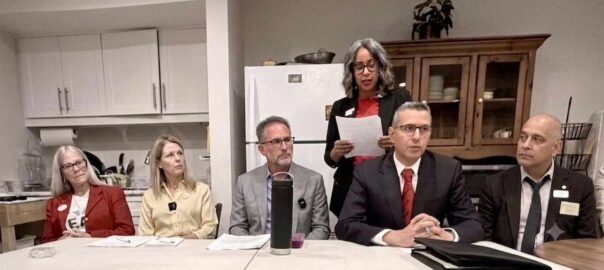
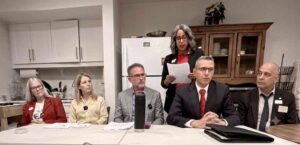
L-R, 2026 Vancouver Mayoral candidates: Colleen Hardwick, TEAM for a Livable Vancouver; Rebecca Bligh, Vote Vancouver; William Azaroff, OneCity Vancouver; Stephanie Allen (standing), The Coalition of Vancouver Electors (COPE); Kareem Allam, Vancouver Liberals; Pete Fry, Green Party of Vancouver.

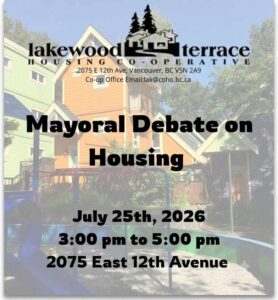
On Saturday, July 25th, Lakewood Terrace Housing Co-op held a Mayoral Debate.

The main issue before those gathered in the Co-op’s Common Room: housing.

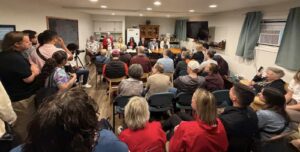
An overflow crowd of Vancouverites attended the July 25 Mayoral debate at Lakewood Co-op

The first speaker of the afternoon was Colleen Hardwick, representing TEAM for a Livable Vancouver, under whose banner she was unanimously endorsed as the party’s standard bearer.


Colleen Hardwick, TEAM for a Livable Vancouver

As per usual, Ms. Hardwick was heartbreakingly articulate in her presentation, with a solid command of the housing issue — a critical tenet of TEAM’s platform document and, in reality, the raison d’être of the civic party — as Ms. Hardwick argued housing co-ops represent the best answer to the provision of affordable housing in Vancouver, and across the vast land we call Canada.

Sadly, as articulate as Ms. Hardwick is on a myriad of civic issues, as we have written previously, she is an imperfect messenger for TEAM’s various policy proposals. There is about Ms. Hardwick a meanness of character, a distinct lack of joy, or as a friend said recently “an offputting sharpness that would make it difficult, if not impossible for me to cast my ballot for her as our city’s next Mayor.”

Ms. Hardwick comes into the campaign with “baggage” — not the least of the concerns expressed by many her lack of a general appreciation of the “trans issue” — which translates into a utter lack of respect (never mind support) for the too often marginalized members of the trans community, that while a central tenet of the platform of right-of-centre B.C. Conservative Party leader Kerry-Lynne Findlay, hardly seems resonant with the views of the majority population of Vancouverites who will go to the polls this October.

Transphobia. The bane of TEAM for a Livable Vancouver Mayoral candidate Colleen Hardwick’s existence, an issue likely to dog her second Mayoral bid.


Adrienne Smith, transgender human rights activist

The following is a quote by Adrienne Smith, a prominent Vancouver-based transgender human rights activist, social justice lawyer, and litigation director at the Catherine White Holman Wellness Clinic.

“The chair of the City’s own LGBTQ advisory committee was asked in open Council by Councillor Hardwick, after their submission, what their sex assignment was at birth. This is an incredibly invasive, inappropriate question. I’m going to give Councillor. Hardwick the benefit of the doubt that she learned something, but I’m still angry about that specific question.”

“Certainly, she’s had time to familiarize herself with some of the elements of contemporary transphobia and focusing on people’s sex assignment. Asking the Chair of the LGBTQ advisory committee about their surgical status, interrogating whether their gender identity is valid, is a central feature of transphobia.”


Andrea Reimer, former Vancouver City Councillor

Anti-reconciliation acknowledgment commentary by Colleen Hardwick.

Andrea Reimer, who sat on Council from 2008 to 2018 with Vision Vancouver, tweeted that her heart hurts and her head is angry over Councillor Colleen Hardwick’s vote against receiving a City report written by Katelyn Crabtree, the City’s Manager of Indigenous relations, and a specialist in Indigenous law.

“In 9 years of purposeful work in reconciliation, we achieved 100% unanimous votes on every single item brought forward,” Reimer says. “There was a lot of tough work — all of it involved land and money, because that’s what colonialism is all about.”

Councillor Hardwick also voted against City Manager Sadhu Johnston’s recommendation that Council direct staff to include in its Reconciliation Report an analysis of the status of  Vancouver’s reconciliation commitments — as well as recommendations for building on these commitments, as Ms. Hardwick openly questioned whether it is appropriate for the local level of government to “spend taxpayers’ money on reconciliation,” or if the issue  is the responsibility of senior levels of government. Ms. Hardwick also expressed her opposition to Council opening their meetings with a reconciliation acknowledgement, as recommended by Murray Sinclair, the author of the 2015 Truth and Reconciliation Report.

Rebecca Bligh, Vote Vancouver, and William Azaroff, OneCity Vancouver

   
Vote Vancouver’s Rebecca Bligh; and OneCity Vancouver’s Mayoral candidate William Azaroff

We are combining both Vote Vancouver  Mayoral candidate and sitting Vancouver City Councillor Rebecca Bligh, and OneCity Vancouver Mayoral candidate William Azaroff together given their polling numbers, at present, are in the basement, and the likelihood that either Mayoral candidate ascending to the Mayor’s office would seem remote, at best.

Rebecca Bligh. We are befuddled that the two term Vancouver City Councillor — and recent President of the Federation of Canadian Municipalities, which represents the interests of Canadian cities vis-a-vis the federal government — is polling at a mere 0.5%. Wrenchingly articulate on the issue of housing during the course of the debate at the Lakewood Terrace Housing Co-operative Mayoral forum held on the afternoon of Saturday, July 25th, there was no Mayoral candidate addressing those gathered who argued as articulately and well for the construction of housing co-ops on City-owned / Crown land on a 99-year leasehold basis that afternoon than Councillor Bligh.

“To provide safety and truly affordable homes for struggling families who reside across all 23 of the neighbourhoods that comprise the city we all love.”

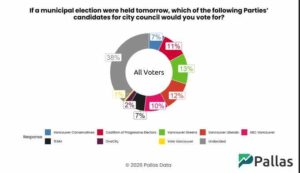
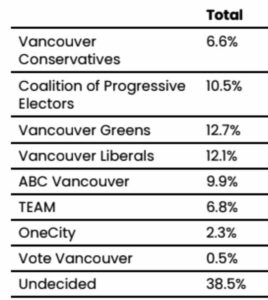
Yet, Councillor Bligh finds herself mired at dead last in support by those polled by the Pallas Data polling company. We’re confused.


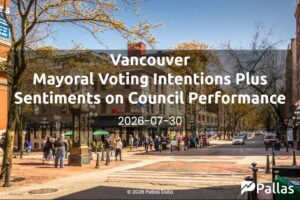
Click on the link for further insight into the Pallas Data civic poll conducted on July 30, 2026

Subsequent to the meeting, as Councillor Pete Fry and VanRamblings were walking towards East Broadway and Commercial Drive, Councillor Fry wondered aloud as to why Councillor Bligh had come forward to seek the Mayor’s Chair, when from all reports she is polling terribly, and the chance that she might be Vancouver’s next Mayor would seem, at best, remote if not an impossibility, the two of us agreeing that in putting her name forward as a Mayoral candidate, Ms. Bligh was simply “bowing out of politics with grace.”

William Azaroff. OneCity Vancouver’s Mayoral candidate, endorsed by the Vancouver & District Labour Council, given his fiscal history working for the Vancity Credit Union, and since 2019, the CEO of Brightside Homes, a non-profit which builds affordable housing, Mr. Azaroff would seem to be a first-rate candidate for Vancouver Mayor. Not so, according to the Pallas Data polling company, and certainly not so if the response he received from those gathered for the forum on that Saturday afternoon is any indication.

Mr. Azaroff was hardly afforded an opportunity to speak, as each time he opened his mouth, he was heckled by one or another member of the audience, who questioned him as to why Brightside Homes so readily evicted their tenants on the thinnest possible evidence, and why Brightside — given so many of the tenants are vulnerable seniors — made it near impossible for residents to install air conditioners to mitigate the effects of Vancouver’s hot weather.

On a side note, if there is one candidate running for Mayor in 2026 that a surfeit of members of COPE, the Coalition of Progressive Electors are vehemently opposed, it would be the poor, woebegone Mr. Azaroff.

Polling at 2.3% — yep, seems just about right.

COPE, the Coalition of Progressive Elector’s Mayoral candidate Stephanie Allen (standing)

Quite simply, Stephanie Allen (standing, addressing the audience) walked away with the debate on that somewhat chilly, overcast Saturday afternoon, by far the most dynamic and engaging speaker of the afternoon, a charismatic presence at the front of the room, and the long sought saviour of COPE — the too often confused Coalition of Progressive Electors  …

A personal aside: Just what the hell is COPE Councillor Sean Orr doing when he floats the idea of bringing back the Villages Plan in the next term of Council … whose side is he on, anyway? … developers, or the community who spoke up so vehemently against the developer-initiated Villages Plan designed to enrich themselves at the expense of those of us who live in one of the 14 Vancouver neighbourhoods designated as “density friendly”, Councillor Orr seemingly ignoring the wishes of the hundreds of folks, the Vancouver residents who turned up to address Council on why the Villages Plan constituted non-consultative, top down, autocratic city planning, that utterly failed to take into consideration the wishes of the residents who have long called these neighbourhoods home, where we raise our families …

We don’t mean to be unduly harsh in our criticism of COPE Councillor Sean Orr, who has stepped up to the plate, put in the hours, making himself available to the public in every neighbourhood across our city after being elected as the top candidate voters cast a ballot for in the April 5, 2025 by-election, securing 34,448 votes, the highest among all the candidates running for Vancouver City Council.

Not to mention, the utter ugliness of the allegation made by Mayor Ken Sim about Councillor Orr, that Mr. Orr had distributed illegal drugs on the DTES over the December 2025 holiday season, an utterly specious and unfounded allegation, given that in reality Councillor Orr was visiting friends and family on the Sunshine Coast when he, according to Mayor Sim, allegedly was distributing drugs. Having spoken with Councillor Orr about the matter, we are quite aware that Sean was emotionally devastated by the allegation made by Mayor Sim, that sought to damage Mr. Orr’s hard earned reputation for integrity.

All said, thank goodness that COPE Mayoral candidate Stephanie Allen is the most knowledgeable Mayoral candidate on the issue of affordable housing, given her past role as the respected Vice President of BC Housing, who brings herself forward as the democratic socialist candidate in the 2026 Vancouver civic election, with a strong a commitment to the democratic participation of Vancouver residents on the issues that dominate their lives, and her long held belief that democratic socialism is the only true cure for the ills that impact the alienated and disenfranchised majority population of Vancouver, who for so long have been locked out of decision-making at Vancouver City Hall, as one autocratic civic administration after another assumed power at City Hall.

Make no mistake, a Stephanie Allen-led City — ably aided by Shawn Vulliez, who we expect would be her outstanding Chief of Staff — is committed to the democratic participation of the residents of Vancouver on the decisions taken at Vancouver City Hall that impact their lives, no autocrat she, but rather a democrat, and a democratic socialist of the first order.


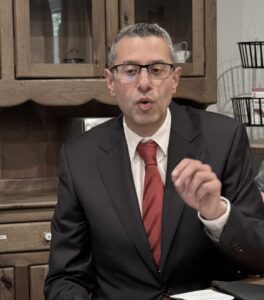
Kareem Allam, Vancouver Liberals Mayoral candidate

Kareem Allam, Vancouver Liberals.

In a word, tepid.

One of the worst presentations by a candidate for office that we’ve witnessed over the course of our lifetime. When members of the audience repeatedly demanded that Mr. Allam “speak up, we can’t hear you,” you know there’s trouble in his candidacy for Mayor that must be addressed before the current Vancouver municipal election truly gets underway next month.

The above said, although to some extent for us “the bloom is off the rose” in respect of Mr. Allam’s Mayoral candidacy, our continuing and heartfelt belief that Kareem Allam would make the best Mayor of Vancouver the residents of our city would experience in a generation, as the only action-oriented candidate for Mayor who has a plan of action for change that will transform civic governance which truly represents the interests of all of us who call Vancouver home, both Kareem Allam and Stephanie Allen have our full-throated support as the two of them fight tooth and nail to become Vancouver’s next Mayor.

Mr. Allam has to recognize he’s the candidate, not a behind-the-scenes campaign manager, who must up his game if he is to become Vancouver Mayor.

At one point in the afternoon, Kareem mentioned — in passing, while addressing those gathered at the Lakewood Terrace Co-op — that he was the only Mayoral candidate who “grew up living in a housing co-operative”, after which he let his statement lie dormant, seemingly without meaning, as he addressed a crowd consisting mostly of housing co-op members !!! … before moving on to discuss his, for this crowd anyway, his utterly irrelevant personal family history, rather than waxing poetic on the salutary role living in a housing co-op afforded him, the sense of community imbued living in a housing co-operative, where opportunity was afforded him that might not otherwise be available to an immigrant family attempting to make a new life for themselves in Metro Vancouver.


Councillor Pete Fry, Green Party of Vancouver

Pete Fry is the status quo candidate, the avuncular and well-regarded opposition to the corrupt ABC Vancouver civic administration that has ruled Vancouver for the past four interminable years, under the unsteady thumb of an often too absent Mayor Ken Sim.

Were Pete to become Mayor — mark my words, we’d soon be referring to him as Mayor Pete — there is little doubt he’d bring back the Renter’s Office, and in time would re-instate the Livable Wage Programme at Vancouver City Hall that the Sim administration jettisoned early in their term of office.

Mayor Pete wouldn’t look to get much done, rather he’d be a caretaker — a sane and caring caretaker, unlike the current incumbent — of the Mayor’s office. An upside? A Mayor Pete would be much more available to the public than any Mayor in Vancouver’s recent history, a kind of Mayoral energizer bunny, who would be everywhere in the public weal throughout the entirety of his term in office.

VanRamblings harbours a concern that Emily Lowan, the current democratic socialist leader of the Green Party of British Columbia — who has endorsed Stephanie Smith for Council, the accomplished and sophisticated ‘woman of the people’ who is running under the Green banner for the second time (we’ll be endorsing Stephanie, whose voice and presence we need on Council) — would not endorse Pete Fry in a month of Sundays.

Maybe that’s what the citizens of Vancouver want: someone they know, someone they trust who won’t upset the apple cart, but dedicate himself to taking care of the basics (garbage pick up, recycling, road  maintenance. etc.) while keeping taxes down.

Although, we’re not so sure.

Research Co. and Angus Reid have recently published polling asking  Vancouver voters what they want. The answer according to 56% of those polled: change, significant and even radical change, not the status quo.

Change is in the air.

Pete Fry, for all that he’s a good guy would not in any way, shape or form be the Mayoral candidate of change for whom a majority of Vancouver voters would seem to wish to cast their ballot as the next leader of our beloved city, come this early autumn October. Or, so it would seem this early in the 2026 campaign for Vancouver municipal office.

On Thursday, VanRamblings’ intends to publish a thoughtful, reflective column on what the three serious-minded candidates to become Vancouver’s next Mayor — that would be COPE’s Stephanie Allen, the Vancouver Liberals’ Kareem Allam, and the Green Party of Vancouver’s Pete Fry — would mean for those of us who live in Vancouver, and call our respective neighbourhoods and our city, home.


#VanPoli | Frances Bula | A Must-Elect Candidate for Vancouver City Council


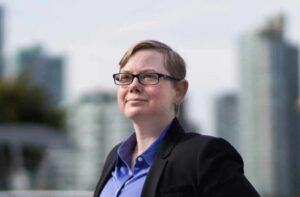
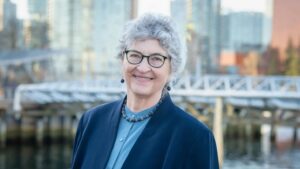
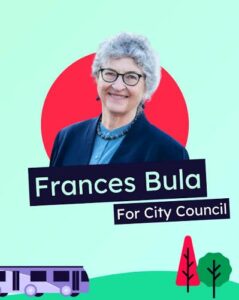
Frances Bula, running as a OneCity Vancouver Council candidate in the 2026 civic election

After a career spent observing Vancouver City Hall from the press gallery, journalist Frances Bula is attempting something entirely different.

In 2026, Ms. Bula is seeking a seat on Vancouver City Council, as a candidate with OneCity Vancouver. As is stated on OneCity’s website, “Frances’s candidacy marks one of the most significant transitions in recent Vancouver civic politics — a reporter who spent years scrutinizing elected officials is now asking voters to entrust her with public office.”

VanRamblings wholeheartedly supports Frances Bula’s candidacy for Vancouver City Council. We believe Frances Bula, who we have long known and respected, to be a must-elect at the polls, in our upcoming October civic election.

As Frances has written — the information also to be found in OneCity Vancouver literature — Ms. Bula’s career in journalism spans more than four decades.

According to her own biography, Frances Bula began her reporting career in southeastern B.C. in 1983, the very day a province-wide general strike began. From those beginnings in community journalism, she gradually developed a lifelong fascination with cities, and the political systems that shape them.

The Journalist Who Helped Interpret Vancouver City Politics

Frances Bula has spent so many years explaining Vancouver to itself that, for many residents, it is difficult to imagine the city’s civic conversation without her.

For more than three decades, Ms. Bula has occupied a unique place in Vancouver public life: part journalist, part historian, part urban anthropologist, and part translator of the often bewildering language of municipal politics.

Frances Bula’s career in journalism spans more than four decades.

The defining chapter of her career began in 1994, when she started covering Vancouver municipal politics and urban affairs.

Over the course of the following years, Ms. Bula became one of the most respected and recognizable civic-affairs reporters in British Columbia. At the Vancouver Sun, where she spent approximately two decades as a staff reporter, she covered City Hall, education, housing, transportation, homelessness, development, infrastructure, drug policy, and nearly every other issue that defines urban life.

One pivotal moment in Frances Bula’s life came in 1998-99 when she received the prestigious Atkinson Fellowship in Public Policy, after which she spent a year studying housing and homelessness issues, producing a major series and a documentary project that deepened her understanding of urban poverty and housing policy. Housing would become a central theme of her journalism.

Frances Bula Leaves the Vancouver Sun, to Re-Invent Her Journalism

In 2008, Ms. Bula left the Vancouver Sun, to become one of British Columbia’s most prominent freelance journalists, writing extensively for The Globe and Mail, as well as contributing to publications ranging from BCBusiness, Canadian Architect, Canadian Business, Western Living to The Guardian, and more.

Among Ms. Bula’s most influential post-Sun work was her column Urban Fix in Vancouver Magazine where from 2008 through 2015 she explored the challenges facing Vancouver as it grappled with growth, affordability, transportation, density, neighbourhood change, and urban planning, all while profiling a broad cross-section of political leaders, planners, community advocates, developers, architects, and the overlooked civic actors who influence how cities evolve, her work examining those in power and how power operates in urban environments.

Vancouver. Culture, Diversity, and Civic Life

Ms. Bula has long championed the idea cities are fundamentally about the citizens who reside in the city, and the communities in which they live.

Ms. Bula’s writing has highlighted Vancouver’s multicultural character, examining how immigrant communities shaped Vancouver neighbourhoods, transforming the city over time, reporting on Chinatown, the Punjabi Market, Richmond’s Asian communities, and Metro Vancouver’s changing demographics.

Similarly, Frances Bula has long possessed a deep interest in, and consistent supporter of, Vancouver’s cultural institutions and artistic life, her writing regularly exploring the connections between culture, public space, and civic identity.

Ms. Bula is also a supporter of the Vancouver International Film Festival, reflecting a broader interest that extended beyond politics, as she focused on film, the arts, and cultural expression, over the years emphasizing and prioritizing the importance of cultural institutions in creating vibrant, livable cities not solely about infrastructure, but about creativity, diversity, public life, and community.

Why Politics? What Frances Bula Hopes to Accomplish in Elected Office

The obvious question surrounding Frances Bula’s candidacy is simple: Why leave journalism for politics? Ms.Bula has offered a straightforward answer.

As she recently told journalist Kenneth Chan in the Daily Hive …

“Journalism was my service to the public for decades. Now I want to do public service more directly.”

After decades documenting problems and analyzing solutions, in 2026 Frances Bula has decided that she wants a direct role in civic decision-making.

In her run to secure a seat on Vancouver City Council, in her campaign literature Frances Bula has emphasized housing, livability, transparency, and effective governance, as well as fighting for civic improvements that will make Vancouver function better for residents. Few candidates in Vancouver history would arrive at Vancouver City Hall with as deep an understanding of municipal governance and the institutional knowledge about how Vancouver City Hall operates.

Based on her writing and public statements, several priorities appear likely to define Frances Bula’s approach to public office.

  • Housing will almost certainly be central. Throughout her career she has treated housing affordability as Vancouver’s defining challenge;
  • Advocating for evidence-based policy making, drawing lessons from successful initiatives elsewhere;
  • Ms. Bula has also expressed an interest in improving the efficiency and effectiveness of municipal government. Her own experiences navigating the permitting process while building a laneway house provided first hand exposure to the frustrations many residents experience when dealing with City Hall;
  • Balancing growth with livability, recognizing Vancouver must accommodate more residents while preserving the qualities that make neighbourhoods attractive;
  • Strengthening public trust in local government through transparency, accountability, and thoughtful decision-making.

For 30-plus years, Frances Bula sat inside Council Chambers, notebook in hand, watching elected officials wrestle with the complexities of governing a rapidly changing city, observing the administrations of multiple mayors, political parties, planning movements, housing booms, and civic controversies, chronicling their triumphs and failures, ambitions and unintended consequences.

Few people understand Vancouver’s civic history as comprehensively as she.

Now, Frances Bula wants in, to step into the story she once covered.

For decades, Vancouver residents relied on Ms. Bula to explain City Hall.

In 2026, VanRamblings endorses the candidacy of Frances Bula for Vancouver City Council, as she asks the residents of our city for the opportunity to serve.

The journey — from reporter to candidate, from observer to participant — may prove to be one of the most intriguing civic stories Vancouver has seen in years.

VanRamblings asks you to vote for Frances Bula for Council this October.