As the 2024 British Columbia election campaign heats up, key ridings across the North Shore — comprised of West Vancouver, and North Vancouver — Vancouver city proper, Richmond, Burnaby, and New Westminster have come into focus.
These regions, traditionally home to strong B.C. New Democratic Party and B.C. Liberal (transformed into the now defunct B.C. United) representation, in 2024 are witnessing fierce competition, especially with the rise of the insurgent B.C. Conservative Party under leader John Rustad.
The political dynamics across these urban and suburban ridings will play a crucial role in determining whether Premier David Eby’s B.C. NDP holds onto power, or John Rustad’s B.C. Conservatives, alongside a surfeit of former B.C. United candidates, now identifying as Independents — given the demise of B.C. United — in the 2024 British Columbia election, can carve out a significant share of the electorate.
The North Shore: West Vancouver-Sea to Sky | West Vancouver-Capilano | North Vancouver-Lonsdale | North Vancouver-Seymour
The North Shore, with its blend of affluence and environmental activism, is often seen as a bellwether for middle-class urban voters.
To read Vote Mate candidate profiles of the West Vancouver-Sea to Sky candidates, click here.
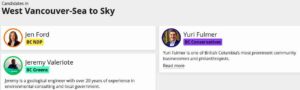
In West Vancouver-Sea to Sky, B.C. NDP candidate Jen Ford, a Whistler municipal Councillor, faces stiff competition from B.C. Greens candidate Jeremy Valeriote, and B.C. Conservative candidate, Yuri Fulmer. This riding is marked by its environmentally-conscious electorate, which aligns with Valeriote’s strengths, particularly given his party’s history in the riding. However, the B.C. NDP, buoyed by Ford’s local reputation and the B.C. NDP’s progressive climate policies, could make inroads. The wildcard here is Fulmer, representing the B.C. Conservatives, who may attract right-leaning voters disillusioned with B.C. United’s recent collapse.
Moving to West Vancouver-Capilano, the race is even more complex.
High profile Independent Karin Kirkpatrick, formerly a B.C. United MLA, is mounting a well-funded, high energy campaign. Her decision to run as an Independent threatens to split the centre-right vote, complicating the path for the B.C. Conservatives’ Lynne Block, who also faces competition from another Independent, Jaclyn Aubichon, who insists she is the true B.C. Conservative candidate. The B.C. NDP’s Sara Eftekhar and the B.C. Greens’ Archie Kaario are hoping this division on the right opens a narrow path to victory, but Kirkpatrick’s sterling local reputation and deep ties to the riding make her the likely frontrunner.
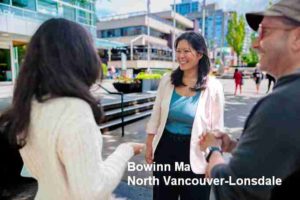
In North Vancouver-Lonsdale, B.C. NDP incumbent Bowinn Ma, a high-profile Minister and advocate for housing and transit, remains a strong contender. However, with the B.C. Conservatives fielding a serious challenge — in the form of David Splett, a seasoned Chartered Professional Accountant with over 30 years of international experience in financial and operational management within large organizations — in this suburban riding, Ma will need to fend off attacks on affordability and public safety. In North Vancouver-Seymour, NDP MLA Susie Chant faces a similar battle. Both North Shore ridings are typically competitive, but the fragmentation on the right may play to the B.C. NDP’s advantage here, as Ma and Chant can leverage their incumbency and the government’s progressive record.
Richmond: Crime and Economic Uncertainty
Richmond, a traditionally right-leaning suburb, delivered an unexpected triumph for the B.C. NDP in 2020 when they claimed three out of four ridings.
In Richmond-Queensborough, B.C. NDP incumbent Aman Singh faces an uphill battle, with crime emerging as a central issue. Steve Kooner of the B.C. Conservatives is making crime and public safety the core issues of his campaign, hoping to appeal to voters frustrated with perceived rising crime rates. Global B.C.’s Richard Zussman has identified this riding as a bellwether riding, and suggests that this riding could determine whether David Eby or John Rustad form government post October 19th election night. To win, Aman Singh will need to hold onto the diverse coalition that propelled him to victory in 2020, to retain his seat.
In Richmond-Steveston, NDP MLA Kelly Greene is in a similarly tough race. Her challengers include former B.C. United candidate Jackie Lee — who was an incredible fundraiser for B.C. United, but now running as an Independent Mr. Lee doesn’t have access to the monies he raised — and B.C. Conservative Michelle Mollineaux. Still and all, Mr. Lee is a known quantity. Kelly Greene won a squeaker in 2020; in 2024, with the vote on the right split, it would seem likely that with a fragmented opposition, Greene’s incumbency may give her an edge. Still and all, as is the case in Richmond-Queensborough, crime, alongside economic uncertainty, will dominate the conversation in Richmond-Steveston.
Unless the B.C. NDP can respond to crime and public safety effectively, Ms. Mollineaux could emerge victorious on election night.
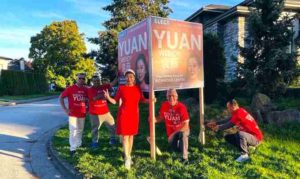
However, in Richmond Centre — where former B.C. United candidate Wendy Yuan is mounting a high profile, effective campaign, with an army behind her to help get out the vote (they’ve already identified they’re vote, which is important), again with a split on the right, incumbent B.C. NDP candidate Henry Yao could take the riding on election night. In Richmond-Bridgeport, the resurgence of the B.C. Conservatives, especially with former B.C. United MLA Teresa Wat now running under Rustad’s Conservative banner, adds unpredictability. Wat’s candidacy is especially notable, as she could potentially recapture her base from the splintered B.C. United, making Richmond a pivotal region on election night.
Vancouver: An NDP Stronghold Under Threat?
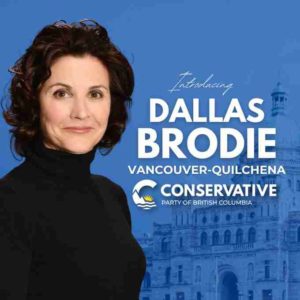
Vancouver has been the bedrock of B.C. NDP support in recent elections, but the emergence of the B.C. Conservatives has introduced uncertainty, especially in ridings like Vancouver-Quilchena, where the departure of B.C. United leader Kevin Falcon has left the field wide open for the B.C. Conservative’s Dallas Brodie, who is assured of victory in this affluent, traditionally right-leaning riding. A significant win for the B.C. Conservatives that could signal broader gains across the city.
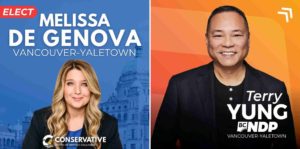
Global B.C.’s Richard Zussman has called Vancouver-Yaletown a top 10 riding to watch on election night. The two candidates: two time Vancouver City Councillor Melissa De Genova running with the B.C. Conservatives, and retired Vancouver Police Department Inspector, Terry Yung, running with the B.C. NDP. Read the riding profile we published on September 4th for extensive insight into this riding.
In Vancouver-South Granville, Brenda Bailey, a prominent Minister in the Eby government, is running for re-election. She faces B.C. Conservative candidate Aron Lageri, whose campaign could tap into growing frustrations over housing and crime. Ms. Bailey will win this riding, the demographic data leaning heavily NDP.
For insight into the Vancouver-Little Mountain race, click here.
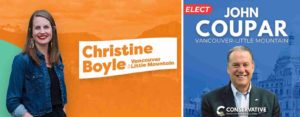
Meanwhile, in Vancouver-Little Mountain, Vancouver City Councillor Christine Boyle, having secured the B.C. NDP nomination in a hard fought contest with former Vision Vancouver City Councillor, Andrea Reimer, is running against former Vancouver Park Board Chair John Coupar, one of the first potential candidates B.C. Conservative leader approached to run with his nascent B.C. Conservative Party. This race highlights the ongoing battle for progressive votes in the city, with Boyle’s deep connections to local politics providing her an advantage, although Coupar’s early recruitment by Rustad signals a strong conservative push, and a likely Cabinet position for Mr. Coupar should the Conservatives form government.
Vancouver-Langara also warrants attention, with B.C. NDP candidate Sunita Dhir running against controversial B.C. Conservative Bryan Breguet. Breguet’s inflammatory comments on race and crime have made this a particularly charged contest. The NDP hopes to capitalize on his divisiveness to hold the riding.
One of the most competitive ridings is Vancouver-Fraserview, where long-serving NDP MLA George Chow, a longtime B.C. NDP Minister, is being challenged by B.C. Conservative Jag S Sanghera. If the B.C. Conservatives manage to turn this election into a wave election, Fraserview could flip — as it did in 2013, when B.C. Liberal Suzanne Anton won the riding, going on to become Attorney General in the administration of B.C. Liberal Premier Christy Clark. The B.C. Greens’: a perennial Green candidate and teacher, Françoise Raunet is unlikely to mount a serious challenge.
VanRamblings will focus on Premier David Eby’s Vancouver-Point Grey riding, at the top of tomorrow’s column, in a post which may or may not explore ridings in contention in Surrey-Delta, the Tri-Cities out to Chilliwack, north of the Fraser River, and ridings in contention in the Fraser Valley. At this point, we think we’re gonna get carried away writing about the contest in Vancouver-Point Grey.
One candidate has some ‘splain’ to do.
Burnaby and New Westminster: NDP Heartland in Flux?
Burnaby has been a stronghold for the B.C. NDP, but cracks may be appearing.
Burnaby-North, where incumbent Janet Routledge is running for re-election, is particularly vulnerable. Her B.C. Conservative opponent, entrepreneur Michael Wu, could pose a serious challenge, especially if the election turns into a wave election for the Conservatives. The other Burnaby ridings, such as Burnaby Centre and Burnaby South-Metrotown, are more secure for the NDP, although shifting voter demographics and discontent over housing affordability make these ridings worth watching on election night.
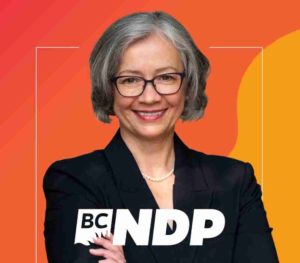
Jennifer Whiteside, B.C. NDP candidate in New Westminster-Coquitlam
In New Westminster-Coquitlam, NDP MLA and Minister in the Eby government, Jennifer Whiteside, looks secure in her seat, with the B.C. Conservative’s Ndellie Massey and B.C. Greens’ Maureen Curran unlikely to mount significant threats. However, New Westminster’s stability may not reflect broader trends if the B.C. Conservatives make gains across the province.
Will Urban British Columbia Hold the Key to Victory?
As the election progresses, the urban ridings: the North Shore, Vancouver, Richmond, Burnaby and New Westminster will be critical election determinants.
While the B.C. NDP remains strong in these areas, the resurgence of the B.C. Conservatives and the presence of well-funded Independents introduce volatility.
Should the B.C. Conservatives succeed in turning the election into a wave election, or even a tsunami election, many of the ridings we have written about today — long considered safe ridings for the B.C. NDP — could be up for grabs.
On Election Night, Saturday, October 19th, these key battlegrounds will likely tell the story of whether David Eby can hold onto government, or if John Rustad’s insurgent campaign can propel the B.C. Conservatives to power.
2024 British Columbia Provincial Election | Regional Riding Analysis
Part 1 | Vancouver Island | Five Ridings in Contention, and Subject to Change
Part 2 | The Interior, the North and the Kootenays | Battleground Ridings
The Hotel Pacifico podcast will broadcast daily, Monday thru Friday, throughout the 2024 election
The good folks at Air Quotes Media’s Hotel Pacifico podcast — featuring Mike McDonald, Christy Clark’s campaign manager in 2013; Geoff Meggs, Premier John Horgan’s Chief of Staff; and Kate Hammer, a former Globe and Mail British Columbia legislative reporter — will “broadcast” on the B.C. Election each day, Monday through Friday. Find the latest episode above.
VanRamblings will post the podcast, for your edification and enjoyment.