Category Archives: VanRamblings

#VanPoli | Vancouver 2050 | The City of the Future

A draft 30-year plan calls for limiting growth in Vancouver, and pushing new residents to the suburbs

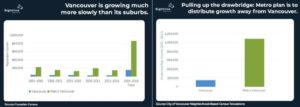
All development decisions within the City of Vancouver that are currently being made by senior staff employed within the city’s Planning Department — currently slated to add more than 100,000 new residents to Vancouver, over the course of the next 30 years — is predicated on a rate of population growth that many commentators, and the most recent figures published by Statistics Canada, don’t jibe with population growth projections that are being made at Vancouver City Hall.

In an article published in The Vancouver Sun this past weekend, reporter Douglas Todd writes …

“In recent years about 12,000 more people have been annually moving out of Metro Vancouver for other parts of B.C. than have been moving into the metropolis. The vast majority of new arrivals into Metro Vancouver are foreign-born immigrants.”

Todd goes on to quote former provincial NDP MLA and current two-term Nanaimo Mayor, Leonard Krog.

“We have had lots of people from Alberta and the East cashing out and moving to Nanaimo — to get away from the crush and the smoke,” says Krog. “People are also fleeing Vancouver, and the Lower Mainland. Now it’s more common for people to ask why would you stay in the Lower Mainland when you can cash out on your $2-million house on a crowded Burnaby street, or $3 million Vancouver home and get a great $1 million home in Nanaimo?”

Krog says newcomers are pouring into Nanaimo for several reasons — affordable housing, less density, and a higher-quality lifestyle. “The strong overall shift of residents from other provinces, and from Vancouver or Metro Vancouver, to smaller B.C. cities, which have more young adults, is unsurprising,” writes Douglas Todd.

“Nanaimo’s rapid growth of two per cent a year”, Krog says, “is a result of a ‘perfect storm’ of conditions, including the attractiveness of the region’s oceanfront, university, airport, nearby ski mountains, climate and a lower cost of living.”

“It has all been amplified by the pandemic,” he said. “COVID-19 is helping many across Canada and in other parts of B.C. realize they might be able to permanently work out of their homes. So why not do it in a place that is pleasant and somewhat more affordable?”

If as lawyer, writer, and and community organizer Daniel Oleksiuk writes on the Sightline Institute website that population growth in Metro Vancouver will occur in the Metro Vancouver suburbs, and not in Vancouver, and if Nanaimo Mayor Leonard Krog is correct in his assertion that rather than remain in Vancouver, families are instead opting to move to smaller, more affordable cities such as Nanaimo, how can the Vancouver Planning Department justify a growth strategy, population growth projections, and the consequent tower-driven densification projects they are currently presenting to the members of Vancouver City Council for approval?

At Issue: Form of Development, and the Livability of Vancouver
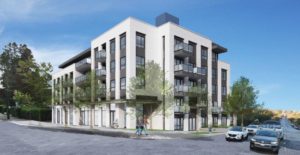
Artistic rendering of the Esso gas station site at 3205 Arbutus, redeveloped into a mixed-use building

A deep issue of concern that has arisen for many, as Vancouver’s  Planning Department presents their plans to City Council, is “form of development”.

For the most part, if you take a look at many of the projects VanRamblings wrote about yesterday, they adhere to the ‘development at all cost’ ethos of the now discredited former Vision Vancouver civic administration, who were roundly and wholly turfed from office in the 2018 Vancouver municipal election: a plethora of greenhouse gas-emitting podium and tower-driven developments — whether they be in the northeast “forest of condos” False Creek neighbourhood, the newly-reimagined Oakridge Centre or nearby Heather Lands development, or in the southern sector of the Grandview Woodland neighbourhood’s ‘Safeway site’.

The question must be asked: whatever happened to the notion of ‘gentle density’?

Why is it that rather than construct high-rise condominum towers all along the Broadway Corridor, from Clark Drive all the way out to UBC, could we not opt instead for the kind of low-rise building illustrated directly above, in the proposed, neighbourhood friendly project located at West 16th Avenue and Arbutus Street?
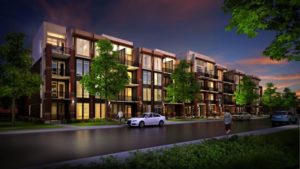
Artistic rendering of a planned, environmentally-friendly wood construction building

Perhaps of even more importance to the stewards of our environment who sit on Vancouver City Council, why not mandate that future home construction be built employing sustainable, carbon-storing cross-laminated timber —  glued at perpendicular angles to make thick beams, and clearly visible in columns, beams, walls and ceilings? Wood construction has proven popular across a broad section of our developer, architect and contractor communities, who see building with wood as a way to increase density at a lower cost, while reducing environmental impact.

Now, that would be an innovation for our Vancouver City Council to truly consider.
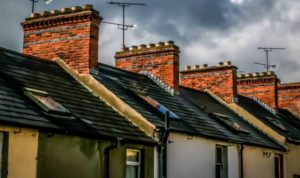
Rowhouses such as the ones above are common in many cities around the world, but not in Vancouver

And what of fee-simple row housing , which architect Michael Geller argues for in an interview conducted by Carlito Pablo, in the October 6, 2021 issue of The Straight?

“In a fee-simple rowhouse or townhouse, there’s nothing owned by the association. The owners own their roof, their windows, the land under and around their townhouse. That means the individual owners are responsible for taking care of any lawn, painting the outside, fixing leaks in the roof, and shoveling the snow.”

Whatever happened to the notion of human-scale, gentle density townhouse construction, all the rage 40 & 50 years ago? Why, in recent years, has townhouse construction fallen so out of favour, as podium and high-rise tower-driven plinth construction has become the greenhouse gas-emitting building forme de la journée?
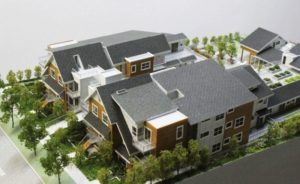
Vancouver Co-Housing, located on 33rd Avenue between Victoria Drive and Knight Street

And what about co-housing in Vancouver, housing that is family-supportive, senior-friendly and energy-efficient? For instance, Vancouver Co-Housing consists of 29 privately owned, fully equipped homes plus 2 rental units, in addition to a large and beautiful common house and outdoor common areas. This vibrant community is located on East 33rd Avenue between Victoria Drive and Knight Street.

The homes range from studios to one-, two-, three- and four-bedroom units – all with their own kitchens. The common house has an area of 6,500 sq ft. and includes a community kitchen, dining room, and lounge; activity rooms for children and teens; office areas; two guest rooms; a yoga studio; and rooftop gardens. As well, there are ground-level gardens, workshops, plus a courtyard and play area that encourage year-round social contact. All parking is underground.

By working together, Vancouver Co-Housing members are able to share amenities common to a traditional home and reduce the size of their private dwelling.


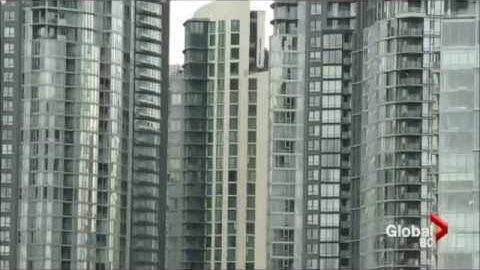
A 2014 Global BC video, identifying Vancouver as one of the high-rise capitals of the world

On July 24, 2014, during the lead up to the Vancouver civic election that year, VanRamblings published a column titled At Issue: Form of Development, and the Livability of Vancouver, which quoted a 2012 study conducted by University of British Columbia Chair of Urban Design and Landscape Architecture, Patrick Condon, addressing the question of how Vancouver might reasonably approach the reduction of energy use and consequent greenhouse gas production in the city by at least 80 per cent by 2050, and how that goal might be accomplished.

The answer: the construction of compact, low-rise structures across the city, along its arterials and throughout its neighbourhoods, as a greener, more workable, more energy-efficient alternative to the present form of high-rise development that so captured the imagination of Vision Vancouver, as seems to be the case with our present Council. That 2014 VanRamblings column is well worth reading.
The indefatigable Patrick Condon, future — and absolutely necessary — Vancouver City Councillor

Again today, VanRamblings will leave you with the words of Patrick Condon …

“While it is true that high-rises, when combined in large numbers, create GHG-efficient districts, the buildings themselves are not as efficient as mid-rise buildings.

“High-rises are subject to the effects of too much sun and too much wind on their all-glass skins. And all-glass skins are, despite many improvements to the technology, inherently inefficient. Glass is simply not very good at keeping excessive heat out, or desirable heat in. High-rises, according to BC Hydro data, use almost twice as much energy per square metre as mid-rise structures.”

“High-rise buildings built largely of steel and concrete are less sustainable than low-rise and mid-rise buildings built largely of wood; steel and concrete produce a lot of GHG. Wood traps it. Concrete is 10 times more GHG-intensive than wood.”

Patrick Condon argued with heart and with purpose in 2014, as he does through until today, for the construction of thousands of primarily mid-rise wood frame mixed use commercial / residential buildings on Vancouver’s arterial streets.

And, most importantly, Patrick Condon argues for the retention of existing neighbourhood quality, and the supply of sufficient units to house the burgeoning wave of our elderly population, housing for young families, housing equity, and neighbourhood preservation, through the gentle infill of existing residential streets.

#VanPoli | False Creek South | The Heart of Our City Preserved


REJECTED | City of Vancouver Real Estate Department Plan for False Creek South

In early October, when the City of Vancouver’s Real Estate Department presented a sordid, mercenary plan for the redevelopment of False Creek South —  that parcel of land on the south side of False Creek stretching from the Cambie Street bridge to the Granville Street bridge — Mayor Kennedy Stewart the very next day came out in full-throated support of The Plan, writing in an overly solicitous column published in The Straight that averred …

“Great cities like ours can never stand still. We must always examine whether our city is meeting our needs, both for today and tomorrow.”

The Real Estate Department’s Plan called for a greedy financial return to the City, that sought to more than triple the existing density of homes in the False Creek South neighbourhood, from 2450 units to a reconfigured 6600 units.

The real cost of the Plan?

The absolute, utter destruction of the False Creek South neighbourhood, a decimation of the heart and demographic integrity of one of Vancouver’s most sustainable and livable districts — the ‘close-fisted’ Plan laying waste to existing housing co-operatives dotted throughout the neighbourhood, moving residents from their current locations to a ghettoized, ‘poor door’ stretch of land situated along the bustling, carbon emitting 6th Avenue traffic corridor.

Community outrage soon ensued.

As founding chair of the UBC urban design programme, Patrick Condon, wrote in an article in The Tyee , the City’s Real Estate Department’s Plan would …

  • Increase market condos nearly fourfold, from 688 to 2,350 units;
  • Increase by more than 13x market rental units, from 150 to 2020 units;
  • See all new buildings constructed at least six storeys tall, ranging up to 50 storeys tall at the Granville Street bridgehead. Today, most buildings on the district’s city-owned land are three to four storeys in height;
  • Shift the tenure mix on city-owned land from the current 36% market strata, 8% market rental & 56% non-market co-op / affordable rental units, to 35% market strata, 30% market rental, and 34% non-market co-op and affordable rental;
  • Eventually demolish most of the existing co-ops, with these sites reused for market rentals and market condos, or to expand Charleson Park.

As Robert Renger, a retired senior planner who worked with the City of Burnaby, wrote in a response article in The Straight to the column written by Mayor Stewart — as well as to supporters of the City of Vancouver’s Real Estate Department’s Plan for False Creek South, which accused False Creek South residents of both nimbyism and elitism

  • 15% of FCS residents are children, with 11% freehold and 16% citywide;
  • 17.5% of False Creek South family households are single-parent, compared to 10.9% of False Creek South freehold and 15.9% citywide;
  • The income mix on FCS lands closely parallels that of the city as a whole.
  • The residents of False Creek South had long ago published a document they called RePlan , a thorough and critical vetting of the City’s proposed Plan for the False Creek South neighbourhood, writing that …

    “False Creek South offers a housing model that is affordable, resilient and community-focused, with a variety of affordable, mixed-income housing options that span a spectrum of housing tenures. We are calling on Vancouver City Council to protect the existing variety of affordable, mixed-income housing options in False Creek South, to eliminate the threat of housing insecurity on leased City land, to kick start community growth, and to create right-sized housing in the False Creek South neighbourhood.

    Let’s expand affordable, resilient, mixed-income, mixed-tenure housing communities. Vancouver needs to protect and create more housing that is community centred, diverse, equitable, inclusive and secure that spans all leasehold housing tenures, including permanent housing for people who have experienced or are at risk of homelessness.”

    On October 5th in a motion presented to her colleagues on Vancouver City Council, Councillor Colleen Hardwick did just that in calling for security of tenure for the beleaguered residents of False Creek South, whose ongoing residency in the neighbourhood would be jeopardized by the redevelopment Plan published by the City’s Real Estate Department. Before that motion could be discussed around the Council table, the members of Council sought to hear feedback from the residents of False Creek South, as well as citizens from right across the city.

    Councillor Colleen Hardwick + retired CoV planner / RePlan co-author , Nathan Edelson

    Long story short, after hearing from some 171 residents of the City of Vancouver — many of them children, now adults, who had grown up in the False Creek South neighbourhood — in, perhaps, the most moving series of addresses this or any other Council has ever heard, in an amendment motion presented by Councillor Christine Boyle, all 10 Vancouver City Councillors, with an about face by Mayor Kennedy Stewart, unanimously rejected the City Real Estate Department’s Plan for False Creek South, instead opting to turn the process of the redevelopment of False Creek South to the City’s Planning Department, which planning process will include respectful and extensive consultation not only with False Creek South residents, but engaged residents across the city at-large.

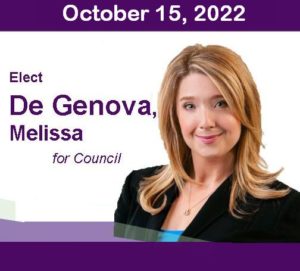
#VanPoli | Melissa De Genova | Fighting for You on Vancouver City Council

In the 2018 Vancouver municipal election, Vancouver City Councillor Melissa De Genova was elected to a second term of office, finishing a solid third place in the polls with 53,251 votes, support for her re-election coming from across the city, in every one of the 23 neighbourhoods comprising our piece of paradise by the sea.

More than any other current Vancouver City Councillor, in the years since Ms. De Genova first assumed elected office in 2011, as a Vancouver Park Board Commissioner, Melissa De Genova emerged from the outset and continues thru until this day as a champion and a fighter for the interests of working people.

Now, it is true that Ms. De Genova has a long and glorious, ought-to-be celebrated history of driving the members of Vancouver’s partisan and arrogantly self-righteous, so-called “left” just nuts, driving them around the bend at every turn, as often as she is able — which in her first seven years of elected office was often.

Melissa has no time for “politics” when there’s a job to be done, a seniors facility to be built, a senior level of government to finagle into doing her bidding to ensure the delivery of programmes and affordable housing to the residents of Vancouver.

Melissa De Genova is always ready to engage with the electorate, be it on social media or one-to-one in person (there’s not been much opportunity for the latter in these pandemic times). When Melissa is challenged on social media — which is often — she readily engages, setting out the rationale for a decision she has taken around the Council table, engaging with whatever miscreant, unnamed person who is hiding behind a faux identity on, say, Twitter, thoughtfully and methodically laying out why she has taken the decision she has.

Inevitably, these online tête-à-têtes devolve, with Ms. De Genova’s “challenger” resorting to invective and name-calling. But still, Melissa hangs in, always respectful. With a current Council rightfully afraid of the pit of despair that is Twitter in 2021, only OneCity Vancouver City Councillor Christine Boyle is Ms. De Genova’s equal when it comes to dialogue and informed response to the too often egregious and ferociously vicious nature of the engagement extant on the Twitter platform.

One of the great joys of VanRamblings life in recent years was observing Melissa go after Aaron Jasper and Niki Sharma — and much to her chagrin, Sarah Blyth — when the four sat on Vancouver Park Board. Aaron Jasper’s conduct towards Ms. De Genova was supercilious and condescending at all times, as if she was somehow “below” him, and undeserving of even one iota of humanity that might emerge from him during his time as Chairperson of the Vancouver Park Board.

At the time, during the course of Park Board meetings, Melissa remained respectful of the Chair and her Vision Vancouver colleagues around the Park Board table — but when the meetings ended, Melissa De Genova lit into her Vision colleagues with a vigour that was something (of a great delight) to behold, calling them out for their wrong-headed “in the pocket of (then, ruthless and none-too-stable City Manager), Dr. Penny Ballem,” and their utter failure to represent the interests of the citizens who voted to elect them as Vancouver Park Board Commissioners.

In 2014, Melissa De Genova ran for office under the Non-Partisan Association banner — all but bereft of support from the members of the 2014 NPA campaign team, and party President at the time, Peter Armstrong — and willed herself onto Council with a vitality, urgency and strength of purpose that so enraptured Vancouver’s voting electorate that she garnered an amazing 63,134 votes, placing a high fourth place at the polls, in her first run for elected office as a Vancouver City Councillor.

Never one to hide her light under a bushel, it wasn’t very long into her first term of office at Vancouver City Hall that Ms. De Genova came head-to-head with the seven-headed monster that was — back in the day, only 7 short years ago — Vision Vancouver, identifying early on the challenge with which she was confronted, most particularly in the form of Vision Councillor Andrea Reimer, whose every utterance directed towards Councillor De Genova dripped with a contemptuous condescension  that all but demanded a response from Council novice Melissa De Genova.

To say that Melissa gave as good as she got is to understate the matter.

Alas, that was then, and this is now.

During the current term of office Councillor De Genova has transformed from a fighter into a pussy cat, a ‘can barely stand on her legs’ kitten.

These past three years, what has happened to Vancouver resident champion and fighter for all that is right and good, challenger of her opposition colleagues, and ruthless yet still humane Council combatant, a woman who takes no truck nor holds any prisoners, the Melissa De Genova who calls out dissembling, self-righteous virtue signaling nonsense when one opposition Councillor or other makes a statement so ludicrous and offside that it all but demands a response from Vancouver’s warrior City Councillor.

Melissa, Melissa, come out, come out from wherever you’ve been hiding! We need you! Please, be our champion once again.”

VanRamblings wrote yesterday that only two current City Councillors are assured re-election in 2022. We’d like to add Melissa De Genova to that list — but first she’s going to have to rekindle the fire in her belly that was once her electoral raison d’être, and re-emerge as the fighter for all that is right and good, and be seen to do so, if she is to emerge victorious in the 2022 election.

And, yes, VanRamblings is well aware of that damnable Code of Conduct that has stifled debate around the Council table this term of office at City Hall, with Green Councillor Adriane Carr the chief enforcer of this “we must play nice, never give the appearance of impugning the integrity of a staff person, presenter to Council, or woebegone citizen, because nicey-nicey is the order of the day on this current term Vancouver City Council — and, quite simply, I won’t have it any other way!”

What does VanRamblings hope wlll be Councillor Melissa De Genova’s response?


#VanPoli | The Worst Council in 50 Years?

The current Vancouver City Council is the worst, most inept, least productive, least progressive City Council Vancouver citizens have witnessed in 50 years.

In the amalgam of Green Party, OneCity, COPE and “independent” (formerly Non Partisan Association) Councillors, we have a group of 10 Councillors and a Mayor who cannot seem to get along with one another, do not work in common cause to benefit the electorate, and genuinely don’t like one another.

Burnaby City Council vs Vancouver City Council, 2018 – 2022

In May 2019, Burnaby City Council adopted a ‘best in Canada’ tenant assistance policy that provides support for tenants displaced from rental buildings with 5-plus apartments, mandating developers cover tenants’ moving costs (up to $1,400), and pay the difference between a tenant’s current rent and the rent in the new building tenants move to, while providing the …

Right of first refusal to displaced tenants to move into the replacement building once construction is complete, at the same rent as they paid before being displaced (subject only to the provincially mandated maximum annual increases), as well as mandating that developers will again have to cover moving costs when tenants move back into the new building.

The Burnaby City Council tenant assistance plan created inclusionary rental zoning bylaws, which requires of developers one-to-one replacement of demolished rental apartments, and that at least 20% of new housing developments in Burnaby will be secured as rental, in perpetuity.

Did Vancouver’s City Council’s purported, on the side of working people ‘left saviour’, OneCity Vancouver’s Christine Boyle, or the three-person environmental Green Party contingent, the Mayor, or any one of the five (now former) Non-Partisan Association City Councillors even consider implementing a tenant assistance policy similar Burnaby’s — and, now, New Westminster, as well?

Not on your life they didn’t, a point made comprehensible in the tweet below.

As Charles Menzies — a Professor in the Department of Anthropology at the University of British Columbia — wrote on Twitter yesterday in response to VanRamblings’ Tuesday column, about how some folks have deemed current Vancouver City Councillor Colleen Hardwick to be “right wing”, he wrote …

Tom ‘Not So Terrific’ Campbell, controversial Vancouver mayor, 1966 to 1972

In 1966, running as an independent, a brash Tom Campbell defeated Non Partisan Association mayor, Bill Rathie, to become Vancouver’s 31st mayor. From the outset, Campbell heralded a pro-development ethos that would make even Vision Vancouver (not to mention, our current City Council) blush, as he advocated for a freeway that would cut through the downtown east side, demolish the historic Carnegie Centre at Main and Hastings, and bring about the construction of a luxury hotel at the entrance of Stanley Park, as well.

Vancouver’s West End neighbourhood, circa 1960, pre high-rise construction

In the West End, where Campbell — a wealthy developer — owned substantial properties in the neighbourhood, the newly-elected Mayor all but ordered the demolition of almost the entirety of the well-populated West End residential neighbourhood — housing mostly senior citizens in their single detached homes — as he made way for the rapid construction of more than 200 concrete high-rise towers, irreversibly transforming Vancouver’s West End … forever.

All of these “changes” augered controversy among large portions of the Vancouver populace, leading to vocal, often violent protests throughout Campbell’s treacherous tenure as Mayor, finally leading to his defeat at the polls in the November 1972 election, with the election of a majority, progressive T.E.A.M. (The Electors’ Action Movement) Vancouver civic administration.

Mayor Art Phillips discussing his legacy project, the Property Endowment Fund

Since 1972 and the election of the T.EA.M majority Vancouver civic government, whatever their stripe over the years — Non Partisan Association, COPE or Vision Vancouver — have strictly adhered to the dictum of Abraham Lincoln, “a government for and by the people.” Can the members of our current City Council honestly say that their primary goal is to serve the “public good”?

How Can VanRamblings Write That The 2021 City Council is the Worst in 50 Years?

A diverse — not — set of Vancouver City Council aldermen, circa 1933

Say what you will about Vision Vancouver Councillors.

At least they got along with one another, and saw themselves as a team working to make Vancouver a greener and more  livable city, while also working to achieve the laudable goal of eliminating homelessness in our city.

Vancouver’s current Council? How do they fare in an objective analysis?

Unlike any City Council elected to Vancouver City Hall over the course of the past 50 years, the current contingent of Vancouver City Councillors have steadfastly continued to spot rezone across the city, causing land prices to skyrocket, while not listening to the citizens who elected them to office.

Absolutely bereft of humility, most of the 10 members of Council have arrogantly set about to enact policy that is “good for us” because ‘our’ Councillors “know better” and were elected to govern not listen — despite what the citizens of the city say we all need — all the while building ever more unaffordable condominium and market rental complexes.

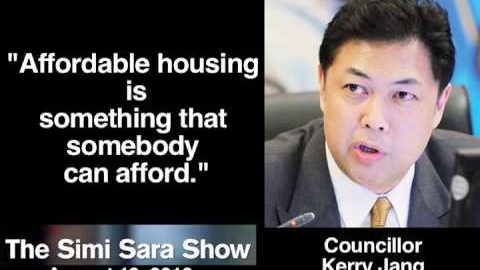
All this while barely paying lip service to the provision of “social housing” and “affordable housing” — which Council continues to define in the same manner former Vision Vancouver Councillor Kerry Jang elucidated as …

“Affordable housing is something that somebody can afford.”

Isn’t it so much hyperbole to call this Council the worst in 50 years?

To deny the Councillors their innate humanity, while failing to take into account that all 10 Councillors and our Mayor are dedicated servants of the people, who week-in and week-out work anywhere from 50 to 75 hours a week, more often than not sitting in Council chambers from 9:30 a.m. until 11 p.m., on behalf of and in the social, financial and environmental interests of  Vancouver citizens, as creditable and exemplary servants of the public good?

Maybe.

Over the next 360 days, leading up to the upcoming and always critically important Vancouver civic Election Day, on Saturday, October 15, 2022, VanRamblings will set about to support the claims we make, while introducing you to the next contingent of civic candidates seeking elected office in Vancouver.