Category Archives: #VanPoli Civic Politics

Human Compassion. Caring for Our Most Vulnerable in the City of Vancouver.

A truly compassionate and caring city is measured not by the prosperity of its wealthiest citizens, but by how it treats its most vulnerable.

In Vancouver, the obligation to provide supportive housing and shelter for those without a home, for seniors, for veterans, and for persons with disabilities is not a matter of charity — it is a moral and civic responsibility. No one should be left to struggle on the streets or in unsafe, unstable conditions when we have the collective capacity to do better.

Supportive housing is more than just a roof over someone’s head. It is the foundation of dignity, stability, and health. For people living with mental illness, addictions, or physical disabilities, housing linked with services can be the difference between despair and recovery.

For seniors and veterans, many of whom have given so much to our communities, supportive housing ensures they are not left behind in their later years, but instead live with safety, respect, and connection.

The crisis of homelessness in Vancouver has reached levels that demand urgent action. Yet, municipalities cannot solve this challenge alone. That is why partnership with provincial and federal governments is critical.

The City of Vancouver must continue to press senior levels of government for sustainable investments in housing, shelter, and wraparound supports. With co-ordinated effort, resources, and political will, we can build more non-market housing, expand emergency shelter capacity, and provide permanent solutions that end the cycle of homelessness rather than simply managing it.

This obligation is not just about bricks and mortar; it is about values. If we claim to be a city defined by compassion, equity, and justice, then our policies must reflect that claim. The measure of a city’s greatness lies in how it uplifts its most vulnerable residents. Vancouver has the opportunity — and the responsibility — to lead the way in showing that no one is disposable, that everyone deserves a home, and that together, across all levels of government, we can create a city where compassion is more than a slogan, but a lived reality.

The Job of a Journalist, to Comfort the Afflicted and Afflict the Comfortable

For journalists covering politics, and this very much includes VanRamblings, few tasks are more fraught than writing critically about political figures they have come to know well, respect, or even like.

In recent days, VanRamblings has been critical of Mayor Ken Sim, who we know and — to be perfectly frank, we — like (in the days to come, we will publish a supportive story of Mayor Sim). VanRamblings take no great pleasure in writing critically, or negatively, about a political figure, be it Mayor Sim, or Premier David Eby.

The above said, we acknowledge that the craft of political journalism demands objectivity, independence, and an unwavering commitment to the public interest.

Yet, the human element of this work cannot be denied. Political reporters often spend years in the company of the same politicians — interviewing them in hallways and offices, sharing off-the-record conversations, and at times even developing bonds of mutual trust. Against this backdrop, when a journalist is faced with reporting something unflattering, or deeply critical about a politician with whom they have built a rapport, the weight of the responsibility can feel crushing.

The essence of the journalist’s dilemma is a tension between personal loyalty and professional duty. On one hand, the journalist is human, and to knowingly cause another person pain — especially a hard working public figure who has chosen a career in public office — can feel cruel. On the other hand, journalism’s higher calling is to serve democracy by ensuring that those in power are held accountable.

As Finley Peter Dunne memorably wrote in his 1902 book Observations by Mr. Dooley, the role of the press is “to comfort the afflicted and afflict the comfortable.” That phrase has endured because it distills the moral purpose of journalism: to give voice to the powerless while scrutinizing the powerful. Political figures, by definition, fall into the category of the comfortable.

This mission often collides with the personal relationships that naturally develop between journalists and politicians. When a journalist covers a politician for years, the proximity can foster understanding and even admiration. A journalist may see the long hours, the sacrifices of family life, and the sincere desire by the political figure to substantively improve the lives of constituents who placed them in office.

Such observations humanize politicians, stripping away the caricatures often presented in the media. In turn, politicians may confide in journalists, trusting them with context, nuance, and moments of vulnerability that rarely make it into print, or onto your screen. Out of this closeness, empathy grows. And empathy, while essential in making reporting fair and textured, can also — from time to time — soften a journalist’s willingness to strike hard when the facts demand it.

To manage this tension, ethical journalists rely on principles that act as guardrails.

The first is the unwavering primacy of the public interest. However difficult, the journalist (and that includes VanRamblings) must remember that their ultimate loyalty is not to politicians, but to readers, viewers, and the democratic system itself. The second is transparency: by disclosing potential conflicts of interest and being open about their methods, journalists reinforce their credibility. The third is fairness. Criticism need not be cruel; it must be grounded in facts, and contextualized with nuance. In this way, the journalist can both honour their human empathy and fulfill their professional obligation.

Still, even within ethical frameworks, the emotional toll for the journalist is real.

Journalists who publish critical stories about politicians they respect may face strained relationships, loss of access, or even feelings of guilt. Yet this hardship is part of the profession. Indeed, it is in navigating these very difficulties that journalism earns its claim to being a cornerstone of democracy. If members of the press flinch from their duty, those in power would operate with impunity, and the public would be left in the dark.

The adage attributed to Dunne — “comfort the afflicted and afflict the comfortable” — serves as a guiding light precisely because it acknowledges the discomfort inherent in journalism. It is easier to flatter than to confront, easier to protect relationships than to risk them. But journalism is not meant to be easy. It is meant to be honest, courageous, and unyielding in the face of power.

For the journalist who must write critically about a political figure they admire, the pain is real, but the obligation is greater. In choosing to afflict the comfortable, even when it means hurting someone they know and admire, the journalist ultimately fulfills the noblest promise of their profession.


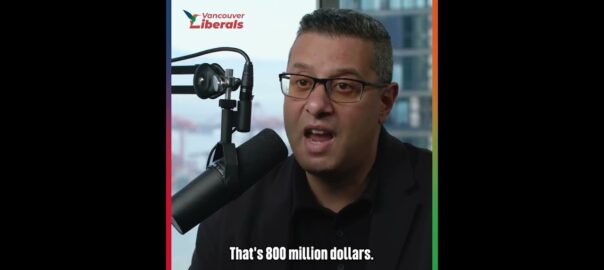
Vancouver’s Next Mayor | Kareem Allam | Priorities | Cancel Ken Sim’s $800 Million City Hall Campus

A Note from Kareem Allam, Vancouver’s Next Mayor

I am seeking the nomination of the Vancouver Liberal Party to be the next Mayor because I think I can do a better job.

As I prepare to launch, I am reaching out to my friends to donate to ensure my campaign has the best launch possible.

I’m running because we need to fix the mess at City Hall.

Vancouver should be a place young people flock to — for great careers and to raise their families. It needs to be more affordable with great public services that just work for people.

And on great services … this week I announced on Day One the Vancouver Liberals would requisition 400 more frontline workers, and we will pay for it by ending the practice of hiring management consultants and managers … who do nothing more than manage other managers.

I want a new rule at City Hall: if it doesn’t help bring young people back, make life more affordable, improve city services, or keep people safe, we’re not doing it.

Period.

So many people have stepped forward to offer their help, to volunteer to run for office, to offer smart ideas to make our city better. You’re one of them — and so I’m writing to ask for your help:

  • Donate as much as you’re able today. You can give as much as $1,402.40 – but whatever you can contribute today will help.
  • Get involved. You can sign up at VancouverLiberals.com — let us know you want to be a part of this project.

Thank you so much — more to come.

— Kareem

The Politics of Personal Destruction in Vancouver

In Vancouver, the politics of personal destruction has long been stock and trade for those running for office. In a city where political competition is fierce and civic identity is fragmented across 23 neighbourhoods, campaigns often take the shape of contests not about ideas, but about the destruction of personalities.

For instance, on March 20th, 2020, when Mayor Kennedy Stewart called for a cessation of in-person meetings in Vancouver City Hall’s Council chambers, due to the outbreak of COVID-19, Councillor Pete Fry allegedly tweeted out an untoward comment about a fellow Councillor. This alleged tweet was allegedly directed at then City Councillor Colleen Hardwick.

When VanRamblings’ friend Joseph Jones filed a formal complaint with the office of the City Manager respecting Councillor Fry’s alleged injudicious “mean” tweet, the City replied in an e-mail that, as a third party, he did not have any standing, and therefore his complaint could not be accepted, nor acted upon.

Vancouverites know well the stories of politicians torn apart not by their policies or their vision, but by narratives manufactured and circulated for the purpose of ensuring their defeat. Former Vancouver City Councillor Colleen Hardwick is the candidate for office most often subject to personal attacks by her political opponents. In these latter days of his time as Mayor, Ken Sim runs a close second.

The politics of personal destruction is not new. Its roots can be traced back through centuries of democratic life, from pamphleteers in the 18th century to the tabloids of the 20th. Yet in recent years, the vitriol has intensified.

Donald Trump’s entrance into politics a decade ago supercharged a cultural shift: insult, ridicule, and character assassination became normalized as the central tools of political combat. What began as spectacle in the United States has since migrated north, settling into Canada’s civic politics with troubling force.

Vancouver, far from immune, has absorbed this toxin into its bloodstream.

The dynamic plays out in every election cycle. Local media, amplified by social media platforms, frame candidates in terms of their weakest or most controversial qualities. What might once have been a gaffe becomes a defining feature. A poorly worded sentence becomes a character flaw. A photo from decades past resurfaces as proof of hypocrisy or malice. The candidate’s ideas are eclipsed; the person becomes the story. And in a political environment as fragmented as Vancouver’s, where candidates often win office with a fraction of the vote, tearing down opponents is more effective than inspiring broad-based support.

The consequences are corrosive. At the civic level, Vancouver faces enormous challenges: a housing affordability crisis, an opioid epidemic, climate pressures, and deepening inequality. Addressing these issues requires serious debate, collaboration, and — above all— public trust in political leadership.

Yet when the political arena becomes consumed by personal attacks, trust evaporates. Politicians no longer seem like public servants but more like caricatures, defined only by the accusations lodged against them. Voters, in turn, grow cynical and disengaged. Democracy shrinks when citizens come to see politics not as a space for collective problem-solving but as a blood sport where the only winners are those most adept at tearing others down.

This dynamic does more than corrode public trust; it also drives away talent.

Who, knowing the ferocity of political campaigns, would willingly step forward?

For every candidate who accepts the risks, there are others who quietly decline.

Community leaders, business people, academics, and activists who might bring fresh perspectives to City Hall weigh the costs of public humiliation against the potential rewards of civic leadership — and they walk away.

The result is a narrowing of the pool of candidates, leaving the field to those willing to endure or even to participate in destructive politics. In this way, the politics of personal destruction perpetuates itself.

The media plays an undeniable role. The incentive structures of journalism reward conflict, scandal, and controversy. A headline about a candidate’s vision for neighbourhood development rarely generates as much attention as one about a candidate’s personal misstep. Social media amplifies the dynamic, rewarding the sharpest, most caustic takes with likes, retweets, and viral circulation.

In Vancouver’s polarized civic politics, with factions aligned around housing, development, and ideological identity, these attacks are not just tolerated but often celebrated by supporters eager to see opponents discredited.

Yet the responsibility does not lie solely with media or candidates. Citizens, too, play a role in perpetuating the culture of personal destruction. By consuming, sharing, and rewarding negative content, voters enable the very dynamics that undermine our democracy. It is easier, in some ways, to join the pile-on than to engage thoughtfully with the complexities of policy.

The digital age has made outrage a form of social currency, and too often Vancouverites spend it freely.

But the politics of personal destruction is not inevitable.

Cities like Vancouver thrive not when they are divided, but when they are connected — when residents and leaders alike focus on building bridges rather than tearing one another down. The challenges Vancouver faces are collective ones, and they demand collective solutions.

The housing crisis will not be solved by discrediting the character of those who hold office; it will be solved by debate, compromise, and innovative policy. The overdose crisis will not be solved by mocking the missteps of political leaders; it will be solved by compassion, evidence-based strategy, and political will.

Towards building a better society, our job as citizens, as political candidates, and as journalists ought to be to resist the destructive instincts that have come to plague politics. We must choose instead to elevate the conversation. That means expecting better of our leaders, but also of ourselves. It means seeking common ground in our city’s diverse neighbourhoods, acknowledging difference without demonizing those who hold it. It means holding candidates accountable for their ideas and actions, not for caricatures drawn by their opponents.

If Vancouver is to be a city worthy of its promise, it must move beyond the politics of personal destruction. It must embrace politics as an act of community-building, not community-breaking.

Each of the 23 neighbourhoods that make up our city deserves leadership that is respected, even when it is contested. Each citizen deserves a politics that invites them to participate, not one that drives them away in disgust.

The politics of personal destruction has been with us for too long, but it need not define our future. In Vancouver, a city of breathtaking landscapes and vibrant communities, our city by the sea, we can and must choose a different path: one of conscience, common ground, and collective purpose.