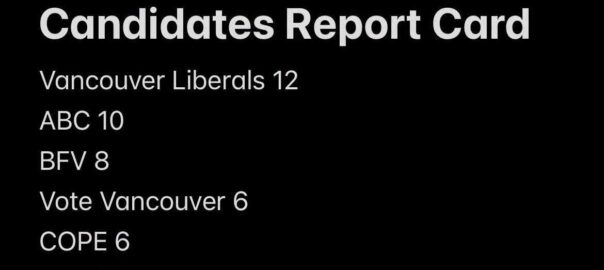
Part 4. The Whole Story. pic.twitter.com/VKNvUFItlg
— Kareem Allam (@kareemformayor) September 11, 2026
According to the last census, there are 662,248 citizens who call Vancouver home.
54.5% of Vancouver’s population, or 354,615 people, belong to one of Vancouver’s 201 visible-minority communities.
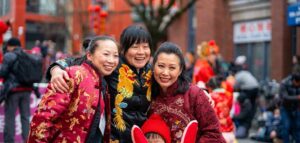
The Chinese community is by far Vancouver’s largest single ethnic/cultural-origin group, with 159,080 people — roughly one Vancouver resident in four. The latest census puts the Chinese population at 168,385, or 25.9% of the long-form population.
There are another 378,000 citizens in Vancouver whose ethnic origins are not part of the visible minority population: with the largest of these non-visible minority populations represented by the English (84,370), Scottish (69,200) and Irish (65,695).
Taken together, those four origins account for more than 378,000 reported origins, although, again, many people report more than one origin.
According to the latest census, as above, Vancouver has 354,615 people identified by Statistics Canada as belonging to a visible-minority population, again (as reported above) representing 54.5% of Vancouver’s 662,248-person overall population.
The disparity in numbers between Vancouver’s Census Canadian population of 662,248 Vancouver citizens, and the 742,615 figure that is a combination of the visible and non-visible ethnic populations may be accounted for by the fact that many Vancouverites who reported out in the most recent Statistics Canada census identified as being members of more than one ethnic community.
Chinese residents accounted for 159,080; South Asians 44,850; Filipinos 38,605; Southeast Asians 20,585; Latin Americans 18,080; West Asians 12,100; Koreans 10,895; Japanese 10,990; and Black residents 8,515.
The chart below shows Vancouver’s visible minority populations by ethnic group, the Vancouver neighbourhoods where most reside, the population numbers, and the percentage of the population each community comprises within the City of Vancouver.
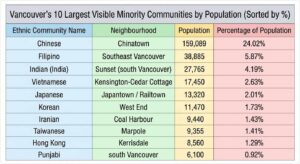
| Rank | Ethnic/cultural origin | Population | % of Vancouver |
|---|---|---|---|
| 1 | Chinese | 159,080 | 24.02% |
| 2 | English | 84,370 | 12.74% |
| 3 | Scottish | 69,200 | 10.45% |
| 4 | Irish | 65,695 | 9.92% |
| 5 | German | 45,215 | 6.83% |
| 6 | Filipino | 38,885 | 5.87% |
| 7 | Canadian | 33,685 | 5.09% |
| 8 | French, n.o.s. | 30,625 | 4.62% |
| 9 | Indian (India) | 27,765 | 4.19% |
| 10 | British Isles, n.o.s. | 21,545 | 3.25% |
| 11 | Italian | 21,155 | 3.19% |
| 12 | Ukrainian | 20,000 | 3.02% |
| 13 | Vietnamese | 17,450 | 2.63% |
| 14 | Polish | 15,900 | 2.40% |
| 15 | Russian | 14,135 | 2.13% |
| 16 | Dutch | 13,330 | 2.01% |
| 17 | Japanese | 13,320 | 2.01% |
| 18 | European, n.o.s. | 11,990 | 1.81% |
| 19 | Spanish | 11,605 | 1.75% |
| 20 | Jewish | 11,555 | 1.74% |
| 21 | Korean | 11,470 | 1.73% |
| 22 | Asian, n.o.s. | 11,330 | 1.71% |
| 23 | Caucasian (White), n.o.s. | 11,105 | 1.68% |
| 24 | Norwegian | 10,125 | 1.53% |
| 25 | Iranian | 9,440 | 1.43% |
| 26 | Taiwanese | 9,355 | 1.41% |
| 27 | Welsh | 9,255 | 1.40% |
| 28 | Hong Konger | 8,560 | 1.29% |
| 29 | Swedish | 8,270 | 1.25% |
| 30 | Mexican | 7,855 | 1.19% |
| 31 | American | 7,565 | 1.14% |
| 32 | Portuguese | 6,535 | 0.99% |
| 33 | Punjabi | 6,100 | 0.92% |
| 34 | Hungarian | 5,615 | 0.85% |
| 35 | Greek | 5,475 | 0.83% |
| 36 | Danish | 4,890 | 0.74% |
| 37 | Austrian | 4,710 | 0.71% |
| 38 | French Canadian | 4,070 | 0.61% |
| 39 | Croatian | 3,580 | 0.54% |
| 40 | Persian | 3,510 | 0.53% |
| 41 | Romanian | 3,370 | 0.51% |
| 42 | Sikh | 3,225 | 0.49% |
| 43 | Finnish | 2,775 | 0.42% |
| 44 | Hindu | 2,685 | 0.41% |
| 45 | African, n.o.s. | 2,660 | 0.40% |
| 46 | Icelandic | 2,525 | 0.38% |
| 47 | South Asian, n.o.s. | 2,460 | 0.37% |
| 48 | Turkish | 2,350 | 0.35% |
| 49 | Belgian | 2,160 | 0.33% |
| 50 | Eastern European, n.o.s. | 2,065 | 0.31% |
In 2022, turnout at the polls in the last civic election, 36.3% of eligible Vancouver voters cast a ballot at the polls during the last municipal election.
Looking specifically at Vancouver civic elections using the City’s/BC CivicInfo’s reported turnout among eligible or registered voters, the trend is quite clear: turnout rose sharply from 2011 to 2014, fell in 2018, and fell again in 2022.
| Election | Ballots cast | Eligible/registered voters | Turnout |
|---|---|---|---|
| 2022 | 171,494 | 472,665 registered | 36.3% |
| 2018 | 176,450 | 448,322 estimated eligible | 39.4% |
| 2014 | 181,707 | 429,390 estimated eligible | 43.4% |
| 2011 | 144,823 | — | 35.0% |
In 2022, The City of Vancouver’s official final results report 171,494 ballots cast from 472,665 registered voters, producing a 36.3% turnout. The City’s subsequent election review confirms the 36.3% figure.
If you’re looking at this in the context of the 2026 Vancouver election, the really interesting question is what the turnout would look like if members of the city’s 201 visible minority ethnic/cultural communities voted at anything approaching the participation rates of the broader electorate. That could materially change the electoral math.
That is the subject matter of today’s VanRamblings post: in 2026, what would the election outcome in the City of Vancouver look like were members of the alienated, disenfranchised visible minority population of our city to cast their ballot at the advance polls on October 3rd, 7th, 10th and 13th, and on Election Day, Saturday, October 17th?
Which is not to say that Kareem Allam and the Vancouver Liberals have not reached out to members and Vancouver citizens in all 264 distinct ethnic communities, as can be seen in the chart above, from persons whose heritage hails from Great Britain / the British Isles / Scotland / Wales / and Ireland. Not to mention, France, the western European countries, Poland and the other countries in the Eastern Bloc, as well as citizens who lives originated in South America, Australia, and across the globe.
Kareem Allam and the Vancouver Liberals want your vote next month!
East Vancouver Voter Turnout in 2022
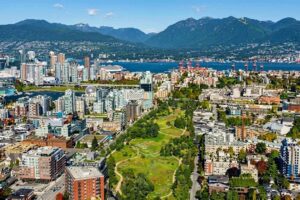
Defined by the City of Vancouver local areas east of Ontario Street, where most of the visible minority ethnic populations reside — Strathcona, Grandview-Woodland, Hastings-Sunrise, Downtown Eastside, Mount Pleasant East, Kensington-Cedar Cottage, Renfrew-Collingwood, Riley Park East, Sunset, and Victoria-Fraserview — voter turnout, on average, was anywhere from 22% to 28%, with some polls reporting voter participation, ranging from 38% to 42%.
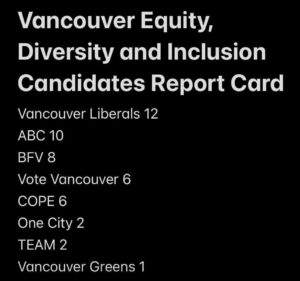 The list of Vancouver political candidates drawn from minority communities seeking elected office in Vancouver in 2026, by party affiliation, was compiled by the Coalition Against Bigotry-Pacific
Kareem Allam and the Vancouver Liberals are working towards getting out the vote on Vancouver’s east side, and in south Vancouver, setting a new record for voter participation in these neighbourhoods, to give every community a voice at Vancouver City Hall. That is the solemn commitment the Vancouver Liberals are making to the citizens of Vancouver in the 2026 municipal election, as they reach out to members of the 264 distinct ethnic communities who live across Vancouver, to young people, to seniors, to folks who are members of the New Democratic Party, the Conservatives, the Green Party, and more.
West Side of Vancouver Turnout in 2022
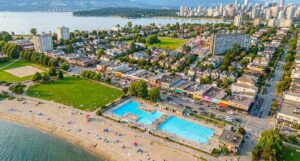
The lowest participation rate on Vancouver’s West Side occurred in Fairview and Marpole, where voter turnout drops to 31%–35%. This reflects lower homeownership rates and a higher proportion of transient renters compared to the single-family enclaves further west.
As reported in The Georgia Straight, based on data provided by the City of Vancouver, in the 2022 Vancouver municipal election, the single highest voter participation percentage on the West Side recorded occurred in Shaughnessy and Dunbar-Southlands, peaking at 52%–55% on average in each Vancouver municipal election since 2011.
In 2022, a full 63.7% of eligible voters failed to cast a ballot in that year’s Vancouver municipal election.
What would happen if a Vancouver municipal party, and a candidate for Mayor of the City of Vancouver, set out 15 months ago to meet with representatives of the alienated and disenfranchised voters in these communities, specifically on Vancouver’s East Side, meeting with members of each of these 201 visible minority communities who, traditionally, have not voted in Vancouver’s civic elections?
Well, that is exactly what Kareem Allam, the Vancouver Liberals Mayoral candidate in the 2026 Vancouver municipal election set out to do 15 months ago.
Over the course of the past 457 days, Kareem Allam and his Vancouver Liberals campaign staff have met with representatives of these alienated, disenfranchised 201 visible minority communities, in their homes and at their community gatherings, and have built a Get Out The Vote (GOTV) army of more the 2,000 Vancouver citizens — across all 264 distinct ethnic communities — who have committed to Kareem Allam and the Vancouver Liberals that each will get 10 or more members of their nuclear and extended families, as well as their friends, neighbours and work colleagues who constitute members of their community, to the polls to cast a ballot for Kareem Allam and the Vancouver Liberals.
Which means that in 2026, Vancouver could see the highest turnout / voter participation rate ever in a Vancouver civic election, emerging as the difference maker in 2026 that will thrust Kareem Allam and the Vancouver Liberals into civic power at Vancouver City Hall, post this year’s October 17th Vancouver municipal election.
In 2015, in the Canadian federal election, 17,711,983 Canadian voters out of a total of 25,939,742 eligible voters — or 68.3% of eligible Canadian voters cast a ballot in that critical federal election — thrust Justin Trudeau into office as the 43rd Prime Minister of Canada, and the Liberal Party of Canada into comfortable majority government status, dramatically defeating Stephen Harper and the Conservatives after 10 years in power.
Average percentage voter turnout over Harper’s 10 years in power was 58.8%.
Justin Trudeau’s Liberals were elected to 184 seats in Parliament in 2015, while Stephen Harper’s Conservatives secured only 99 seats, 67 fewer seats than when the Conservatives won 166 seats in 2011 and Stephen Harper won a majority government.
According to Research Co., Angus Reid and other polling companies, 62.7% of Vancouver voters want change.
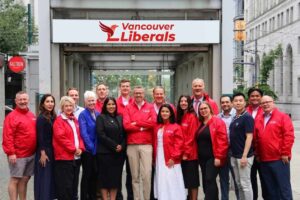 Vancouver Liberals | The most ethnically and politically diverse group of candidates in Vancouver
Change. VanRamblings believes, as was the case in the 2015 federal election, that is exactly what we’re going to get come the evening of Saturday, October 17, when the percentage of eligible voter participation rate in this year’s Vancouver municipal election will rise from the 36.3% turnout rate in 2022, to more than a record 45% voter participation rate in the 2026 Vancouver civic election — based on a radically increased turnout of previously alienated and disenfranchised voters in Vancouver’s visible minority population, who will flood to the polls to elect a Vancouver unity government of civic reconciliation, thrusting Kareem Allam into the Mayor’s office and electing a majority Vancouver Liberals civic government at Vancouver City Hall come the evening of Saturday, October 17, a responsible and responsive, activist civic administration, delivering services for the people of Vancouver, while keeping taxes low.
Vancouver, then, may look forward to a Kareem Allam-led “let’s get ‘er done” Vancouver Liberals civic administration serving the interests of all of us who call Vancouver home, a Kareem Allam-led government delivering for us, holding power and gaining the respect of Vancouver residents in every one of Vancouver’s 23 neighbourhoods through until Vancouver’s next municipal election in 2030 — and, perhaps, beyond.