Category Archives: Food & Health

Stories of a Life | Redux | Chief Cook & Bottle Washer

Jude and Megan Tomlin, aged 3 and 16 months, sitting at the kitchen table in 1978
1978. Jude, at age 3½, and Megan at near 2 years of age. At the kitchen table for breakfast.

A couple of weeks ago, when I was extolling the virtues of my Instant Pot to a friend, in a lull in the conversation, she turned to me and said, “You like to cook, don’t you?”

The short answer: I derive pleasure from both cooking and baking.

Here’s the story behind my love for the culinary powers of the kitchen.

1616 Semlin Drive, and East 1st Avenue, in Vancouver. One of the homes I lived in growing up.
1616 Semlin Drive, at E. 1st Ave. in Vancouver. One of the homes I lived in growing up.

From my earliest days, I fended for myself.

My mother worked three jobs, and my father worked the afternoon shift at the Post Office. When I arrived home from school, although my father often left a stew bubbling away in the slow cooker, from age seven on, for the most part if I wanted to eat, I’d have to make breakfast, lunch and dinner for myself, and for my sister.

So, being somewhat industrious, I learned to cook — well, make sandwiches and, for dessert, Jello, at least for the first few years.

I loved turkey growing up (all that triptiphan), so with the help of my mother, I learned to make her delicious turkey, stuffing, gravy, mashed potatoes and vegetables. For the most part, though, my cooking skills were rudimentary — but I didn’t starve, and more often than not there was food in my belly.

When in 1970, Cathy and I moved in together, marrying soon after, I was responsible for most of the cooking. Cathy’s mom sent her out $1000 a month (she didn’t know we were living together), visiting every three months, taking us to the local Woodward’s grocery floor, where she dropped in excess of $300 at each visit.

With Cathy’s mother money, we ate a fairly staple diet of generously thick T-bone steaks and baked potatoes.

Simon Fraser University's Louis Riel House, a student family one-and-two-bedroom apartment
Simon Fraser University’s Louis Riel House, SFU’S student family 1 + 2 bedroom residence.

Soon after moving into the Louis Riel Student Residence at Simon Fraser University in 1971, Cathy joined a women’s group, who met every Wednesday evening. Among the decisions that were taken by the women’s group was this: men shall participate in all household chores, and share in all food preparation.

As we often ate together with other of the students in the residence, my specialty became salads — all different kinds of healthy, nutritious salads, chock full of vegetables, nuts, sunflower seeds, and more.

At this point, Cathy still hated to cook — there was immense pressure placed on Cathy by her peers to develop culinary skills, but she refused. All that changed in the summer of 1973, which is a story for another day.

2182 East 2nd Avenue, in the Grandview Woodland neighbourhood of Vancouver
2182 East 2nd Avenue, in the Grandview Woodland neighbourhood of Vancouver.

When Cathy and I separated in 1978 — Jude and I lived in the home above, before Jude, Megan and I moved to Simon Fraser University and Louis Riel House, when I began work on my Masters degree — the thought occurred to me one morning when making breakfast that I was now the lone parent, and the sole person responsible for ensuring the children ate nutritious foods at each meal in order that they might grow up into healthy adults.

I took on the task of learning the art of cooking (and baking), in earnest.

There was, however, a quid pro quo involved.

After returning from a day of larnin’ and T.A.’ing at SFU, after picking up the children at daycare at 4:30pm, and walking the relatively short distance to our two-bedroom apartment at Louis Riel House, while the children played with their friends on the lawn in front of our apartment, I prepared dinner, calling them in about 45 minutes after dinner preparation had begun.

The kids were famished, and so was I.

Here’s where the quid pro quo came in: at the end of each meal, each of the children had to turn and say to me some version of, “Daddy that was a good dinner. It was mmmm, delicious. Thank you for making dinner for all of us, and all the work you put in to feeding us healthy and nutritious breakfasts, lunches and dinners, and all those wonderful desserts we love!”

I needed the incentive provided to me by both children, and their gratitude — which, in time, they came to acknowledge as their own. The kids felt good about encouraging me, as I encouraged them in all of their endeavours.

We were a happy family, and all was well with the world for the three of us.

Now, I was an adventuresome cook, and not everything I made turned out to the liking of all of us, or each one of us.

Being a dedicated democrat, Jude, Megan and I made a deal with one another in respect of dinner. Both children had to eat at least two bites of each food item I prepared: after all the work I put into preparing a dish, the least they could do was try out the dish to see whether they might like it.

Most of the time they did, but sometimes not.

One night, I made cream of escargot soup. Honestly, it wasn’t bad. But at the end of the soup entrée, I turned to the children and asked them what they thought, to which they replied almost in unison, “It was all right, tasty enough I suppose, but I’m not sure if I’d ever want to have it again.”

I agreed with them. We never ate cream of escargot soup ever again.

Each of us were allowed to have three foods on a list of our creation, foods we did not have to eat, no matter what.

Megan had three foods, Jude had three foods, and I had three foods — those foods changed over a period of time.

In order to add a food to our individual “nah, I don’t want to eat that food” list, some food on each of our lists had to come off. Took some thought on the part of the children as to whether they wanted to remove a food.

Megan, for a great long while didn’t like avocados — but one day, while placing a new food she didn’t like onto her “don’t eat” list, she took avocados off her list, eventually coming to love avocados, as she does to this day.

Watching me prepare meals all the time he was growing up caused Jude to want to become a chef — he worked in the food industry throughout his late teens and twenties, before getting into teaching, which paid better, and was overall less stressful, with “more honourable people”, he’d say to me.

In her teens, Megan became a vegan — there’s a story there, too, which I’ll leave for another day — and, for the most part, took on the preparation of her own meals, as did Jude over a period of time.

After the summer of 1973, Cathy became a great cook — there’s not much I miss about that tumultuous marriage, but I sure miss Cathy’s avant-garde cooking, her culinary craftsmanship, spicing and phenomenally delicious cooking.

Ah well.
Vancouver Broadway Plan, and Its Impact on the Kitsilano Neighbourhood

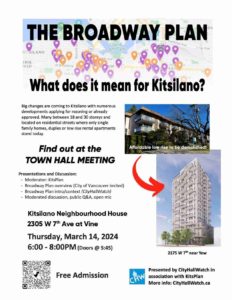
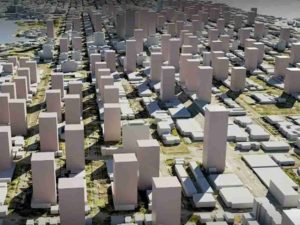
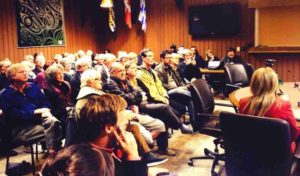
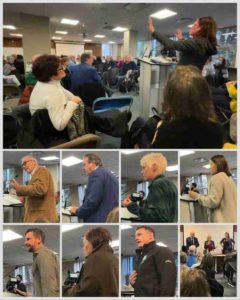
This past Thursday evening, in an event sponsored by CityHallWatch — the online activist civic affairs journal — in a crowded, overflow event held at Kitsilano Neighbourhood House, a broad spectrum of speakers addressed the Broadway Plan — an extensive development plan for the future of Vancouver’s Broadway corridor, a growth plan that envisions an additional 50,000 residents who will take up residence along the corridor from Clark to Arbutus streets, between 1st and 16th avenues — and the implications of the Plan on the Kitsilano neighbourhood.


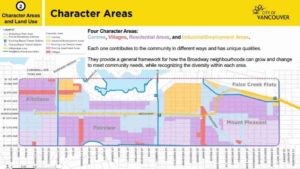
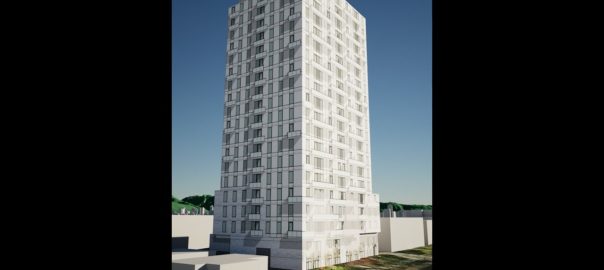
The Broadway Plan will provide a framework for the types of buildings, with towers between 20 to 40 storeys allowed in the light blue ‘centres’. The graphic above was supplied by the City of Vancouver.

The evening was MC’d by Larry Benge, a co-founder and co-Chairperson of the Coalition of Vancouver Neighbourhoods — an alliance of more than 20 community and residents’ associations, who have long sought and continue to seek a respectful relationship between the powers that be at City Hall,  and the 23 neighbourhood communities that comprise and are at the heart of the City of Vancouver.


Video | Vancouver’s Broadway Plan: What does it mean for Kitsilano? Townhall Meeting March 14, 2024

Well-informed, respected and accomplished speakers at Town Hall included …

    • Brian Palmquist, a Vancouver-based architect, and publisher of the ‘you must subscribe to’ City Conversations substack, an in-depth journal that provides detailed coverage of development in the City of Vancouver, and its implications for the health, safety and well-being of those of us who reside in the city;
    • Arny Wise, an urban planner, retired developer, and mediator of municipal housing disputes in Vancouver;
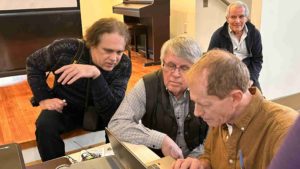
      In front, l-r: Stephen Bohus, Brian Palmquist, Randy Helten. In behind: Arny Wise.
    • Michael Geller, an urban planner, real estate consultant and property developer, who serves on the adjunct faculty of Simon Fraser University’s Centre for Sustainable Development and School of Resource and Environmental Management. His blog may be found at gellersworldtravel.blogspot.ca;
    • Scot Hein, a retired senior urban designer employed by the City of Vancouver for more than 30 years, and at present an Adjunct Professor in the Master of Urban Design Programme at UBC where he works with his colleague …
    • Patrick Condon, the James Taylor chair in Landscape and Livable Environments at the University of British Columbia’s School of Architecture and Landscape Architecture, and the founding chair of the UBC Urban Design programme.

    In addition to those named above, during the question, answer and commentary portion of the meeting, former Vancouver City Councillor Colleen Hardwick spoke about the lack of civic democracy, while an architect present with his family in attendance spoke of the work of an old Simon Fraser University pal of VanRamblings, the University of Victoria’s Robert Gifford, a Professor of Psychology and Environmental Studies, who in his paper titled The Consequences of Living in High-Rise Buildings [PDF], writes …

    “… high-rises are less satisfactory than other housing forms for most people, are sub-optimal environments to raise children, social relations within high-rise towers tends to be more impersonal and less than satisfactory than is the case with more ground-oriented housing forms, there is an increased incidence of crime and fear of crime among those who reside in high-rise developments, social cohesion is more difficult and substantively less present in tower developments, while independent studies have found that tower high-rise living may well be a strong contributory and determinative factor that can lead to an increased incidence of suicidal ideation and actual suicide among residents who live in concrete, steel and glass tower constructed buildings.”


    The future of the Kitsilano neighbourhood along the West Broadway / West 4th Avenue corridors

The thrust of Arny Wise’s address to those gathered at the Kitsilano Neighbourhood House Town Hall was that the advent of environmentally unsound steel, concrete and glass towers to increase density in the Kitsilano neighbourhood is simply not an optimal form of development to achieve the density desired by planners at Vancouver City Hall.

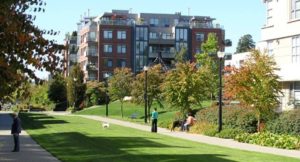
Scot Hein made reference to the Arbutus Walk neighbourhood, west of Arbutus Street and West 12th Avenue that, originally, was presented by the Molson-Carling developers and planners back in the day at Vancouver City Hall as three 50-storey concrete and steel towers — a development which the neighbourhood residents very much objected to — that under Mr. Hein’s watch was transformed into a neighbourhood-friendly and livable townhouse, 3-5-and-10 storey condominium and affordable housing development, with a walkable green space centering the development, and a 10-storey housing co-op established in the northwest corner.

It should be noted in passing that the final Arbutus Walk neighbourhood achieved much higher densification, overall, than would have been the case had the originally planned three 50-storey podium and tower development gone forward.


Two final notes for today (there’s more coming tomorrow) …

As UBC’s Patrick Condon pointed out at meetings’ end …

“Vancouver has tripled the number of housing units in our city since the 1970s, more than any other urban centre on the continent, certainly a laudable and unprecedented development feat, far outstripping the number of developments elsewhere. Yet, if supply is “the answer”, why is it that even with a 300% increase in development in Vancouver, we have the poorest supply of affordable housing for residents, the highest land prices, the highest rents of any jurisdiction across the continent, and the most expensive condominiums? Supply, alone, is not the answer.”

And, finally, on a somewhat hopeful note: both Arny Wise and Brian Palmquist pointed out during their presentations that the Planning, Urban Design and Sustainability Department at City Hall has had a change of heart respecting tower development along the Broadway corridor. No longer will citizens face the prospect of dark corridors lined with towers on either side of arterial streets.


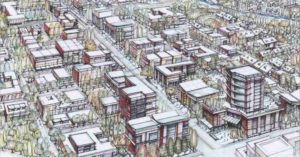
Sensitive Urban Infill Charette Report City of Surrey. Drawing: Neda Roohnia, Landscape / Urban Design

Rather, arterial streets like the Broadway corridor will allow six storey developments, while the allowable 20-to-40-storey tower developments will be situated one block behind either side of the arterial street, so as “to prevent shadowing” and obviate the dark arterial corridor residents have made known in no uncertain terms to Vancouver City Hall that, that under no circumstance they want or desire.

Arterial streets must remain walkable, and neighbourhood friendly.

Not good news, of course, for those residents who live along the tree-lined streets, off Broadway (9th Avenue), along West 10th and West 8th Avenues.

But there you have it, for what it’s worth. As we say above, more tomorrow.

#SaveOurParkBoard | A Passionate, Reasoned, Well-Attended Town Hall

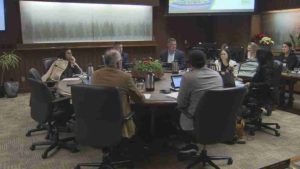
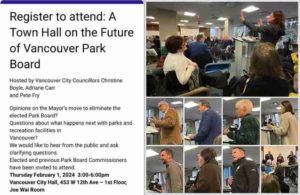
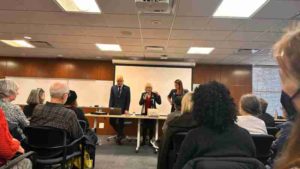
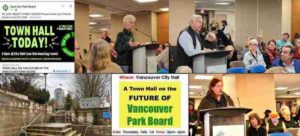
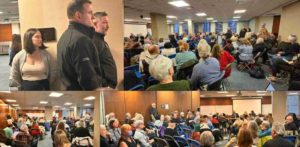
This past Thursday afternoon, Green Party of Vancouver City Councillors Pete Fry and Adriane Carr, and One City Vancouver Councillor Christine Boyle organized a spirited Town Hall — with more than 200 passionate, reasoned citizens in attendance, who oppose the elimination of an independent, elected Park Board — the event taking place in the Joe Wai Room, on the main floor of Vancouver City Hall.


Vancouver City Councillors, l-r:  the Green Party’s Pete Fry and Adriane Carr + OneCity Vancouver’s Christine Boyle

One of the most compelling speakers of the afternoon was Terri Clark, Vancouver Park Board’s Public Affairs Communications Manager from 1973 through 2008.

“In all my years at Park Board, our General Managers worked productively with Vancouver City Managers Fritz Bowers (1977-1990), Ken Dobell (1990-1998) and Judy Rogers (1999-2008). Ours was a relationship of mutual respect and co-operation.

Necessary funds were always provided by the City for the upkeep and maintenance of Vancouver’s parks, pools and community centres, in order to best serve the public interest.

               Photo credit: Elvira Lount
First row, above: l-r
, Park Board Commissioner Tom Digby | John Coupar, former Park Board Chair | Tricia Barker, Commissioner, last term | Laura Christensen, current independent Commissioner; Bottom row, l-r. Michael Wiebe, former Commissioner, former City Councillor | Sarah Blyth, former two term Commissioner | Brennan Bastyovanszky, current independent Park Board Chair.

Recent maintenance problems at the Aquatic Centre or Kits Pool would never have been allowed to happen in Mr. Bowers’,  Dobell’s and Judy Rogers time as City Manager at Vancouver City Hall.

In September 2009, before Susan Mundick, Park Board’s General Manager (1998-2009), announced her “retirement“, City Manager Penny Ballem had stripped Ms. Mundick of all her duties, stating she would “help park board choose Ms. Mundick’s replacement”, a selection process City Hall had never previously been involved in.

If our pools and community centres are in disrepair today, as Mayor Sim has pointed out, such a circumstance arises from City Hall’s decision to cut Park Board out of any and all maintenance decisions, ceding those responsibilities to the City, which over the past dozen years has largely ignored the needs of what was once a world class parks and recreation system of which we were proud.”

Several past and current Park Board Commissioners addressed those who had gathered at City Hall last Thursday, including: Michael Wiebe, who spoke about the role of Park Board Commissioners in preserving the natural environment; past Park Board Chair, John Coupar, who addressed the role of Park Board in creating a livable city;  both Sarah Blyth and Tricia Barker reminded those present that “Ken Sim and his ABC Council were not given a mandate to abolish the Vancouver Park Board”; while formerly ABC Vancouver but now independent Park Board Commissioners Brennan Bastyovanszky, Scott Jensen and Laura Christensen committed to continuing their work in the community to preserve the invaluable 135-year legacy of an independent, elected Vancouver Park Board that serves the interests of all British Columbians and “those who visit our beautiful city”.

Several speakers referenced an article in The Vancouver Sun, written by Canadian gardening legend Brian Minter, who writes …

“The Vancouver Park Board maintains 242 parks that comprises 11% cent of Vancouver land. In addition, Park Board maintains 22 kilometres of seawall at Stanley Park, and walkways along False Creek. Park Board’s mandate includes 10 ocean beaches and a freshwater lake beach. Not only are they responsible for the city’s recreation programmes, services and community centres and facilities, park infrastructure comes under their jurisdiction.

In a time of significant climate change with the huge challenges of heat and drought, and the drive to expand green spaces, a high priority must be placed on the viability of parks. The importance of green spaces, the many proven benefits to both our health and wellness are well-documented, as our needs continue to grow.

The Vancouver Park Board is one of our region’s most important public assets and needs dedicated people and citizen engagement to ensure the long-term viability of  B.C.’s, and indeed, Canada’s, most spectacular green spaces, for generations to come.”

And then there’s the disposition of the 242 Vancouver’s parks, one hundred of which do not a have a protected park designation.


Former ABC, now independent PB Commissioners, l-r: Laura Christensen, Brennan Bastyovanszky, Scott Jensen

Perhaps the most articulate and moving participant in Thursday afternoon’s Town Hall was Laura Christensen’s month-old daughter, who cried throughout most of the proceeding, voicing the despair clearly felt by her mother — to whom Mayor Ken Sim had committed his support, when he asked her to run as a Park Board Commissioner on his ABC Vancouver slate — and the despair and frustration of those who had gathered together in common cause to, as one speaker, said “fight ABC’s undemocratic initiative to abolish our cherished, independent Park Board.”