At a time when municipal politics can sometimes look like an old person’s game, Solomon Yi-Kieran represents something Vancouver badly needs: a younger generation prepared not merely to complain about politics, but to enter the arena and try to change it.
Power structures across the country are often dominated by older cohorts, leaving younger residents feeling that the issues directly shaping their futures — from soaring living costs to climate resilience — are addressed with passive incrementalism rather than urgency. It is precisely why having young leaders come forward to run for elected office is so critical.
Young candidates bring a essential perspective to local government. They carry the lived experience of navigating today’s acute housing crisis, reliance on public transit, and the precarity of the modern economy. Rather than viewing policies through abstract statistics, young representatives experience the direct impact of municipal decisions every day.
At 20 years old, Yi-Kieran — who identifies as they/them — represents a rising generation of community organizers who refuse to wait on the sidelines.
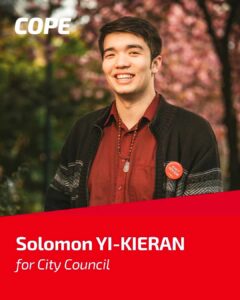
Stepping up to bring that exact energy and perspective to local government is Solomon Yi-Kieran is running for Vancouver City Council with the The Coalition of Progressive Electors (COPE) in the October 17 municipal election. Still in their early 20s, they are among the youngest candidates seeking a seat on Council — and their résumé is already unusually substantial for someone so young.
Yi-Kieran graduated from Glenlyon Norfolk School in Victoria in 2023. While still in high school, they were accepted into Oxford University’s history and politics programme, but ultimately chose to attend the University of British Columbia.
At the University of British Columbia, Yi-Kieran is an Arts student studying History and Linguistics, with a particular interest in history and education. They have said their long-term ambition is to become a high-school history teacher.
Their political education, however, has taken place as much outside the classroom as inside it.
Despite their young age, Yi-Kieran already boasts a track record as a public advocate and student leader. Yi-Kieran has been deeply involved in UBC student politics, serving as a student senator and, more recently, as Vice-President External Affairs of the Alma Mater Society, representing more than 61,000 undergraduate and graduate students.
Yi-Kieran has advocated for improved accessibility and academic accommodations, recorded lectures, affordable student housing, greater financial assistance and more transparent university governance.
Their activism extends beyond campus.
Yi-Kieran has worked with the BC NDP, participated in campaigns involving affordable sexual-health services and humanitarian assistance, and organized advocacy for a federal Youth Climate Corps. That campaign ultimately helped secure $40 million for youth climate employment.
Yi-Kieran’s background in activism is rooted in tangible, grassroots organizers’ campaigns:
-
Public Transit Expansion: As AMS VP External, they spearheaded the high-profile campaign to extend the Millennium Line SkyTrain route directly to UBC, organizing rallies and leading a petition that gathered over 15,000 signatures to press provincial and municipal governments into action.
-
Student & Tenant Advocacy: They have consistently organized around tenant rights, pushing for tenant protections in student residence housing and lobbying for increased non-market and below-market housing options in the University Endowment Lands.
-
Climate & Youth Empowerment: Through coalition work with student unions across British Columbia, Yi-Kieran campaigned for the establishment of a national Youth Climate Corps.
Running on the progressive COPE platform, Yi-Kieran’s Council campaign focuses on systemic challenges:
-
Housing Affordability & Tenant Protection: Expanding non-market, social, and co-op housing, alongside strong rent-control protections to keep renters from being priced out of Vancouver.
-
Public Transit & Infrastructure: Accelerating major regional transit extensions like the UBC SkyTrain corridor and ensuring accessible, frequent municipal transit options.
-
Climate Action & Green Jobs: Supporting local climate initiatives, including clean energy transitions and workforce opportunities for young people in sustainability.
-
Labour & Accessibility Reforms: Championing worker rights, accessibility accommodations, and transparent civic governance that invites broader public participation.
Yi-Kieran’s campaign offers Vancouver voters a chance to bring a fresh, community-driven voice to Vancouver City Hall — one that understands the pressing realities facing the city’s youth, renters, and working residents.
Perhaps their most visible campaign has been the fight for a SkyTrain extension to UBC. As AMS vice-president external, Yi-Kieran spearheaded a petition that gathered more than 10,000 signatures and pressed provincial and federal governments to move forward on the long-promised project.
Now Yi-Kieran wants to take that activism to Vancouver City Hall.
There is a tendency on the left to approach issues on a macro scale, to fight for systemic change that makes a difference for the better in the lives of groups of our disenfranchised population, whose voices are neither heard nor respected.
Sometimes in such a circumstance, there is a tendency to lose touch with the individual needs of members of the community, of families, of Vancouver’s new immigrant or ethnic populations, of individual seniors and students.
From VanRamblings’ personal experience, we are here to tell you that in addition to working on a macro scale for systemic change, Solomon Yi-Kieran also connects — really connects — on a micro scale, that is, they see you, feel you, empathize with you, hear your concerns, and will work with you one-on-one to make the conditions of your life better, to work with you to resolve your issues of concern.

Something else to mention about Solomon Yi-Kieran, for which again we have first hand salutary experience: Solomon is kind.
Sadly, a commodity in short supply in politics.
In an era where political discourse is often dominated by divisiveness, hostility, and polarization, the concept of kindness might seem quaint or naïve.
When we examine the foundational purpose of politics — the organization of society for the common good — kindness emerges as a practical and necessary value.
At its core, kindness represents empathy, respect, and a genuine concern for others. When woven into the fabric of political practices, kindness fosters collaboration, promotes inclusivity, and enables the pursuit of justice and equality.
When you cast your ballot for Solomon Yi-Kieran this October, and when they are elected to Vancouver City Council, you will come to find that there is no stronger advocate for you on City Council than Solomon Yi-Kieran, whose boundless energy, heartbreaking intelligence, inspiring presence in your life, and dedication to improving the conditions of your life will always be the driving force and central feature of their time in municipal governance at Vancouver City Hall.
Their platform emphasizes affordable housing, rents, better and eventually free public transit, government transparency and accountability, and making Vancouver a city in which young people can afford to build a life. They have called for reviving the City’s Renters Office, and establishing a climate defense strategy.
Solomon has emerged as one of COPE’s leading voices opposing proposed artificial-intelligence data centres in Vancouver, calling for a moratorium until their environmental, water, electricity, employment and privacy implications are properly understood.
But Yi-Kieran’s candidacy is about more than any particular policy.
Canadian politics — and especially municipal politics — can become dominated by people who have been around for decades. Experience matters, certainly. But so does having people in government who will live with the consequences of today’s decisions for another 50 or 60 years.
Young politicians bring a different perspective. They experience the housing crisis as renters rather than homeowners. They depend upon public transit. They confront the realities of precarious employment, student debt, climate change and an increasingly digital economy firsthand.
Yi-Kieran’s campaign offers Vancouver voters a chance to bring a fresh, community-driven voice to City Hall — one that understands the pressing realities facing the city’s youth, renters, and working residents.
They also bring something politics desperately needs: a sense of urgency.