Open letter to Vancouver City Council on the “Villages Plan”
Patrick Condon, Professor Emeritus, University of British Columbia
UBC School of Architecture and Landscape Architecture
Subject: Serious Concerns with Vancouver’s Villages Plan
Dear Mayor and Council,
I write to challenge key elements of Vancouver’s Villages Plan Programme.
Together with the recently approved Official Development Plan and Broadway Plan, the City is now granting private owners of more than 80,000 parcels the right to build roughly 700,000 new housing units.
This represents enough capacity to house an extra 1.4 million people — more than double Vancouver’s current population of 670,000.
At today’s 1% annual population growth rate, this single decision delivers over 100 years of future housing supply. Yet even the projects already in the approval pipeline (roughly 78,000 units) would satisfy 30 years of trend growth.
Contrary to this city’s long standing policies for new density approvals, this massive landowner entitlement is being provided free of charge, with no expectation of payment for these new land rights.
These land rights are worth many billions of dollars.
The City is giving them away for free in the hope that this will somehow make housing more affordable.
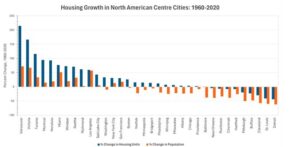
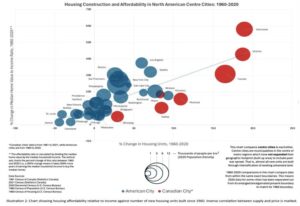
This is an odd notion for our planners to hold. If adding hundreds of thousands of new units to existing neighbourhoods truly lowered prices, Vancouver would have North America’s cheapest housing.
It has North America’s most expensive housing. (charts below)
It defies logic to expect an “unleashing of the housing market” — the primary justification provided for the Villages Plan — to produce affordable housing when we have spent decades trying to do just that. Vancouver has tripled its housing stock since the 1960s, all within a city where virtually every private parcel was in urban use. This is a higher percentage increase of infill development than that of any other North American centre city. If adding housing to existing city districts was the sure fire path to affordability we would have seen positive results by now.
Based on this evidence, it is clear: if affordability is the main justification for this plan, it obviously fails the test.
Massively over-zoning a city above reasonable expectations for population growth serves little purpose. The only purpose it serves is to support the false narrative that only “restrictive zoning” stands in the way of affordable housing. It doesn’t. It never has. It can’t.
The claim is false.
On the contrary, if any city proves that it is possible to use zoning as a positive public policy tool, it is the City of Vancouver. We tripled housing units city-wide. No other centre city did that — an unheard-of achievement.
While this sadly did not make the city more affordable, as we had hoped, it did make the city better. Much better.
How was this 200 percent growth accomplished? By working with residents, not against them. Community planning with local communities was the means to this achievement. Planning with communities was not an impediment, as some now claim. It was the democratic path to a better city.
But sadly it is now obvious that our decades-long effort to encourage the housing market, in the hope that housing would stay affordable, has failed us. Given this evidence, it seems foolish to upzone so aggressively, hoping against hope that, in 30 or 40 years, housing will be more affordable.
Achieving durable affordability much sooner than this requires a major change in direction. We don’t lack housing; we lack affordable housing. Given this fact, we should follow a path that other similar cities have charted — one where the bulk of new housing built is affordable to average wage earners. This can be done by reviving the Vancouver tradition of building non-market housing at scale, largely financed through “land lift” taxes as applied in Yaletown.
Our own internationally famous False Creek South serves as a storied precedent. Service workers to business owners have found homes in that lovely, self-sustaining community.
The pattern is obvious. Reuse it.
Unfortunately, the Villages Plan moves us in exactly the wrong direction. It virtually rules out any form of land value capture tax, based on the mistaken fear that it would raise home prices. It won’t — and it can’t.
A properly designed land-lift tax simply reduces the inflated “land price residual” that now funnels unearned speculative windfalls into private pockets. A properly designed “land lift” tax channels those gains into public benefit — without increasing the price buyers ultimately pay.
I urge you to revise these plans by deeply involving residents from every corner of the city in a highly collaborative, bottom-up, neighbourhood-focused planning process. One that might arrive at much stronger inclusionary zoning requirements.
The people of Vancouver would rally behind such plans — plans that ensure that their sons and daughters, and the workers who keep this city running, can afford to live in the very neighbourhoods they serve and call home.
Do not pass this plan.
Let us turn instead to plans that are sustainable in scale, equitable in outcome, and shaped not for the market alone, but for the people who live and work here.
Yours truly,

Professor Emeritus Patrick M. Condon
University of British Columbia
More voices weigh in on ABC Vancouver’s Villages Plan development proposal
Steve Jedreicich — principal of Vancouver’s SJ Development Ltd., brings over 30 years of local urban planning and real estate consulting experience to the housing discussion — weighs in on ABC Vancouver’s contentious Villages Plan proposal.
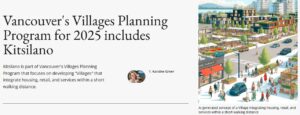
WBN News Vancouver publisher Karalee Greer’s published article on the impact of the Villages Plan development proposal currently before Vancouver City Council, in particular its impact on Vancouver’s Kitsilano neighbourhood. At present, well more than 1000 speakers are set to address the controversial Villages Plan proposal, in meetings that thus far have lasted well into the night at Council.

Randy Helten and Steve Bohus, the good, hard working, dedicated folks behind the informative CityHallWatch website offer a backgrounder on Vancouver’s Villages Plan proposal, suggesting the plan “was born in the USA.” CityHallWatch offers six more Villages Plan articles the site published in the months of June and July. Click on the multi-coloured links below to access the articles.
- Vancouver’s plan for 17 new ‘villages’ will increase uniformity, sterility (Douglas Todd, 5-Jun-2026;
- Why Vancouver Must Re-think the Villages Plan (references one-size-fits-all) (Housing Reset, 18-Jun-2026);
- Stop Calling them Villages (Scot Hein);
- Opinion: It takes time to grow a village. You can’t accelerate that evolution through rezoning. (Erick Villagomez, Vancouver Sun, 14-Jul-2026);
- Families shocked by Villages Plan freeze on homes (14-Jul-2026);
- The Villages Plan – In Defence of a Neighbourhood. Sterilization – one house at a time. (2 Dualities, 19-Jul-2026).
Yes, there are even more Villages Plan articles available to you.
As is his wont — and thank goodness for that — The Daily Hive’s well-respected, incredibly hard working urban affairs reporter Kenneth Chan, early in July, published a thorough and well-researched article on Vancouver’s Villages Plan proposal.
Well worth a read.