Category Archives: Canada

#VanPoli | Housing & Development | Making The Vancouver Plan Irrelevant, Pt. 1

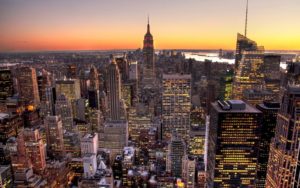
Vancouver Planning Staff and Developers Set to Turn Vancouver into Manhattan West

A core element of Colleen Hardwick’s successful 2018 run for office as a Vancouver City Councillor was the need for the city to draft a visionary planning document — to be called The Vancouver Plan — a bold, comprehensive and inclusive city-wide, neighbourhood and heritage community development plan for all residents living in the City of Vancouver, a 30-year plan that would focus on creating opportunities to integrate new housing, recreation centres, jobs, and amenities across our city.

As a first order of business early in her inaugural term of office, working with three term Vancouver City Councillor, Adriane Carr, Councillor Hardwick seconded a pioneering motion that would have staff employed within the Planning Department at Vancouver City Hall draft The Vancouver Plan (initial title, the City-Wide Plan) document, towards the creation of a livable, affordable and sustainable city, a single, city-wide plan that would guide future growth consistent with key community priorities, a guide to our city’s future growth …

  • The provision of affordable housing in all of Vancouver’s 22 neighbourhoods;
  • Working on a meaningful climate action plan, and environmental sustainability;
  • The provision of well-paying jobs city-wide & in neighbourhoods + economic growth;
  • Prioritizing public and active transportation needs for Vancouver residents;
  • Arts & culture, and the provision for related community amenities;
  • Infrastracture, including community pools, ice rinks and recreation centres.

Public input would be sought in The Vancouver Plan engagement process, which continues through until this day.

The final draft document of The Vancouver Plan is set to be presented to the public and to members of Vancouver City Council in early spring of 2022.

In the video above, the narrator of the visionary Vancouver Plan intones …

“Now more than ever, it’s important to reduce our use of carbon fuels, and adapt to climate change. To advance these big ideas, we need to rethink our low density neighbourhoods. To that end, we could help shape future growth more in major transit areas. New housing, jobs, child care centres, and public plazas would be built along these transit corridors.”
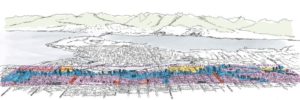
Remembering for just a moment that The Vancouver Plan is far from having completed its community engagement process, and is not due to be presented to both the public and Vancouver City Council until spring 2022, this past Wednesday, November 3rd, the Planning Department presented The Broadway Plan to the members of Vancouver City Council, a fait accompli document that will add 50,000 new residents along the Broadway corridor, framed by Vine Street to the west, 1st Avenue to the north, Clark Drive to the east, and 16th Avenue to the south.”

As reported in The Daily Hive Vancouver by civic affairs reporter Kenneth Chan …

“The emerging direction of the densification strategy calls for increasing Central Broadway’s population by up to 50,000 to about 128,000 residents — an increase of 64% compared to 78,000 residents today. This would be achieved by growing the number of homes in the area from over 60,000 today to up to 90,000 units, with much of this is intended to be more affordable forms of housing.

Added office, retail, restaurant, institutional, and creative industrial spaces would grow the number of jobs from 84,400 today to up to about 126,000 jobs.”

The residential and employment targets outlined above would occur over a period of the next 30 years, through until 2050. Tower heights between 30 and 40 storeys will be built in areas around the stations. Shoulder areas adjacent to the immediate area surrounding the stations — generally within a two or three block radius — will see height allowances of 20 to 30 storeys.

Example of a “Centre” area near the future South Granville Station, November 2021. (City of Vancouver)
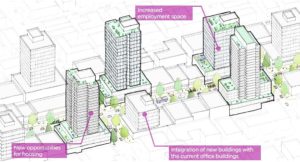
Example of “Shoulder” areas along Broadway in the Broadway Plan, November 2021. (City of Vancouver)

More details on the “Broadway Plan” may be found both in Mr. Chan’s story in The Daily Hive, and John Mackie’s story in The Vancouver Sun.

The question has to be asked: if the reasoned, thoughtful and neighbourhood resident consulted 30-year visionary document, titled The Vancouver Plan, is not due to be presented to Vancouver City Council until spring 2022, why are the members of Vancouver City Council being asked by the City Planning Department to approve The Broadway Plan as early as next week, on either November 16th, 17th or 18th?

And why, if The Vancouver Plan is a city-wide and neighbourhood visionary development plan for Vancouver as we head towards 2050, why is the City Planning Department taking a piecemeal approach to presenting any number of development plans in the pipeline to Council now — months in advance of the presentation of The Vancouver Plan to the public & members of Vancouver City Council?

Tomorrow on VanRamblings, we’ll present 1) several more “visionary” large scale developments currently in the Vancouver development pipeline — of which you may not be aware — that are destined to have a major impact on the livability of our much cherished Vancouver home; 2) a continued exploration of VanRamblings’ ongoing thème du mois — “A city for whom? Benefiting whose interests?”; and 3) whether the tens of thousands of housing units set to be built as envisioned in proposed Vancouver development plans to be presented to Council even before the final draft of The Vancouver Plan will be made public, will result in an overbuilt city that will cater explicitly to wealthy and offshore investment interests and their developer friends, rather than to the implicit and explicit interests of Vancouver residents living in the 22 neighbourhoods across our city.
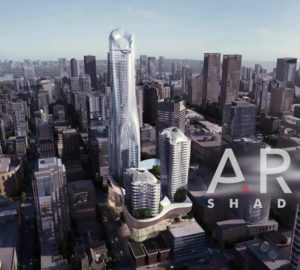
The 70+ storey Bay Parkade development — due east of the Hudson’s Bay Company, and sandwiched between Seymour and Richards streets — one of seven 65+ storey downtown developments approved by Vision Vancouver (the first two, the Shangri-la Hotel on Georgia, and its neighbour across the street, Holborn’s “Trump Tower”), the Bay Parkade development will be presented to Council for approval sometime before the 2022 Vancouver civic election.

#VanPoli | False Creek South | The Heart of Our City Preserved


REJECTED | City of Vancouver Real Estate Department Plan for False Creek South

In early October, when the City of Vancouver’s Real Estate Department presented a sordid, mercenary plan for the redevelopment of False Creek South —  that parcel of land on the south side of False Creek stretching from the Cambie Street bridge to the Granville Street bridge — Mayor Kennedy Stewart the very next day came out in full-throated support of The Plan, writing in an overly solicitous column published in The Straight that averred …

“Great cities like ours can never stand still. We must always examine whether our city is meeting our needs, both for today and tomorrow.”

The Real Estate Department’s Plan called for a greedy financial return to the City, that sought to more than triple the existing density of homes in the False Creek South neighbourhood, from 2450 units to a reconfigured 6600 units.

The real cost of the Plan?

The absolute, utter destruction of the False Creek South neighbourhood, a decimation of the heart and demographic integrity of one of Vancouver’s most sustainable and livable districts — the ‘close-fisted’ Plan laying waste to existing housing co-operatives dotted throughout the neighbourhood, moving residents from their current locations to a ghettoized, ‘poor door’ stretch of land situated along the bustling, carbon emitting 6th Avenue traffic corridor.

Community outrage soon ensued.

As founding chair of the UBC urban design programme, Patrick Condon, wrote in an article in The Tyee , the City’s Real Estate Department’s Plan would …

  • Increase market condos nearly fourfold, from 688 to 2,350 units;
  • Increase by more than 13x market rental units, from 150 to 2020 units;
  • See all new buildings constructed at least six storeys tall, ranging up to 50 storeys tall at the Granville Street bridgehead. Today, most buildings on the district’s city-owned land are three to four storeys in height;
  • Shift the tenure mix on city-owned land from the current 36% market strata, 8% market rental & 56% non-market co-op / affordable rental units, to 35% market strata, 30% market rental, and 34% non-market co-op and affordable rental;
  • Eventually demolish most of the existing co-ops, with these sites reused for market rentals and market condos, or to expand Charleson Park.

As Robert Renger, a retired senior planner who worked with the City of Burnaby, wrote in a response article in The Straight to the column written by Mayor Stewart — as well as to supporters of the City of Vancouver’s Real Estate Department’s Plan for False Creek South, which accused False Creek South residents of both nimbyism and elitism

  • 15% of FCS residents are children, with 11% freehold and 16% citywide;
  • 17.5% of False Creek South family households are single-parent, compared to 10.9% of False Creek South freehold and 15.9% citywide;
  • The income mix on FCS lands closely parallels that of the city as a whole.
  • The residents of False Creek South had long ago published a document they called RePlan , a thorough and critical vetting of the City’s proposed Plan for the False Creek South neighbourhood, writing that …

    “False Creek South offers a housing model that is affordable, resilient and community-focused, with a variety of affordable, mixed-income housing options that span a spectrum of housing tenures. We are calling on Vancouver City Council to protect the existing variety of affordable, mixed-income housing options in False Creek South, to eliminate the threat of housing insecurity on leased City land, to kick start community growth, and to create right-sized housing in the False Creek South neighbourhood.

    Let’s expand affordable, resilient, mixed-income, mixed-tenure housing communities. Vancouver needs to protect and create more housing that is community centred, diverse, equitable, inclusive and secure that spans all leasehold housing tenures, including permanent housing for people who have experienced or are at risk of homelessness.”

    On October 5th in a motion presented to her colleagues on Vancouver City Council, Councillor Colleen Hardwick did just that in calling for security of tenure for the beleaguered residents of False Creek South, whose ongoing residency in the neighbourhood would be jeopardized by the redevelopment Plan published by the City’s Real Estate Department. Before that motion could be discussed around the Council table, the members of Council sought to hear feedback from the residents of False Creek South, as well as citizens from right across the city.

    Councillor Colleen Hardwick + retired CoV planner / RePlan co-author , Nathan Edelson

    Long story short, after hearing from some 171 residents of the City of Vancouver — many of them children, now adults, who had grown up in the False Creek South neighbourhood — in, perhaps, the most moving series of addresses this or any other Council has ever heard, in an amendment motion presented by Councillor Christine Boyle, all 10 Vancouver City Councillors, with an about face by Mayor Kennedy Stewart, unanimously rejected the City Real Estate Department’s Plan for False Creek South, instead opting to turn the process of the redevelopment of False Creek South to the City’s Planning Department, which planning process will include respectful and extensive consultation not only with False Creek South residents, but engaged residents across the city at-large.

#CdnPoli | Prime Minister Justin Trudeau and His Legacy Cabinet

At the end of Tuesday’s Curse of Politics podcast, politico Scott Reid intones …

“Anybody who thinks this is Justin Trudeau’s last term in office, and that sometime before 2024 he’s going to resign as Prime Minister is a fool. That sort of punditry is nothing but lazy ass journalism. There’s absolutely no evidence to support that thesis. Why would you want to resign from the most important elected office in Canada, where change for the better that can be wrought with you at the helm? Never mind all the perks of the office. Those folks just oughta get over themselves, and stop that shit. It serves nobody’s interests. Fuck those assholes.”

Welcome to VanRamblings’ political world — it ain’t an easy life, lemme tell ya.


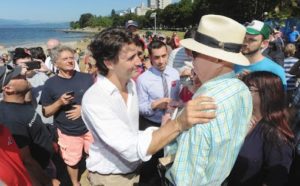
The 2015 campaign for office, with future Prime Minister Justin Trudeau at English Bay

VanRamblings has long believed that Justin Trudeau is a reluctant Prime Minister, who would rather spend time with his family, enjoying a life out of the public eye. Even so, Mr. Trudeau believes that he is uniquely positioned to both make a difference, and to maintain his father’s legacy of a fairer and more just Canada. For now, and the foreseeable future, he will make the sacrifices necessary, in order to maintain his family’s progressive vision for our nation.

In 2003, when Prime Minister Jean Chrétien tendered his resignation as Prime Minister of Canada, the first murmurings of what became known as the “AdScam Scandal” — involving illicit activities established to a fight a Parti Québécois government’s dreams of Québec independence, with tens of millions of dollars awarded to Liberal Party-linked ad firms in return for little or no work, where these ad firms maintained Liberal organizers, while donating much of their awarded monies back to Liberal party coffers — when in late 2005 a …

“Commission of Inquiry into the Sponsorship Program and Advertising Activities, headed by Justice John Gomery — which came to be known as “the Gomery Commission” — reported out, the Commission found that millions had been awarded in contracts without a proper bidding system, that millions more had been awarded for work that was never done, and that the Financial Administration Act had repeatedly been breached by the Liberal party government of Joseph Jacques Jean Chrétien.”

The death knell of federal Liberal governments for a generation was sounded.

Liberal Prime Minister Paul Martin lost the election he called in late 2005. The next federal Liberal Party leader, Stéphane Dion, lost again in the 2008 Canadian federal election, and in 2011 Liberal leader Michael “he’s just visiting” Ignatieff’s campaign saw the Liberals reduced to 34 meagre, ignominious seats, and fourth party status.

In late 2012, at the behest of family and longtime friends, political strategists Gerald Butts and Katie Telford — both senior policy advisors to Ontario Liberal Party leader Dalton McGuinty, dating back to 1999 — approached their former schoolmate and friend of some two decades, Justin Trudeau, and asked him to consider a run for the leadership of the federal Liberal Party of Canada.

On Sunday, April 14th, 2013, the son of former Canadian Prime Minister Pierre Elliott Trudeau, not only won his leadership bid, with 80.1% of the vote to 10.2% for British Columbia MP Joyce Murray, his victory more a coronation.

Two and one half years later, on October 15, 2015, 42-year-old Justin Pierre James Trudeau was elected the 23rd Prime Minister of Canada, having mounted a stunning, come from behind victory that saw the Liberal Party form a strong majority government of 184 seats in the House of Commons in Ottawa.

And since that day, Prime Minister Trudeau has not known a moment’s peace.

The governments of Justin Trudeau have wrought change for the better.

  • The Canada Child Tax Benefit has provided thousands of dollars more to 9 out of 10 Canadians families, lifting more than 40% of Canadian families out of poverty;
  • Marijuana and its by-products have been legal in Canada since 2017;
  • Tax cuts for middle class families, not the wealthy, have benefited 9 million Canadian families each year for the past six years;
  • After 10 years of Prime Minister Stephen Harper muzzling scientists in the Environment and Fisheries and Oceans department, and across his government, federal scientists have, since 2015, been afforded the opportunity to speak openly on government policy;
  • The Trudeau government has quadrupled funding for women’s shelters;
  • $9 billion to train thousands of new, highly-paid personal support workers;
  • Mark Jaccard, a professor of sustainable energy at Simon Fraser University’s School of Resource and Environmental Management has written that the federal Liberal Party climate action plan is a “world best,” with the government’s closure of coal plants, and a carbon tax that will see greenhouse gas emissions in Canada reduced by 40% by 2030, among myriad other world leading initiatives;
  • Through the introduction of Bill C-14, the federal government introduced legalized medical assistance in dying, offering Canadians the choice to die with dignity to patients who are suffering intolerably.

Re-opening the Kitsilano Coast Guard base; providing support to 450,000 students by increasing Canada Student Grants by 50%; reopening and staffing nine Veterans Affairs service offices across the country — these are just a few of the accomplishments of the governments of Justin Trudeau over the past six years in what has emerged as one of the most progressive governments anywhere across the planet.

And yet, you just can’t get away from feeling that Justin Trudeau’s continuing sacrifice of the joys of a private life, and time with his family and friends, weighs ever more heavily on him with each passing day, the relentless attacks by the opposition parties and right-wing media (“Hello, Brian Lilley“), with the support of only 33.12% of Canadians at the polls in this most recent election — despite his 159-seat minority government win — ever more unbearable.

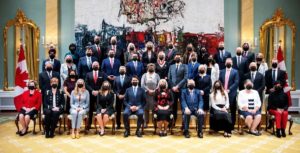
For however long this Parliament lasts, in what may be Mr. Trudeau’s final term in office, the next years will be ‘legacy years’ for his government on the issue of the environment — which is why, on Tuesday, he appointed Greenpeace activist and respected Québec environmentalist Steven Guilbeault as his newly-minted Minister of Environment and Climate Change, and the former activist Minister who held the portfolio, Jonathan Wilkinson, as the new Minister of Natural Resources, both Ministers set to work in tandem to address the issue of oil and gas extraction, and dedicated to moving Canada away from the extraction of fossil fuels.

A pan-Canadian, legacy $10-a-day child care plan already signed onto by seven provinces and one territory, with the Ontario government just wrapping up negotiations with the federal government, and both Alberta and New Brunswick, and the two other territories not far behind; $2.7 billion in increased funding for the National Housing Co-investment fund; $3 billion over five years to support the application of higher standards for long-term care homes; unprecedented investment in public transporation, from buses, commuter rail, and a 21st-century high-speed system of regional train systems; $18 billion over 5 years to improve quality of life and create new opportunities for people in Indigenous communities, while completing the work on eliminating boiled water advisories on Indigenous lands; 10 days of paid sick leave for federal workers; funding for improved ventilation in schools and legal protection for businesses that decide to require vaccinations — represent just a few of the necessary initiatives of the Trudeau government.

Scott Reid, Jenni Byrne and David Herle present below the most cogent analysis of the “shuffle” of the Trudeau Cabinet yesterday morning, in this third — and maybe, final — term of the Justin Pierre James Trudeau-led Canadian federal government.

#COVID19 | Canada Falls Behind | Number of Vaccinations Low

Canada falling behind in vaccine doses administered, in comparison with other countries

In comparison with other countries across the globe, Canada’s roll-out of the two approved COVID-19 vaccines, Pfizer-BioNTech and the Moderna coronavirus vaccine has proved significantly more challenged, and much slower when compared with vaccine roll-outs in many other countries.
Oxford University’s online tool Our World in Data, from which the information in the graphic at the top of today’s column was obtained, has Canada listed far below other countries like Israel and Bahrain, when measuring vaccines administered per 100 people …

  • Canada at 0.14

  • United States at 0.59
  • United Kingdom at 1.18
  • Bahrain at 3.23
  • Israel at 4.37

In Canada, the slow pace is being blamed on limited supply, poorly planned vaccination programmes in some provinces, and the technical deep-cold storage required for the Pfizer vaccine.
Approximately 242,000 doses of the Pfizer vaccine and 168,700 doses of the Moderna vaccine, for a total of just over 410,000 overall vaccines had arrived in Canada by early this week.

President-elect Joe Biden has promised that 100 million American will be immunized in first 100 days of office

In the United States, President-elect Joe Biden has promised Americans that by the end of his first 100 days in office, or near the end of April, more than one hundred million COVID-19 immunizations across the U.S. will have been administered. To meet that goal, which works out at a million immunizations a day, Biden acknowledged that his administration would need to move several times faster than Trump administration roll-out, and vowed to invoke the Defense Production Act to accelerate vaccine production and launch an education campaign to tackle vaccine hesitancy.
In other words, before the end of April 2021, one-third of all Americans over the age of 18 will have been immunized against COVID-19. Biden has promised that by June 30, every American who wants a vaccine will have received a coronavirus immunization, to protect them and their families.

British Columbia plans to immunize 400,000 B.C. residents by March 31, 2021

Meanwhile, in British Columbia, Public Health Officer Dr. Bonnie Henry has stated that B.C. plans on immunizing 400,000 people against COVID-19 by late March of 2021, with priority given to residents and staff of long-term care homes and health-care workers — that would be fewer than 10% of British Columbians over the age of 18 will be vaccinated by March 31st.
Federally, in a sombre pre-Christmas Day message, Prime Minister Justin Trudeau told the populace roughly 375,000 Canadians, or one per cent of the Canadian population, should be vaccinated with the two-dose Pfizer shot by January 30th, with all Canadians who wish to be immunized due to be vaccinated by September 30, 2021 — three long months behind the U.S.

Canadian federal election in spring 2021 thought to be a strong possibility

Meanwhile, for all the bluster among federal political leaders about not wanting an election any time soon, the political truth is as cold as the winter’s wind: the potential for a spring 2021 Canadian election will, in all likelihood, become a reality, as Canadians once again head to the polls.
And what will emerge as the key issue in the upcoming 2021 federal election? Could it be the painfully slow, behind every other developed country in the world, “botched” roll-out of the life-saving COVID-19 vaccine to Canadians anxious to return to some sort of normalcy, sooner rather than later, in 2021 — with the possibility that Canadians might experience an almost usual summer season full of music festivals, Hollywood blockbusters, travel across our great nation sans the necessity of having to wear a mask, a Canada that will allow us to once again congregate with our family, our friends, our neighbours and colleagues in safety and good cheer.

Prime Minister Justin Trudeau expected to call a spring 2021 federal Canadian election

In addition to the already approved Pfizer-BioNTech and Moderna novel coronavirus vaccines, in the coming month Health Canada is expected to approve the following COVID-19 vaccines …

  • Oxford-AstraZeneca: 20 million doses;

  • Johnson & Johnson: up to 38 million doses;
  • Novavax: up to 76 million doses; with …
  • Medicago (up to 76 million doses), and Sanofi and GlaxoSmithKline (up to 72 million doses) also in the pipeline.

If Canada’s roll-out of the life-saving novel coronavirus vaccines is, indeed, slow, you can reasonably predict that Canadians will be not just disconsolate but might find themselves more raucously up in arms, and perhaps even bloody pissed that Canada has proved so slow off the mark.
If there’s no crying in baseball, there ain’t no winning in politics, either.