
Category Archives: Canada

#VanPoli | Taxes | Downloading the Tax Burden to Municipalities

In a disparaging VanRamblings story published last week on this site —  titled Vancouver City Council To Raise Property Taxes a Whopping 6.35% — we took Vancouver City Councillors to task for raising property taxes in our city beyond what most homeowners, small businesses, and landlords could reasonably afford.

Now, as it happens, VanRamblings is a big fan of taxes which, in good measure, pay for: our schools, from kindergarten through university post-graduate work; roads, highways, bridges and other transportation infrastructure (including public transit); our judicial and public safety systems (the courts, police, fire firefighters, paramedics, prisons); ‘social programmes’ including all aspects of child care (encompassing children in the care of the province, when family structures have broken down); all aspects of our vibrant health care system; and much, much more.
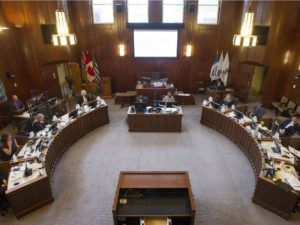
To be fair to Vancouver Mayor Kennedy Stewart, and the five Vancouver City Councillors who voted in favour of the 6.35% property tax increase in 2022 — that would be the three Green Party of Vancouver City Councillors, Pete Fry, Adriane Carr and Michael Wiebe, OneCity Vancouver’s Christine Boyle and COPE’s Jean Swanson —  as is our wont, today we’ll publish one of our infrequent “history lessons” to explain, at least in part, the rationale as to why the Mayor and five City Councillors cast their vote in favour of a  6.35% property tax increase for 2022.

In 1984, Conservative Party leader Brian Mulroney was elected as Canada’s 18th Prime Minister, supplanting a Liberal Party of Canada that had been in power for 21 consecutive years, Canada’s 33rd Parliament in the autumn of 1984 consisting of 202 Tories, 135 Liberals, and 31 New Democrats. During Mr. Mulroney’s nine years in power, his government had many successes, on the environment and on the trade front, negotiating a groundbreaking free trade agreement with the United States. Contrary to billing, more often than not, Conservatives in power tend to be spendthrifts, all while cutting taxes for corporations and the wealthy, and failing to keep an eye on the federal budget.

In the midst of a deepening recession, when Mr. Mulroney stepped down as Prime Minister of Canada on Friday June 25, 1993, apart from and in spite of the then wildly unpopular 7% Goods and Sales Tax (GST) his government had brought in, Mr. Mulroney left his successor, Kim Campbell, with the legacy of a multi-year $42 billion annual budget deficit — a grim sum absolutely unheard of in those days.
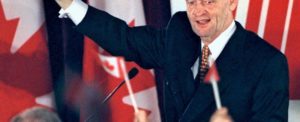
Only four short months later, on Monday, October 25th, 1993 Joseph Jacques Jean Chrétien was elected as Canada’s 20th Prime Minister. First order of business? Appoint a Finance Minister, and commit to not only eliminating the egregious annual deficit, but cut the accumulated $840 billion long term Mulroney legacy debt in half. Who would perform that masterful fiscal feat? The head of Canada Steamship Lines, from 1988 forward the Member of Parliament for the southwestern Montréal riding of LaSalle-Émard, and Prime Ministerial aspirant, Paul Martin.

In Canada, long ago the federal government negotiated what became known colloquially as a tax rental agreement with the provinces. The federal government would collect income taxes from Canadians, take a portion for federal coffers, while transferring the majority of the federal tax income collected back to the provinces. For years, back to 1945, the agreement worked well for all levels of government — until 1996, when Finance Minister Paul Martin “changed the game”.

In the 1995 federal budget Jean Chrétien’s Liberal government abandoned any pretense of federal financing of post-secondary education, changing what was known as the Canada Social Transfer into the renamed the Canada Health and Social Transfer(CHST), cutting a total of $3.5 billion in the CHST for the 1996/97 fiscal year. The total cuts to the provinces in the first five years Jean Chrétien was in power: $7.6 billion in transfer payments that would otherwise have gone to the provinces, or a devastating decline of 40.7% in health, education and other transfer payments to the provinces by the 1999-2000 federal fiscal year.

All of a sudden, the provinces were made almost entirely responsible for the largest provincial budget item: health care, and entirely responsible for funding post-secondary education, federally-funded programmes that had been in place since as far back as the end of World War II.

The good news for the federal government: by 2003 federal Liberal Finance Minister Paul Martin had not only eliminated any notion of an annual federal budget deficit — instead, creating a yearly surplus —  but had, as well, paid down $440 billion in long term debt, cutting the federal debt in half as Jean Chrétien had promised a decade earlier. The bad news for the provinces: provincial Premiers and their Finance Ministers had to come up with funds to make up for the lost / eliminated “tax rental agreement” revenue that funded provincial programmes.

Provincial governments made up for the lost federal revenue by creating, or dramatically raising, provincial sales taxes, instituting or raising fees for every imaginable service, from driver’s licenses to camp ground fees, along with instituting bridge and road tolls while looking to any other sources of revenue provincial Finance Ministers could come up with to make up for lost federal funding.

The major source of newfound provincial revenue: municipalities. If the federal government had download responsibility to the provinces for health care, housing, and post secondary education, provinces sought to gain revenue from the towns, villages and cities that filled the landscape of their provinces. All of a sudden, cities, towns and villages were almost entirely responsible for the provision of affordable and social housing, social programmes, child care, road construction and maintenance, and other infrastructure (sewers, provision of clean water), and any number of programmes previously almost the sole responsibility of the provinces.

Where senior levels of government may run deficit budgets, cities, towns and villages, school boards, and Vancouver’s Park Board are required to run an annual balanced budget. With responsibility for programmes previously funded by the province now the responsibility of municipalities, cities, town and villages scrambled to find the required revenue, which translated into: skyrocketing parking rates and extended paid parking hours, dramatically increased parking fines, and skyrocketing development permit fees for homeowners and developers alike — and, what is known as Community Amenity Contributions by developers paid to the city to fund child care centres, neighbourhood recreation centres, as well as social and affordable housing, and a variety of arts and other programmes.

Here, then — as may be seen in Councillor Boyle’s tweet above — was the dilemma faced by Mayor Kennedy Stewart and our City Councillors when, last week, together our elected civic leaders voted for a 6.35% property tax increase for 2022, to fund not just core programmes, but the programmes that determine the livability of our city, and also fulfill the election commitments made by the Mayor, the three Green Party City Councillors, and our OneCity and COPE Councillors. Last week, for Mayor Stewart and five of our Councillors, conscience won out over fiscal restraint.

#CdnPoli | Why Did Prime Minister Justin Trudeau Call a Summer Election?

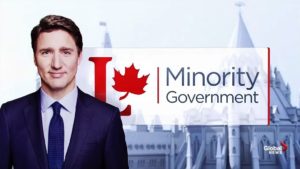
The most frequently asked question over the course, and throughout the duration, of the summer election called by the Prime Minister: why did Justin Trudeau call a needless summer election — particularly when, on Election Day, the final electoral result was a continuing minority Liberal government?

Internal Liberal Party polling conducted last spring, and throughout the summer, registered Justin Trudeau and the Liberals with a 45% approval rating, with Trudeau one of the most well-liked and respected Canadian Prime Ministers since Confederation. In the summer, within the Prime Minister’s office, the pressure on Trudeau to call a snap election was immense.

Prior to the 2021 federal election, the Liberal Party held 154 seats in a Parliament of 338 members. Pragmatically, what that meant for the Liberals was that all of the Committees of the House had majority Opposition party participation, and more importantly, decision-making power that could be — and more often than not was — wielded by the Opposition as a cudgel to serve their own partisan interests: the Conservatives, NDP, Bloc Québécois, and Greens, those parties less interested in the welfare of the Canadian people than scoring points against the government.

As they did during the election, in a display of rank partisanship and future, hoped-for increased electoral success,  and possibly government, the elected members of Erin O’Toole’s Conservative Party and Jagmeet Singh’s NDP colluded to make the life of the government as miserable as possible, using the committees not simply to hold the government to account, but to do all in their power to create an impression that Justin Trudeau’s government was both ‘do nothing’, and corrupt.

Little wonder Prime Minister Justin Trudeau wanted to call a summer election.

Why did Justin Trudeau call a summer election, then? To recap …

  • Throughout the first 8 months of the year, the Liberals had been riding high in the polls, Canadians grateful for the quick action by Prime Minister Justin Trudeau to secure the economy, through the introduction of CERB for Canadians who found themselves out of work due to the pandemic; the introduction of both a seniors grant for the poorest seniors, and an ongoing monthly supplement to the Canada Child Benefit to help families weather the storm of the pandemic; and the introduction of any number of business support programmes to keep the Canadian economy afloat. And, of course, securing the tens of millions of COVID-19 vaccine doses that would keep Canadians safe, and help over time to bring COVID-19 to an end. Thus far, more than 60 million doses of the mRNA Pfizer, Moderna, and the AstraZenica and Janssen vaccines have been administered to Canadians 12+, with millions more doses to be made available for children aged 5 to 12 years;
  • Focus on the economy and the health of Canadians rather than continue to allow the Conservatives and the NDP to play the sort of unproductive partisan politics that not only made the life of the government more difficult, but in having to respond to the partisanship of the Tories and the NDP on the Committees of the House, inhibited the Liberals from governing as effectively as the government deemed necessary, and to serve the best interests of all Canadians. A majority government, had that been the result of the September 20th election, would have made the life of the government easier, while still allowing the Opposition to hold the government to account.

In respect of the Trudeau government not being able to secure a majority, make no mistake: Shachi Kurl cost the Liberals a majority government.

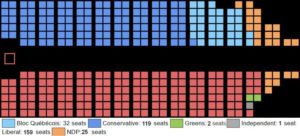
Going into the English Leaders’ debate, the Bloc Québécois had lost their footing, with all polls showing them unable to retain more than 10 seats in Parliament, for a loss of 22 seats. The support of Québeckers had moved virtually wholesale to hometown boy Justin Trudeau and his Liberal party — which looked to pick up most of the lost Bloc seats, propelling them to a majority government. Then Ms. Kurl asked a damnedly poorly phrased question concerning Québec Bill 21 — banning Québec citizens from wearing religious symbols, and mandating that one’s face be uncovered to give or receive specific public services — the contentious nature of her question propelling the Bloc into a stratospherically high 32-riding seat count, costing the Liberals their much sought after majority.

One final point: the opportunity to exercise our franchise, to go to the polls and cast our ballot in seclusion, to hold our government to account, is central to our nation’s democracy. No election held in Canada, or elsewhere, is ever unnecessary. The opportunity to go to vote in an election is both our democratic right, and at the core of our democracy. Following a 35-day election period, Canadians went to the polls, and collectively decided that a continuing minority government for the Liberals would be for all of us the best possible outcome, and voted accordingly.

#CdnPoli | The 44th Session of the Canadian Parliament Begins Today

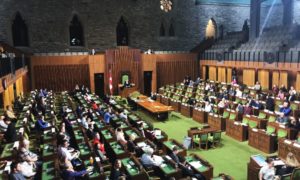
The ‘new’ House of Commons is located in what used to be the outdoor courtyard of the West Block on Parliament Hill, while the decade-long renovation of the Centre Block Commons building  takes place

The 44th session of Canada’s Parliament officially commences today, followed by a Speech from the Throne on Tuesday at 9 a.m. PST, to be read by Governor General Mary Simon, who will lay out Prime Minister Justin Trudeau’s key priorities for his minority Liberal government.

From the last, pre-election, Parliament to this, the Liberals gained 5 seats, the Conservatives lost 2 seats, the Greens lost 1 seat, there’s now one independent, and the Bloc Québécois stand pat at 32 seats

The clock is ticking on the Liberal promise to introduce a host of bills — including the introduction or reintroduction of at least eight bills — within the first 100 days of their new mandate, and the year-end session of Parliament.

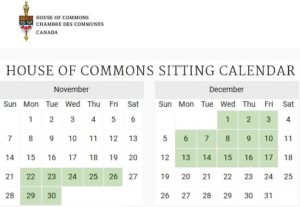
The government will sit for only 24 days to get things done in the Commons before the clock runs out on Feb. 3 — with the first two days essentially lost since they’ll be devoted to electing a Speaker, and delivering a throne speech..

The Commons is scheduled to sit for four weeks before breaking for the holiday season on December 17th. MPs won’t return to Ottawa until January 31st.

If the Liberals intend to keep their promises for the first 100 days — and they insist they do — that spells a crammed legislative agenda for the few weeks the House of Commons will be sitting before the new year.

“We have a very aggressive agenda to get to in the coming weeks and that’s what we’re focused on,” government House leader Mark Holland said last week following the Liberals’ first post-election caucus meeting.

Here’s what’s on the government agenda in the next 24 sitting days …

    • Implement last month’s announcement on more targeted emergency aid benefits for individuals & sectors hardest hit by the COVID-19 pandemic;
    • Pass a bill to impose criminal sanctions on anyone who blocks access to vaccine clinics, hospitals, testing centres and abortion clinics, or anyone who seeks to intimidate or harass health care workers, keeping a promise made by Trudeau as anti-vaccination protests ramped up during the recent, late summer election campaign;
    • An important bill, with NDP support, would provide 10 days of paid sick leave for federally regulated workers, a measure triggered by the pandemic;

    • A bill will be re-introduced  to ban the traumatizing practice of forcing a person to undergo “conversion therapy” aimed at altering their sexual orientation or gender identity. Although Conservatives spun out debate on the ban last time and more than half of the Tory caucus voting against the initiative, banning conversion therapy is strongly supported by all other parties;
    • Combat online hate, including hate speech, terrorist content, incitement to violence, child sexual abuse and non-consensual distribution of intimate images. New legislation will make social media platforms accountable for the content they host;
    • Reform the criminal justice system to address the disproportionate incarceration of Black and Indigenous people: the elimination of mandatory minimum sentences for less serious crimes and greater use of conditional sentences, such as house arrest, counselling or treatment, for people who do not pose a threat to public safety;
    • Safeguard Canada’s critical infrastructure, including 5G networks, to preserve the integrity and security of national telecommunications systems.

    The platform also commits the government to a host of other non-legislative tasks within 100 days, including appointing a new federal housing advocate, holding a summit on restarting cultural industries, and working with provinces and territories to create a national paid sick leave plan.

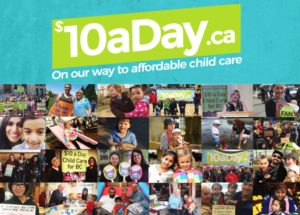
    And, of course, completing the task of bringing all provinces and territories on board for the government’s much needed, and long overdue economic, feminist and family equity issue — $10-a-day national child care.

    More tomorrow on the 44th session of the Canadian Parliament.

#VanPoli | Meet Vancouver’s Next Mayor | Jody Wilson-Raybould

Vancouver’s next Mayor, Jody Wilson-Raybould, principled and a voice for our city, and our nation

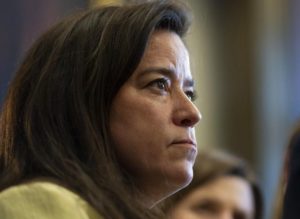
The woman pictured above, former federal Liberal Minister of Justice and Attorney General, Jody Wilson-Raybould — although something of a polarizing political figure, and although she has yet to announce her bid to become Vancouver’s next Mayor — come Saturday, October 15th, 2022 will become Vancouver’s 41st Mayor.

Possessed of great integrity — for which she is justly famous, and highly regarded — incredibly bright, accomplished, articulate and human in a way one rarely finds in the political realm, Jody Wilson-Raybould will likely announce her bid for the Mayor’s chair in early 2022, not out of any cynical calculation, but because Ms. Wilson-Raybould is a protector of our land, our city, and possessed of the kind of integrity that is all too rare in Vancouver politics — which is to say, she’s not involved in politics to enrich her bank account, or find herself beholden to developer interests — but honestly believes that she possesses the innate knowledge on the functioning of government and how best to achieve one’s policy goals, the heart, the humanity and the wit essential to emerge not just as the leader of our city, but a leader across our nation, as Vancouver’s necessary voice on the national stage.

VanRamblings believes that Ms. Wilson-Raybould will announce her candidacy for Mayor in the new year, following a series of meetings with the membership of the Coalition of Progressive Electors — represented by Jean Swanson on Council — and OneCity Vancouver, represented on Council by Christine Boyle.

Given that Ms. Wilson-Raybould is known for doing her homework, and given that affordable housing and human-scale development in Vancouver are key issues of concern for the voting electorate, Ms. Wilson-Raybould will also seek out the learned counsel of Patrick Condon, the James Taylor chair in Landscape and Livable Environments at the University of British Columbia’s School of Architecture and Landscape Architecture, among a host of other academics who care deeply for our city, including Simon Fraser University’s Andy Yan and Josh Gordon, and UBC’s Scot Hein, a highly-regarded former city planner.

Calgary’s new and first woman Mayor, Jyoti Gondek

Calgary’s new Mayor Jyoti Gondek — the first female Mayor in the city’s history, who on her way to victory, defeated 26 challengers to replace outgoing Mayor Naheed Nenshi; Montréal’s re-elected Mayor Valérie Plante, who defeated incumbent mayor Denis Coderre in 2017, trouncing him again last month.

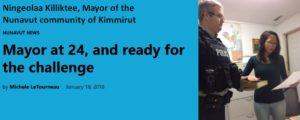
In Nunavut, the Nunavut News stated a new trend had emerged in the territory of young women in politics, as 24-year-old Ningeolaa Killiktee was elected Mayor of Kimmirut, and Pam Gross as Mayor of Cambridge Bay. In the Northwest Territories, one media outlet stated that “Female candidates swept the municipal elections in the NWT,” and the CBC reported the victories of female Mayoral candidates in Hay River, Inuvik, Fort Smith and Yellowknife.

Canadian feminist and Mayor of Ottawa, Charlotte Whitton, was the first woman Mayor of a major city in Canada, serving from 1951 to 1956 and again from 1960 to 1964. Whitton was a Canadian social policy pioneer, leader and commentator, as well as a journalist and writer.

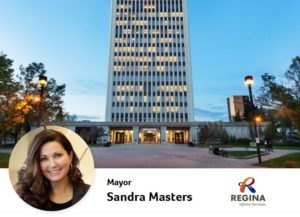
Janice Rhea Reimer became the first female Mayor of Edmonton, Alberta, serving in that capacity from 1989 until 1995. Saskatchewan Mayor Sandra Masters was sworn in as Regina’s 35th Mayor, after having swung to victory as the next year city’s first elected female Mayor, on November 23rd, 2020.

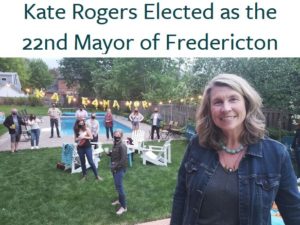
Kate Rogers elected as Mayor of Fredericton in 2020, the first woman to hold the position

Toronto Mayors June Rowland & Barbara Hall, Montréal’s Valérie Plante, Edmonton’s Janice Reimer, Regina’s Sandra Masters, Calgary’s Jyoti Gondek, Ottawa’s Charlotte Whitton, Cambridge Bay’s Pam Gross & Kimmirut’s Ningeolaa Killiktee, Halifax’s Moira Leiper Ducharme (1991-1994), Charlottetown’s M. Dorothy Corrigan, St. John’s Suzanne Duff, and Fredericton, New Brunswick’s current Mayor, Kate Rogers — all duly-elected Mayors of Canadian cities.

Whither Vancouver?

Every Mayor of Vancouver, from Malcolm A. MacLean in 1886, through until Kennedy Stewart today, have been white men of privilege more often than not elected to serve the monied interests of our city. Why is it that in 135 years, the good citizens of Vancouver have never seen fit to elect a woman as Mayor of our city, when almost every other city in Canada has seen fit do do so?

In all likelihood, Vancouver City Councillor Colleen Hardwick will throw her hat into the ring to become Vancouver’s next Mayor.

Rumour has it, too, that former Vision Vancouver Councillor Andrea Reimer is considering a bid to become Vancouver Mayor. VanRamblings’ sources have told us Coalition Vancouver’s Wai Young is set on running for office, as Mayor, in next year’s Vancouver civic election.

Andrea Reimer, former Vision Councillor (l); Adriane Carr, Green Party; Wai Young, Coalition Vancouver

The Green Party of Vancouver’s Adriane Carr is also reportedly considering a run for Vancouver’s top elected office next year.

And there remains to this day, the persistent rumour that current populist and well-schooled Vancouver City Councillor Sarah Kirby-Yung may also run for office as Mayor in next year’s municipal election.

A surfeit of qualified women candidates for Mayor of Vancouver, any one of whom would well represent our city, should she be elected to the office of Mayor in the 2022 Vancouver civic election, only 321 short days from today.