I want to have a plebiscite… on bringing in a ward system but only after a Citizen’s Assembly to make recommendations to form the ballot question. pic.twitter.com/SAFXZtuFlH
— Kareem Allam (@kareemformayor) August 18, 2026
Vancouver Liberals Mayoral candidate Kareem Allam’s proposal to place a plebiscite before voters in the 2030 Vancouver municipal election asking voters / Vancouver residents — should he become Mayor on October 17 2026 — whether they would like to see the adoption of a “ward” system / that is, elect a Councillor to represent their neighbourhood or geographic area, rather than electing 10 City Councillors at-large, deserves more than a passing mention in the 2026 Vancouver municipal campaign.
This issue goes to the heart of what democracy at the municipal level is supposed to accomplish: Is a Councillor primarily accountable to an entire city, or should there be a Councillor whose first responsibility is to the people and neighbourhoods of a particular part of that city?
We are committed to a Citizens’ Assembly to draft a plebiscite question on a ward system:
“Unlike other major Canadian cities, Vancouver chooses its Mayor and City Council via at-large elections where everyone votes for the same candidates and the victors represent the entire… https://t.co/pKvipNsYKz
— Kareem Allam (@kareemformayor) August 21, 2026
Kareem Allam, the Vancouver Liberals’ Mayoral candidate, has proposed establishing a Citizens’ Assembly to examine the adoption of a ward system in Vancouver.
The assembly would make recommendations and develop the question that could go before voters in 2030, with a ward system potentially taking effect for the 2034 civic election. The Vancouver Liberals say the present at-large system makes campaigns expensive and can leave neighbourhoods without direct representation.
Wards / geographic neighbourhood representation is an idea whose time has come.
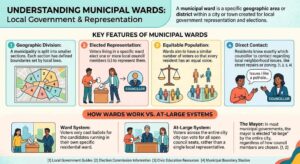
Vancouver Needs a Ward System: Democracy Begins Where People Live

Vancouver is an extraordinary city, but electing City Councillors at-large is an anachronism.
Today, Vancouverites elect the Mayor and 10 Councillors at-large.
Every voter can vote for every Councillor, and every Councillor is theoretically responsible for every resident of the city.
On paper, that sounds wonderfully democratic.
In practice, it can mean the opposite.
When everyone represents everyone, no one necessarily represents you.
That is the fundamental weakness of Vancouver’s at-large electoral system.
Imagine a resident in Killarney confronting a serious neighbourhood issue: a proposed development, traffic problems, inadequate pedestrian infrastructure, a community facility under threat or a local planning decision. Under the current system, that resident has 10 Councillors to whom she or he can appeal — and, paradoxically, no single Councillor whose political job is to be that neighbourhood’s representative.
Under a ward system, there would be one.
That distinction matters.
A Councillor Who Knows, Lives In and Cares About Your Neighbourhood
 In the heart of the city, Vancouver’s Mount Pleasant neighbourhood, looking north towards the mountains
Consider what happens in federal and provincial politics.
If you have a problem with a federal matter, you know who your Member of Parliament is.
If you have a provincial concern, you know who your MLA is.
You may not agree with that person politically. You may never have voted for them. But you know that person is your representative.
There is a geographical relationship between citizen and elected official.
Municipal government should work the same way.
A Councillor representing, for example, a ward encompassing Hastings-Sunrise and Renfrew-Collingwood would have an obvious political responsibility to understand those communities: their transportation problems, housing pressures, parks, schools, businesses, community centres, development proposals and neighbourhood concerns.
That Councillor could hold regular constituency meetings, maintain an office, attend community-association meetings and become known to the people who live there.
Most importantly, residents would know exactly who to call.
That is accountability.
Vancouver is The Outlier: Every Other Major City in Canada Has Wards
 Located in the NE part of Vancouver, the Killarney neighbourhood where ABC Councillor Mike Klassen grew up
The argument for a ward system is strengthened by looking beyond Vancouver.
Toronto elects 25 ward Councillors, with the Mayor elected city-wide.
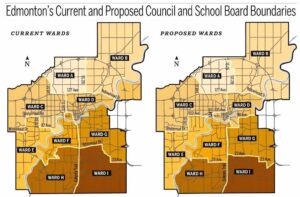
Edmonton has 12 wards and one Councillor per ward. Winnipeg has 15 wards, again with one Councillor representing each. Ottawa has 24 wards, with one Councillor elected from each and the Mayor elected at-large.
These are not small communities experimenting with an untested democratic theory. They are some of Canada’s largest municipalities.
And the principle is straightforward: the Mayor represents the entire city; Councillors represent both their communities and the city as a whole.
That is precisely the model Vancouver should consider.
It is worth correcting one point, however. It would be inaccurate to say that British Columbia is literally the only Canadian province in which large municipalities lack ward systems. Canadian provincial legislation permits different electoral arrangements, and some municipalities outside B.C. also use at-large or hybrid systems.
But Vancouver is unquestionably unusual among Canada’s major cities in continuing to elect its entire Council at-large.
And there is no compelling reason why Vancouver should remain an exception.
The At-large Election System Favours The City-Wide Political Machine
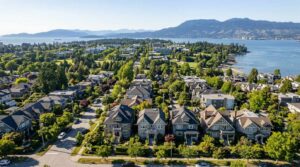 The almost always sunny Vancouver Point Grey neighbourhood, located in the western part of the city
There is another argument for wards that should not be ignored: money.
Running for one of 10 city-wide Council positions is enormously different from campaigning in a defined geographical constituency.
An at-large candidate must communicate with hundreds of thousands of voters across Vancouver. That requires money, organization, name recognition, volunteers and often the support of a political party or electoral slate.
A ward campaign would be different.
A candidate could concentrate on 50,000 or 60,000 residents rather than the entire city.
That opens the door to people who do not have the financial resources, political connections or city-wide name recognition required to mount an effective at-large campaign.
It could make civic politics more accessible to community activists, small-business owners, renters, neighbourhood advocates, younger candidates and people who have spent years working in their communities but have never contemplated a city-wide campaign.
In that respect, wards could actually democratize Vancouver politics.
Every Vancouver Councillor Must Have a Neighbourhood Constituency
 Vancouver’s east side Grandview-Woodland neighbourhood, home to a thriving retail Commercial Drive
Critics of ward systems argue that Councillors should think about the entire city.
Of course they should.
A ward Councillor would still vote on the city budget, transportation policy, housing, policing, parks, taxation, climate policy and every other issue before Council.
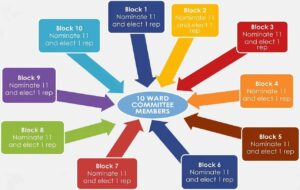
But representing a ward does not mean abandoning the city.
It means bringing a particular community’s perspective into the debate.
Indeed, a Council composed of geographically accountable representatives could arguably produce better city-wide decisions, because Councillors would arrive at the table with a deeper understanding of the communities affected by those decisions.
Vancouver is not one homogeneous city.
The concerns of Downtown are not identical to those of Kerrisdale.
Killarney is not Kitsilano.
Marpole is not Mount Pleasant.
Renfrew-Collingwood is not the West End.
That diversity should be reflected in the composition of City Council.
Elect a Mayor At-Large + 10 Councillors Representing Wards Makes Sense
 Osler Street in the Shaughnessy neighbourhood, Vancouver’s richest and most well-heeled neighbourhood
Kareem Allam has not proposed simply drawing 10 arbitrary lines across Vancouver. His proposal is to establish a Citizens’ Assembly that would examine the question and make recommendations.
That is precisely the right approach.

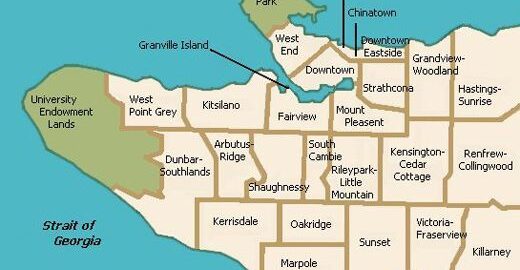
The neighbourhood groupings suggested for discussion provide a starting point:
- Hastings-Sunrise / Renfrew-Collingwood
- Grandview-Woodland / Kensington-Cedar Cottage
- Riley Park / Mount Pleasant
- Chinatown / Strathcona / Downtown / West End
- Fairview / Kitsilano
- Point Grey / Dunbar-Southlands
- Arbutus Ridge / Shaughnessy
- South Cambie / Oakridge
- Kerrisdale / Marpole
- Sunset / Victoria-Fraserview / Killarney
These should not be treated as predetermined boundaries. Population equality, communities of interest, natural boundaries, transportation patterns, neighbourhood identities and future population growth would all have to be considered.
Toronto’s ward-boundary process, for example, explicitly considered population equality, communities of interest, neighbourhoods, history and physical or natural features.
That is precisely the kind of independent, evidence-based process Vancouver needs.
Creating a Citizens’ Assembly is Critical to Adopting a Ward System
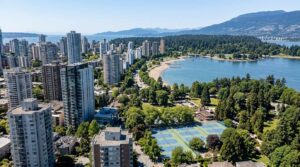 Vancouver’s West End neighbourhood, incorporating towers, tennis courts, English Bay and Stanley Park
The beauty of Kareem Allam’s proposal is that he is not saying: Elect me and I will impose 10 wards.
He is saying: let Vancouverites study the question first.
That distinction matters.
A Citizens’ Assembly could hear from constitutional and municipal-government experts, community associations, Indigenous representatives, political scientists, former Councillors, election administrators and ordinary residents.
It could examine ward sizes, boundaries, the number of Councillors, campaign financing, representation of renters and homeowners, population growth and whether a hybrid system might work better than a pure ward system.
Then, in 2030, Vancouverites could decide.
That gives the proposal democratic legitimacy.
Electing Vancouver’s Mayor Through The At-Large System Should Remain
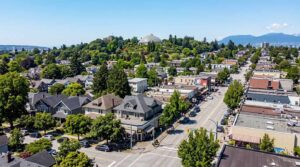 Vancouver’s welcoming, family friendly east side Riley Park neighbourhood, bounded by 16th Avenue to the north, 41st Avenue to the south, Cambie Street to the west, and Fraser Street to the east
There is a strong argument for retaining a city-wide Mayor.
The Mayor is the one elected official whose mandate should encompass the entire city.
The Councillor’s job is different.
The Mayor should speak for Vancouver.
The Councillor should speak for Vancouver, and for their respective neighbourhoods.
That creates a healthy balance between city-wide leadership and local accountability.
It is already the model used in Edmonton and Ottawa, among other cities. Edmonton explicitly describes its system this way: the Mayor is elected by all Edmontonians, while Councillors are elected by voters in their individual wards.
Why shouldn’t Vancouver do the same?
Changing the Vancouver Charter: The Province Can Accommodate Wards
 Vancouver’s east side Victoria-Fraserview neighbourhood, current home to ABC Councillor Mike Klassen and the love of his life, Stacey, Mike’s lovely bride, who together celebrated 28 years of marriage in July
There is an important misconception about this debate.
The Vancouver Charter already contemplates Councillors being elected on a neighbourhood-constituency basis.
Section 138 currently provides that Councillors are elected at-large unless Council adopts a by-law establishing neighbourhood constituencies. Such a by-law must receive approval from the Lieutenant Governor in Council before it can take effect.
In other words, the idea of geographically based representation is not foreign to Vancouver’s governing legislation.
The Province ultimately has the authority to approve the change.
The Vancouver Charter is provincial legislation, and the Province describes it as the statute that governs Vancouver’s structure, elections and principal municipal powers.
So, Kareem Allam’s proposal would ultimately require co-operation between Vancouver and Victoria.
That is entirely appropriate.
A Better, More Representative Democracy in Vancouver is Worth Pursuing
 Dunbar, one of Vancouver’s oldest west side neighbourhoods, adjacent to the University of British Columbia
There is no electoral system that guarantees perfect representation.
Ward Councillors can become overly parochial. They can favour their own neighbourhood at the expense of the wider city. Boundary-drawing can become contentious. Population changes can make wards unequal unless boundaries are periodically reviewed.
These are arguments for designing a good ward system — not preserving a flawed one.
Toronto has undertaken independent ward reviews specifically because population growth can make some wards substantially larger than others.
Vancouver can learn from Toronto, Ottawa, Edmonton, Winnipeg and other municipalities.
The central question is remarkably simple:
When a Vancouver resident has a problem with City Hall, a citizen should be able to look at a map, identify their Councillor and say, “That’s my representative”?
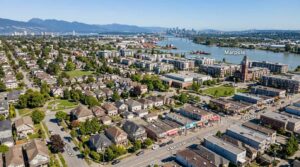 The Sunset and Marpole neighbourhoods of Vancouver, the Sunset neighbourhood home to Vancouver’s thriving Indo-Canadian population, Marpole bounded by the Fraser River, British Columbia’s longest river, to the south
The answer should be yes.
For too long, Vancouver has treated city-wide elections as synonymous with democracy.
But democracy is not merely the ability to vote for 10 Councillors.
Democracy is also representation, accessibility, accountability and proximity.
A ward system would bring City Hall closer to the people it serves.
It would give neighbourhoods a recognizable voice.
It could lower the barriers to entering municipal politics.
It could make Councillors more accountable to their constituents.
And it could ensure when a resident knocks on the door of City Hall, there is a Councillor whose political responsibility begins with the community where s/he lives.
Kareem Allam is right to put the question on the table.
The final decision should not belong to Kareem Allam, COPE, OneCity, ABC, TEAM, Vote Vancouver, the Greens, the Vancouver Liberals or any other political organization.
The decision on whether to adopt a ward system must belong to Vancouver’s citizens.
Let the Citizens’ Assembly do its work. Let the experts and residents debate the alternatives. Draw fair and transparent boundaries. And then let Vancouverites vote.
If, in 2030, the people of Vancouver decide that they want Councillors who actually represent where they live, then the 2034 election should mark the beginning of a new era in Vancouver democracy.
The city should elect its Mayor at-large. But those of us who live in one of Vancouver’s 23 neighbourhoods deserve Councillors of our own to represent our voices at City Hall.
