The Politics of Development, Corruption and Vancouver House. Thank you Robert Renger.
The story of Vancouver House is, depending on one’s perspective, either a triumph of architectural ambition or a cautionary tale about the dangers of a city becoming too closely aligned with the interests of powerful developers.
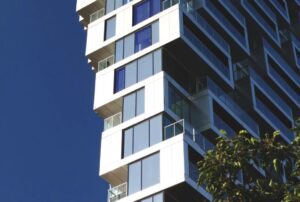
Today, the twisting glass tower at the foot of the Granville Bridge stands as one of Vancouver’s most recognizable landmarks. Designed by the internationally acclaimed Danish architect Bjarke Ingels and developed by Ian Gillespie’s Westbank Corp., Vancouver House has appeared in architectural journals around the world. Its dramatic form rises from a narrow triangular base before expanding into a rectangular tower as it climbs 58 storeys and 155 metres into the skyline.
Yet behind the celebrated architecture lies a political and financial controversy that has lingered for more than a decade and has now been reignited by findings from Vancouver Auditor General Mike Macdonell. What began as an ambitious redevelopment of awkward land beneath the Granville Bridge has evolved into one of the most contentious examples of Vancouver’s developer-driven era under former mayor Gregor Robertson and his governing party, Vision Vancouver.
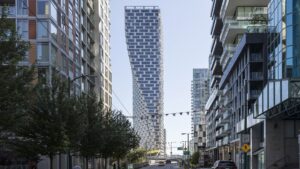 Westbank Corp.’s Vancouver House, on Howe Street leading to the Granville Street bridge
For supporters, Vancouver House transformed a neglected urban void into a world-class architectural destination.
For critics, it exposed how City Hall bent rules, discounted public assets and abandoned promised public benefits in order to accommodate a politically connected developer.
The controversy stretches back to the late 2000s.
The triangular parcel beneath the Granville Bridge had long been considered difficult to develop. Previous proposals had failed.
The City of Vancouver eventually entered into negotiations with Westbank, which proposed an ambitious mixed-use development featuring luxury residential units, retail space and extensive public realm improvements.
What followed became one of the most controversial land transactions in modern Vancouver history.
Critics argued that Vision Vancouver effectively removed the site from the open market for approximately six years while Westbank assembled financing and refined its proposal. Opponents contended that the city was no longer acting as a neutral steward of public land, but had become a partner in realizing a specific developer’s vision.
One of the most persistent criticisms was that the city failed to test the market adequately and did not seek competing bids that might have generated significantly greater value for taxpayers.
 In 2014, Glen Chernen, Cedar Party candidate for Mayor, who following days of day and night research of Vancouver City Hall was the first to expose the “corruption” associated with Vancouver House
These concerns were amplified by the work of Glen Chernen, who ran for Vancouver City Council in 2014 with the Cedar Party. During that election campaign, Chernen examined city documents and negotiations surrounding Vancouver House and raised questions about what he characterized as preferential treatment afforded to Westbank. His research helped bring public attention to agreements that had largely escaped broader scrutiny and contributed to growing concerns about the relationship between Vision Vancouver and major developers.
At the heart of the controversy was the price Westbank paid for the city-owned land.
Critics argued that Westbank acquired the property for approximately $32 million despite assessments and valuations suggesting a substantially higher market value. Over the years, opponents have repeatedly cited figures indicating the land’s value was closer to $119 million, arguing that taxpayers effectively subsidized the project through an undervalued transaction.
Whether those valuations can be directly compared remains disputed. Nevertheless, questions about whether the city maximized value from the sale have never fully disappeared.
 Vancouver Auditor General, Mike Macdonell who in his 2026 scathing report to Vancouver City Council found concerning irregularities in the Vancouver House development process, in 2014 through 2026
Those concerns gained renewed legitimacy in February 2026 when Vancouver Auditor General Mike Macdonell released a major audit examining city land sales and exchanges. The report found that city staff did not consistently provide Council with all relevant information needed to determine whether land sales reflected market value. In some cases, land was sold for less than assessed value, and documentation supporting valuation decisions was incomplete.
While the audit was broader than Vancouver House alone, critics immediately connected its findings to long-standing concerns about the Westbank transaction.
Even more damaging was a separate whistleblower investigation that examined community amenity contributions associated with Vancouver House.
Community amenity contributions, known as CACs, are intended to ensure that when rezonings dramatically increase land values, the public receives a share of that value through amenities, infrastructure or cash contributions. According to city policy, rezonings are expected to capture a significant portion of the resulting “land lift” for public benefit.
The Vancouver House rezoning ultimately secured approximately $4 million in cash contributions and roughly $6 million in promised in-kind public improvements.
The problem, according to Macdonell’s investigation, is that many of those promised benefits either were never properly defined, were reduced, or were not adequately tracked and enforced by the city. The auditor found that the city’s management of these commitments fell below a reasonable standard and constituted “waste” under the city’s whistleblower framework.
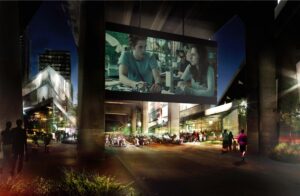
Among the promised public improvements were enhanced pedestrian connections between Granville Street and the bridge structure above, upgraded public spaces, landscaping, seating areas, special lighting, event infrastructure and other public realm features. Over time, several elements were altered, reduced or abandoned. The auditor found evidence that city staff excused some obligations without ensuring equivalent public benefits were delivered in return.
The findings were particularly significant because they reinforced a criticism that had existed since the project’s approval: Vision Vancouver’s enthusiasm for landmark architecture overshadowed its responsibility to protect the public interest.
Critics argue that Vancouver House became emblematic of a broader governing philosophy that dominated City Hall during the Robertson years. Vision Vancouver promoted density, urban design excellence and partnerships with the private sector. Many of the city’s most ambitious projects emerged during this period.
Yet opponents increasingly argued that City Hall had become too close to the development industry.
The Vancouver House negotiations appeared, to many observers, to confirm those fears.
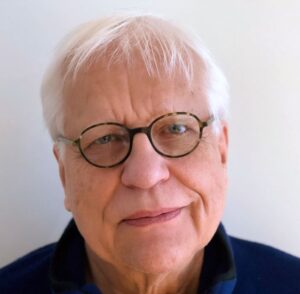 Retired planner Robert Renger brings the Vancouver House controversy to the fore
Retired Burnaby planner Robert Renger became one of the most persistent voices raising concerns about the project. Renger, who had extensive experience negotiating major development agreements, filed complaints and provided information that ultimately contributed to the Auditor General’s investigations. He argued that Vancouver House represented a failure to maximize public value and a failure to enforce negotiated public benefits.
Renger’s concerns were not focused primarily on architecture. Rather, they centred on governance.
His argument was straightforward: if developers receive enormous increases in land value through rezonings, the public should receive commensurate benefits. When those benefits are reduced, deferred or abandoned without compensation, taxpayers effectively absorb the loss.
The Auditor General’s findings did not conclude that bribery, fraud or criminal corruption occurred. In fact, the report explicitly noted that the circumstances did not meet the threshold for serious wrongdoing in the legal sense and found no evidence of fraud.
Nevertheless, the report painted a troubling picture of weak oversight, poor documentation and inadequate protection of public interests.
That distinction is important.
Political scandal does not necessarily require criminal conduct.
A city can follow legal procedures and still make decisions that produce poor outcomes for taxpayers.
In the eyes of many critics, that is precisely what happened with Vancouver House.
The irony is that the project itself is, in many respects, a success.
Vancouver House has become an internationally recognized architectural icon. It transformed an awkward and neglected site. It helped redefine the southern entrance to downtown Vancouver. The building’s engineering and design innovations have been celebrated globally.
But success in architecture does not automatically translate into success in public policy.
The project was also controversial because of how it was marketed. During Vancouver’s housing affordability crisis, luxury condominiums in Vancouver House were aggressively promoted overseas, particularly in Hong Kong and mainland China. Many Vancouver residents viewed the marketing strategy as symbolic of a city increasingly designed for global wealth rather than local residents.
The optics were especially damaging during a period when housing prices were accelerating beyond the reach of many middle-class families.
To critics, Vancouver House represented not merely a building but a broader economic model: public land converted into luxury housing marketed internationally while affordability worsened at home.
The lingering question is why subsequent city councils have done so little.
 A photo of the newly elected, or re-elected, members of the 2022 Vancouver City Council
Since Vision Vancouver’s defeat in 2018, two entirely different governing administrations have controlled Vancouver City Hall. First came the minority Council elected in 2018. Then came the ABC Vancouver administration under Ken Sim.
Neither administration has aggressively pursued remedies related to Vancouver House.
There are several possible explanations.
First, many of the agreements were legally finalized years ago, limiting available remedies.
Second, governments are often reluctant to reopen complex development contracts because doing so can trigger litigation and financial risk.
Third, Vancouver remains heavily dependent on private-sector development to finance infrastructure, amenities and housing construction. Political leaders may fear that aggressively challenging major developers could undermine future investment.
And finally, there is the uncomfortable reality that municipal governments of every political stripe often inherit decisions they would prefer not to revisit.
Yet the Auditor General’s findings have ensured that the controversy will not disappear.
The central question remains remarkably simple.
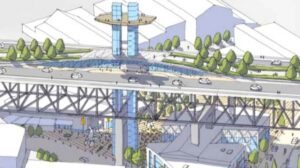 An elevator connecting the Granville Street Bridge and Granville Island was proposed as a way to improve access to the often gridlocked island that could have, in part, met Westbank’s obligations
Did Vancouver receive fair value for public land, public density and public approvals?
The architectural success of Vancouver House cannot answer that question.
The beauty of the building cannot answer it.
The prestige associated with Bjarke Ingels cannot answer it.
The Auditor General’s reports suggest that documentation was inadequate, public benefits were poorly managed and opportunities to maximize value may have been missed.
For critics such as Robert Renger and Glen Chernen, those findings validate concerns they have been raising for years.
For defenders of the project, Vancouver House remains a remarkable example of what ambitious city-building can achieve.
Perhaps both interpretations contain elements of truth.
Vancouver House is simultaneously one of Vancouver’s greatest architectural achievements and one of its most enduring political controversies. It stands as a glittering monument at the gateway to downtown —a building that transformed the skyline while raising difficult questions about governance, accountability and the relationship between public institutions and private power.
Long after debates about its twisting form have faded, those questions may prove to be the building’s most lasting legacy.