On Monday, VanRamblings wrote about The Vancouver Plan, a visionary document destined to inform growth in our city over the next 30 years.
A core issue of concern VanRamblings explored was how, months in advance of the publication of The Vancouver Plan, Vancouver City Hall’s Planning Department has set about to place before the members of Vancouver City Council several massive redevelopment projects — including, two weeks ago, a revisioning of False Creek South — the 32 hectares (80 acres) of city-owned land situated between the Granville and Cambie street bridges, on the south shore of False Creek, that proposed to triple the number of homes on the site.
And, last week, The Broadway Plan, a massive development plan for the Broadway corridor, extending from Vine Street to the west, 1st Avenue to the north, Clark Drive to the east, and 16th Avenue to the south, came before Council, a proposal to build dozens of 30 to 40 storey towers surrounding the areas adjacent to future Broadway Millennium Skytrain stations — at Main, Cambie, Oak, Granville and Arbutus streets, and when the Skytrain extension to UBC is approved, at Macdonald, Alma and Blanca streets, with the shoulder areas adjacent to the areas surrounding the stations, extending from 1st Avenue to the north and 13th Avenue to the south, set for a mass construction of 20, 25 and 30 storey towers.
Given all of the above, as founding chair of UBC’s urban design programme, Patrick Condon, wrote in response to yesterday’s VanRamblings column …
“What’s left to plan?
Who voted for more unaffordable condo towers?”
Before her election to Vancouver City Council in 2018, and throughout her campaign for office, and every day since her election as a City Councillor, Colleen Hardwick has hammered home two informed, salient points …
1. The population growth figures employed by the City’s Planning Department that are a determinative factor in development planning in the City of Vancouver are based on flawed data, arising from one immodest year of population growth in our city, the fiscal 2016 – 2017 year. Before that fiscal year, and each year since, population growth figures in Vancouver, as determined by both the Canada Mortgage and Housing Corporation and the Pacific Regional office of Statistics Canada, have dwarfed that one unique year in the current millennium;
Reliance’s Burrard Place project, a three-tower development at Burrard and Drake
2. The City of Vancouver, the office of the City Manager, and the Director of Planning have become far too reliant on the Community Amenity Contributions developers must pay in order that their projects will receive approval from the City’s Planning Department. As an example of monies paid in CAC’s by a developer, when Reliance Properties made application for a three tower mixed use development at Drake and Howe / Burrard — now known as Burrard Place — Reliance Properties paid the City of Vancouver $46 million in Community Amenity Contributions.
Given the affordable housing shortage in our city, you’d think that the civic government of the day — Gregor Robertson’s Vision Vancouver — would allot a portion of that $46 million towards the construction of affordable housing. Instead, the then Mayor declared that there was NO affordable housing shortage in the West End (CAC monies must be dedicated to serve the interests of the neighbourhood where the large scale development project is to be built).
Another salient point informing decision-making by senior members of Vancouver’s Planning Department: in point of fact, the very employment of the excluded / non-union white collar staff at City Hall — to whose numbers, 1100 new staff have been added over the past decade — is almost entirely dependent on extracting from developers as much money in CAC’s as possible.
As VanRamblings promised yesterday, today we’ll present more massive developments slated to be built, or currently under construction, in our city.
Artistic rendering of the Sen̓áḵw redevelopment at the south end of the Burrard Bridge in Vancouver
The Squamish Nation’s Sen̓áḵw Indigenous redevelopment of their 11.7-acre reserve at the south end of the Burrard Street Bridge promises 6,000 homes will be built within 11 towers housing 15,000 residents, consisting mostly of rental housing — a 50-50 partnership between the First Nations and local developer Westbank — forming a new skyline in the Kitsilano neighbourhood, the tallest buildings, two 56 storey condo towers. As the project is being built on Indigenous lands, the sole involvement by the City of Vancouver respects a negotiation with the Squamish Nation on hooking up to the city amenities, and addressing issues such as the provision of schools, and transportation.
A rendering of the proposed buildings to be constructed on Point Grey’s Jericho Lands
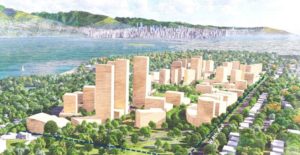
Another Indigenous land development within the City of Vancouver will occur on the 90-acre Jericho Lands — a largely undeveloped site bordered by West 4th Avenue to the north, Highbury Street to the east, West 8th Avenue to the south, and Trimble Park to the west.
The sprawling, hillside site, a former military base and home to the West Point Grey Academy, is owned by a partnership of three local First Nations — Musqueam, Squamish, and Tsleil-Waututh, collectively known as the MST Development Corporation — and the federal Crown Corporation, Canada Lands Company. As the First Nations purchased the Jericho Lands, development of the site falls under the jurisdiction of the City of Vancouver’s Planning Department, who will be intimately involved in the project’s development.
Construction on the Jericho Lands site will begin in 2024, with a completion date of 2050. Although the Jericho Lands site is five times the size of the Sen̓áḵw development, the Jericho Lands project envisions 10,000 new homes and 25,000 residents. West Point Grey is currently home to 13,000 residents — the Jericho Lands development will triple the number of residents who will call Point Grey home.
November 2021 artistic rendering of the Broadway Commercial Safeway redevelopment, Vancouver
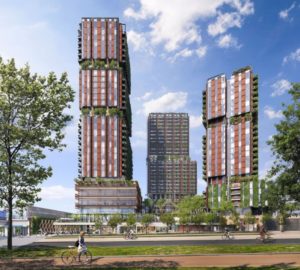
Over on the east side of town, in the Grandview Woodland neighbourhood, there’s the redevelopment of the Safeway site, next to the Broadway Skytrain station, just east of Commercial Drive. Heights ranging between 24 and 29 storeys above the podium’s retail plinth are, as can be seen in the graphic representation above, planned for the site. The project is a partnership between Crombie REIT and … wait for it, wait for it … leading luxury developer, Ian Gillespie’s Westbank Corporation, which has engaged its usual architectural design firm, Perkins & Will.
A massive redevelopment of the Norquay ‘Village’ Neighbourhood — which community activist Joseph Roberts writes about frequently on his Eye on Norquay website — has been underway for more than a decade. Roberts writes, the redevelopment plan for Norquay went “against what renters and homeowners want to see happen in their neighborhood.” The Norquay neighbourhood densification redevelopment will more than triple residential population of Norquay by 2030.
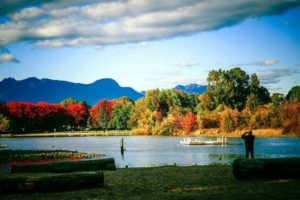
An autumn day at Trout Lake Park, in the heart of the Kensington-Cedar Cottage neighbourhood
And, the area bounded by Victoria Drive on the west, Nanaimo Street on the east, 12th Avenue on the north, and Kingsway on the south, in the Kensington-Cedar Cottage neighbourhood, the very heart of east Vancouver, where the urban park and Trout Lake is located, is set for massive densification that will more than triple the number of residents in the neighbourhood over the course of the next 20 years.
Ian Gillespie is also the developer behind the redevelopment of the Oakridge site.
- 2,600 homes in 19 towers will house nearly 6,000 residents;
- A workspace for 3,000 creative professionals will be created;
- More than 300 stores will feature the world’s most distinguished brands;
- Oakridge will be home to one of Vancouver’s largest community centres;
- Oakridge will be home to Vancouver’s second-largest library;
- A nearly 10-acre rooftop park made up of six integrated smaller parks will be built.
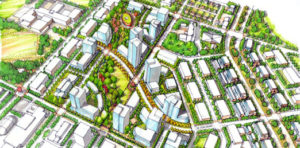
The Heather Lands 8.5-hectare (21-acre) development, situated between West 37th and 33rd avenues, and bounded by the lanes behind Willow and Ash streets.
Nearby is the Indigenous-owned Heather Lands development, the 21-acre site the subject of a rezoning application to the city, is a comprehensive planning site overseen by the City of Vancouver’s Planning Department. 2,600 rental homes will be constructed on the site, ranging from three to 28 storeys.
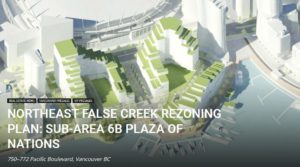
And let us not forget, either, the first of many development applications to be made by Concord Pacific on the currently undeveloped northeast portion of offshore billionaire Li Ka-shing’s Expo lands, where a permit has been applied for to build a mixed-use commercial and residential community.
The current application proposes a maximum floor area of 181,625 sq. m (1,955,000 sq. ft.) and building heights of 89.9 m (295 ft.). on the 10.28-acre site, once known as the Plaza of Nations, where construction of a variety of terracing buildings of up to 30 storeys is planned, and set for approval by the Planning Department at Vancouver City Hall, and our current City Council. The Plaza of Nations redevelopment is expected to house 20,000 residents.
Artist’s conception of the new Northeast False Creek neighbourhood Vancouver is planning for
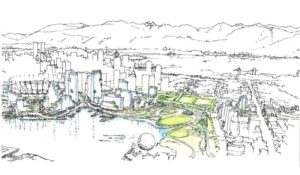
The new northeast waterfront False Creek neighbourhood will be housed in a forest of highrise condos that stretches from the Plaza of Nations on the west, to Carrall Street on the east. The plan includes taking down the Georgia and Dunsmuir viaducts, which will be replaced by an expanded street network. Three acres of waterfront park will be added to the neighbourhood. By the time the plan is completed in 2038, Creekside Park will be expanded by another eight acres.
The tallest site will be at Georgia and Pacific, where the city envisions a 425-foot tall building, which probably means 46 or 47 storeys.
In an article published in The Vancouver Sun on October 30th, Elizabeth Murphy, formerly a property development officer in the City of Vancouver’s Housing and Properties Department, as well as for B.C. Housing, wrote …
“Vancouver continues arbitrary citywide re-zonings without neighbourhood context. The Vancouver Plan just implements the previous Council’s initiatives, without any meaningful planning process. To achieve positive outcomes for the citizens of Vancouver that avoid negative impacts on the climate, affordability and livability, growth needs to be managed very carefully.
The city must first consider the broader consequences of growth. Council asked for transparent data to recalibrate the housing targets that are currently almost three times what can be justified by census population growth of about one per cent per year.
After a decade of record amounts of rezoning and development, Vancouver is one of the most unaffordable cities in the world. Spot rezonings, land assemblies, displacement, speculation and land inflation are significant contributors to our current malaise.
Going forward, in order to be a livable, affordable and sustainable city, Vancouver must build for actual needs, in a scale and location that suits each neighbourhood, with meaningful community input, supported by affordable transit, and community amenities.
The indefatigable Patrick Condon, one of — if not the — most important voices on urban development and the livability of Vancouver, as a city for everyone, here and across the Metro Vancouver region
We’ll leave the final word to UBC professor of all things good, Vancouver’s beloved commentator on development across our city, Patrick Condon …
“Providing affordable housing is the existential need in our city. Our service workers, many of who are our sons and daughters, are being forced out of this city in droves. This Trojan Horse of the proposed rental bylaw changes at City Hall will mainly benefit the land speculator, whose pockets are already stuffed to overflowing. We need to put the interests of citizens first, over the interests of speculators and developers, and those who mean ill for our city.”