Tag Archives: devanyi singh

#VanPoli | COPE | Restoring Funding to the Vancouver Public Library


View this post on Instagram


A post shared by Chloe Leslie (@intheknow_withchlo)

Vancouver’s Libraries Are Closing.
Ken Sim and ABC Vancouver Had Money for FIFA. Enough Said.
Want to know what Ken Sim’s ABC Vancouver administration thinks is essential? Look at what it is willing to spend money on — and what it is willing to let disappear.

For FIFA, there was $13.4 million.

For hospitality packages, suites and lounges surrounding the 2026 World Cup, Vancouver City Hall found the money. The City says the packages were purchased as assets that could be resold to offset World Cup costs. Fine. Let’s accept that explanation.

But ask Ken Sim’s administration to keep neighbourhood libraries open seven days a week and suddenly we are talking about budgets, constraints and difficult choices.

Apparently, in ABC Vancouver’s vision of a world-class city, FIFA deserves a suite while Vancouver’s children can wait outside the library on Monday.

That isn’t a budgetary footnote.

It is a statement of priorities.

And Vancouver voters should remember it come voting day October 17, 2026.

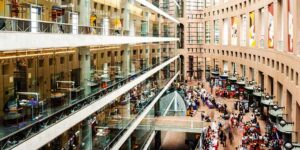
Ten Vancouver Public Library branches are closed on Mondays.

Other branches have reduced hours. The Vancouver Public Library Board has made clear that restoring Monday service would require additional funding, and COPE Councillor Sean Orr has repeatedly pushed City Council to restore the lost hours and move toward seven-day-a-week library service.

Orr calls libraries “vital community hubs.”

He is right.

In fact, he may be understating their importance.

A public library is one of the few places left in Vancouver where you can walk through a door without being expected to spend money.

Think about that.

Vancouver is increasingly a city of private spaces. Coffee shops want you to buy coffee. Restaurants want you to buy food. Entertainment venues want your admission fee. Commercial workspaces want your membership.

The public library wants nothing from you except that you come in.

You can read.

You can study.

You can use a computer.

You can access the Internet.

You can borrow books.

You can attend a programme.

You can bring your child to story time.

You can sit quietly.

And you don’t have to buy anything.

That is what public means.

For young families, libraries are an essential piece of the social infrastructure of a city.

Children’s story time at the Britannia Public Library on Vancouver’s east side

In a city where housing, childcare, food and virtually every form of recreation are becoming more expensive, the library offers parents something increasingly rare: a place where their children can learn, play and discover without another bill arriving at the end.

For children growing up in small apartments, the library can provide something their homes cannot — space to read, study and concentrate.

For teenagers, it can be a safe place after school.

For students, it can be a quiet place to work.

For newcomers, it can be a gateway to language learning, information and civic life.

And for seniors, the library can be much more than a place to borrow books.

It can be a place to go.

A place to meet people.

A place to use technology.

A place to read newspapers.

A place to participate in community life.

For an isolated senior, that can be enormously important.

And yet this is the public service Ken Sim & ABC have allowed to become less accessible.
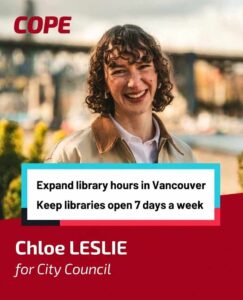
COPE Council candidate Chloe Leslie has argued that Vancouver must be a city that works for ordinary residents rather than simply for those who can afford it.

The library debate is a perfect illustration of that principle.

Because when you reduce library hours, you don’t inconvenience everyone equally.

A wealthy professional with a home office, high-speed internet, a private collection of books and the ability to drive across the city can shrug.

A single parent working irregular hours cannot.

A senior without a car cannot.

A teenager whose home isn’t conducive to studying cannot.

A newcomer without reliable internet cannot.

A person experiencing poverty cannot.
Cuts to public services are never merely cuts. They determine who gets access.

And that’s why the FIFA comparison matters.

This is not about suggesting that the City literally handed Ken Sim’s friends $13.4 million in tickets. It didn’t. The World Cup expenditure involved hospitality packages purchased through the tournament’s official hospitality provider, with the intention of recovering costs through resale.

But that doesn’t change the fundamental political question.

When ABC wants something badly enough, the money appears.

When the administration wants Vancouver to shine on the international stage, millions can be committed.

But when residents ask for the doors of their neighbourhood libraries to remain open?

Suddenly there are constraints.

Apparently Vancouver can afford to host the world.

It just can’t afford to keep the library open on Monday.

That is not leadership.

It is a question of priorities.

And it is a question Vancouver voters should answer this fall.

Mayor Ken Sim has repeatedly presented himself as the Mayor of a modern, ambitious, internationally recognized Vancouver.

Wonderful.

But a world-class city isn’t defined by FIFA hospitality suites.

It is defined by the quality of life of the people who live there.

A genuinely world-class city makes sure a child can access a book regardless of family income.

It makes sure seniors have places to gather.

It makes sure newcomers can learn.

It makes sure students can study.

It protects public spaces where people aren’t required to consume.

And it keeps those spaces open when people actually need them.

Seven days a week.

Sean Orr has put that principle before City Council.

Chloe Leslie has made equitable public services part of her campaign.

Now every candidate seeking a seat at City Hall should be asked the same question:

Will you vote to restore Vancouver’s lost library hours and make seven-day-a-week service the standard across the city?

No slogans.

No vague promises.

No “when finances improve.”

Yes or no.

Because the library is not a luxury.

It is one of the foundations of a civilized city.

And on October 17, Vancouver voters will have an opportunity to decide whether Ken Sim and ABC Vancouver’s priorities reflect the city they want to live in.

If you believe Vancouver should be a city where public institutions are strengthened rather than diminished, where children and seniors matter as much as FIFA, where public space remains public and where access to knowledge isn’t determined by your income, then the choice is clear.

Vancouver doesn’t need another four years of ABC’s version of “world-class.”

It needs a City Hall that understands the meaning of the word public.

On October 17, vote ABC Vancouver out.

And then open the library doors.

Seven days a week.

#BCPoli | A Troubling Race in Vancouver-Point Grey

In the 2024 British Columbia election, Premier David Eby is once again seeking re-election in his home riding of Vancouver-Point Grey, a constituency known for its progressive values and highly educated voters.


To read Vote Mate candidate profiles of the Vancouver-Point Grey candidates, click here.

David Eby, leader of the British Columbia New Democratic Party (NDP) since November 2022, is facing several challengers, but the one drawing the most controversy is Paul Ratchford, the B.C. Conservative Party candidate.

Mr. Ratchford’s incendiary, partisan remarks about his now fellow B.C. Conservative candidate Elenore Sturko, a former B.C. United MLA, have raised concerns about homophobia and intolerance, potentially shaping the tone of the election campaign in Vancouver-Point Grey, and beyond.

In response to Ms. Sturko’s victory in the Surrey South by-election in 2022, Mr. Ratchford called the just elected MLA a “woke, lesbian, social justice warrior.”

Such language immediately triggered a backlash.

Ms. Sturko — a wife, a mother, and a high profile longtime spokesperson for the Surrey RCMP detachment, as well as a novice candidate in 2022 running with the recently renamed B.C. United political party  — was, as may be seen in the photo above, decidedly over the moon at her victory in the Surrey South riding.

Who, with any degree of integrity and humanity would seek to impinge in a partisan manner on Ms. Sturko’s good fortune in Surrey South, with a cruel comment on what must have been a joyous and halycon night for Elenore Sturko?

Ratchford, in referring to someone’s sexual orientation as part of a derogatory attack plays into harmful stereotypes and marginalizes the LGBTQ community.

The following day, Mr. Ratchford escalated his rhetoric by calling Ms. Sturko a “groomer,” a term long used in anti-LGBTQ narratives to falsely suggest LGBTQ individuals are trying to influence or “recruit” children into their community.

These remarks are not just harmful to Ms. Sturko, who has since joined the B.C. Conservative Party —  in 2024, running in the riding of Surrey-Cloverdale — but also to the broader LGBTQ community, and voters at large.

The “groomer” trope is especially damaging as it revives debunked homophobic and transphobic fears that still resonate in some corners of society.

Employing such a term in modern political discourse reflects an effort to exploit those fears, polarizing communities and harming vulnerable individuals.


L-r, candidates for office in Vancouver-Point Grey: David Eby, Paul Ratchford & Devanyi Singh

For candidate Paul Ratchford running to unseat David Eby in Vancouver-Point Grey — an urban riding that has historically voted for progressive candidates — such comments are likely to alienate a significant portion of the electorate.

Vancouver-Point Grey is home to a socially conscious, diverse population that places a high value on inclusivity and equality.

The area has a substantial LGBTQ population, and its voters are likely to be repelled by the kind of divisive rhetoric Mr. Ratchford has employed.

Residents of the Vancouver-Point Grey riding, many of whom work in education, health care, and in the public service, are generally attuned to the implications of such inflammatory language, recognizing its potential to incite hate and discrimination. Mr. Ratchford’s injurious remarks will likely reinforce perceptions of the B.C. Conservative Party as out of touch with Vancouver-Point Grey’s values.

In addition to offending the LGBTQ community, B.C. Conservative candidate Paul Ratchford’s comments are also problematic for the broader electorate.

Many voters in Vancouver-Point Grey prize civility and fairness in politics.

Personal attacks, particularly those based on sexual orientation, are viewed as inappropriate, but also as distractions from substantive policy discussions.

While issues like housing affordability, health care, and climate change dominate the concerns of Point Grey and Kitsilano residents, Mr. Ratchford’s rhetoric may be seen as a diversion that detracts from addressing these pressing issues.

Given the gravity of his comments, the question arises: Has Paul Ratchford apologized to Elenore Sturko, now his fellow B.C. Conservative candidate, for his earlier hurtful and incendiary remarks?

As of yet, no public apology has been issued.

The absence of an apology underscores the broader challenge facing the B.C. Conservative Party under John Rustad’s leadership.

While Elenore Sturko’s defection to the B.C. Conservatives suggests the party is attempting to broaden its appeal, Mr. Ratchford’s explosive comments stand in stark contrast to this effort, signaling internal contradictions within the party.

At the upcoming all-candidates meeting in Vancouver-Point Grey, where both Paul Ratchford and incumbent Member of the Legislature David Eby will share the stage, Premier Eby is likely to address these remarks head-on.

As a strong advocate for human rights and social justice, David Eby could seize the moment to challenge Mr. Ratchford’s intolerant views, framing the contest as a battle between progressive values and regressive intolerance.

David Eby’s response would resonate with the riding’s electorate, many of whom value inclusion and equality as fundamental principles of good governance.

Given David Eby’s calm demeanour and legal expertise, Mr. Eby will likely approach the issue with a measured tone, appealing to voters’ sense of fairness while subtly highlighting the unsuitability of his opponent.

Meanwhile, the B.C. New Democratic Party’s “war room” has proven adept at capitalizing on their opponents’ missteps.

With the release of footage earlier this week of B.C. Conservative leader John Rustad’s controversial views on COVID vaccines and his insinuation that Dr. Bonnie Henry’s rationale for decisions taken on how to fight COVID and keep British Columbians safe was, in his estimation, tied to efforts to ensure “population control,” … well, it’s entirely plausible the NDP might have additional material that could further undermine Mr. Ratchford’s credibility.

If the B.C. NDP possesses video of Paul Ratchford making similarly offensive comments about the LGBTQ community, they could release it strategically to reinforce the narrative that the B.C. Conservative Party harbours intolerant views.

Such a revelation would almost certainly derail Mr. Ratchford’s campaign, making it difficult for him to gain traction in a riding like Vancouver-Point Grey.

Ultimately, Paul Ratchford’s controversial remarks about Elenore Sturko are likely to be a significant liability in his campaign to unseat David Eby.

In a riding that embraces diversity and progressive values, Paul Ratchford’s mean-spirited and untoward commentary is out of sync with voters’ priorities.

As a result, Paul Ratchford’s contemptuous remarks could serve to strengthen David Eby’s chances for re-election, as voters in Vancouver-Point Grey seek a representative who reflects their commitment to tolerance, respect, and inclusivity.

The upcoming all-candidates meeting will offer a pivotal moment for these dynamics to play out in real time, potentially sealing the fate of Mr. Ratchford’s candidacy.