
Andrey Zvyagintsev’s Minotaur
Minotaur: Andrey Zvyagintsev’s Chilling Russian Masterpiece
There are filmmakers who make movies. And then there are filmmakers who seem to stare directly into the soul of a country and, with an almost unbearable patience, wait for its darkest secrets to reveal themselves.
Andrey Zvyagintsev is one of the latter.
With Minotaur, winner of the Grand Prix at this year’s Cannes Film Festival, the Russian master has created another unmistakably political, bleak and methodical work — a film that holds you in its grip from beginning to end.
At first glance, Minotaur appears to be a domestic thriller.
Gleb (Dmitriy Mazurov), a wealthy logistics-company owner living in provincial Russia, is under mounting professional pressure as the war in Ukraine reaches into every corner of civilian life. Local authorities demand that he provide 14 employees for military service. Unwilling to sacrifice his existing workforce, Gleb recruits unsuspecting truck drivers with promises of lucrative employment, knowing full well that they will soon be sent to war.
At the same time, Gleb discovers — or believes he has discovered — that his wife Galina (Iris Lebedeva) is having an affair. Suddenly, the pressures of business, marriage, family and war collide.
And that is where Zvyagintsev’s genius becomes apparent.
Because Minotaur is not really about choosing between a political thriller and an erotic thriller. It is about recognizing that, in a morally diseased society, there is no such choice. The personal is political. The political is personal. And, most damningly, we can never deal with one crisis at a time.
Mazurov is extraordinary as Gleb, a man whose outward confidence masks an almost bottomless moral vacancy. Lebedeva is equally remarkable as Galina, giving the film a quietly devastating emotional centre. Together they inhabit a marriage that feels less like a relationship than a sealed chamber in which privilege, resentment, desire and fear have been slowly accumulating for years.
Zvyagintsev’s filmmaking is icily exacting. His camera waits. And waits. And waits some more. Minotaur is morbidly humorous at times, but its humour only makes the surrounding dread more unsettling. Shot with extraordinary patience, the film allows latent anxieties to creep gradually to the surface.
The film’s midway turning point is especially bracing. What initially appears to be one more ugly consequence of Gleb’s private predicament suddenly becomes something much larger — an eruption of violence that propels the narrative forward while exposing the corruption at the heart of the Russian state.
This is an urgent film, yet remarkably restrained.
Searingly political yet controlled and understated, Minotaur is a denunciation of the Russian state that is never spelled out in so many words, but expressed through intricate layers of irony. Russia under Vladimir Putin is not merely criticized; it is rendered as an amoral ecosystem in which ordinary people have learned to accommodate corruption, violence and complicity.
Zvyagintsev had to make the film outside Russia. Unable to shoot in his homeland, he filmed in Latvia, using a Latvian town to stand in for provincial Russia. Given the film’s subject matter and its uncompromising portrait of Putin-era Russia, it is difficult to imagine the Kremlin permitting such a production to be made there.
The audacity of Minotaur lies in its oscillating sprawl.
Against the backdrop of a war that has blotted out almost everything else, Zvyagintsev somehow makes room for a bourgeois love triangle, corporate venality, family dysfunction, murder and the machinery of state violence.
The result is a thriller about corruption that becomes a thriller about corruption of the soul.
Zvyagintsev sets his own deliciously ink-black stamp on Claude Chabrol’s La Femme Infidèle, the 1969 erotic thriller on which the film is loosely based. Yet he deliberately flattens both the eroticism and the thrills for much of Minotaur, a carefully judged gambit that makes the eventual nudity and violence land with considerably greater force.
This is Zvyagintsev at his most devastating: patient, furious, darkly funny and morally clear.
Minotaur doesn’t roar.
It waits.
And then it strikes.
VanRamblings Grade: A. A quietly devastating and lacerating look inside Putin’s corrupt Russian state, told as a personal — yet still political — story of betrayal.
There are two more scheduled screenings of Minotaur at VIFF 45, this upcoming Friday at 8:30 PM, at the Lindsay Family Stage at Granville Island.
And, Sunday October 11th, 2:30 PM, at the Vancouver Playhouse.
Peter Farrelly’s I Play Rocky
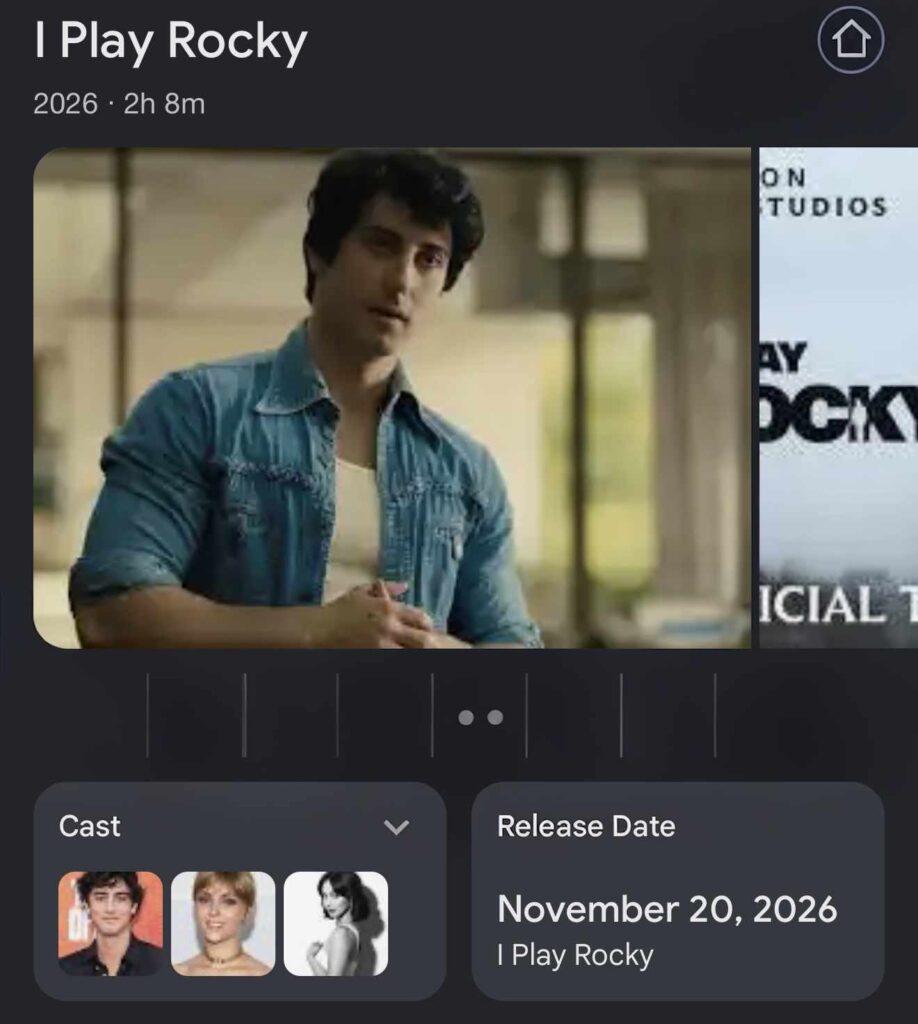
Sometimes you walk out of a movie knowing you have just seen a good film.
And sometimes you walk out knowing you have just seen a hit.
I Play Rocky is a hit.
Not merely a respectable little biographical drama about the making of Rocky, not simply another Hollywood movie about Hollywood, but the kind of genuine crowd-pleaser that sends audiences out of the theatre grinning, talking, arguing over their favourite scenes — and, inevitably, telling everyone they know that they absolutely have to see it.
Word of mouth is going to send I Play Rocky into the stratosphere!
Directed by Oscar-winner Peter Farrelly (Green Book), this wonderfully entertaining film tells the improbable story behind the making of Rocky: how a struggling young actor named Sylvester Stallone, repeatedly told no by Hollywood, refuses to surrender either his screenplay or his insistence that he play Rocky Balboa himself.
It is, in other words, the ultimate underdog story about the making of the ultimate underdog movie.
And Farrelly knows exactly what he has.
The brilliance of I Play Rocky is that we already know the ending. We know Rocky will get made. We know Stallone will become a star. We know the movie will become a cultural landmark. We know what is coming.
And yet Farrelly makes us care desperately about every seemingly impossible obstacle along the way.
Anthony Ippolito is sensational as Stallone. This is a career-defining performance — not an impersonation, but an extraordinarily charismatic recreation of a young man possessed by the belief that his life is waiting for him on the other side of one more locked door. Ippolito captures Stallone’s physicality, voice, vulnerability and sheer stubbornness with astonishing precision.
AnnaSophia Robb is superb as Sasha, Stallone’s girlfriend and eventual wife, giving the movie its emotional heartbeat. Sasha believes in him with all her heart, even when almost everyone else believes he is deluding himself. Robb brings warmth, intelligence and genuine emotional force to a role that could easily have been reduced to supportive-girlfriend shorthand.
Then there is Matt Dillon, almost unrecognizable as Stallone’s father, Frank Sr., whose crazed, unsupportive presence gives the film another layer of tension. Tracy Letts, meanwhile, is once again terrific as the kind of obstacle — half villain, half immovable force of Hollywood reality — that every great underdog movie requires.
And Canadian actor Stephan James as Carl Weathers? Fantastic.
There is palpable magic here.
I Play Rocky captures the chaos, setbacks and unlikely collaborations behind an independent production that somehow became one of the defining movies of the 20th century. But more importantly, it understands what made Rocky so beloved in the first place: hope, ingenuity, persistence and the almost irrational belief that you might just be able to change your life if you refuse to give up.
Stallone is a man battling homelessness, rejection and obscurity, a man who finds love and writes his way into a cultural phenomenon. The parallels are almost too perfect. Yet Farrelly never allows the story to become syrupy. There is a ton of wit and charm here, along with an infectious sense of movie-loving joy.
This is the feel-good film of the year.
And yes, I am going to go out on a limb: come January, when the Academy announces its Oscar nominations, don’t be surprised if I Play Rocky is sitting there with multiple nominations — Best Picture, perhaps Best Original Screenplay, potentially Best Director for Farrelly, and acting recognition for Robb, Dillon, Ippolito and James.
The film has that has that rare quality audiences recognize immediately.
It makes you feel good about movies.
Little wonder its November theatrical release is positioned to carry the film into the holiday season, when word of mouth can turn a sleeper into a phenomenon. The film already finished as first runner-up for the 2026 TIFF People’s Choice Award, an encouraging sign of exactly the audience affection it is likely to generate.
I Play Rocky is a resounding success — funny, touching, exuberant and enormously entertaining.
It doesn’t just tell us how Rocky was made.
It reminds us why we go to the movies in the first place.
And that, in a year desperately in need of a little cinematic optimism, may be the most wonderful thing of all.
VanRamblings Grade: A+. The feel good film of 2026 that is not a cheat, but a genuinely inspirational story that reminds us: we can create the conditions of our own lives.
There in one final screening of I Play Rocky, this upcoming Sunday, October 11th, 6:15 PM, at The Rio Theatre. You are going to want to arrive early.
