Category Archives: Vancouver

#VanPoli | Movements Build Slowly, Inexorably


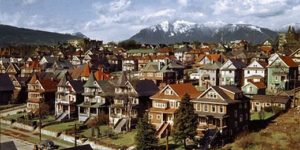
Vancouver’s West End in the 1960s, a comfortable family neighbourhood next to Stanley Park

In the 1960s, when Vancouver was still very much a village rather than the thriving metropolis we know it to be today, in those near soporific, pre-movement times, rare was the occasion when the citizens of our fine city got up on their hind legs to protest the status quo or what seemed like the inevitable, as wealthy old men of circumstance wrought change unchallenged, untrammelled by reflection.
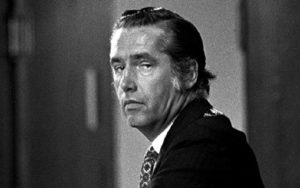

Tom ‘Not So Terrific’ Campbell, controversial Vancouver Mayor, in office from 1966 to 1972

Such was the case in 1971, when Vancouver Mayor Tom Campbell and his Non-Partisan Association Council cohorts decided that the time had come to develop the Coal Harbour site at the entrance to Stanley Park, cherished green space of long duration, but not much longer if Mr. Campbell — and the provincial government, led by 17-years-in-power Socred Premier W.A.C. Bennett — had their way.

The Coal Harbour site, owned by Harbour Park Developments, a politically connected local group with strong ties to the Non-Partisan Association, developer Tom Campbell — who in 1966 ran for Mayor as an independent, and won — and the Socred government, first unveiled their development plans in 1965.

The Four Seasons Hotel chain came forward in 1965 with a $40-million development plan on the Coal Harbour waterfront. The initial plan would house 3,000 people in three 30-storey buildings, including a 13-storey hotel and townhouses.

Over time, the development plan was expanded into an unheard of at the time $55-million massive multi-tower plan, with 15 apartment towers, ranging from 15 to 31 storeys set to be constructed on the then green space, a veritable high-rise forest along the Georgia Street causeway entrance to Stanley Park.

As you might well expect, the massive tower development plan for the 14-acre Coal Harbour waterfront site turned into a contentious issue that lasted for years and years, causing increasing numbers of people to rise up in adversarial opposition. The public wanted the site preserved as green space. Developers, Tom Campbell, the Non-Partisan Association, and the Social Credit government had other ideas.

Each week, for years, the community rose up in high dudgeon.

After all, the West End at the time was a single family dwelling neighbourhood, the tallest structure in Vancouver was the Marine Building on Burrard Street.

In 1966, each weekend for the first couple of months, a rag tag group of community activists — who came to include a young storefront lawyer, Mike Harcourt, and Darlene Marzari, an employee of the City — protested on the deserted site. Over time, their numbers grew to five hundred, and then a thousand, rising up in protest and stark and strident opposition to development plans for the cherished green space.
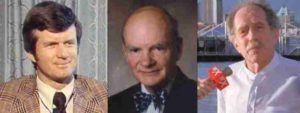

Vancouver City Councillor and then Mayor, Art Phillips; Councillors Walter Hardwick and Harry Rankin

In 1968, a reform-minded Art Phillips and his friend, Walter Hardwick — an Urban Planning professor at UBC, and a community leader whose work would come to shape the city and Metro Vancouver region — ran for Vancouver City Council under the banner of a civic party they had created, The Electors’ Action Movement (TEAM), securing two seats on City Council, joining a young lawyer by the name of Harry Rankin, who had been elected to Council in 1966, sitting in sole opposition to the developer-friendly Non-Partisan Association City Council of the day.

Throughout their campaign for office in 1968, both Art Phillips and Dr. Hardwick stated their clear opposition to the Harbour Parks Development / Four Seasons plan for the green space at the entrance to Stanley Park, standing with the community, and with Vancouver City Councillor Harry Rankin. Would community opposition to the Coal Harbour development plan, in ever increasing numbers, carry the day?

Only the continued opposition of Vancouver citizens could and would tell the tale.
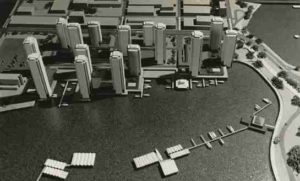

A model of the Harbour Park Developments proposal for the entrance to Stanley Park. The $55-million development would have constructed 15 high-rise towers. Photo: Selwyn Pullan / PostMedia

By the early spring of 1971, hundreds of community activists gathered each weekend on the Coal Harbour site at the entrance to Stanley Park, in protest.
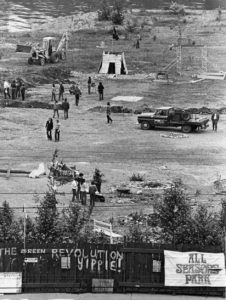

June 7, 1971. All Seasons Park after squatters reclaimed the site. Photo credit: Vancouver Sun

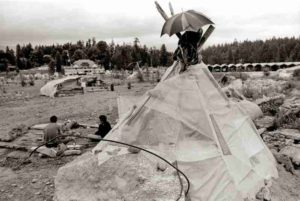
On May 29th, 1971, seventy community activists (hippies they were called by the press) took matters into their own hands, ripping down a fence surrounding the site, storming onto the Coal Harbour waterfront site to plant maple trees, setting up a camp of tents and ramshackle huts, the protest squat sustaining for a year, each subsequent weekend joined by hundreds and hundreds of concerned, mostly young, Vancouver citizens, at what was now called All Seasons Park.
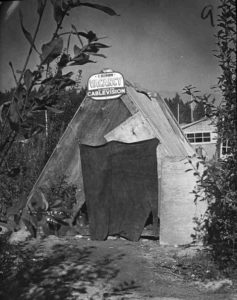

September 23, 1971. An A-frame squatter’s shack in All Seasons Park. Photo: Ross Kenward / PostMedia

In early 1972, bowing to public pressure, a combative Tom Campbell announced there would be a plebiscite on the Four Seasons development, but that only property owners could vote.
This was roundly denounced at a public meeting on June 21, when urban planner Setty Pendakur dubbed the project “the biggest abortion in the history of development in Canada.” Pendakur said the development would create traffic chaos at the entrance to Stanley Park, that Council was confusing people with its plebiscite.

Property owners voted to reject the Four Seasons proposal by 51%. Then the federal government stepped in. On February 10, 1972, Pierre Elliot Trudeau’s government killed the proposal by withholding the transfer of a crucial water lot.
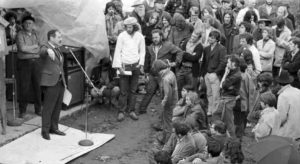

1972.  Alderman Harry Rankin talking to activists at All Seasons Park. Photo: Gord Croucher / PostMedia

With a new Mayor and majority progressive T.E.A.M. (The Electors’ Action Movement) Council voted into office in 1972 by a public eager for change, led by Mayor Art Phillips, with Walter Hardwick, Darlene Marzari, Mike Harcourt and Setty Pendakur securing seats on, perhaps, Vancouver’s most progressive Council ever, in November 1973, the City of Vancouver bought the entire site for $6.4 million.
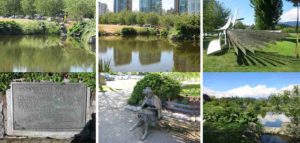
The green space at the entrance to Stanley Park is now known as Devonian Harbour Park, but for some of us, it will always be All Seasons Park.


Some historical source material for this article provided by Vancouver Sun reporter John Mackie.
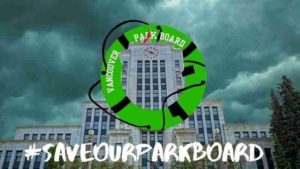

There is a correlation to be drawn between the movement leading to the defeat years ago of the Harbour Park Development project at the entrance to Stanley Park — championed by the City Council of the day — and the movement opposition of, now, 200 informed citizens (and more) who gathered at City Hall two weeks ago, and again this past Monday evening to state their opposition to the initiative of the Ken Sim-led ABC Vancouver City Council to eliminate Vancouver’s cherished, 135-year-old, independent and elected Board of Parks and Recreation.

Movements start off small, with generally only a few of our better informed citizens coming to the fore to state their opposition.

As time passes, more of our citizens become informed, inform themselves, taking the power to change for the better into their own hands, to rise up for the better, to work in common cause with friends and neighbours who share their concern to, in time, elect a more democratically-minded local government committed to the livability of our beloved city.

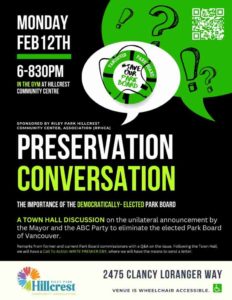
#SaveOurParkBoard | A Preservation Conversation

On Monday evening, February 12th, 2024, approximately 100 citizens tried-and-true, almost to a person strong advocates for the preservation of Vancouver’s cherished 135-year-old independent, elected Vancouver Park Board met together.

Why do we say almost to a person?

Because at meeting’s outset, a group of “concerned citizens” were present, who did their best to hijack the meeting, to push their agenda that take our present Park Board to task for failing to “save the trees in Stanley Park.” A righteous cause, for sure (or, perhaps not) but not the reason why the 100, or so, people meeting in the Hillcrest Community Centre gym on Monday evening had gathered together in common cause, which is to say: save Vancouver’s much cherished and beloved 135-year-old independent, elected Board of Parks and Recreation.

The video above pretty much presents the highlights of Monday night’s phenomenally moving meeting of a sterling group of Vancouver’s finest, most activist citizens, persons possessed of uncommon wit and intelligence, heart and conscience, committed to a social democracy that champions the community, the hope of our present and our future, folks who could just as easily stayed at home, but instead gathered in common cause to work together to preserve our elected Park Board.

Terri Clark, in charge of Park Board communications from 1973-2008, was present, as was Erin Shum, a past Park Board Commissioner (and one of our very favourites), in the city, traveling from her home in the Okanagan, and Jerry Fast, the President of the Kitsilano Community Centre — to whom we owe a thousand apologies — as well as former Killarney Community Centre President Ainslee Kwan (another one of our very favourites), and someone who we’ve been asked not to write about — cuz she’s in the employ of the City, and no one, we mean no one (except maybe a dastardly few in the administration and employ of Mayor Ken Sim … hey, it’s politics, and the current folks at City Hall, like many folks in past civic administrations, play hard ball) wants to see this fine woman of character, intelligence and passion for our city have her employment with the City jeopardized.

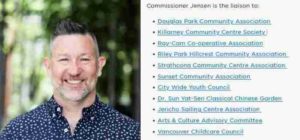
Of course, Scott Jensen — current Vice-Chair of Park Board — was present.

One wonders if Mr. Jensen ever thought for a moment — when a couple of years back, then ABC Vancouver candidate for Mayor Ken Sim asked him to run for Vancouver Park Board on his party’s slate — whether a couple of years on he’d find himself in the midst of a trying political maelstrom that rather than lead to an enhanced quality of life instead has changed his focus, such that too much of his energy is being directed away from his family, his satisfying career of contribution as an educator, and his very important work as a Park Board Commissioner.

Still, as a nascent #SaveOurParkBoard movement begins to burgeon, how can one not take heart that we are together a small but sturdy group of activists working collectively in common cause, part of a salutary movement for the ages in our little burgh by the sea, destined to be recorded in the history books as a grassroots democratic movement the likes of which we’ve not seen in Vancouver in decades.

Fills one with hope for a better, more democratic and more community-minded city.

#VanPoli | Ken Sim | Swagger | Bullying, Misogyny & Hubris | Pt. 1


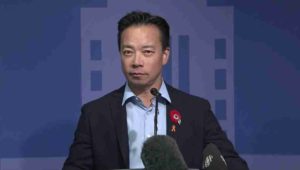
ABC Vancouver Mayor, Ken Sim

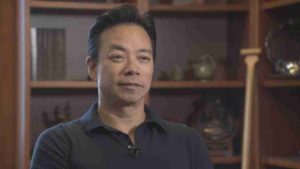
What is it with men who lack humility, intellectual heft, or have little character and no experience, and their unwholesome mistreatment of women?

In the case of Mayor Ken Sim, perhaps there is a partial answer to the multiple questions above, deriving from Mr. Sim’s use of the word “swagger”.

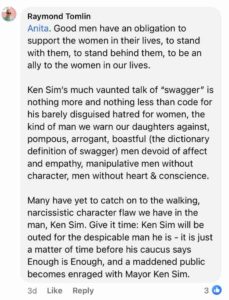
Social media response to former Park Board Chairperson, Anita Romaniuk

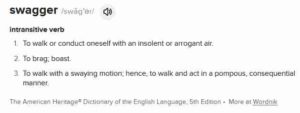
A Definition of Swagger

Pompous, arrogant, boastful. An insolent braggart, and from the definition of insolent:  disrespectful, rude, insulting in manner and speech, and deviant.

Swagger. Think: that jerk on the beach in a too small swimsuit who believes he’s God’s gift to women, who moves with a near drunken stagger, on the prowl for a victim of his all-too-visible misogyny and disdain for women, a man who is lacking in fidelity of purpose, and a little man devoid of empathy, and humanity.


Mayor Ken Sim, the next time he uses the word swagger, think: misogynist, arrogant, pompous, lacking in character, intellect and empathy, boastful, braggart, rude, scornful, with no conscience.

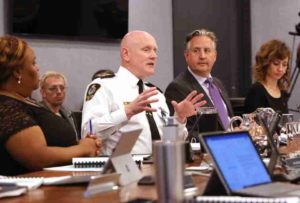
Under the current provincial Police Act, the Mayor of Vancouver upon election becomes the de facto Chairperson of the Vancouver Police Board.

Faye Wightman led several high-profile agencies before Solicitor General Mike Farnworth appointed Ms. Wightman, a well-respected and accomplished member of our community, to the Vancouver Police Board, in September 2020.

In past years, dating back to 1990, Ms. Wightman served as CEO of the Vancouver Foundation, CEO of B.C. Children’s Hospital Foundation, vice-president of the University of Victoria, Board Chair of Inspire Health, and interim CEO of the Canadian Cancer Society, appointed as a B.C. Housing Commissioner, and Coast Capital Savings Executive Director.

“The Vancouver Police Board is guided by the values of independence, fairness, objectivity and accountability in all that it does,” Faye Wightman wrote in a statement she issued last week, following her resignation from the Police Board. “I believe Police Board Chair Ken Sim, and certain directors of the Board have lost sight of these key values, and I resigned.”

Faye Wightman’s departure comes less than a year after Police Board member Rachel Roy resigned in June 2023. Stephanie Johanssen also lost her job as Executive Director in November 2022, after serving three years and seven months in the role. Note should be made that Ms. Johanssen’s departure came the same month Mr. Sim and his ABC Vancouver majority Council were sworn into office.


From Mike Howell’s Glacier Media story: “The Vancouver Police Board won’t say why its Executive Director Stephanie Johanssen (far right) is no longer on the job.” File photo Mike Howell.

In a follow-up interview with Glacier Media’s Mike Howell, Ms. Wightman states …

“If the Board is comprised of directors who have a professional reliance on the City of Vancouver for funding, or on maintaining a positive relationship with the Mayor, who also chairs the Police Board, then their objectivity is compromised,” Ms. Wightman said in her statement.

“That is the case with two of our directors at the [police board] and it was becoming clear they were in a position of conflict.”

Ms. Wightman also named Trevor Ford, the Mayor’s Chief of Staff, when asked about her allegation of interference from Mayor Ken Sim’s staff.

“[Trevor Ford] came to an in-camera meeting, he phoned and directed Board members to fire the Executive Director,” Ms. Wightman alleged in the interview.

“He sat in on one-on-one meetings that the Mayor had with individual Board members. If that’s not political interference, I’m not sure what is.”

Vancouver Police Board Executive Director Stephanie Johanssen,  Board member Rachel Roy and now Faye Wightman, who has stated that “Ken Sim, from the outset and throughout our tenure together on the Police Board repeatedly asked for my resignation.”

Gone.

Harassment of Ms. Wightman? Political inference from the Mayor’s Chief  of Staff in the firing of Police Board Executive Director, Stephanie Johannsen?

VanRamblings, in reading Ms. Wightman’s statement, believes so, yes.

Readers. Do you notice a pattern?

Could it be that Mayor Ken Sim demanded the resignation of the three strong women of accomplishment written about above because Vancouver’s current Mayor finds strong women of character, integrity and accomplishment threatening, and as such they must be excised from his circle of influence?

Not to worry, though.

Although B.C. Solicitor General Mike Farnworth has been uncharacteristically silent following the resignation of Ms. Wightman as his chosen appointee to the Vancouver Police Board, fear not …

Premier David Eby in his GlobalBC interview on Police Act reforms, states …

“I understand there’s some concern in Vancouver right now. The reforms (to the Police Act) are clearly needed. We’ll be working with local governments, and with police and the public in terms of the changes that are coming forward. The Solicitor General’s office is working on it right now.”

GlobalBC reporter Catherine Urquhart ends her report, stating …

“Legislation changing the Police Act to remove Mayors from police boards is expected to come as early as the spring session.”


British Columbia Solicitor General Mike Farnworth keeping his powder dry. Buh-bye, Mayor Ken Sim.

Solicitor General Farnworth’s silence thus far = revenge is a dish best served cold.


The History of Musicals | Capturing the Magic of the Stage on the Screen

Movie musicals are often a polarizing topic.

People either love them or hate them, and even those that love them are critical of on-screen adaptations of their favourite stage shows.

In recent years, Hollywood hasn’t had a great track record of adapting musicals from the stage to the screen in a way that works, and many movie musicals in past years have been criticized for not having that certain something that makes the onstage musicals feel so special and unique.

That was the case until three years ago, 2021, which apparently became the year when Hollywood figured out how to make a good movie musical.

As the musicals that were made that year were, sadly, not big box office hits, nor successful streaming, movie musicals have once again faded from our screens, both in our local multiplex, and on Netflix and other streaming platforms.

Still and all, if you love musicals, you can still take heart with the rich and glorious history of the musical, in whatever form it has taken cinematically.

Regardless of their box office success, there were there a great many 2021 musicals that were Oscar nominated — In The Heights, Dear Evan Hansen, tick, tick…BOOM!, West Side Story, and even Encanto (which wasn’t derived from a stage play). For the most part, they were well executed, and loved by critics, if not by a mass, anticipatory audience.

For the past century, the Hollywood musical has been recognized as a distinguished part of our movie history, playing an integral role in the evolution of movies during the 1920s through 1950s, til now.

It wasn’t until 1927 that Warner Brothers first introduced to the big screen singing along with sound in their release of The Jazz Singer; a remake of the Broadway musical of the same name.

The late 1920s brought difficult economic times, and a worldwide Depression.

It was during this time that Hollywood came to the public’s rescue with the dynamically entertaining diversion of the Hollywood musical.

Hollywood studios began to release a plethora of musicals which offered the movie-going public a chance to temporarily escape from the dire economic issues that had the world in its grip.

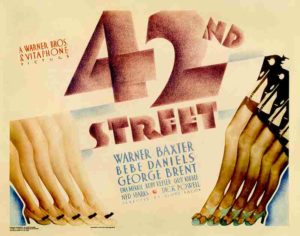
In the 1930s, with Warner Brothers’ acquisition of choreographer Busby Berkeley, the musical genre was truly born with the release of popular musicals like 42nd Street, Bright Lights, and Gold Diggers.

Capping the decade was 1939’s The Wizard of Oz, still one of the classic musicals that continues to entertain audiences today.

It was during the 1940s that the Hollywood musical really came of age, and the popularity of the movie musical continued right through the 1950s.

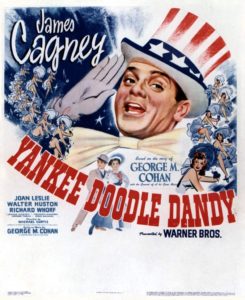
One of the more popular 1940s musicals was Yankee Doodle Dandy, a film that introduced movie lovers to a young James Cagney who gave a performance that earned him an Oscar. Another popular 1940s title, long a holiday tradition, is The Bells of St. Mary’s.

Metro-Goldwyn-Mayer embraced old-fashioned musical films in the ’40s and ’50s, furthering the boundaries of the musicals, with stars like Judy Garland, Fred Astaire and Mickey Rooney leading the way.

Starting with Meet Me in St. Louis (Vincent Minnelli, 1944), MGM began producing some of the most popular films of the era, including Easter Parade (Walters, 1948), An American in Paris (Minnelli, 1951), and Singin’ in the Rain (Kelly and Donen, 1952).

Marilyn Monroe brought a new element to the musical movie during the 1950’s.

This was also the time to bring Broadway to film in movies such as Oklahoma! and Guys and Dolls.

Elvis also started to make the big screen his home, which many believe signalled the beginning of the end for the genre.

Through the 1960s, though, the adaptation of stage material for the screen remained a predominant trend in Hollywood. West Side Story, My Fair Lady, The Sound of Music, and Oliver! were all adapted from Broadway hits and each won the Academy Award for Best Picture.

The genre changed slightly during the 1970’s, where in some cases, such as Saturday Night Fever and Tommy, the stars were not the singers. The movie plot was being driven by song, but in a pre-recorded way.

There were a few musicals to note in the ’80s, like Annie and Purple Rain, but for the most part, the entire genre had changed to musicians supplying the music.

With the arrival of the early 1990s, one of the more successful modern-day musical movements emerged: Disney’s animated musical blockbusters, including such films as The Little Mermaid, Aladdin and The Lion King, all released in rapid succession, amassing an enormous fan base along the way.

In 2000, let us not forget the Coen Brothers’ O Brother, Where Are Thou?

Although the animated musical film has become a popular route for the genre in recent years, the success of musicals like Chicago, Rent, Sweeney Todd, and Les Misérables seems to indicate that large scale, live action musical productions are still very much relevant to film today.

In 2006: John Carney’s début film, Once, with Glen Hansard and Markéta Irglová.

In 2017, three musicals were nominated for Best Motion Picture – Musical or Comedy at the Golden Globes: Florence Foster Jenkins, La La Land, and Sing Street, with La La Land taking home the award (well, sort of).

Although musicals might not necessarily find success in terms of receiving the most awards recognition, they are nonetheless popular and enjoyed by audiences.

Once upon a time, huge, spectacle musicals were the backbone of Hollywood.

The pandemic year of 2021 offered Hollywood a chance to return to the glory days of the 1930s Depression era musical, allowing audiences to reacquire a taste for the musical, to help lift of us out of the malaise that had us in its grip.

The Hollywood musical has always offered viewers a page out of movie history, memories that will forever be captured on film, and musical films that will continue to be enjoyed by audiences around the world.