Category Archives: canadian politics

#BCPoli | Ridings in Contention | North Shore, Vancouver, Richmond, Burnaby and New West

As the 2024 British Columbia election campaign heats up, key ridings across the North Shore — comprised of West Vancouver, and North Vancouver — Vancouver city proper, Richmond, Burnaby, and New Westminster have come into focus.

These regions, traditionally home to strong B.C. New Democratic Party and B.C. Liberal (transformed into the now defunct B.C. United) representation, in 2024 are witnessing fierce competition, especially with the rise of the insurgent B.C. Conservative Party under leader John Rustad.

The political dynamics across these urban and suburban ridings will play a crucial role in determining whether Premier David Eby’s B.C. NDP holds onto power, or John Rustad’s B.C. Conservatives, alongside a surfeit of former B.C. United candidates, now identifying as Independents — given the demise of B.C.  United — in the 2024 British Columbia election, can carve out a significant share of the electorate.

The North Shore: West Vancouver-Sea to Sky | West Vancouver-Capilano | North Vancouver-Lonsdale | North Vancouver-Seymour

The North Shore, with its blend of affluence and environmental activism, is often seen as a bellwether for middle-class urban voters.


To read Vote Mate candidate profiles of the West Vancouver-Sea to Sky candidates, click here.

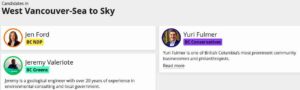
In West Vancouver-Sea to Sky, B.C. NDP candidate Jen Ford, a Whistler municipal Councillor, faces stiff competition from B.C. Greens candidate Jeremy Valeriote, and B.C. Conservative candidate, Yuri Fulmer. This riding is marked by its environmentally-conscious electorate, which aligns with Valeriote’s strengths, particularly given his party’s history in the riding. However, the B.C. NDP, buoyed by Ford’s local reputation and the B.C. NDP’s progressive climate policies, could make inroads. The wildcard here is Fulmer, representing the B.C. Conservatives, who may attract right-leaning voters disillusioned with B.C. United’s recent collapse.

Moving to West Vancouver-Capilano, the race is even more complex.

High profile Independent Karin Kirkpatrick, formerly a B.C. United MLA, is mounting a well-funded, high energy campaign. Her decision to run as an Independent threatens to split the centre-right vote, complicating the path for the B.C. Conservatives’ Lynne Block, who also faces competition from another Independent, Jaclyn Aubichon, who insists she is the true B.C. Conservative candidate. The B.C. NDP’s Sara Eftekhar and the B.C. Greens’ Archie Kaario are hoping this division on the right opens a narrow path to victory, but Kirkpatrick’s sterling local reputation and deep ties to the riding make her the likely frontrunner.

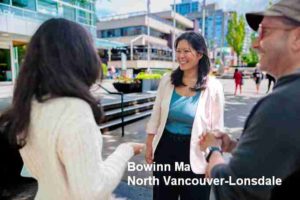
In North Vancouver-Lonsdale, B.C. NDP incumbent Bowinn Ma, a high-profile Minister and advocate for housing and transit, remains a strong contender. However, with the B.C. Conservatives fielding a serious challenge —  in the form of David Splett, a seasoned Chartered Professional Accountant with over 30 years of international experience in financial and operational management within large organizations — in this suburban riding, Ma will need to fend off attacks on affordability and public safety. In North Vancouver-Seymour, NDP MLA Susie Chant faces a similar battle. Both North Shore ridings are typically competitive, but the fragmentation on the right may play to the B.C. NDP’s advantage here, as Ma and Chant can leverage their incumbency and the government’s progressive record.

Richmond: Crime and Economic Uncertainty

Richmond, a traditionally right-leaning suburb, delivered an unexpected triumph for the B.C. NDP in 2020 when they claimed three out of four ridings.

In Richmond-Queensborough, B.C. NDP incumbent Aman Singh faces an uphill battle, with crime emerging as a central issue. Steve Kooner of the B.C. Conservatives is making crime and public safety the core issues of his campaign, hoping to appeal to voters frustrated with perceived rising crime rates. Global B.C.’s Richard Zussman has identified this riding as a bellwether riding, and suggests that this riding could determine whether David Eby or John Rustad form government post October 19th election night. To win, Aman Singh will need to hold onto the diverse coalition that propelled him to victory in 2020, to retain his seat.

In Richmond-Steveston, NDP MLA Kelly Greene is in a similarly tough race. Her challengers include former B.C. United candidate Jackie Lee — who was an incredible fundraiser for B.C. United, but now running as an Independent Mr. Lee doesn’t have access to the monies he raised — and B.C. Conservative Michelle Mollineaux. Still and all, Mr. Lee is a known quantity. Kelly Greene won a squeaker in 2020; in 2024, with the vote on the right split, it would seem likely that with a fragmented opposition, Greene’s incumbency may give her an edge. Still and all, as is the case in Richmond-Queensborough, crime, alongside economic uncertainty, will dominate the conversation in Richmond-Steveston.

Unless the B.C. NDP can respond to crime and public safety effectively, Ms. Mollineaux could emerge victorious on election night.

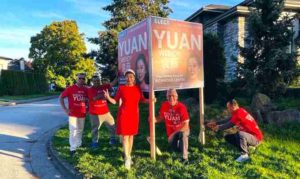
However, in Richmond Centre — where former B.C. United candidate Wendy Yuan is mounting a high profile, effective campaign, with an army behind her to help get out the vote (they’ve already identified they’re vote, which is important), again with a split on the right, incumbent B.C. NDP candidate Henry Yao could take the riding on election night. In Richmond-Bridgeport, the resurgence of the B.C. Conservatives, especially with former B.C. United MLA Teresa Wat now running under Rustad’s Conservative banner, adds unpredictability. Wat’s candidacy is especially notable, as she could potentially recapture her base from the splintered B.C. United, making Richmond a pivotal region on election night.

Vancouver: An NDP Stronghold Under Threat?

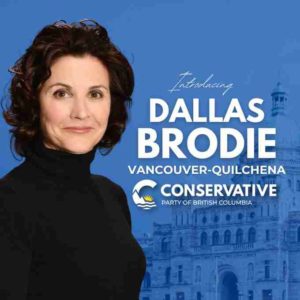
Vancouver has been the bedrock of B.C. NDP support in recent elections, but the emergence of the B.C. Conservatives has introduced uncertainty, especially in ridings like Vancouver-Quilchena, where the departure of B.C. United leader Kevin Falcon has left the field wide open for the B.C. Conservative’s Dallas Brodie, who is assured of victory in this affluent, traditionally right-leaning riding. A significant win for the B.C. Conservatives that could signal broader gains across the city.

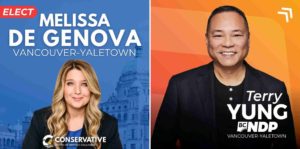
Global B.C.’s Richard Zussman has called Vancouver-Yaletown a top 10 riding to watch on election night. The two candidates: two time Vancouver City Councillor Melissa De Genova running with the B.C. Conservatives, and retired Vancouver Police Department Inspector, Terry Yung, running with the B.C. NDP. Read the riding profile we published on September 4th for extensive insight into this riding.

In Vancouver-South Granville, Brenda Bailey, a prominent Minister in the Eby government, is running for re-election. She faces B.C. Conservative candidate Aron Lageri, whose campaign could tap into growing frustrations over housing and crime. Ms. Bailey will win this riding, the demographic data leaning heavily NDP.


For insight into the Vancouver-Little Mountain race, click here.

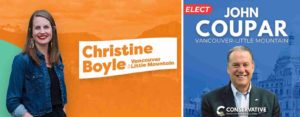
Meanwhile, in Vancouver-Little Mountain, Vancouver City Councillor Christine Boyle, having secured the B.C. NDP nomination in a hard fought contest with former Vision Vancouver City Councillor, Andrea Reimer, is running against former Vancouver Park Board Chair John Coupar, one of the first potential candidates B.C. Conservative leader approached to run with his nascent B.C. Conservative Party. This race highlights the ongoing battle for progressive votes in the city, with Boyle’s deep connections to local politics providing her an advantage, although Coupar’s early recruitment by Rustad signals a strong conservative push, and a likely Cabinet position for Mr. Coupar should the Conservatives form government.

Vancouver-Langara also warrants attention, with B.C. NDP candidate Sunita Dhir running against controversial B.C. Conservative Bryan Breguet. Breguet’s inflammatory comments on race and crime have made this a particularly charged contest. The NDP hopes to capitalize on his divisiveness to hold the riding.

One of the most competitive ridings is Vancouver-Fraserview, where long-serving NDP MLA George Chow, a longtime B.C. NDP Minister, is being challenged by B.C. Conservative Jag S Sanghera. If the B.C. Conservatives manage to turn this election into a wave election, Fraserview could flip — as it did in 2013, when B.C. Liberal Suzanne Anton won the riding, going on to become Attorney General in the administration of B.C. Liberal Premier Christy Clark. The B.C. Greens’: a perennial Green candidate and teacher, Françoise Raunet is unlikely to mount a serious challenge.

VanRamblings will focus on Premier David Eby’s Vancouver-Point Grey riding, at the top of tomorrow’s column, in a post which may or may not explore ridings in contention in Surrey-Delta, the Tri-Cities out to Chilliwack, north of the Fraser River, and ridings in contention in the Fraser Valley. At this point, we think we’re gonna get carried away writing about the contest in Vancouver-Point Grey.

One candidate has some ‘splain’ to do.

Burnaby and New Westminster: NDP Heartland in Flux?

Burnaby has been a stronghold for the B.C. NDP, but cracks may be appearing.

Burnaby-North, where incumbent Janet Routledge is running for re-election, is particularly vulnerable. Her B.C. Conservative opponent, entrepreneur Michael Wu, could pose a serious challenge, especially if the election turns into a wave election for the Conservatives. The other Burnaby ridings, such as Burnaby Centre and Burnaby South-Metrotown, are more secure for the NDP, although shifting voter demographics and discontent over housing affordability make these ridings worth watching on election night.

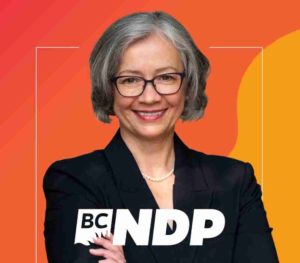
Jennifer Whiteside, B.C. NDP candidate in New Westminster-Coquitlam

In New Westminster-Coquitlam, NDP MLA and Minister in the Eby government, Jennifer Whiteside, looks secure in her seat, with the B.C. Conservative’s Ndellie Massey and B.C. Greens’ Maureen Curran unlikely to mount significant threats. However, New Westminster’s stability may not reflect broader trends if the B.C. Conservatives make gains across the province.

Will Urban British Columbia Hold the Key to Victory?

As the election progresses, the urban ridings: the North Shore, Vancouver, Richmond, Burnaby and New Westminster will be critical election determinants.

While the B.C. NDP remains strong in these areas, the resurgence of the B.C. Conservatives and the presence of well-funded Independents introduce volatility.

Should the B.C. Conservatives succeed in turning the election into a wave election, or even a tsunami election, many of the ridings we have written about today — long considered safe ridings for the B.C. NDP — could be up for grabs.

On Election Night, Saturday, October 19th, these key battlegrounds will likely tell the story of whether David Eby can hold onto government, or if John Rustad’s insurgent campaign can propel the B.C. Conservatives to power.


2024 British Columbia Provincial Election | Regional Riding Analysis

Part 1 | Vancouver Island | Five Ridings in Contention, and Subject to Change

Part 2 | The Interior, the North and the Kootenays | Battleground Ridings


The Hotel Pacifico podcast will broadcast daily, Monday thru Friday, throughout the 2024 election

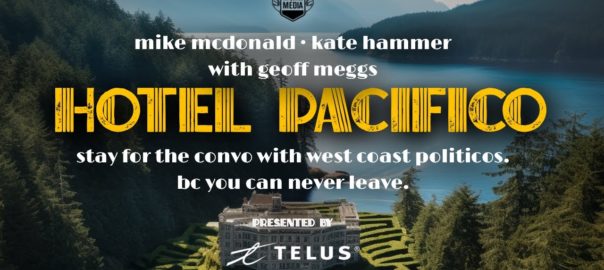
The good folks at Air Quotes Media’s Hotel Pacifico podcast — featuring Mike McDonald, Christy Clark’s campaign manager in 2013; Geoff Meggs, Premier John Horgan’s Chief of Staff; and Kate Hammer, a former Globe and Mail British Columbia legislative reporter — will “broadcast” on the B.C. Election each day, Monday through Friday. Find the latest episode above.

VanRamblings will post the podcast, for your edification and enjoyment.

#BCPoli | Ridings in Contention in the Interior, the North & the Kootenays

With the 2024 British Columbia election now underway, several key ridings in the Interior of the province, including in the Okanagan, the Kootenays, and northern British Columbia look to play pivotal roles in determining the overall outcome.

These regions are historically less urbanized, with a mix of rural and resource-based economies, making them more politically diverse. The B.C. New Democratic Party (NDP), the resurgent B.C. Conservative Party, and a handful of high-profile Independents, including former B.C. United MLAs, are all vying for influence.

The B.C. Conservative Party, under leader John Rustad, is expected to make significant gains, particularly in the more conservative and rural areas of the province.

The party has capitalized on growing discontent with both the B.C. NDP government and the now virtually defunct B.C. United.

With Rustad steering the party towards a platform that resonates with socially conservative and populist voters, the B.C. Conservatives could emerge as the dominant opposition in the northern and Interior ridings.

In regions like the Okanagan and the Kootenays, where small-c conservative values have a strong foothold, the B.C. Conservatives are expected to gain traction.

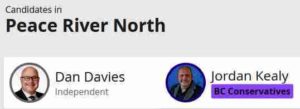
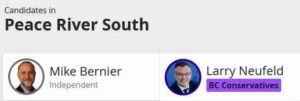
In ridings such as Peace River North and Peace River South, long-time former B.C. United MLAs Dan Davies and Mike Bernier, respectively, are now running as Independents.


To read Vote Mate candidate profiles of the Peace River North candidates, click here.

These ridings, which have traditionally voted conservative, will see fierce competition between these Independents, and the B.C. Conservative candidates.

If the vote splits between Independent conservatives and the B.C. Conservatives, it could allow the B.C. NDP to secure an unexpected victory — if they were running a candidate in either riding, which as of this writing they most decidedly are not. The B.C. NDP must figure it’s a lost cause.


To read Vote Mate candidate profiles of the Peace River South candidates, click here.

As we say above, former B.C. United MLAs running as Independents could significantly impact the political dynamics in their respective ridings.

These candidates carry local recognition and established track records, but the collapse of B.C. United has left a vacuum that both the B.C. Conservatives and NDP are seeking to fill. The presence of high-profile Independent candidates, such as Bernier in Peace River South, Dan Davies in Peace River North, Coralee Oakes in Cariboo North, and Tom Shypitka in Kootenay-Rockies, could lead to a fragmentation of the right-leaning vote.

Mike Bernier, for example, has deep roots in Peace River South, and his decision to run as an Independent is likely to retain a significant portion of his previous support. However, he faces competition from a growing B.C. Conservative presence in the area. Similarly, Coralee Oakes in Cariboo North may siphon votes away from the B.C. Conservative candidate, potentially paving the way for a closer contest with the B.C. NDP.

Before we leave the North, let’s take a look at …

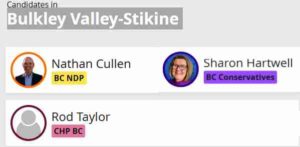
Bulkley Valley-Stikine. The Stikine has been in the NDP column since 2009 with Doug Donaldson. Prior to 2009, Bulkley Valley-Stikine had been held by Dennis McKay of the B.C. Liberals. It’s the smallest riding in the province by population, and the largest by geography. The NDP’s Nathan Cullen is the MLA for the riding, which he won handily in 2020, following a 15-year stint as the shadow Finance Critic for the federal New Democratic Party.  As was the case in 2020, Rod Taylor, the head of the Christian Heritage Party, is running again; generally, he receives about 10% of the vote. Although not announced as of this writing, word is that the B.C. Greens will run an Indigenous candidate who has been active in the anti-pipeline movement. Stir that all around, and  Bulkley Valley-Stikine could very well turn into a horse race. One to keep an eye on.

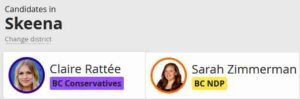
Skeena. Pair this riding with Bulkley Valley-Stikine and this could be a pick up for the NDP, now that Ellis Ross — who had held the riding for B.C. United — has jumped to the federal Conservatives, where he’ll run as a federal candidate in the Skeena riding. Sarah Zimmerman who has deep roots in Skeena, and currently sits as an elected Terrace City Councillor and was the former Executive Director of Communications for Coast Mountain College is considered to be a very strong candidate in the riding. Expect David Eby to spend time in both ridings, to secure two victories in the North.

In the Okanagan, where former B.C. United candidates Ashley Ramsay (Kelowna-Mission), Dr. Michael Humer (Kelowna Centre), Tracy St. Claire (Penticton-Summerland), and Kevin Acton (Vernon-Lumby) are now running as Independents, the political landscape is equally complicated.

The Okanagan is traditionally conservative, but the vote-splitting between Independents and B.C. Conservative candidates could offer opportunities for the NDP, particularly in historically competitive ridings such as Vernon-Lumby, which the NDP won in 2020. Acton’s candidacy will face pressure from both the B.C. NDP and a surging B.C. Conservative base. If the vote splits, it could swing the riding back into NDP control, or allow the B.C. Conservatives to make gains.


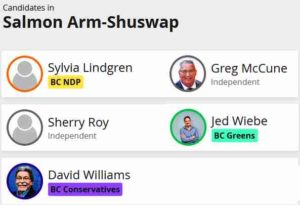
To read Vote Mate candidate profiles of the Salmon Arm-Shuswap candidates, click here.

In Salmon Arm-Shuswap, Greg McCune’s Independent bid will face similar dynamics. This riding has a deeply conservative base, but with B.C. Conservatives gaining momentum, vote-splitting could alter the outcome.

The Kootenay Ridings: NDP vs. B.C. Conservatives

In the Kootenays, the B.C. NDP has traditionally done well, especially in ridings like Kootenay West and Kootenay-Rockies, where progressive and environmentally-focused voters dominate. However, the B.C. Conservatives are working to broaden their appeal in these areas by emphasizing opposition to government overreach, particularly on resource management and rural development issues.


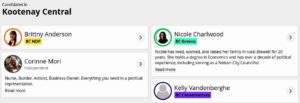
To read Vote Mate candidate profiles of the Kootenay-Central candidates, click here.

The B.C. Greens have historically been a strong force in Nelson and surrounding areas, appealing to environmentally conscious voters who support sustainable resource management and climate action. In ridings like Kootenay-West (the old Nelson-Creston riding) the Greens are expected to remain a key player, with potential to siphon votes away from the B.C. NDP. However, it is unlikely that the B.C. Conservatives will gain significant traction here due to the progressive nature of the electorate.


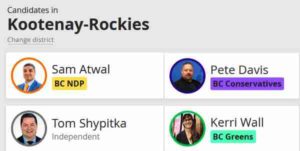
To read Vote Mate candidate profiles of the Kootenay-Rockies candidates, click here.

In Kootenay-Rockies, Tom Shypitka’s decision to run as an Independent, having previously been a B.C. United MLA, will complicate the conservative vote. The B.C. Conservatives are likely to perform well in this region, but Shypitka’s local popularity could create a fragmented right-leaning vote, giving the NDP a chance to maintain or even expand their influence.

The Kamloops Ridings

Kamloops has historically been a battleground, with ridings like Kamloops-North Thompson and Kamloops-Centre frequently seeing close contests.

The B.C. Conservatives, emboldened by their recent growth, are aiming to make headway in these ridings.

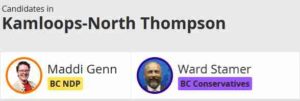
To read Vote Mate candidate profiles of the Kamloops-North Thompson candidates, click here.

In Kamloops-North Thompson, where rural concerns about resource industries and housing affordability dominate, the B.C. Conservatives are expected to perform well, potentially at the expense of the B.C. NDP.


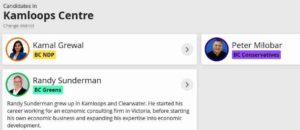
To read Vote Mate candidate profiles of the Kamloops-Centre candidates, click here.

Kamloops-Centre, with a more urban electorate the Conservatives could retain the seat with former B.C. United / B.C. Liberal candidate Peter Milobar holding down the fort for the Conservatives, unless voters disillusioned with both the remnants of B.C. United. and decide to cast their ballot for a reinvigorated B.C. New Democratic Party.

The 2024 B.C. election in the Interior, Okanagan, Kootenays, and the North is shaping up to be one of the most competitive in recent history.

The B.C. Conservatives are positioned to make significant gains, particularly in more rural, conservative-leaning ridings. However, the presence of high-profile Independents, especially former B.C. United MLAs, adds complexity to the race, creating the potential for vote-splitting and unexpected outcomes.

The B.C. Greens will remain strong in progressive enclaves, particularly around Nelson, while the B.C. NDP faces the challenge of defending its gains from 2020 in the face of a re-energized conservative movement.

As of today, we are 25 days away from October 19th Election Day.


2024 British Columbia Provincial Election | Regional Riding Analysis

Part 1 | Vancouver Island | Five Ridings in Contention, and Subject to Change


The Hotel Pacifico podcast will broadcast daily, Monday thru Friday, throughout the 2024 election

The good folks at Air Quotes Media’s Hotel Pacifico podcast — featuring Mike McDonald, Christy Clark’s campaign manager in 2013; Geoff Meggs, Premier John Horgan’s Chief of Staff; and Kate Hammer, a former Globe and Mail British Columbia legislative reporter — will “broadcast” on the B.C. Election each day, Monday through Friday.

VanRamblings will post the podcast, for your edification and enjoyment.

#BCPoli | Election 2024 | Riding Breakdown Analysis | Vancouver Island

In the 2024 British Columbia provincial election there are 93 ridings, six more than in the 2020 B.C. election, thanks to the redistribution recommendation of the Independent Electoral Commission which was charged to make voting in British Columbia fairer and more representative of the population of the province.

In British Columbia, there are 25 ridings in the Interior (the Okanagan and the Kootenays), 16 ridings across Vancouver Island, and 52 ridings across Metro Vancouver, reaching out into the Fraser Valley, and extending to Chilliwack.

In total, there are approximately 30 ridings that will tell the tale on Election Night,  October 19th. The outcome in these ridings will determine whether incumbent Premier David Eby’s New Democratic Party will hold onto government, or will be replaced by John Rustad’s insurgent Conservative Party of British Columbia.

Today, VanRamblings will focus on the Vancouver Island ridings in contention.

For the past couple of provincial elections Vancouver Island has proved to be a New Democratic Party fortress, with the party winning every riding on the Island. Following the October 19th election, we could witness a return to the days when a handful of Socred  / B.C. Liberal candidates held sway in five or six Vancouver Island ridings.

VanRamblings will publish three additional riding analysis columns covering the Interior and the North, a good portion of Metro Vancouver (focusing on Vancouver / Burnaby / Richmond / Delta / New Westminster / Surrey), and a final riding by riding analysis column covering the Tri-Cities, the north side of the Fraser River, Langley, and into the Fraser Valley through to Chilliwack.

Today, VanRamblings is focused on the Vancouver Island ridings that could allow David Eby to hold government, or thrust John Rustad into the Premier’s chair.

Vancouver Island | Five Ridings in Contention in Election 2024

(Click on the underlined text for more information on the candidates running in the riding)

  • Victoria-Beacon Hill . Held by former B.C. NDP leader / Finance Minister Carole James from 2005 to 2020, upon resigning for health reasons, popular Victoria City Councillor Grace Lore ran in her stead in the 2020 B.C. election and won. During her first term, Ms. Lore’s four-year-old son was diagnosed with a brain tumour, which saw his mother cut back on some of her political activities in the riding, also gaining her family much sympathy and support. Upon her son’s return to health, Grace Lore was appointed as the Minister of Children and Family Development, a job she has excelled at, gaining much recognition for competence in the post, as well as for her caring and compassion. Ms. Lore’s challengers in 2024: Green Party of B.C. leader Sonia Furstenau, who moved from her Cowichan riding after redistribution, and B.C. Conservative candidate, Tim Thielmann. According to the most recent internal party polling, this will be a tight three-person race, with the very real possibility that there could be as little as half a percentage point in the vote separating the winner from the two politicos who fail to secure victory on the evening of October 19th.

  • Ladysmith-Oceanside . Adam Walker was elected as the NDP candidate in the riding in the 2020 B.C. election. For reasons that have never been revealed, Mr. Walker was removed from the NDP caucus on September 18, 2023, and since that date has sat as an Independent. Mr. Walker is running for office in 2024 as an Independent, with the endorsement of the Green Party, and the on the ground support of the party’s supporters. Stephanie Higginson, a past president of the B.C. School Trustees’ Association, is the B.C. NDP candidate. The B.C. Conservative candidate, Brett Fee, is a relative unknown. There’s also a second Independent candidate, Lehann Wallace, who is seeking the seat. The outcome in the riding is unpredictable. Ordinarily, the riding would be solidly NDP, but the candidacy of Adam Walker throws a spanner into NDP expectations for a win. This one’s gonna be a nailbiter come election night.

  • Courtenay-Comox . Both Courtenay-Comox and North Island are in the federal riding of North Island-Powell River, where Aaron Gunn — whose claim to fame was being removed from the B.C. Liberal party leadership race in 2021 for being too far right — is the federal Conservative Party candidate. In 2017, Ronna-Rae Leonard — who is running for re-election in 2024 — won Courtenay-Comox by a hair’s breadth. For the previous two decades, the riding had been a B.C. Liberal stronghold. With support for the Green Party in the basement, political pundits suggest that Courtenay-Comox will be a tight two way race, with B.C. Conservative candidate Brennan Day set to win the riding come October 19th. Not for no reason was John Rustad front and centre in the riding on the opening day, and again on Sunday for a big rally, of Election 2024.

  • North Island. As far as North Island is concerned, the riding oughta be another pick up for the B.C. Conservatives, their candidate physician Anna Kindy, who was an organizer with the Trucker Convoy, who brought hundreds of her future (anti-vaxx) constituents to the B.C. Legislature to protest Health Minister Adrian Dix, and Provincial Health Officer Dr. Bonnie Henry’s edicts on how to fight COVID. In a change election, the pundits’ smart money is on Dr. Kindy to put the riding in the win column for the B.C. Conservatives — who will fire Dr. Henry as a first order of business should they form government.

  • Saanich North and the Islands. B.C. Liberal from 1991 to 2013. A bare NDP victory in 2013, with B.C. Green Party candidate, Adam Olsen — who is not running again in 2024 — securing victory in 2017 and 2020. With former Islands Trustee Rob Botterell running with the Greens, lawyer David Busch with the B.C. Conservatives and Sarah Riddell, elected to Central Saanich City Council in 2022, the B.C. NDP candidate — a riding that has voted Conservative federally for decades — it’s anyone’s guess as to the outcome of this tight three way race come election night.

The 11 remaining Vancouver Island ridings oughta vote solidly NDP come election day. C’mon back tomorrow for more riding analysis, as we move to the Interior and the North, after which we’ll analyze Metro Vancouver and the Fraser Valley.


The Hotel Pacifico podcast will broadcast daily, Monday thru Friday, throughout the 2024 election

The good folks at Air Quotes Media’s Hotel Pacifico podcast — featuring Mike McDonald, Christy Clark’s campaign manager in 2013; Geoff Meggs, Premier John Horgan’s Chief of Staff; and Kate Hammer, a former Globe and Mail British Columbia legislative reporter — will “broadcast” on the B.C. Election each day, Monday through Friday.

VanRamblings will post the podcast, for your edification and enjoyment.

#BCPoli | Former BC United MLAs & Candidates to Run as Independents

In the aftermath of the dissolution of B.C. United, formerly known as the B.C. Liberal Party, several incumbent B.C. United members of British Columbia’s Legislative Assembly, and former candidates, have this past week decided to run as Independents in the upcoming 2024 British Columbia provincial election.

This rise of Independents running for election — or, re-election — follows B.C. United leader Kevin Falcon’s decision to endorse B.C. Conservative leader John Rustad and shutter the party, leaving centrist voters without a clear political home. The choices made by these MLAs and former candidates to run as Independents reveal a divergence of political philosophy from Kevin Falcon’s strategy, and reflect concerns about the lack of moderate representation in provincial politics.

The Independent Candidates: Incumbent Members of the Legislature

Several incumbent B.C. United MLAs have announced they will be running as Independents. Each brings their own rationale for breaking away from the party and running independently:

  • Karin Kirkpatrick (West Vancouver-Capilano): A staunch advocate for centrist policies, Kirkpatrick has expressed discomfort with B.C. United’s decision to merge its support with the B.C. Conservatives. Her primary concerns centre on the erosion of moderate voices, particularly regarding social policy issues like LGBTQ rights and environmental policies, which she sees as being disregarded by the decidedly more right-wing Conservative Party of British Columbia. MLA Karin Kirkpatrick aims to continue representing her constituents with hard work, and a centrist approach.

  • Coralee Oakes (Cariboo North): Ms. Oakes — a former B.C. Liberal Minister of Community, Sport and Cultural Development — with a deep history of public service in her rural riding, has also similarly distanced herself from the merger. She has criticized the B.C. Conservatives alt-right stance, as she emphasizes her commitment to pragmatic, community-based governance that is neither aligned with the socially democratic B.C. NDP nor the far-too-right-wing for her, B.C. Conservatives. Oakes’s focus remains on rural issues such as forestry and infrastructure.
  • Mike Bernier (Peace River South): Mr. Bernier — a former B.C. Liberal Minister of Education — has long advocated for resource development and economic growth, but believes that the endorsement of the B.C. Conservative Party by Kevin Falcon represents a step too far toward the political right. Running as an Independent allows Mr. Benier to maintain a balance between economic conservatism and moderate social policies that he believes reflect the values of his constituents.
  • Dan Davies (Peace River North): Mr. Davies has taken a similar stance, underscoring the importance of responsible fiscal policy without compromising on social issues like education and healthcare. His departure from B.C. United reflects his unease with the B.C. Conservatives extreme positions, particularly regarding climate change and Indigenous relations, which are key issues in his resource-rich riding.
  • Tom Shypitka (Kootenay-Rockies): Mr. Shypitka, known for his work in mining and natural resource sectors, has voiced concerns about how Kevin Falcon’s endorsement of the John Rustad-led B.C. Conservative Party could alienate voters who are interested in economic development, but who also value progressive stances on issues like environmental sustainability. By running as an Independent, Mr. Shypitka hopes to represent a balance that the B.C. Conservative Party does not embrace.

Former B.C. United Candidates Turning Independent in 2024

Several former B.C. United candidates are also taking the Independent route:

  • Jackie Lee (Richmond-Steveston) and Wendy Yuan (Richmond Centre).  A long-time advocate for immigrant communities and small businesses, Jackie Lee has voiced frustration over the lack of moderate representation, most particularly Conservative’s socially intolerant stances. Meanwhile, Wendy Yuan is a three decade resident in the Richmond Centre riding, who has expressed concern about escalating crime, open drug use, and a relentless surge in the cost of living.
  • Karen Long (Langley-Abbotsford), Ashley Ramsay (Kelowna-Mission), Dr. Michael Humer (Kelowna Centre) and Tracy St. Claire (Penticton-Summerland). All four former — well known in their communities — B.C. United candidates, now running as Independents, have expressed similar concerns regarding social policies and a desire to represent their ridings with a more balanced platform, reflecting frustration with the direction taken by John Rustad’s B.C. Conservative Party.

  • Kevin Acton (Vernon-Lumby) and Greg McCune (Salmon Arm-Shuwap): These candidates, who have championed rural issues like farming and resource management, have expressed concerns about the polarizing impact of the B.C. Conservative Party on voters who may not agree with their stance on climate change or social issues, but still want robust support for local economies.
  • Meiling Chia (Burnaby South-Metrotown): Ms. Chia has positioned herself as a voice for urban issues like housing affordability and transit. She believes that neither the B.C. Conservatives nor the B.C. NDP offers real solutions for these problems, particularly in fast-growing urban areas where centrist solutions are needed

The Impact of Independent Candidates on B.C.’s Provincial Election

The decision by these former B.C. United MLAs and candidates to run as Independents will have significant implications for both the B.C. Conservative Party and the B.C. New Democratic Party (NDP) in the upcoming election.

  • Impact on B.C. Conservative Party: With B.C. United’s former base splintering, the B.C. Conservatives under John Rustad are poised to gain support, especially in rural ridings where conservative values are popular. However, the presence of high-profile Independents like Bernier, Oakes, and Davies could split the vote in these regions, potentially reducing the chances of a B.C. Conservative victory. These Independents may appeal to voters who are fiscally conservative but uncomfortable with the B.C. Conservatives’ positions on social issues like LGBTQ rights and climate change.
  • Impact on B.C. NDP: The splintering of the centre-right vote could benefit the B.C. NDP, especially in urban ridings like Richmond-Steveston, Burnaby South-Metrotown, and Kelowna-Mission. Without a strong centrist party, the B.C. NDP may face less competition from a unified right, allowing them to consolidate support in key battlegrounds. However, if Independent candidates gain enough traction, they could draw away moderate voters who would otherwise have supported the NDP as a strategic choice.

Kevin Falcon’s decision to endorse John Rustad and close B.C. United has left a significant void in British Columbia’s political landscape. VanRamblings has been told by folks in the know that come the 2028 British Columbia provincial election voters will see the revival of a vibrant new, well-funded B.C. Liberal party, offering a fiscally responsible, and socially progressive approach to B.C. politics.

In 2024, by running as Independents, the former B.C. United MLAs and candidates we write about today are aiming to fill that gap, providing voters with a centrist option they believe no longer exists within B.C.’s formal party system.

Their presence in the election is likely to reshape the dynamics in key ridings, creating new challenges for both the B.C. Conservatives and the B.C. NDP.

Whether this strategy will succeed remains to be seen, but it underscores the shifting political terrain in British Columbia as voters navigate between the increasingly polarized political options on offer in the British Columbia provincial election.