Category Archives: canadian politics

#BCPOLI | Two Months Out from British Columbia’s 43rd Provincial Election

Two months from today, at 9pm on the chilly mid-autumn evening of Saturday, October 19th, British Columbians will be apprised of who will form government in the coming four years, from November 2024 through October 2028.

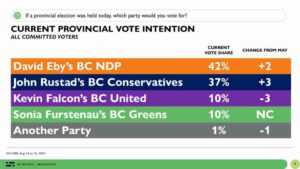
According to David Coletto’s August 16th Abacus poll, David Eby’s BC NDP maintain a comfortable 5-point lead over John Rustad’s novice BC Conservative Party. BC United leader Kevin Falcon and BC Greens leader Sonia Furstenau remain in the also ran category, with no hope of forming government post October 19th.

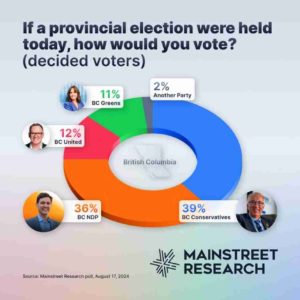
VanRamblings has been told that Quitto Maggi will release his latest Mainstreet poll later this week, weighing in on British Columbia’s provincial election, following an in-the-field survey of 2000+ prospective voters across the province.

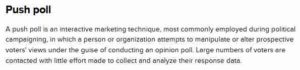
Mainstreet gives John Rustad’s BC Conservative Party a 5-point lead over David Eby’s BC NDP — which reads to VanRamblings as more of a push poll, commissioned by the BC Conservative Party and designed to influence prospective voters still sitting on the fence as to who they will cast a ballot for this upcoming October.

Back to David Coletto’s, more credible, Abacus August 16th poll.

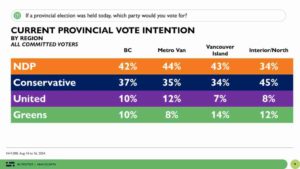
According to Mr. Coletto, David Eby’s BC NDP maintain an even more comfortable 9-point lead over John Rustad’s upstart BC Conservative Party in the vote rich Metro Vancouver region out to Chilliwack, where there are 52-seats up for grabs, which will constitute 58% of the 93 seats in the next session of the British Columbia Legislature.

Further, David Eby’s BC NDP maintains an almost insurmountable lead of nine points over John Rustad’s woefully unprepared BC Conservative Party across the entirety of Vancouver Island, where 17 seats are up for grabs, all but two of which are currently held by BC NDP incumbents.

VanRamblings has been told the BC Conservatives are polling better north of Nanaimo, and could very well pick up Courtenay-Comox and the North Island.


John Rustad, leader of the upstart British Columbia Conservative Party, which is currently polling well.

Although John Rustad’s BC Conservative Party holds an 11-point lead over David Eby’s BC NDP outside of the Lower Mainland — in the Okanagan, the Interior and in the North —  there are only 24 seats that the BC Conservatives could possibly win. Nathan Cullen, currently the wildly popular BC NDP Member of the Legislative Assembly representing the Stikine, and current Minister of Water, Land and Resource Stewardship and Minister Responsible for Fisheries in David Eby’s BC NDP government hardly constitutes a winning seat up north for the BC Conservative Party, so John Rustad would likely be denied a sweep of the ridings outside of Metro Vancouver.

All is not lost for John Rustad and the BC Conservative Party, though, which VanRamblings will write about later in the week.


Kevin Falcon, the beleaguered leader (at least for now) of the down in the dumps BC United Party.

Apropos of nothing in particular, VanRamblings has also been told by a generally reliable source that BC United leader Kevin Falcon will tender his resignation as party leader later this week or early next week, and most certainly before month’s end.

We don’t find the information respecting Mr. Falcon’s pending, apparent, resignation to be credible. In tomorrow’s VanRamblings, we’ll express why, while going into some detail as to why we believe Mr. Falcon is not faring better in the lead-up to the 43rd BC provincial election.


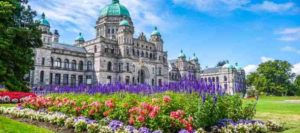
Government House, home of BC Lieutenant Governor Janet Austin, where Premier David Eby will visit   September 14 to ask Ms. Austin to dissolve the Legislature and call for B.C.’s  43rd provincial election.

As we wrote last week, the Writ will be dropped on Sunday, September 14th, at which point what is sure to be an uncommonly “pointed” (read: vicious and unsettling) 35-day election cycle will commence, with the four main British Columbia political parties fighting hammer and tong for victory, whatever the nature of that “victory” might mean— for BC United, survival and six seats would suffice to keep the party alive, as would be the case with the BC Greens, who would be thrilled were they to secure two seats in the next session of the Legislature.

1979 | 27-Year-Old NDP Rogue Candidate Wins Landslide Nomination

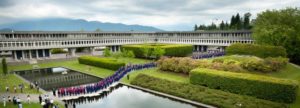
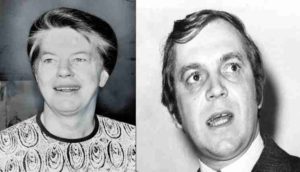
In 1979, when VanRamblings was enrolled in a Master’s Programme at Simon Fraser University (in Policy Administration, don’tcha know), Pauline Jewett — Simon Fraser University’s President, the first woman to head a major co-educational university in Canada — was approached by federal NDP leader Ed Broadbent, who asked the esteemed Dr. Jewett to consider becoming the New Democratic Party candidate in the Burnaby riding, in the upcoming federal election. With her tenure as SFU President drawing to a close, Dr. Jewett readily agreed to the proposal made by Mr. Broadbent, the deal done, the nomination sealed.


Pauline Jewett, Simon Fraser University President | Ed Broadbent, New Democratic Party federal leader

Not so fast …

Across town, there was a 26-year-old young man who had just graduated with distinction from the University of British Columbia Law School, and moved into a condominium with his boyfriend, just “down the hill” from Simon Fraser University.

Now, we’re talking 1979, when openly living with your boyfriend was not well accepted among the general population.

Even so, this brash and very bright young man made the decision to seek the federal New Democratic Party nomination in Burnaby, turning what had been planned as a New Democratic Party coronation for Pauline Jewett into a race.


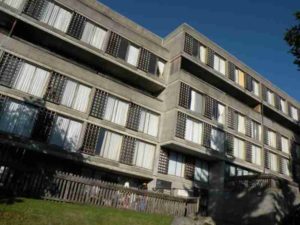
Louis Riel House, Simon Fraser University student family residence, where VanRamblings lived.

The young man had every intention of winning the nomination, and becoming the next Member of Parliament, representing the good citizens of Burnaby.

This young man made his way to Simon Fraser University, meeting with members of the Student Forum, various of the student political groups on the left of the political spectrum, staff at the student newspaper, The Peak, as well as student leaders across the university, one of whom was VanRamblings, this young man meeting with us — usually in a packed apartment full of campus activists — on several different occasions, in our student residence apartment at Louis Riel House.

In fact, this vibrant, charismatic and engaging young man made a point of introducing himself to every student in each of the student residences at SFU, often meeting with these students several times, signing them up to his campaign team.

In the three months leading up to the off campus NDP Burnaby riding nomination meeting, the young man’s campaign team had signed up 3,000 new members to the Burnaby riding association, from across the demographic and cultural spectrum. Membership in the party had grown to such an extent that the riding association kept having to book larger and larger venues. On the night of the nomination meeting, more than 2,700 riding association members arrived at the hall to vote for their candidate, the majority of whom it soon became clear would cast their ballot for this charming, fascinating, almost bewitching, and intriguing young man.


Svend Robinson, 1979. New Democratic Party Member of Parliament, May 22, 1979 – June 28, 2004

Svend Robinson went on to win the federal New Democratic Party nomination to represent the citizens of Burnaby in a walk, garnering more than 90% of the ballots cast, the writ dropped by Prime Minister Pierre Elliot Trudeau within days of Mr. Robinson’s precision, near military campaign-style run to secure the nomination.

On May 22nd, 1979, Svend Robinson became the Member of Parliament for the Burnaby riding, where he was re-elected term after term for a quarter of a century.

In the years that followed Svend Robinson’s election to Ottawa, this principled New Democratic Party Member of Parliament, working locally with Gary Cristall on the Committee for the Defense of Human Rights in Latin America, and with Scott Parker and Daryl Adams on the Galindro Madrid Defense Committee — Mr. Madrid jumping ship in Vancouver, to make an application for asylum, to escape the brutal regime of Chilean dictator, Augusto Pinochet — Svend Robinson played a pivotal role in gaining citizenship for thousands of Chilean refugees fleeing the Pinochet regime, in all of our meetings, a quick study always, getting quickly to the core issues at hand, as we moved together towards remediative action and resolution.

When, over time, reflecting on his initial run for office and his work to secure the Burnaby NDP nomination in 1979, Svend passed on this piece of wisdom …

“Raymond, winning a nomination or winning election to office is always a numbers game. Planning, hard work, a first-rate campaign team, commitment, knowing why you’re running, keeping an eye on the goal, working closely with people to gain their confidence, to win them over, to assure your future voters you’re on their side, that you will do everything humanly possible to represent their interests locally, to work to resolve their individual problems, while remaining aware of the macro goals of your work — that’s the key to winning, not just for yourself, but for your constituents, for society at large, and for the world.”

Little wonder that Svend Robinson served with distinction for a quarter century.


Coda


Pauline Jewett, NDP Member of Parliament, New Westminster-Coquitlam, May 22, 1979 – July 5, 1988

Having lost her bid to become the Member of Parliament to serve the residents of Burnaby, NDP leader Ed Broadbent appointed Pauline Jewett to run as the NDP candidate for New Westminster-Coquitlam, where she served with distinction in Parliament for nearly a decade, elected to office in 1979, again in 1980 and in 1984.

In 1991, Dr. Jewett was made an Officer of the Order of Canada, and in 1992, she was appointed to the Privy Council.

In 1990, Pauline Jewett was appointed Chancellor of Carleton University, serving in that role until her death from cancer on July 5, 1992.
#VanPoli | Humility | Critical, Yet Missing, in Our Municipal Electoral Politics

In the era of Donald Trump and Pierre Poilievre, humility has become so out of fashion as to almost have been forgotten. Nonetheless, it is worth articulating why humility is an essential attribute of civic life.

Genuine humility and good governance is defined by grace and an intense interest in the lives of others. The perspective of the public, our neighbours, must always be taken into account in the taking of decisions in the public realm.

In the fabric of democracy, humility will always stand as a cornerstone that fortifies the integrity and efficacy of electoral processes and the governance that ensues.

At the municipal level, where governance directly touches the lives of citizens in their communities, the significance of humility becomes even more pronounced.

Humility plays a critical role in the electoral process and among elected officials at the civic level, in fostering trust, co-operation, and effective leadership.

If we in Vancouver have suffered in the civic domain for most of the past quarter century, bereft of an otherwise recommendable civic administration of conscience, the central failure of governance in our city has occurred as a consequence of an unremitting arrogance, and a certitude that what is being done is right and in the collective interest, whether or not community consensus has been achieved.

Humility in the electoral process serves as a linchpin in maintaining the democratic ideals of fairness and equality.

Municipal elections are the bedrock of local democracy, where individuals come together to choose representatives who will voice their concerns, make decisions, and shape policies that directly impact our day-to-day lives.

Humble candidates prioritize the needs and aspirations of their constituents over personal ambitions, engaging in genuine dialogue and actively listening to the diverse voices within their communities. They eschew grandstanding and instead focus on authentic connections and constructive discourse, thereby fostering an electoral environment that is characterized by respect, civility, and inclusivity.

Once elected, those persons who are elected to City Council, Park Board or School Board bear the weighty responsibility of representing the interests of their constituents, while navigating the complexities of policy making and administration.

In this capacity, humility serves as a guiding principle that grounds officials in a recognition of their fallibility and the limitations of their knowledge.

Humble leaders understand that they do not possess all the answers and thus remain open to diverse perspectives, expertise, and feedback from both constituents and fellow stakeholders.

By embracing humility, elected officials cultivate an environment of collaboration and collective problem-solving, transcending partisan divides and fostering innovative solutions to the myriad challenges facing their communities.

Furthermore, humility engenders trust and credibility among constituents, essential elements for the legitimacy of municipal governance.

In an era marked by heightened skepticism towards traditional institutions, humility offers a powerful antidote to the erosion of public trust in government.

Humble leaders prioritize the common good over personal gain, earning the respect and admiration of their constituents through their humility, authenticity, and commitment to serving the public interest.

The challenges confronting municipalities require leaders who possess the humility to acknowledge the complexity of these issues and the willingness to collaborate with diverse stakeholders to address them effectively.

Fostering trust and cooperation to promoting effective leadership and governance, humility serves as a guiding principle enriching the fabric of local democracy.

Let us be very clear here: we as a voting public in Vancouver do not want more arrogance in civic governance of our city.

We do not want holier-than-thou elected civic officials, whether they are with the so-called “progressive coalition” or the nominally right-of-centre ABC Vancouver civic party dictating what is best for us, and ignoring our voices. We’ve had a quarter century of that, and that is more than enough.

In Vancouver, to be a respected, successful and admired politician, one must know what one stands for and what one is fighting for, to know how to work with others, to listen to the public and be a voice for change for the better.

If you’re an elected official, you better darn well listen to the public, bring them along with you, and not find yourself sitting back on your high horse telling the public …

“Oh, deary, I know what’s best for you. Oh sure, I know you think you know what’s best for you, but believe me, I know better than you what’s good for you. Just trust me. And even if you don’t trust me, I’m going to go ahead and do what I damn well please, anyway.”

That’s a recipe for electoral disaster, and a very pissed off public — and if you’ve got any caring, compassion and humility at all, you don’t want that.

Take heed elected officials. Should you fail to do so, you proceed at your peril.

#VanPoli | Our Collective Journey Towards Indigenous Reconciliation

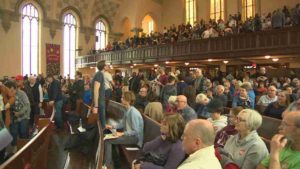
In contemporary discourse, acknowledgment of reconciliation at the commencement of gatherings of people — when such gatherings take place in Parliament, the Legislature, or at meetings of municipal Councils, or more informally at other types of political meetings, in churches, at housing co-operative meetings, or even when people gather to take in a screening at the Vancouver International Film Festival’s VIFF Centre — has gained considerable attention and importance.

The land acknowledgment serves as a recognition of past injustices and a commitment to moving forward with mutual respect and understanding.

Today on VanRamblings, we’ll explore the significance of the reconciliation acknowledgment in fostering inclusivity, building relationships, and promoting healing within organizations and communities.

One significant catalyst for the reconciliation acknowledgment was the global recognition of the need to address the historical and ongoing impacts of colonization on Indigenous peoples. This recognition was spurred by advocacy efforts from Indigenous communities, grassroots organizations, and allies pushing for truth, justice, and reconciliation.

In Canada, the Truth and Reconciliation Commission (TRC), established in 2008, played a pivotal role in raising awareness about the legacy of residential schools and advocating for reconciliation between Indigenous and non-Indigenous Canadians. As part of its Calls to Action, the TRC called on governments, organizations, and individuals to recognize and respect Indigenous rights, cultures, and traditions, through the acknowledgment of traditional territories and treaties.

By acknowledging the traditional owners of the land and recognizing the histories of colonization and marginalization, a space is created where all participants feel valued and respected. This acknowledgment extends beyond geographical boundaries, encompassing the acknowledgment of past wrongs against Indigenous peoples, marginalized communities, and minority groups.

The voicing of the land acknowledgment signals a commitment to equity and diversity, creating an environment where everyone’s voice is heard and valued.

Acknowledging reconciliation at the outset of meetings builds trust and strengthens relationships among participants. It demonstrates a willingness to confront uncomfortable truths and engage in meaningful dialogue about the legacy of colonialism, oppression, and discrimination.

The land acknowledgment also opens the door for honest conversations about privilege, power dynamics, and systemic injustices, fostering empathy and understanding among individuals with diverse backgrounds and experiences. Through the reconciliation process, relationships based on mutual respect and solidarity are cultivated, laying the foundation for collaborative action and social change.

Reconciliation acknowledgment is an essential step towards healing historical wounds and addressing intergenerational trauma. By acknowledging past injustices and their ongoing impacts, it validates the experiences of those who have been marginalized and oppressed.

This acknowledgment is not merely symbolic but serves as a tangible commitment to truth-telling, justice, and reconciliation. It provides an opportunity for healing and restoration, allowing individuals and communities to confront the legacies of the past and work towards a more equitable and inclusive future.


Canadians grieve the finding of the mass graves at the Kamloops Indian residential school, the 215 children lost to their families when they were taken by the government, but also for their lost lives.

Joanne Mills, the Executive Director of the Fraser Region Aboriginal Friendship Centre, has expressed concern about overuse of the the word reconciliation.

“Reconciliation in Canada is more about the acknowledgement that there were wrongs, but there isn’t a lot of action attached to it. It’s difficult to be talking about reconciliation while one party is in power and another is still asking for rights from the former.

There definitely isn’t an equal power distribution. We’re not coming to the table as peers, we’re still coming to the table as have and have-nots,” she says.

Joanne Mills says for reconciliation to take shape, there needs to be an honest attempt to restore to Indigenous people what was taken at the time of colonization.

“I just don’t want to talk about the stereotypes anymore. People should go and educate themselves and learn the truth,” Mills says.

Mills says inequality remains in areas of provincial jurisdiction, such as the high rates of Indigenous kids in foster care in B.C., access to education and over representation of Indigenous people in prison.

B.C. has seen changes in elementary and secondary school curriculum to include more education about Indigenous people, but there have been bumps along the way. Some teachers say they are at a loss on how to teach Indigenous content. Others say they lack sufficient resources.

The adoption of reconciliation acknowledgments reflects a broader societal shift towards acknowledging and confronting the injustices of the past, promoting dialogue, understanding, and working towards an inclusive and equitable future. While the genesis of the reconciliation acknowledgment vary across contexts, its underlying principles of recognition, respect and reconciliation remain universal.