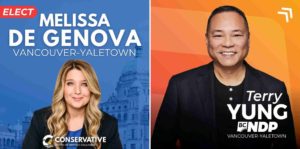
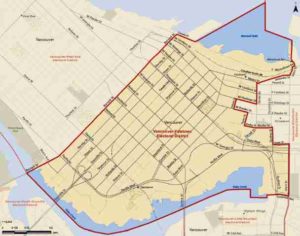
One of the more interesting battles for office in the 2024 British Columbia provincial election will occur in the new, redistributed riding of Vancouver-Yaletown.
Vying for supremacy on election night, Saturday, October 19th, are Conservative Party of BC candidate for office, Melissa De Genova, and the recently recruited British Columbia New Democratic Party candidate, Terry Yung.
As we say above, Vancouver-Yaletown is a new British Columbia electoral riding that was created from a 2022 re-drawing of electoral riding boundaries.
Previously, the area was part of the Vancouver-False Creek riding, which is a geographical area that includes the False Creek South neighbourhoods.
Between 2013 and 2020, the riding of Vancouver-False Creek was held by former Vancouver Mayor Sam Sullivan. Currently, Vancouver-False Creek is represented by the BC NDP’s Brenda Bailey, who is the Minister of Jobs, Economic Development, and Innovation. In 2024, Ms. Bailey will seek elected office as the BC NDP candidate in the newly-created riding of Vancouver-South Granville.
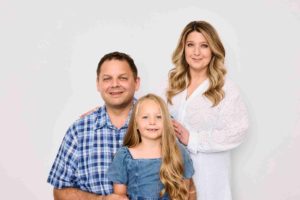
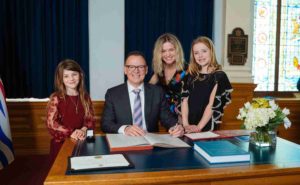
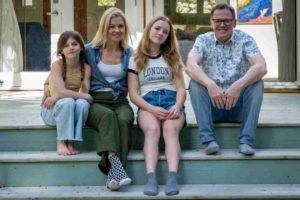
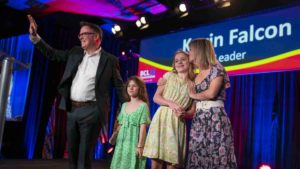
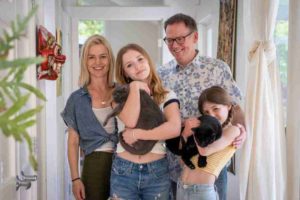
Melissa De Genova, her VPD officer husband, Blair, and daughter, Lili — who just entered Grade Two
B.C. Conservative Party leader John Rustad, upon successfully recruiting Melissa De Genova as a party candidate, had this to say …
“Melissa brings valuable experience regarding getting housing built, with her deep understanding of the challenges of actually getting housing built, from all perspectives. In her tenure as a two-term Vancouver City Councillor, and her work in the private sector, Melissa worked to get both market and non-profit housing built. The Conservative Party believes Melissa De Genova’s expertise in housing is critical to tackling the affordability crisis in BC.”
The Conservative Party website adds about their Vancouver-Yaletown candidate.
Ms. De Genova was named one of the top forty under forty by Business in Vancouver for her work in creating affordable housing. She has volunteered for numerous community-focused charities, including the Moberly Arts and Cultural Centre, the Salvation Army in the Downtown Eastside, Odd Squad productions, Honour House and the Italian Day Festival Society.
What is true about Melissa De Genova is that she is a fighter, a community activist and elected official who doesn’t put up with any guff.
When Melissa De Genova fought for the construction of the Killarney Seniors Centre — despite members of the majority Vision Vancouver City Council dragging their heels on approval of the needed seniors facility — Melissa was relentless in working to get the seniors facility built, as she moved the sun, the moon, the Earth and the stars to achieve her goal.
VanRamblings, and anyone who has worked with Melissa, can tell you, this three time elected official (Melissa sat as a Park Board Commissioner from 2011 to 2014, before being elected to two terms on Vancouver City Council) is no one to mess with when she sets her mind to serving the best interests of the community.
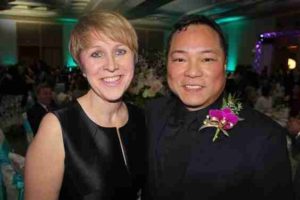
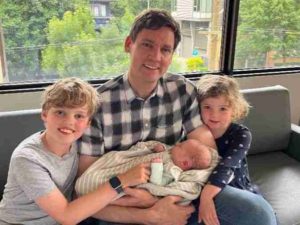
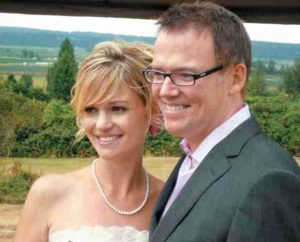
Vancouver City Councillor Sarah Kirby-Yung, and her beloved husband Terry Yung, BC NDP candidate.
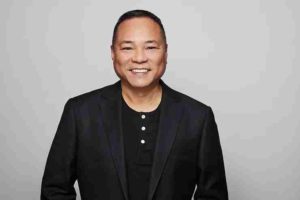
Retired Vancouver Police Department (VPD) Inspector Terry Yung — who recently left the VPD after three decades of distinguished service — on August 28th became the British Columbia New Democratic Party candidate for office in the newly-created Vancouver-Yaletown riding, ready to fight for victory in the October 2024 provincial election.
“I know Terry is values driven.
He readies action any time someone is pushed around, exploited, taken advantage of, or left behind,” said BC NDP Premier David Eby, when Terry Yung secured the nomination.
“He knows we need to be tough on crime, and tough on the causes of crime. These values led him to an exceptional career in law enforcement, and have called him to public life as a BC NDP candidate. Terry will join two other senior police officers on our candidate team, all of whom have spent their careers dedicated to delivering safe and strong communities. The people of Vancouver-Yaletown can count on him to be in their corner,” continued Eby.
Terry Yung was also the longtime board Chair of the non-profit social service organization SUCCESS (United Chinese Community Enrichment Services Society), and involved with other organizations such as the Big Brothers of Greater Vancouver, the Vancouver Cambie Lions Club, and the Jewish Federation of Greater Vancouver. Terry is a recipient of the BC Medal of Good Citizenship and a Melvin Jones Fellow.
“City cores across North America are facing crises with homelessness and addictions, and the impact on public safety that follows. Here in B.C., we’re focused on keeping people safe and getting to the root causes of crime — it’s starting to make a difference,” Yung told those gathered for the Vancouver-Yaletown BC NDP meeting where he was acclaimed the party’s candidate.
“As a former VPD officer, I know B.C. can be a leader in successfully taking on these challenges with kindness and compassion, recognizing the roles of poverty and mental health in creating these conditions. And that’s the approach David Eby’s government has taken: hiring new police officers to take on organized crime, launching mental health crisis response teams, while opening more homes and treatment facilities. B.C. is tackling our public safety challenges on every level. It’s work worth doing — and worth being a part of, which is why I came forward. I can’t wait to get to work in the British Columbia Legislature.”
The emergent, central, defining election issue in Vancouver-Yaletown: crime.
Let me guess…
With 49 Days until the election, ill bet the NDP will say they’ll be ‘looking into this’?
Add to list with:
-Chaotic housing projects
-Drug paraphernalia vending machines
-Prov. Health Officer suggesting drug dispensaries. #BCPoli#TooLittleTooLate #hypocrisy https://t.co/8Ly1OdPSZF— Melissa De Genova 鄭慧蘭 (@MelissaDeGenova) September 2, 2024
VanRamblings sources tell us that …
- When recruiting Terry Yung, the Premier made a commitment to Mr. Yung he would appoint the decorated VDP Inspector as our province’s next Solicitor General, and …
- According to internal party polling, from both the Conservatives and NDP, Melissa De Genova currently enjoys a substantial lead over her opponent. But believe us when we say, with 46 days to go until Election Day, it is waaayyyy too early to predict the outcome of the electoral race to represent the residents of Vancouver-Yaletown..
Terry Yung’s claim to fame is that the residents of Yaletown give him credit for shutting down the controversial Overdose Prevention Society safe injection site — which was a magnet for crime and disorder in their neighbourhood.
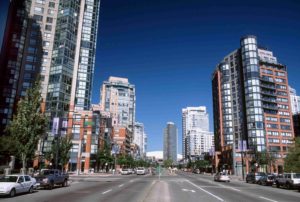
Given that Yaletown has emerged in recent years as a family neighbourhood — we’re always surprised to find young children and their families walking throughout the neighbourhood, heading home from a visit to the T&T market, to their home on the 11th floor of one of the myriad Yaletown towers — moving the safe injection to a nearby site, adjacent to Yaletown, was the first order of business for Terry Yung, and the grateful residents of Yaletown.
If we have a criticism of Melissa’s 2024 campaign for provincial office it’s that she is — as has been the case throughout her political career — far too partisan for her own good, her daily visceral, ad hominen attacks on David Eby … who most folks actually like on a personal level, even if they’re not fans of his government … we believe to be counterproductive to her goal of attaining a seat in the provincial Legislature. In the 2022 Vancouver civic election, the electorate tired of her act, relegating her to a 19th place finish on election night, on Saturday, October 15th.
Melissa may wish to reconsider her strategy by adopting a somewhat less inflammatory approach to her goal of winning elected provincial office.
We will say two more things pertinent to Ms. De Genova’s bid to attain office.
- There is no love loss between Ms. De Genova and current ABC Vancouver / former Non-Partisan Association (NPA) Vancouver City Councillor Sarah Kirby-Yung. Terry Yung loves his wife, and hardly cottons to Ms. De Genova’s less than generous appreciation of his beloved spouse. For Melissa, this is personal, not to mention which, knowing Melissa it is probable that she feels Terry Yung to be a turncoat — “How dare he have supported his wife’s run for Vancouver City Council under the centre-right Non-Partisan Association banner, while supporting his good friend, Vancouver-Langara B.C. Liberal Member of the Legislature, Michael Lee, and now emerge as a latter day candidate for the hated NDP.”
- Terry Yung is a respected and beloved, retired 30-year member of the Vancouver Police Department. Ms. De Genova’s husband is Blair Da Costa, a multi-year member of the aforementioned Vancouver Police Department. Now, dear and constant reader, you may have heard something about “the boys in blue are a brotherhood.” If Terry Yung doesn’t exactly cotton to Ms. De Genova’s derision for his wife, you can bet that members of the VPD will not be thrilled with Mr. Da Costa’s wife going after one of their own. Just sayin’ …
One more thing: for far too long, members of the public — particularly on the left side of the political spectrum — have underestimated Melissa De Genova, written her off as a “whack job,” designated her as a ne’er-do-well right winger (this name calling on the left drives VanRamblings crazy).

In our long association with Melissa, VanRamblings has always found her to be a progressive on the social issues of the day — and, dare we say, a union supporter — a person of heart and conscience who means well for our city, a person who strives each and every day towards building a better tomorrow for her young daughter, and for all children and families who reside in every region of our province.
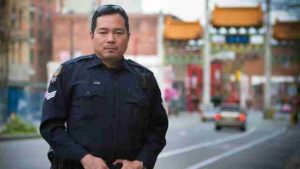
Photo of Terry Yung taken on May 11, 2012 for a BBC story on Vancouver’s Downtown Eastside
When it come to Terry Yung — who we know and like — we’re unconcerned about the viability and potential for success of his bid for elected provincial office.
Terry Yung went after the Vancouver-Yaletown New Democratic Party nomination with his eyes open. To underestimate Terry Yung’s wit, his intelligence, his experience and his political acumen — hell, he’s married to VanRamblings’ favourite political person in the province! — would be a terrible mistake. No fool he — they’re ain’t a smidgen of naïveté in how Terry Yung brings himself to the world.
Not to mention which: David Eby has no intention of losing this election.
The BC NDP and the BC NDP alone in the 2024 British Columbia provincial election have built an unassailable election campaign machine, with Dippers from across Canada arriving on our shores daily — experienced and winning campaigners, who mean to re-elect David Eby’s NDP government, given that there is so much on the line as they run against an alt-right, Trump-like John Rustad (who actually told the CBC’s Michelle Elliott last week that teachers are indoctrinating students in their care, distributing pornography to Grade 4 students as part of the SOGI 123 programme — without any evidence whatsoever to prove his claim — and that his government would ban thousands of books currently on the shelves in school libraries) — ready to fight for what is right, forward thinking and just for all.