All posts by Raymond Tomlin

About Raymond Tomlin

Raymond Tomlin is a veteran journalist and educator who has written frequently on the political realm — municipal, provincial and federal — as well as on cinema, mainstream popular culture, the arts, and technology.

Decision 2021 | Post Mortem, Part 2 | NDP | Despicable, Disingenuous, Unconscionable


(Left to right) | The Right Honourable Lester B. Pearson, 14th Prime Minister of Canada; the Right Honourable John Diefenbaker, 13th Prime Minister of Canada;  Paul Hellyer, Canada’s Minister of National Defence; and the Honourable Tommy Douglas, Leader of the New Democratic Party of Canada from 1961 until 1971. (From: The Shaw Family collection of photographs.). Circa 1962.

On Thursday, August 3rd 1961, Tommy Douglas resigned as Premier of the province of Saskatchewan to become the first leader of the federal New Democratic Party (NDP), a formal alliance between the Co-operative Commonwealth Federation (CCF) and organized labour. As the left’s most eloquent spokesman, Tommy Douglas was able to inspire and motivate both the members of his nascent federal political party and the working women and men he sought to represent in the halls of power in Ottawa, and in Parliament.

Tommy Douglas, as the architect of Canada’s cherished medicare health care system, is considered by many to be a Canadian hero.

From Thursday, June 15th, 1944 — when, as leader of the CCF, he won 47 of 52 seats in the Legislative Assembly of Saskatchewan, forming our nation’s first social democratic government — Tommy Douglas set about to …

  • Create the only publicly owned electrical power corporation, providing inexpensive power to all regions of his province;
  • Create Canada’s first publicly owned automotive insurance service;
  • Create a large number of crown corporations, replacing private sector interests;
  • Legislate the unionization of the public service;
  • Create a programme to offer taxpayer-funded hospital care to all citizens — the first in North America;
  • Introduce medical insurance reform in his first term, gradually moving the province towards universal medicare, which was adopted in Saskatchewan in 1960, and enacted into law by his successor, Woodrow Lloyd in 1962;
  • Pass a Saskatchewan Bill of Rights, protecting fundamental freedoms and equality, preceding the adoption of the Universal Declaration of Human Rights by the United Nations by 18 months.

Upon becoming leader of the federal New Democratic Party, Mr. Douglas was congratulated by then Conservative Prime Minister of Canada John Diefenbaker — a fellow, lifelong resident of Saskatchewan — and the Leader of the Opposition, the head of the Liberal Party since January 16, 1958, Lester B. Pearson, a 1957 recipient of the Nobel Peace Prize for his role in resolving the Suez Crisis in 1956.

Over the years, John Diefenbaker had opposed each and and every initiative introduced and passed into law by the CCF government of Tommy Douglas. Tommy Douglas accepted the leadership of the NDP, stating, “What I would wish for one, I would wish for all — and, for me, that means the adoption of a national health care programme for all Canadians” — which is what Mr. Douglas set about to achieve.

Working collaboratively with Lester Pearson, when Mr. Pearson became Canada’s 14th Prime Minister on April 8th, 1963, Tommy Douglas worked closely with the new Prime Minister to bring about a pan-Canadian Medicare system, resulting in 1966 with the passage into law of a publicly-funded and administered, comprehensive, accessible hospital and medical services health insurance plan covering all Canadians, from coast to coast to coast, from that day to this.

Working collaboratively and co-operatively with NDP leader Tommy Douglas, during his tenure as Prime Minister, Mr. Pearson launched not just progressive policies such as universal health care, but as well, the Canada Student Loan Programme, and a universal social programme particularly close to Tommy Douglas’ heart, the Canada Pension Plan, introduced and passed into law in 1965.

There is much to be achieved when progressive parties work closely together, in the spirit of forwarding and promoting the social and economic interests of Canadian women, men and children — working to achieve a just Canada for all.


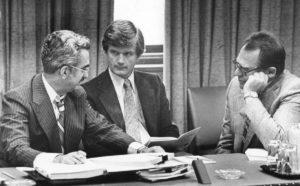
New Democratic Party leader David Lewis & Liberal Prime Minister Pierre Elliott Trudeau, circa 1972

On Saturday, April 24, 1971 David Lewis became the 2nd leader of the federal New Democratic Party of Canada, following Tommy Douglas’ resignation as NDP leader.

On September 2nd, 1972, Prime Minister Pierre Elliott Trudeau called an election, and on Election Day, October 30, 1972, failed to secure a majority, losing 38 seats in Parliament, requiring the support of David Lewis and the New Democratic Party — which had increased its seat count from 25 to 31 — in order to govern.

David Lewis and Pierre Trudeau sat down in the days and weeks following the 1972 federal election, negotiating the implementation of two programmes that would prove critical to the interests of working people, to Canada’s youth, to families, and for the creative classes across Canada …

1. An affordable housing programme, which became “a made in Canada solution to the provision of affordable housing”, a co-operative housing programme that provided affordable housing to more than 130,000 Canadian families in its first decade, and …

2. A federal jobs programme mainly geared towards youth, a multi-faceted jobs programme geared to serve the interests of a lost generation of seemingly unemployable Canadian youth — which became the Local Initiative Programme (LIP), the Local Employment Assistance Programme (LEAP), and the Youth Employment Programme (YEP) — the three programmes providing billions of dollars in funding for jobs programmes for youth to initiate “entrepreneurial” projects, ranging from the creation of food, farm and wholesale import food co-operatives, child care centres, community-based furniture / automotive / and recycling programmes, as well as the creation of innovative theatre companies across Canada, providing funding to actors and support theatre staff, directors and subsidy funding for the creation of arts centres, such as the Vancouver East Cultural Centre (“The Cultch”).

New Democratic Party leader David Lewis and Prime Minister Pierre Elliott Trudeau worked closely together between 1972 and 1974, when Mr. Trudeau called a federal election on May 8, 1974, re-gaining a majority government two months later, on July 8, 1974, when his government won 32 additional seats. Between October 30, 1972 and May 8, 1974, David Lewis and Mr. Trudeau worked collaboratively and co-operatively together in the interests of the Canadian people, setting aside partisan concerns, developing an enduring respect and admiration for one another — as had been the case with their predecessors, Tommy Douglas and Lester B. Pearson. Although Mr. Lewis was leader of the fourth Opposition Party in Parliament — as is the case with Jagmeet Singh and the NDP today — and while Mr. Lewis held Mr. Trudeau to account in the House of Commons, not once did Mr. Lewis ever allow his criticism of the Liberal government to devolve (as Jagmeet Singh has) into personal attacks full of invective against the Liberal Party leader.

During their terms as leaders of the federal New Democratic Party of Canada, both Tommy Douglas and David Lewis — great Canadian leaders, both — achieved much good for the people of Canada, as they set aside corrosive, soul destroying and ruinous partisanship and the damaging and annihilating politics of personal destruction, in favour of co-operation and collaboration to bring about a more just and economically fair Canada that might serve the interests of all Canadians.

And now we come to the NDP ‘attack’ era of Jagmeet Singh, in the year 2021.

Now, let’s take on the points raised in the NDP ad above.

Seniors care. On August 19, 2021, Prime Minister Trudeau made what was called an historic announcement

“Today we heard a detailed commitment from Justin Trudeau that would lift-up working women and bring PSWs greater economic security with a $25 minimum wage,” said Sharleen Stewart, president of SEIU Healthcare. “Leadership at the federal level directly in support of our healthcare heroes is nothing short of historic for working women in the elder care economy.”

“We cannot allow Canadian seniors to go without dignified care. That is why introducing and passing the Safe Long-Term Care Act is so essential to ensuring higher quality care standards for our most elderly moms and dads,” added Stewart.

In addition, the Trudeau government brought in programmes to support seniors by passing legislation establishing new national standards in seniors care, while also legislating programmes that will act to ensure seniors can remain in their homes longer, with new, universal support programmes. Rather than doing nothing, as the ad above suggests, the Trudeau government enacted legislation that …

  • Raised wages for personal support workers, including a guaranteed minimum wage of at least $25 per hour;
  • Will train up to 50,000 new personal support workers;
  • Doubled the Home Accessibility Tax Credit, which will provide up to an additional $1,500 to help seniors stay in their homes longer by making them more accessible;
  • Improved the quality and availability of long-term care home beds;
  • Continued to implement strict infection prevention and control measures, including through more provincial and territorial facility inspections for long-term care homes;
  • Developed a Safe Long Term Care Act collaboratively with the provinces and home care providers to ensure that seniors are guaranteed the care they deserve, no matter where they live.

Meanwhile, the Prime Minister has stated that his government will introduce legislation this next term that will raise the corporate taxes paid by Canada’s “largest and most profitable” financial services firms, raising the corporate income tax rate by three percentage points — from 15 per cent to 18 per cent — on all bank and insurance earnings over $1 billion. Mr. Trudeau has stated repeatedly that his government will not tolerate “sophisticated tax planning or profit-sharing” by companies looking to dodge the new measures, promising the introduction of legislation that would “target anti-avoidance rules” to ensure the companies “pay their fair share.”  Working with the provinces, the federal government will set about to strengthen and enhance the powers of the federal Financial Consumer Agency of Canada to protect the financial — and house purchasing — interests of Canadians.

Justin Trudeau has stated that enacting universal, single-payer public pharmacare is not off the table for his government. Prior to introduction of such legislation, in their most recent term of office, the government introduced and passed drug pricing measures, explicitly designed to tamp down Canada’s rising pharmaceutical costs, and expanded the mandate of the independent Patented Medicine Prices Review Board — to “protect consumers by ensuring that the prices of patented medicines are not excessive.” At the explicit instruction of the Trudeau government, the Board has removed the United States as a comparator, instead relying on seven comparator countries, including Germany, France, Italy, the United Kingdom, Sweden and Switzerland, where drug prices are much cheaper.

One is left to wonder, if the three ads the New Democratic Party ran in this most recent election are so misleading, what else are the NDP lying to Canadians about?

As stated previously, Jagmeet Singh and the NDP focused their ads and their ire exclusively on Justin Trudeau and the Liberal Party, without ever making reference to the Conservative Party’s record of homo-and-transphobia, their anti-vaxx rhetoric, their egregious position on rescinding the ban on assault weapons, the Tories’ proposed re-introduction of the Northern Gateway pipeline which, apart from blowing Canada’s climate action goals out of the water, would see tanker traffic carrying raw bitumen from the Alberta oil sands down B.C.’s west coast, not to mention, the Conservatives’ truculent position on women’s reproductive rights!

Meanwhile, by seeming to offer support and succour to Erin O’Toole and the Conservatives in the 2021 election, the New Democratic Party expressed no concern whatsoever on the Tories proposed rescinding of the national child care programme the Trudeau government had negotiated with 8 provinces and territories, or the elimination of the Canada Child Benefit in favour of a tax credit that would benefit only the wealthy. The NDP were also mum on the re-introduction of a ban on conversion therapy covering all LGBTQ2+ Canadians, as an early priority for a Liberal minority government were it to be re-elected.

The NDP spent a record $25.8 million over the course of the past five weeks trying to convince Canadians to vote for them — raising their seat count in Parliament by one. $25.8 million dollars for one additional seat, and achieving a mere 17.7% share of the vote, while Jagmeet Singh blatted on about “When, on September 20th, the NDP form government” … what a ludicrous idea, and how demeaning a message to Canadians, who the NDP clearly thought to be fools, if they believed for one moment that the NDP had a hope in hell of forming government.

On Tuesday, Jagmeet Singh faced questions about his leadership over the party’s one-seat gain, despite being in a much stronger financial position for this campaign than the one in 2019.

Asked by the Toronto Star’s Alex Ballingall if Mr. Singh felt secure in his leadership that produced only one additional seat, the NDP leader projected confidence with a wide smile and unambiguous, “Yes.”

Reporters in a scrum with Jagmeet Singh also noted that the NDP targeted Justin Trudeau with negative attacks throughout the campaign and up until the final day, undermining trust in the Prime Minister. In response, Jagmeet Singh doubled down on his — clearly unproductive and wildly ineffectual — campaign approach, which included calling Mr. Trudeau an “abject failure” and “bad for Canada.”

The New Democratic Party federal leader, Jagmeet Singh, told reporters …

“My words, the NDP attack ads, and what some have called the vicious, personal nature of the NDP campaign towards Mr. Trudeau won’t cause any damage to a future negotiation strategy with the re-elected Prime Minister. Everything I said was true. I’m going to stand behind it 100%,” said Mr. Singh. “But when, or if, I meet with the Prime Minister, let me be clear: I’m going to tell him, ‘You messed up’. Even given my relentless attack on Mr. Trudeau and his Liberal team, I believe that together we can get things done for Canadians.”

Maybe former broadcaster Tamara Stanners has the right idea …

Decision 2021 | Canada | Post Mortem, Part 1 | It’s Déjà Vu All Over Again


On Monday evening, Canadians returned a stable and responsible Liberal minority government, led by Prime Minister Justin Trudeau,  to the halls of power in Ottawa and to Parliament, in an election that would appear on the surface not to change much. Only time will tell, of course, if the 2nd, 3rd and 4th parties will find themselves able to work with the Liberals in the interest of all Canadians, or whether they’ll return to their destructive and unproductive orientation of morbid  partisan politics that defined their conduct prior to the calling of the August 15th election.

For VanRamblings, here are a few takeaways from the election …

1. Shachi Kurl cost Canadians and the Liberal Party a majority government. Going into the English Leaders’ debate, the Bloc Québécois had lost their footing, with all polls showing them unable to retain more than 10 seats in Parliament, for a loss of 22 seats. The support of Québeckers had moved to Justin Trudeau and the Liberal party — which looked to pick up most of the lost Bloc seats, propelling them to a majority government. Then Ms. Kurl asked a damnedly poorly phrased question concerning Québec Bill 21 — banning Québec citizens from wearing religious symbols, and mandating that one’s face be uncovered to give or receive specific public services — the contentious nature of her question propelling the Bloc into a stratospherically high, and unforgiving, seat count;

2. The NDP. In an entirely wrong-headed collusionary campaign with Erin O’Toole’s Conservative campaign team — that, it should be noted, won the NDP only one additional seat in Parliament — the NDP relentlessly joined the Conservatives in attacking the Prime Minister, yet never saying an unkind word about one another. Had it not been for Jason Kenney’s announcement of a vaccine passport for Albertans last week — which all but destroyed Erin O’Toole’s chance at winning government —  the Tories would have won government, and thanks to the NDP, Canadians would not have realized the Liberal national child care plan, the continued ban on assault weapons, and the re-introduction of a bill banning  conversion therapy, among a myriad of other progressive Liberal policies.

Annamie Paul is finished as the Green Party leader, and should have resigned on Monday night — but didn’t. Ms. Paul came in a distant fourth place in her home riding of Toronto Centre, securing only 9% of the vote for herself and the Green Party.

In Conservative Party leader Erin O’Toole’s re-tread of former Tory leader Andrew Scheer’s 2019 concession speech, Mr. O’Toole talked about working together with his Tory colleagues to win the next election. Sad for Mr. O’Toole, most members of his party are far to the right of the leader, and want him gone. The knives are already out for Mr.  O’Toole — who is hanging onto his leadership with a hare’s breadth. Mr. O’Toole will resign his leadership within months of his status quo loss.

In happier Election Night stories: federal New Democratic Party candidate Bonita Zarrillo (above) — in the riding of Port Moody-Coquitlam — decisively won her second go-round at the polls, defeating near invisible Conservative Party parachute candidate Nelly Chin by a healthy 1,607 vote count.


Vancouver Granville NDP candidate Anjali Appadurai awaiting count of all polls, and mail-in ballots

At this writing, Vancouver Granville NDP candidate Anjali Appadurai finds herself in a near dead heat with Liberal Taleeb Noormohamed — behind by 230 votes — with 1 poll and the mail-in ballots yet to be counted.

In Richmond Centre Liberal Wilson Miao handily defeated Conservative imcumbent Alice Wong, while in Steveston-Richmond East Liberal candidate Parm Bains absolutely thrashed the Conservative incumbent, Kenny Chiu.

In Burnaby North-Seymour Liberal Terry Beech handily won a third term in office, with VanRamblings favourite, Fleetwood Port Kells Liberal incumbent, Ken Hardie, performing the same feat. Liberals’ Joyce Murray in Vancouver Quadra and Hedy Fry in Vancouver Centre were also gratefully victorious on election night.


Defeated candidates, the NDP’s Ruth Ellen Brosseau & recent Liberal Cabinet Minister, Maryam Monsef

In sad news: in Québec, Berthier—Maskinongé’s Ruth Ellen Brosseau lost her bid to return to Parliament, as did Ontario’s recent Liberal Minister for Women and Gender Equality and Minister of Rural Economic Development, Maryam Monsef.

One final note: in perhaps the best news of the evening, now former Cloverdale-Langley City incumbent Tory MP, renowned climate change denier, and rampant homophobe and transphobe, not to mention activist anti-choice campaigner, Tamara Jansen, was unceremoniously unelectedyippee !!!

Post Election columns from The Globe and Mail (click on the links directly below)

Tory Leader Erin O’Toole’s ideology shift not enough to surpass Liberals

Jagmeet Singh still holds balance of power but NDP doesn’t make major seat gains

After failing to secure majority, Trudeau will face questions within his caucus

Plus these reflections on Election Night 2021 (click on the links directly below)

CBC | Canadians have re-elected a Liberal minority government

Maclean’s A win’s a win | Paul Wells

Vancouver Sun | Liberals hold onto battleground Metro Vancouver ridings

New York Times | Trudeau Projected to Remain PM, Falls Short of a Majority

Washington Post | Liberals win re-election, will lead minority government again


Decision 2021 | E-Day 2021 | The State of the Race | Election Day | Vote Today!


The final Nanos / Globe and Mail poll in #Elxn44. Now we simply await the outcome of the election.

Well, here we are, Election Day — Monday, September 20th. At this point, it’s anybody’s guess as to the outcome, but a Liberal minority seems probable.

In the final VanRamblings #Elxn44 written prior to E-Day — we’ll be weighing in again tomorrow, Tuesday, September 21st, once the results of today’s federal election have been tabulated — we tried to do our very best to make sense of where Canadians stood heading to the polls to choose the next government of Canada.

Erin O’Toole and the Conservative Party of Canada

A few days ago, VanRamblings believed that Erin O’Toole had an even odds chance of forming a majority — or,  at the very least, a significant minority government — once (almost) all the votes have been counted late on the evening of Monday, September 20th. With the rise of the People’s Party of Canada, and Alberta Premier Jason Kenney’s decision last week to bring in a vaccine passport, we no longer believe that prospects for the Tories forming government to be all that rosy.

As may be seen in the Nanos poll above, the Liberal Party and Conservative Party remain in a neck-and-neck battle to determine who will form the next government of Canada. By August 29th, two weeks after Prime Minister Trudeau had called the election the Tories’ focused, policy-driven campaign had Erin O’Toole and the Conservatives at 37% in the polls, while the Liberals’ lacklustre, enervating campaign had their prospects in the doldrums, garnering the support of only 27.7% of the Canadian electorate. And then, the following series of events unfolded …

1. Liberal ads began to appear on the nightly news, raising concerns about a Tory platform that would “take Canada backward“;

2. Erin O’Toole began to flip flop on many of the core issues contained in the Tory handbook: gun control (“We’ll keep the current ban in place, but will review it in the first year.”); climate change (“We’re committed to carbon pricing, just not the Liberal carbon pricing plan.”); abortion (“I believe in a woman’s right to choose. Whether or not, we choose to place limits on abortion will be left to the members of my government.”); transit (“My government would be prepared to move forward on funding transit. Yes, I recognize that this represents a departure from what you see in the Tory handbook, but …”); a projected deficit that exceeds the Liberal party proposal (“We’ll work to eliminate the deficit in the next 10 years. For now, though, there is spending required to get us out of the pandemic.”); the pandemic (“The Conservative Party under my leadership will support vaccine passports, and will work with the provinces to implement this necessary restriction on Canadians’ access rights, as a meaningful way to wrestle COVID-19 to the ground.”);

3. Québec. Never before in Canadian political history has a question asked by the moderator of a Leaders’ Debate so changed the complexion, and possible outcome, of a federal election.

As valid as Shachi Kurl’s questioning was of Bloc Québécois leader Yves-François Blanchet on the inherent discriminatory aspects of Québec’s Bill 21 — banning Québec citizens from wearing religious symbols, and mandating that one’s face be uncovered to give or receive specific public services — the contentious nature of her question had two immediate effects: a) Coalition Avenir Québec Premier François Legault came out the next morning, urging Québec voters to cast their ballot for the Conservative Party, and their leader Erin O’Toole — who would not interfere in provincial jurisdiction, he said, stating that an O’Toole government would not take Bill 21 to court; and, b) support for the Bloc Québécois shot through the roof, while cutting in half support for Justin Trudeau and the Liberal party;

4. The People’s Party of Canada. At the outset of the election, the far right-of-centre, anti-vaxxer, Trump-like People’s Party stood at 2.8% in the polls. As Erin O’Toole began to flip flop on the issues, though, the libertarian “fringe element” in the Conservative Party left in droves to join either Maxime Bernier’s People’s Party, or Jay Hill’s northern B.C. and prairie-based and separatist Maverick Party, causing support for those parties to spike dramatically. Some Ontario/Alberta polls have the People’s Party polling as high as 11%.

In the waning days of #Elxn44, Tory campaign officials made contact with disaffected members of the Conservative Party who’ve now joined the People’s Party or the Maverick Party, to bring them back into the fold, by re-assuring them that …

“Erin O’Toole’s Conservative Party is your Conservative Party. We all believe in the same things: we all want our civil rights, and don’t want to see them abridged by mask mandates or vaccine cards, or anything of the sort. Let me assure you that we’ll move forward on reversing Justin Trudeau’s gun control legislation. Just like in the U.S., we’ll introduce legislation limiting a woman’s right to a child-killing abortion. And we’ve got no intention of acting on a job-killing climate action plan. We’re this close to achieving what you want to see from your federal government — but every vote for the People’s or the Maverick party is a vote that will ensure that a Justin Trudeau government will be returned to Ottawa next Monday. Don’t let that happen! C’mon back to the Conservative Party. We need you!”

https://twitter.com/EDenhoff/status/1436059426335576075?s=20

If the Conservative Party outreach to disaffected Tory members proves even partially successful, Erin O’Toole could win a minority government this evening. If enough members of the People’s or the Maverick party cast a ballot not for either of these fringe, right-of-centre parties, Erin O’Toole and the Conservatives might even win a majority — possibly a massive majority — government tonight, although with each passing hour that potential outcome seems increasingly unlikely.

Justin Trudeau and the Liberal Party of Canada

With anti-vaxx protesters dogging Justin Trudeau’s every campaign stop throughout his campaign for office, hurling gravel at the Prime Minister and shouting misogynist comments about his wife Sophie, in the final week of the campaign, Mr. Trudeau has found a vigorous new energy, his campaign now in a more spirited & dynamic gear, taking the fight for “a better Canada” to Canadians across our land.

As occurred in both the 2015 and 2019 federal election campaigns, as Election Day draws nearer, and the prospect of a right-of-centre “backward” Conservative Party once again assuming the reins of power in Ottawa looms, support for the Liberal Party has burgeoned, mostly — almost exclusively — at the expense of the long woebegotten democratic socialist party of Canada,  our beloved New Democrats.

NDP leader Jagmeet Singh did his cause no favours by failing to answer any of the questions placed to him on Tuesday evening by chief CBC political correspondent, Rosemary Barton, who pretty much savaged the under prepared and decidedly underwhelming (at least on Tuesday evening) leader of Canada’s fourth party.


Progressive’s concern: Erin O’Toole praises Alberta’s UCP leader Jason Kenney on COVID-19 response. Late news: O’Toole had asked  Mr. Kenney to delay til next Tuesday his vaccine passport announcement.

In the past two weeks, support for the NDP has dropped from a campaign high of 28.4% to its current 17.5% E-Day Nanos poll standing. For most progressive voters, a national child care programme; maintenance of the Canada Child Benefit — which has not only served the interests of young families, but also reduced the child poverty rate in Canada by 40%; and a continued ban on the murderous assault weapons that have killed and maimed so many of our fellow citizens matters.

Implementation of a global best climate action plan, continuing the ban on tanker traffic along British Columbia’s pristine coast; support for the diversity that is Canada in 2021 (which will include a ban on conversion therapy, and an anti-racism strategy that will support and ensure the safety of all persons of colour), while bringing Afghan refugees and Yazidi women exploited and imprisoned by ISIS to Canada — and a hundred other programmes championed by Justin Trudeau’s Liberal government will cause many progressive voters to cast their ballot strategically this upcoming Monday, voting for the Liberal or New Democratic Party candidate best positioned to defeat the Conservative Party candidate.

Justin Trudeau’s Liberal government mounted a massive response to the pandemic, quarterbacking an unprecedented campaign against the threat of a virus that had shaken the economy, legislating necessary programmes to keep Canadians safe and economically whole, while procuring 100 million doses of the Pfizer-BioNTech and Moderna vaccines, and funding three new biomanufacturing facilities to manufacture up to four million doses per month at home, to ensure Canada’s ability to produce sufficient vaccine doses to meet our country’s need.


Justin Trudeau bringing his friend Dominic LeBlanc back into Cabinet following his cancer battle.

Last Tuesday, Justin Trudeau’s longtime friend and recent Intergovernmental Affairs Minister Dominic LeBlanc told the Toronto Star’s Tonda McCharles that he thought the Liberals might win a majority government this upcoming Monday. VanRamblings believes Mr. LeBlanc is dreaming in technicolour — although some pundits believe a majority Liberal government is possible, just not probable.

Unless the New Democratic Party vote completely collapses — which seems unlikely, with current electoral prospects suggesting the NDP will, perhaps, better their 2019 election outing, when they achieved a near record low of 15.98% voter approval, and 24 seats in Parliament — the Liberals will likely win a stand pat minority around the 157-seat mark, or should the New Democratic Party really suffer in the voting booth, a minimally increased minority government. A majority federal Liberal government is not in the cards, or so it would seem.Democracy. Late on Monday evening we’ll know the will of the Canadian people.


The final #Elxn44 Curse of Politics podcast, E-Day, Monday, September 20, 2021 | A Liberal minority.


The Curse of Politics podcast, Saturday, September 18, 2021 | The campaign is over —  that’s all she wrote.


The Curse of Politics podcast, Friday, September 17, 2021
David Herle states in Friday’s Curse of Politics podcast that on voting day, the NDP vote will collapse.


The Curse of Politics podcast, Thursday, September 16, 2021

Decision 2021 | Day 32 | Hubris As A Motivating and Ill Factor in Politics


Liberal Prime Ministers Paul Martin and Jean Chrétien, two men who really don’t like one another

In 1990, after having lost two elections to Brian Mulroney, Liberal Party of Canada leader John Turner tendered his resignation, and asked the party to hold a convention to select a new leader.

Five leadership hopefuls entered the race, the most prominent of whom were  …

    • Paul Martin, 51, MP for LaSalle—Émard, Québec since 1988, and Opposition Critic for Treasury Board, Housing, and Urban Affairs; as well as former president and CEO of Canada Steamship Lines;
    • Sheila Copps, 37, Member of Parliament for Hamilton East since 1984 and Opposition Critic for the Environment and Social Policy, who from 1981 to 1984 — before entering federal politics — had been a Member of Provincial Parliament in Ontario;
    • Jean Chrétien, 56, who had placed second to Turner at the 1984 Liberal leadership convention. As the MP for Saint-Maurice, Québec from — 1963 until 1986 — Mr. Chrétien had served in several senior portfolios under Pierre Elliott Trudeau, including Industry Minister, Finance Minister, Energy Minister, and Justice Minister and was the minister responsible for constitutional negotiations from 1980 to 1982 when the Constitution of Canada was patriated and the Canadian Charter of Rights and Freedoms negotiated and ratified.

During the course of the leadership campaign, Mr. Chrétien and Mr. Martin developed an intense dislike for one another, an enmity that continues to this day.

Mr. Chrétien thought Mr. Martin to be a servant only to the wealthy elite — given Mr. Martin’s family ownership of the behemoth that was Canada Steamship Lines, that Mr. Martin lacked a touch for “the common people”,  and that Mr. Martin was unfit for the cut and thrust of federal politics, as well as utterly naïve politically.

On the other hand, while Mr. Martin held great respect for Mr. Chrétien and all he had achieved, his  assessment of Mr. Chrétien was no more generous. Mr. Martin thought Mr. Chrétien’s le petit gars de Shawinigan persona to be disingenous, was far too populist, and sensed in Mr. Chretien, an utter lack of a “moral centre.”

The 1990 Liberal Party of Canada leadership election was held on June 23, 1990 in Calgary, Alberta. The party chose former Deputy Prime Minister Jean Chrétien as its new leader, replacing the party’s outgoing leader.

When Jean Chrétien won a massive majority government on Monday, October 25, 1993, when forming Cabinet, Prime Minister Chrétien was quick to appoint Paul Martin as his government’s Finance Minister, assigning him the thankless task of wrestling to the ground the $42 billion annual deficit left to him by former Tory PM Brian Mulroney, and cutting in half the $840 billion accumulated long term debt.

Paul Martin proved an able Finance Minister, and by the time Mr. Chrétien had resigned his office on December 13, 2003, with Paul Martin installed as Canada’s 21st Prime Minister only nine short days later, Jean Chrétien left behind a Liberal corruption legacy that would keep the Liberal Party out of office for 10 long years.

The sponsorship / Sponsorgate / or AdScam scandal, as it came to be known, involved illicit and even illegal activities ostensibly established to counter the actions of the Parti Québécois government intent on achieving Québec independence, with federal monies awarded to Liberal Party-linked ad firms in return for little or no work, in which these firms maintained Liberal organizers or fundraisers on their payrolls or donated back part of the money to the Liberal Party.

Prime Minister Martin was incensed when he learned of the malfeasance of Jean Chrétien, his hated rival, confronting the former Prime Minister …

“Paul, Paul, Paul,” Mr. Chrétien intoned to Prime Minister Martin. “There is only one avenue for you to take. Tell the public that you will order a full investigation of the circumstance that has been brought to your attention. Of course, you’re not really going to conduct an investigation. You’ll do what I did for 10 years: let the public move on from a momentary concern, and continue governing. A failure to do so on your part will mean an early end to your time in office, and a long period of time in the wilderness for the Liberal party.”

Prime Minister Martin’s response to Mr. Chrétien: the establishment of a Commission of Inquiry into the Sponsorship Program and Advertising Activities, headed by Justice John Gomery — which came to be known as “the Gomery Commission.” When reporting out, the Commission found that millions had been awarded in contracts without a proper bidding system, that millions more had been awarded for work that was never done, and that the Financial Administration Act had repeatedly been breached by the government of Jean Chrétien.

The Gomery Commission Report created a firestorm, the scandal featured as a significant factor in the lead-up to the 2006 federal election when, after more than 12 years in power, the Liberals were defeated by the Conservatives — not to return to power in Ottawa for more than 9 years.

Had Prime Minister Martin taken Jean Chrétien’s “advice”, more than likely he would have served many years as Canada’s 21st Prime Minister.

That’s where the hubris comes in.

Hubris derives from the Latin adrogare, meaning one has a right to demand certain attitudes and behaviours from other people. Hubris, it must be observed, generally indicates a loss of contact with reality, and an overestimation of one’s own moral good and capabilities. As such, hubris is often considered to be a fatal, or near fatal, character flaw that can become, if left unchecked, so obsessively all-consuming that it, more often than not, will lead to the complainant’s downfall.

As Prime Minister Martin sought to (rightfully, perhaps) “besmirch” and vilify the legacy of his hated rival —  the “villainous and contemptible” Mr. Chrétien —  Mr. Martin succeeded only in bringing his time in government to a premature and inglorious end, assigning himself to the scrap heap of history as a “failed leader”, while Jean Chrétien’s multi-term era as Prime Minister continues to be well celebrated through until this day, as a highly revered and universally respected former leader of Canada’s natural governing party, the Liberal Party of Canada.

L-R | People’s Party’s Maxime Bernier,  ex-Tory leader Andrew Scheer + current Tory head, Erin O’Toole

So what does all this have to do with the cost of kombucha at your favourite local grocer, and the current perambulations of #Elxn44?

Think current People’s Party of Canada leader Maxime Bernier, former federal Tory leader Andrew Scheer, and current Conservative Party leader, Erin O’Toole, pictured “left to right” above —  which in no way reflects their political positioning.

When, on May 27, 2017, former Speaker of the House and MP for the Saskatchewan riding of Regina—Qu’Appelle, Andrew Scheer, defeated Maxime Bernier —  Member of Parliament (MP) for Beauce from 2006 to 2019, and former Minister of Foreign Affairs in the Conservative government of Stephen Harper — with Mr. Scheer becoming the new leader of the Conservative Party, in what was a hotly contested (and, later, a disputed) leadership bid, which at the very last minute saw Mr. Scheer barely defeat his rival by a mere 50.95% to 49.05% margin, bad blood existed between the two rivals from that moment on, causing an excoriated Mr. Bernier to vow that he would seek revenge against a person he found to be wholly inept, and undeserving of the mantle of Leader of Her Majesty’s Loyal Opposition.

In this neck of the woods — way out here on Canada’s west coast, our country’s Pacific playground — we call that kind of revenge … wait for it, wait for it … hubris.

As VanRamblings will express in more detail tomorrow, had Maxime Bernier’s People’s Party not emerged in this election as a rival for the affection of the right wing, libertarian “fringe element” of Erin O’Toole’s Conservative Party — rising as high as 15% in some polls, in Alberta and Ontario, and in the process stealing votes  from the Tories — this upcoming Monday, September 20th, Mr. O’Toole would win a majority government, and become Canada’s 24th Prime Minister.

As a  play on and reversal of Michelle Obama’s 2016 campaign dictum to aid Hillary Clinton’s Democratic party campaign for President, Maxime Bernier’s campaign theme in 2021 has emerged as: “When they go low, we go even lower.” And, in the process, thwart the ambitions of both Andrew Scheer and Erin O’Toole — leaders of a political party, whose leadership he believes “rightfully belongs” to him.