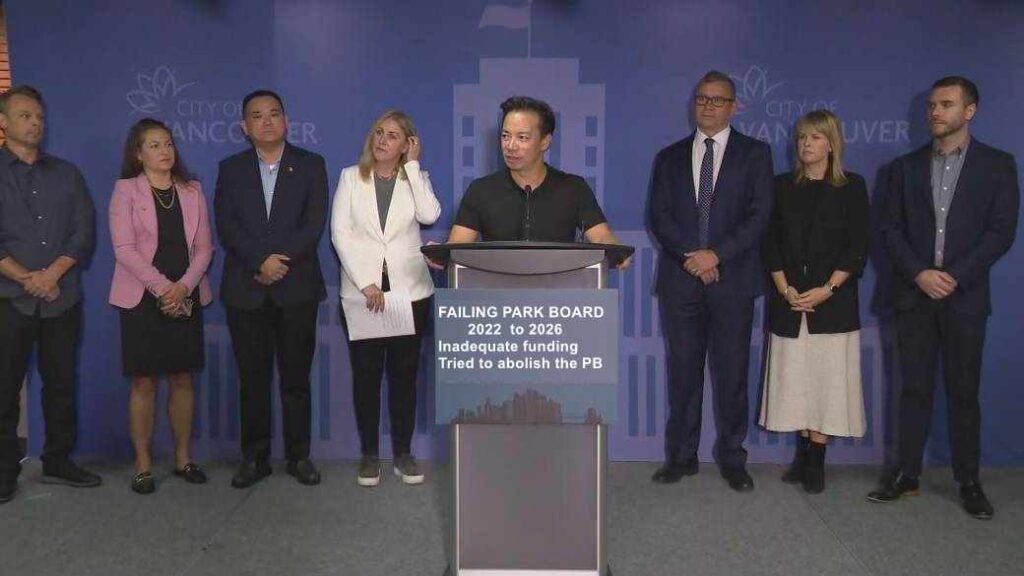
Mayor Ken Sim’s majority ABC Vancouver administration at Vancouver City Hall is the most morally bankrupt and cruelest civic administration the woeful citizens of Vancouver have witnessed in the past 60 years, and perhaps even longer than that.
The Vancouver Mayor with the worst attendance record at Vancouver City Hall, and on the Metro Vancouver Board, in our city’s history, who in his first three years as Mayor, took off right after his early November 2022 Inauguration for Qatar, where he watched the World Cup with his well-heeled billonaire backers and friends, who when he returned to Vancouver three weeks later, decided to “take control”, coming up with one hare-brained (and, dare we say, illegal) scheme after another.
No wonder current Vancouver Mayoral aspirant, Kareem Allam — the mastermind of ABC Vancouver’s massive majority victory in 2022, who went on to become Mayor Ken Sim’s Chief of Staff, and now strongest opponent — lasted only 34 miserably short days in his post, so cruel and off-putting, so mean-spirited and just plain idiotic Ken Sim proved to be that Allam simply couldn’t take it anymore, and resigned, his heart broken, and his spirit wounded.
Allam drew up ABC’s Vancouver’s platform.
Yes, ABC Vancouver committed to removing the homeless from Hastings Street, early in their term of office. Allam was clear: no person living in a tent on Hastings Street would be “removed” without the permission of the individual, but would leave of their own volition when more than adequate housing had been found for the cruelly abused unhoused who had taken up residence on Hastings Street.
Kareem Allam’s plan was not dissimilar to that of the late Brenda Prosken, a senior official at BC Housing (and neighbour and friend of VanRamblings), achieved at Oppenheimer Park, or when Ms. Prosken died from cancer six months after being diagnosed with her terminal illness, BC Housing Vice-President, Stephanie Allen — COPE’s recent candidate to be Mayor — achieved at the Strathcona encampment.
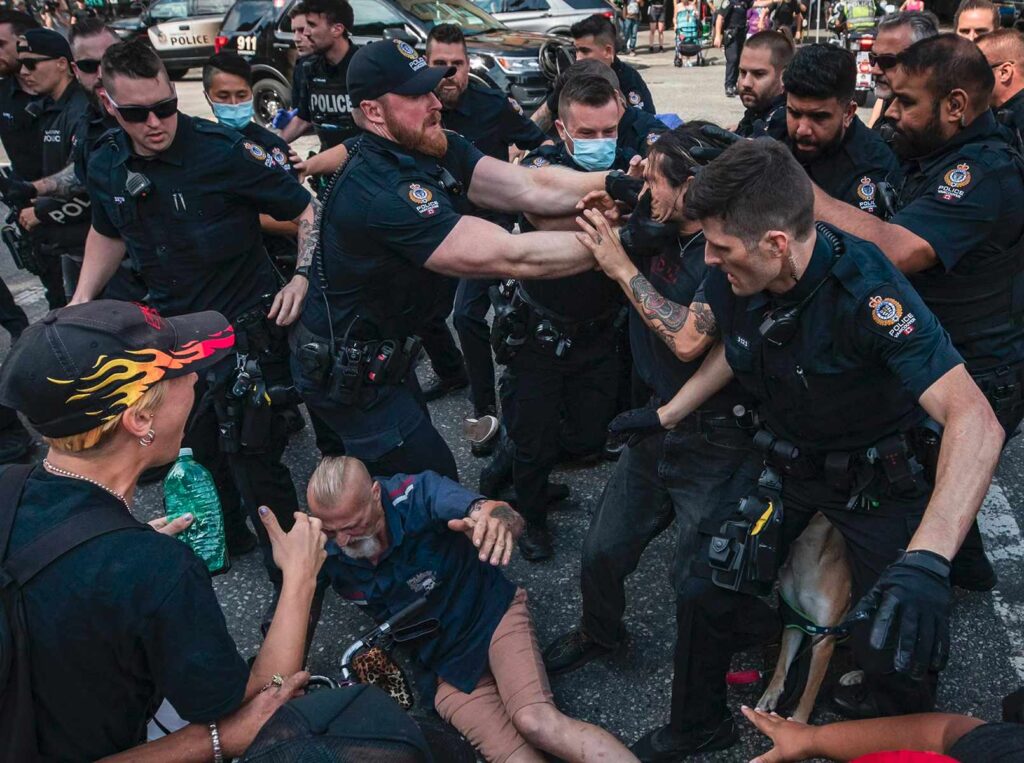
A cruel Ken Sim had other ideas: bulldoze (literally, bulldoze) the unhoused on Hastings Street, send in Vancouver’s (reluctant) police force to “help” clear the street, which a cruel and heartless Ken Sim and his ABC Vancouver Councillor colleagues managed to do.
Kareem Allam was aghast, disheartened and disgusted at the cruelty and inhumanity of Mayor Ken Sim and Mr. Sim’s ABC Vancouver colleagues.
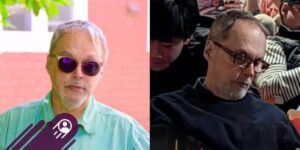
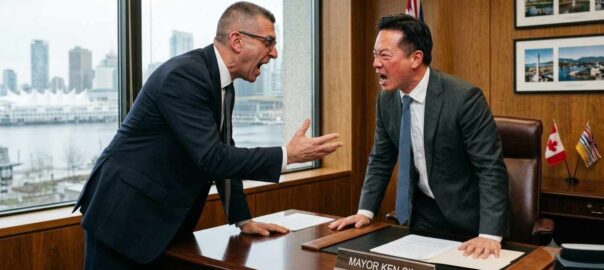
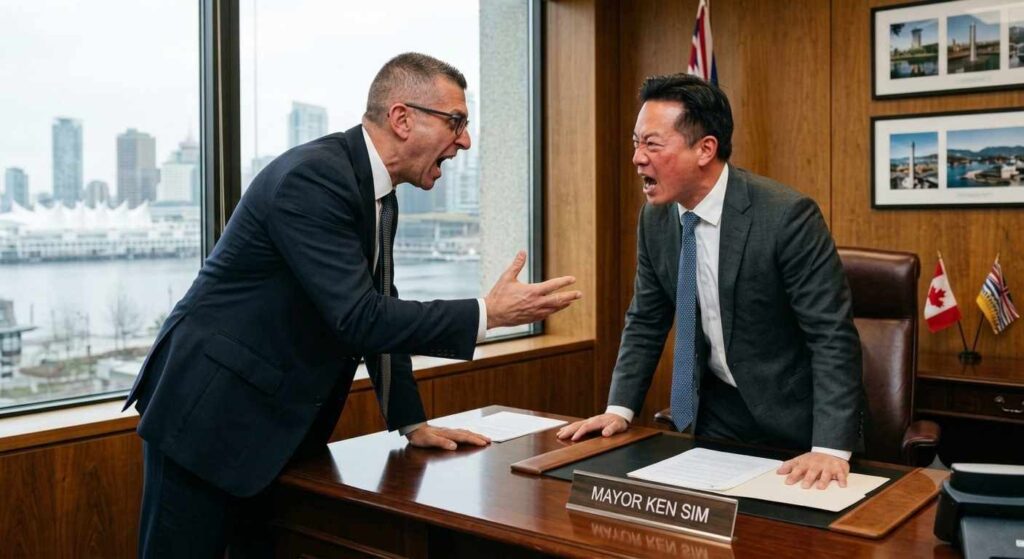 Chief of Staff Kareem Allam and Mayor Ken Sim Arguing During Mr. Allam’s last day at City Hall.
The final straw came on Monday, February 6, 2023, when Ken Sim called Mr. Allam into his office, where current ABC Vancouver Council candidate David Grewal was standing excitedly by the Mayor’s side.
Mayor Ken Sim told his Chief of Staff the following …
“Kareem, David and I have come up with the perfect way to ensure that over the next four years, businesses and homeowners in Vancouver will not have to pay one red cent in property taxes. We’re thrilled with the idea we’ve come up with.”
Here’s what Ken Sim and David Grewal came up with: Mayor Ken Sim was going to order the sale of the 100 of the 242 parks in Vancouver that are not officially designated as parks. Not only that, Mayor Sim proposed to sell off billions of dollars of property owned by the City to his friends, at cents on the dollar, properties that constitute our city’s Property Endowment Fund, created by Mayor Art Phillips in 1972, a fund that sustains to this day.
As Kareem Allam turned briefly away from Mayor Sim, and rolled his eyes, he then turned to face the Mayor, telling him …
“With all due respect, Mr. Mayor, the Vancouver Charter, and both provincial and federal legislation would prevent you from carrying out your plan to sell off the officially non-designated parks, many of which sit on provincial and federal Crown land, or have been gifted to the City under a long term contract to be kept in place as parks.
As for selling property lodged in the Property Endowment Fund, that is something you might consider, or re-consider. There would be a big hue and cry were you to attempt to sell off properties in the Property Endowment Fund to your friends. Legal challenges would likely follow, and the stories around your plan would dog your days for the next four years of your administration. I would strongly advise you against taking this precipitous, and potentially calamitous course of action.”
By the time, the Mayor’s Chief of Staff had completed making his statement to the Mayor, Ken Sim was livid, firing Mr. Allam on the spot. Thus, February 6, 2023 was Kareem Allam’s last day serving as Mayor Ken Sim’s Chief of Staff.
Ken Sim’s Cruelty. Where Does It End? Hint: It Doesn’t.
Ken Sim’s Vancouver: The Cruelest City Hall in a Generation — And Why He Must Go
There is a word that increasingly defines Ken Sim’s Vancouver.
It is not “better.”
It is not “inclusive.”
It is not “compassionate.”
It is not even “competent.”
It is cruel.
And as Vancouverites prepare to go to the polls on October 17, we should all ask ourselves a profoundly simple question:
Do we really want four more years of Ken’s Sim’s ABC Vancouver administration?
In the more than half-century since Mayor Tom “Terrific” Campbell presided over Vancouver City Hall, it is difficult to think of a civic administration that has so consistently demonstrated such disdain for people with the least power, such contempt for political opponents, such indifference toward vulnerable Vancouverites and such extraordinary self-regard as the Ken Sim–led ABC Vancouver administration.
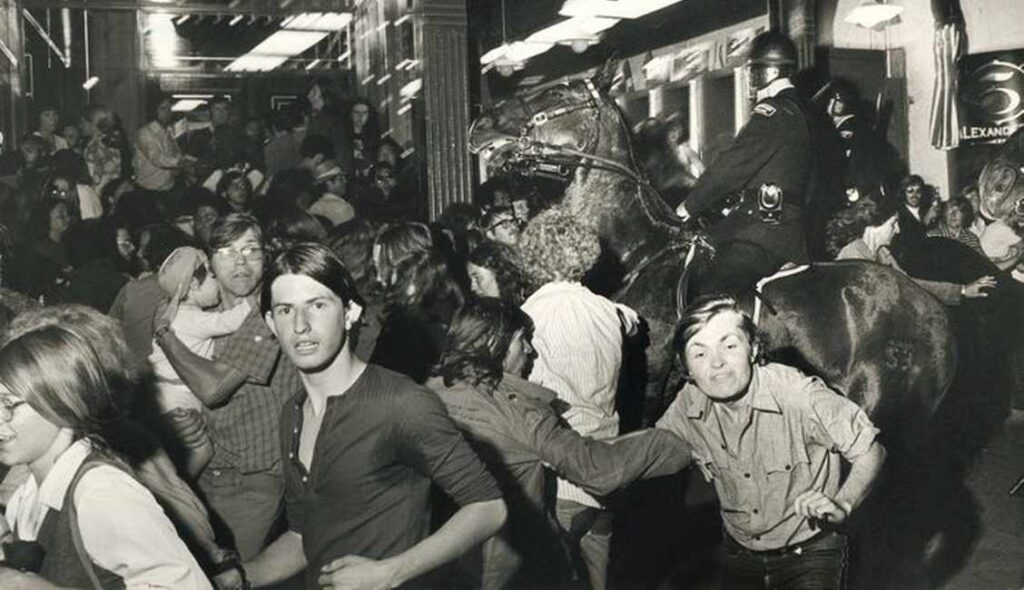
Campbell was a different kind of Mayor. He was brash, confrontational and openly hostile to the counterculture of his day. His administration became infamous for its treatment of Vancouver’s hippies, culminating in the 1971 Gastown Riot, when mounted police moved against a peaceful smoke-in and dozens were arrested. Campbell also tried to suppress the Georgia Straight, and championed the destruction of neighbourhoods in the name of development.
His was a politics of confrontation.
Ken Sim’s is something more modern.
It is the politics of indifference.
And sometimes, indifference is every bit as cruel as confrontation.
As a First Order of Business Ken Sim Undercut the Interests of Workers
The first great moral statement of the Sim administration came almost immediately after ABC Vancouver took power.
It was not a new housing programme.
It was not an investment in poverty reduction.
It was not an expansion of social services.
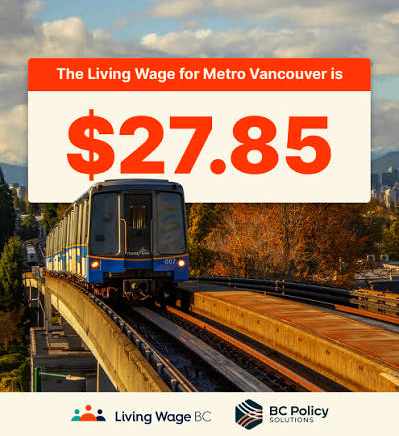
It was the cancellation of Vancouver’s Livable Wage Programme.
The programme required companies supplying goods and services to the City to pay their workers a livable wage. At the time it was approximately $25.68 an hour; today, the comparable living-wage figure is roughly $27 to $28 an hour.
Think about that.
In one of the most expensive cities in Canada, an administration elected promising to make Vancouver “a better city” decided that workers employed by companies doing business with the City did not need to be paid a wage sufficient to live in the city in which they worked.
The decision was made without the kind of public consultation one might reasonably expect for a policy with direct consequences for low-wage workers. City records subsequently included residents writing to the Mayor that they were “infuriated and disgusted” by the decision to withdraw from being a living-wage employer.
That is not merely a budget decision.
It is a statement of values.
And then came the renters.
Half the city rents. Ken Sim shut their office.
Again, more than half of Vancouver’s residents are renters.
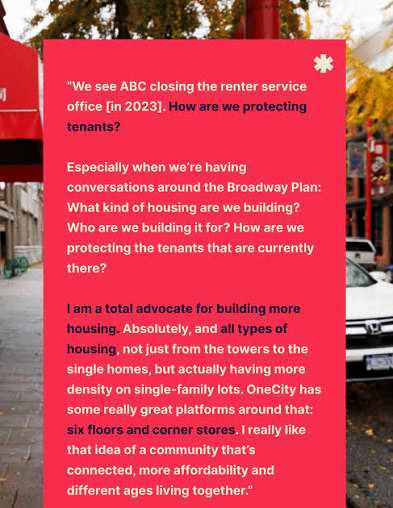
Yet one of the first things ABC Vancouver did was eliminate the City’s Renters Office — an office that provided renters with information about their rights, referrals to organizations capable of helping them and assistance navigating the City’s rental bylaws and permitting system.
In January 2023, ABC Councillors voted as a bloc to discontinue the office.
Yes, ABC promised that funding would be redirected to the Tenant Resource & Advisory Centre, and that TRAC would receive additional support and City-owned office space.
Surprise, surprise. Under Ken Sim, that did not happen. Renters were left high and dry by the Ken Sim-led ABC Vancouver administration.
But the larger political message was unmistakable.
The City’s own dedicated institutional resource for renters was expendable.
The people who rent — the 54% of Vancouverites who do not own the homes in which they live — would be told to find somewhere else to turn.
This is what structural cruelty looks like.
It doesn’t necessarily arrive with a fist.
Sometimes it arrives as a line item in a budget.
Sometimes it arrives as an office closure.
Sometimes it arrives as a decision made in a Council Chambers by people who will never have to worry about whether the next rent increase will force them out of their neighbourhood.
That was the argument made in VanRamblings’ August editorial, Cruelty vs. Kindness: The Moral Choice at the Heart of Vancouver Civic Politics.
Cruelty is not simply yelling at someone.
Cruelty can mean deliberately disregarding their well-being.
And when that disregard is embedded in government policy, thousands of people can suffer.
Then Came the Scandal of the Mayor’s Personal Gym
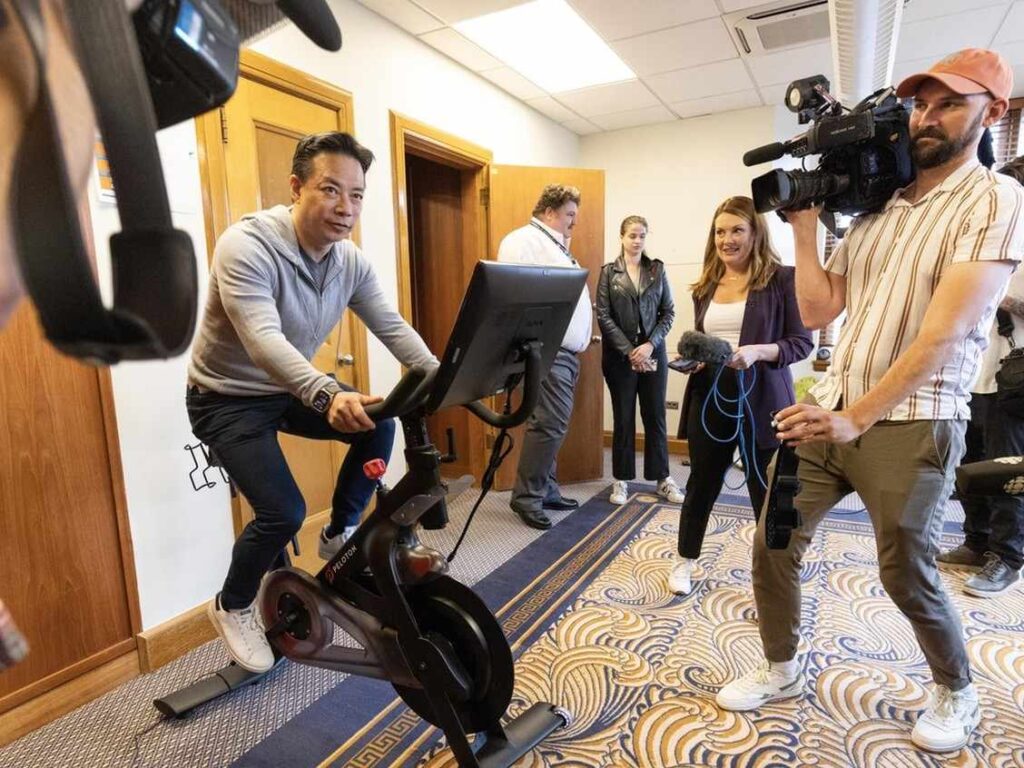
And while renters were losing a dedicated office at City Hall, Ken Sim found a rather different use for City Hall space.
A Committee Room used by civic Advisory Committees was converted into a personal gym for the Mayor.
When under the Vision Vancouver Gregor Roberston administration, then City Manager Dr. Penny — at a cost of more than $6 million — moved her office, which took up two-thirds of the third floor at City Hall, and moved her office to the newly-opened (at her outrageously expensive bequest) “renovated” fifth and six floors of City Hall, converting her old offices into a luxurious suite for the Mayor, replete with a large dining room, and the services of a chef and serving staff, not to mention a full suite with a luxurious bedroom, full spa bathroom, and comfortable living space with all of the amenities and latest hi-tech gadgetry.
Even so, living the life of Riley, a “Nothing is Too Good for Me” Mayor Ken Sim felt he needed additional space, converting a well-used Committee Room into a personal gym for himself.
At City Hall.
Converted for the personal use of the Mayor.
There is something almost breathtaking about the symbolism.
At a time when Vancouver faces a housing crisis, a homelessness crisis, an affordability crisis, a public-health crisis and a crisis of aging civic infrastructure, Ken Sim’s administration found space for the Mayor to work out.
That juxtaposition would be almost humorous if the consequences of this administration’s priorities weren’t so serious.
And Then There Is The Issue of Mayor Ken Sim Shotgunning Beer

Broadcaster and political commentator Jody Vance has gone on and on during the course of Rachael Segal’s Beyond a Ballot political podcast, where Ms. Vance, Ms. Segal and former Vision Vancouver City Councillor Andrea Reimer are broadcasting daily, commenting on the current Vancouver civic election.
Ms. Vance was present for what she calls Mayor “Ken Sim’s egregious error in judgment earlier in his term if office.”
At Khatsalano Days in the summer of 2023, in front of a family audience that included impressionable young children, Ken Sim appeared on stage and shotgunned a beer, more than one, actually.
Some people thought it was hilarious.
Others did not.
For many parents in the audience, the spectacle was less “mayoral leadership” than an extraordinary lapse in judgment.
And that matters because leadership is not merely about policy.
It is also about setting an example as a municipal leader.
The Mayor of Vancouver is not simply another guy at a neighbourhood beer garden.
He is the city’s principal elected representative.
The office carries responsibilities of conduct, decorum and judgment.
And when a Mayor appears to revel in behaviour that causes families in the audience to recoil, it tells us something about the office-holder’s understanding of the difference between being popular and being responsible.
The Case of The Disappearing Mayor Who Fails to Turn Up for Work
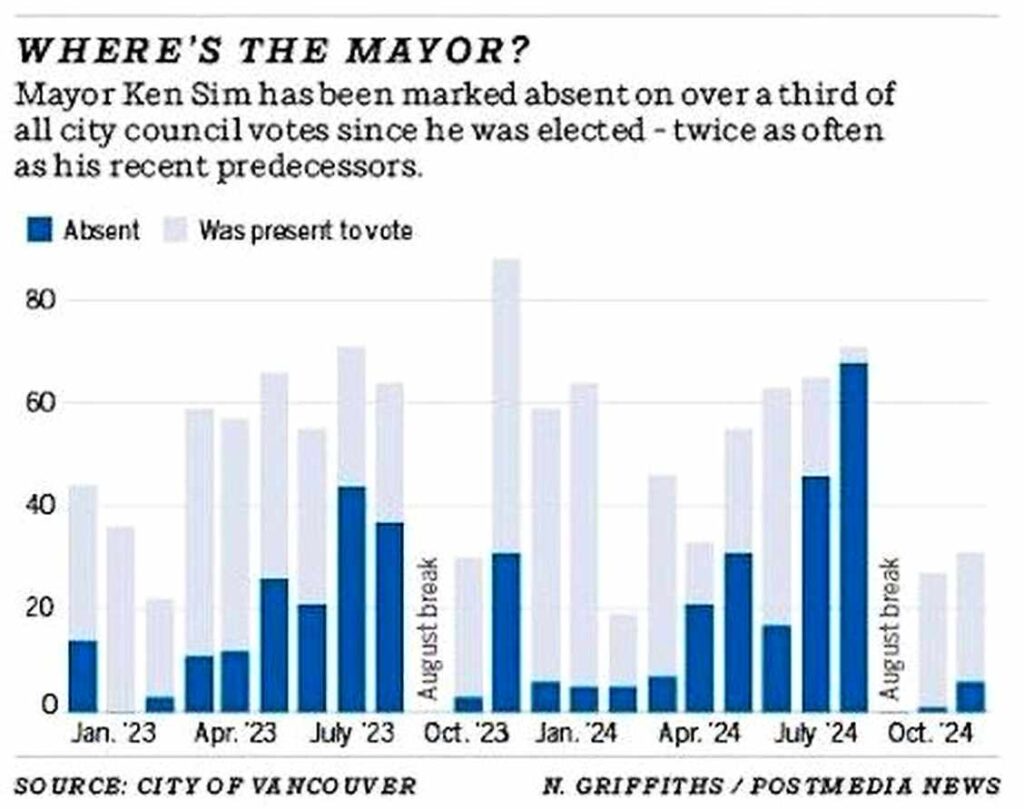
Then there is the extraordinary question of attendance.
Ken Sim’s relationship with the job of Mayor has often seemed remarkably casual.
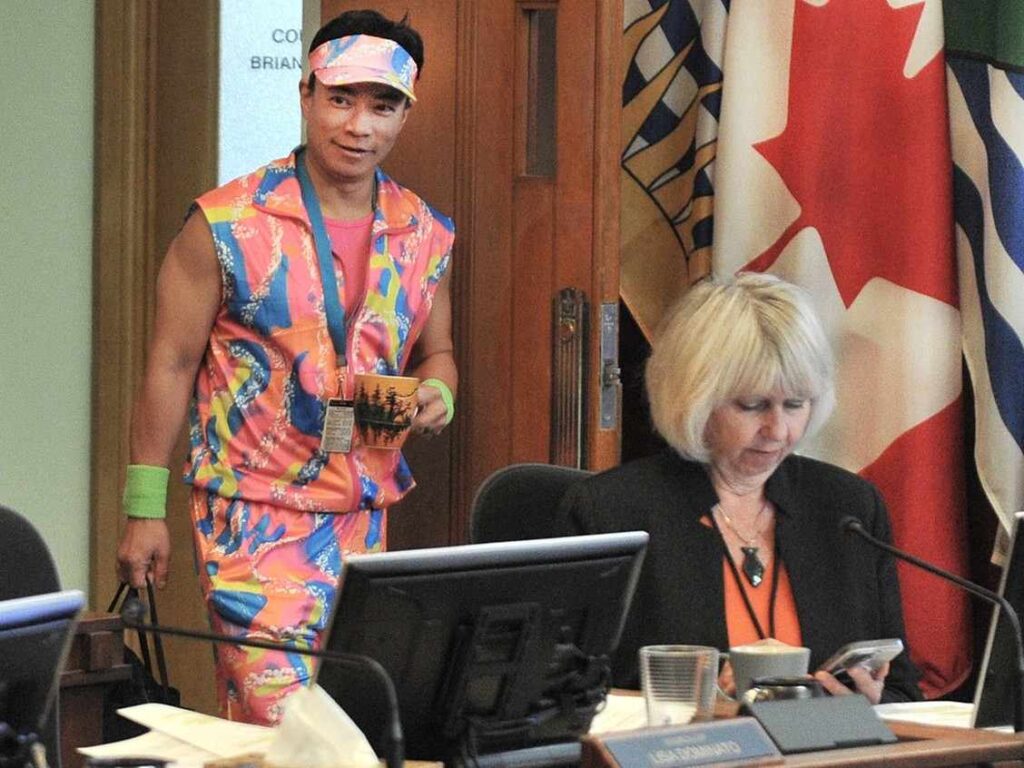
For much of his first three years in office, VanRamblings observed, he was rarely seen participating meaningfully in Council debate. When he did attend, the Mayor was often dressed casually in a T-shirt and sweatpants and, critics argued, appeared to remain in Chambers only long enough to vote before leaving.
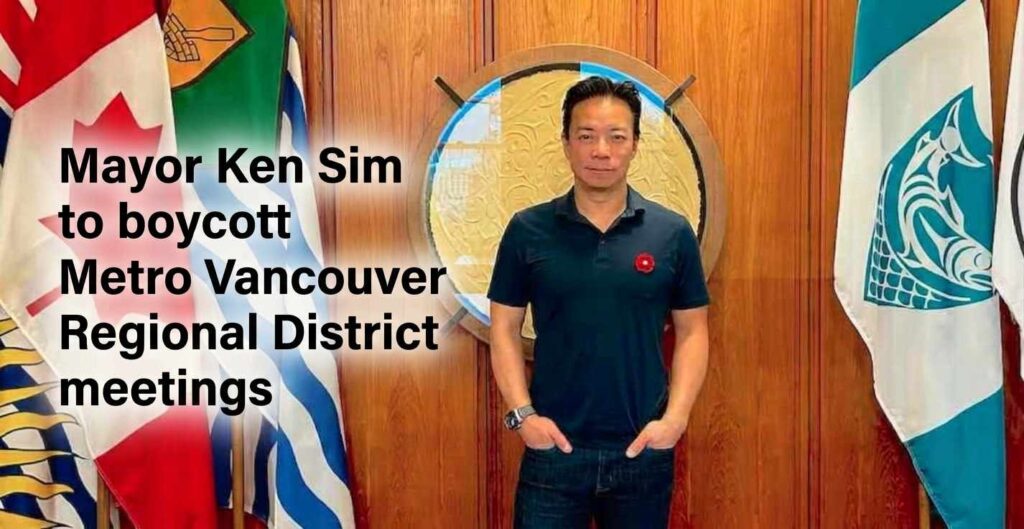
More consequentially, in January 2025 Sim announced that he would boycott Metro Vancouver meetings, declaring that the regional government was “broken.” Global News reported that his attendance at Metro Vancouver had already been sporadic, with Sim attending roughly one-quarter of meetings the previous year.
This is not an argument that a Mayor must attend every meeting under every circumstance.
It is an argument that showing up is part of the job.
Vancouver did not elect Ken Sim to be an occasional Mayor.
It elected him to govern.
And then the attacks began
There is something particularly disturbing about what happens when political disagreement becomes personal.
Ken Sim filed formal complaints against then-OneCity Councillor Christine Boyle, requiring her to spend time and resources defending herself against the Mayor’s allegations.
And then came Sean Orr.
This may be the ugliest episode of the entire ABC Vancouver story.
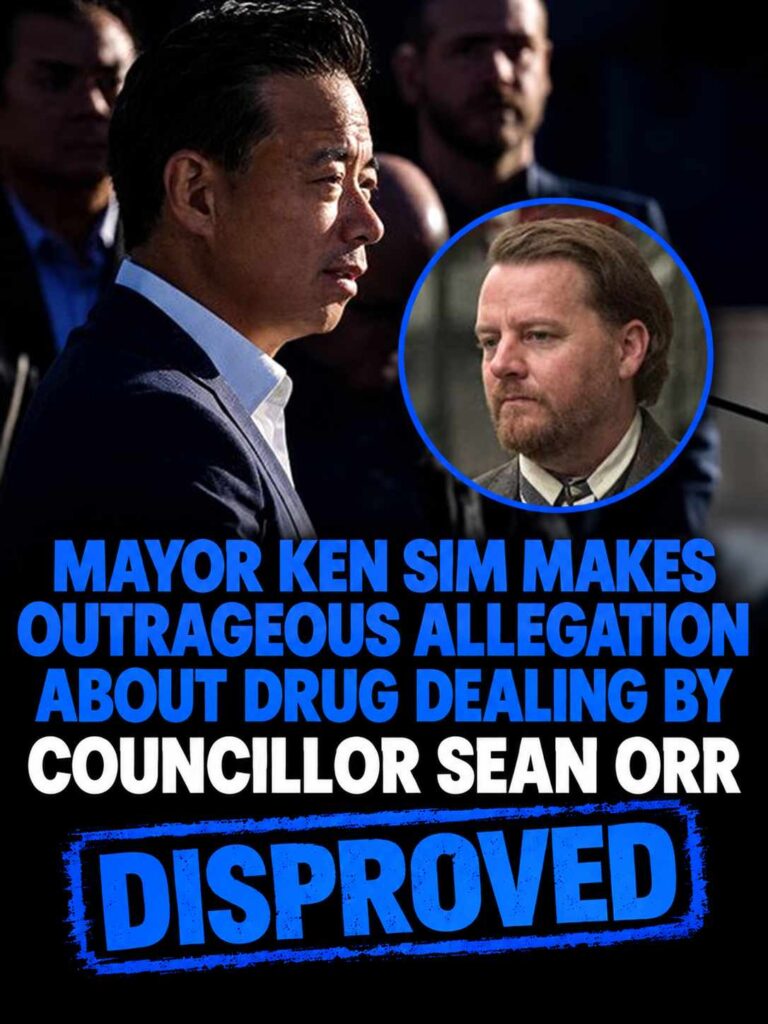
In February 2026, Mayor Ken Sim told Chinese-language media that COPE Councillor Sean Orr had been handing out illegal drugs on Vancouver’s Downtown Eastside on Christmas Day.
The allegation was false.
It was subsequently revealed that ABC Councillor Lenny Zhou had repeated the allegation in a Chinese-language video, which was later removed, and Zhou apologized, saying his comments were based on incorrect information. CityNews subsequently reported that the information had originated with Mayor Sim himself.
Orr has said he was not even in Vancouver at the time but was visiting friends and family on the Sunshine Coast.
The political implications are enormous.
A Mayor accusing an elected City Councillor of distributing illegal drugs is not ordinary political criticism.
It is not a disagreement over zoning.
It is not an argument over homelessness.
It is not even a nasty election-season barb.
It is an attack on a person’s reputation.
And it was made publicly.
In Chinese-language media.
The consequences were serious enough that Orr subsequently filed a defamation lawsuit against Sim.
This is the Politics of Cruelty in its Purest Form
When you disagree with someone, debate them.
When you think they are wrong, defeat their arguments.
When you believe their policies are harmful, expose them.
But do not invent or repeat allegations that can destroy a person’s reputation.
Political opponents are not enemies.
They are fellow citizens entrusted by voters to represent them.
The Granville Street Bridge Tells the Whole Story
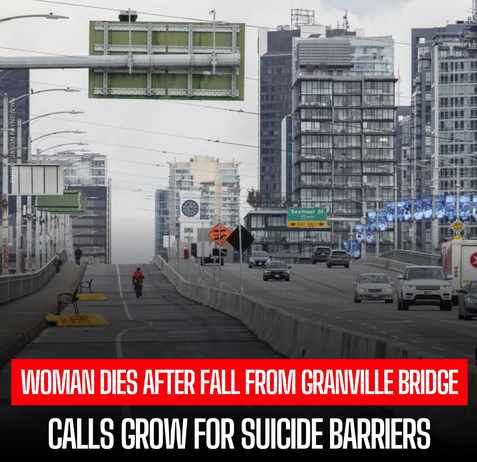
And then there is the issue that, more than any other, exposes the moral bankruptcy of the Sim administration’s priorities.
Suicide-prevention barriers on the Granville Street Bridge.
For years, Vancouver has known that Granville Bridge is a suicide hotspot.
Health professionals know it.
First responders know it.
The Crisis Centre knows it.
Families know it.
And City Hall knows it.
The evidence for physical barriers is overwhelming. Vancouver’s own documentation has cited research associating bridge barriers with a 93 per cent reduction in suicide deaths.
There is also Vancouver’s own experience.
Barriers were installed on the Burrard Street Bridge in 2017.
There have been no known suicide deaths from the Burrard Street Bridge since.
Similar barriers were installed on the Ironworkers Memorial Bridge in 2015.
Again, the evidence is striking.
Yet in March 2026, ABC Councillors voted to remove funding for Granville Bridge suicide-prevention barriers from the capital plan. VanRamblings subsequently documented that Vancouver had set aside $13.4 million for FIFA hospitality packages while the City continued to delay actual construction of the barriers.
Let us be absolutely clear.
The argument is not that FIFA is bad.
The argument is that a government that can find millions of dollars for international sporting hospitality ought to be able to find the political will and financial commitment necessary to protect people from dying at a known suicide hotspot.
Dr. Brandon Yau, Vancouver Coastal Health’s Medical Health Officer, described suicide deaths from the bridge as “preventable tragedies” and barriers as “critical, life-saving infrastructure.” Crisis Centre executive director Stacy Ashton has said, in substance, that the barriers work and save lives.
That is the moral test.
Not whether the project is convenient.
Not whether the Mayor gets good photographs.
Not whether FIFA executives are impressed.
Do we save lives?
A suicidal person standing on Granville Bridge does not care about FIFA.
Their family does not care about FIFA.
The police officers trying to talk them back from the edge do not care about FIFA.
The firefighters and paramedics who respond do not care about FIFA.
They care about whether that person lives.
And yet Ken Sim’s City Hall has demonstrated vastly greater urgency when the subject is a global sporting event.
That is not merely bad policy.
It is a question of values.
Ken Sim and ABC Vancouver Practice the Politics of Fear
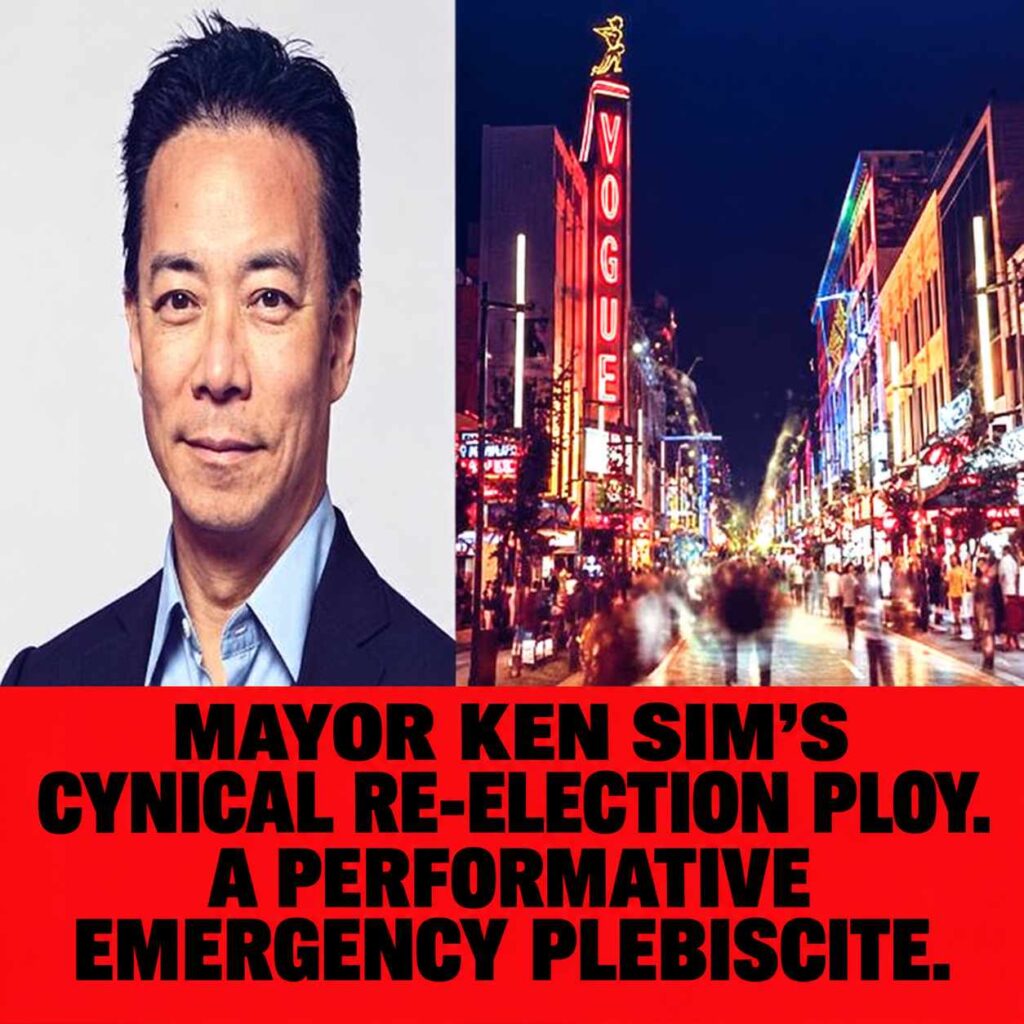
And now, as the election approaches, ABC Vancouver has added another dimension to the politics of cruelty: fear.
The administration’s public-safety plebiscite, pushed through Council at a cost estimated at approximately $400,000 to $550,000, asks voters to weigh in on drug use and mental-health/addiction beds.
The questions are non-binding.
They do not themselves create a treatment bed.
They do not build a hospital.
They do not provide a mental-health worker.
They do not put a roof over anyone’s head.
They are, however, extraordinarily useful election-season political theatre.
The administration that had four years to govern is now asking voters whether they want the Mayor to govern.
That is not leadership.
That is campaigning.
What kind of city do we want?
This is the question VanRamblings posed in “Cruelty vs. Kindness.”
Politics is ultimately a moral choice.
A government can make life easier for people with less power.
Or it can make life harder.
It can expand dignity.
Or it can withdraw support.
It can build institutions that help renters.
Or close them.
It can protect low-wage workers.
Or abandon the living-wage standard.
It can protect people contemplating suicide.
Or delay.
It can disagree with political opponents.
Or attempt to destroy their reputations.
It can treat vulnerable people as human beings.
Or turn them into election props.
And it can govern.
Or campaign.
Ken Sim has shown Vancouver what his administration chooses.
Again and again.
And again.
This is why the comparison with Tom Campbell is not hyperbole.
Campbell’s Vancouver was an angry city.
Ken Sim’s Vancouver is increasingly an indifferent one.
Campbell fought the counterculture openly.
Sim’s administration too often appears to fight the people who have the least power to fight back.
Campbell’s police confronted the hippies of Gastown.
Sim’s political machine has made political capital out of the unhoused, the drug-dependent, renters, political opponents and people in crisis.
Campbell’s era was defined by confrontation.
Sim’s is defined by something colder:
the willingness to inflict pain, or simply not to care when pain is inflicted.
That is cruelty.
And cruelty should never be rewarded with another term in office.
Vancouver deserves better
The great lie of modern politics is that kindness is weakness.
It isn’t.
Kindness is recognizing that the renter facing eviction is not a statistic.
That the low-wage worker trying to live in Vancouver is not a disposable input in a procurement contract.
That the person standing on Granville Bridge is not a problem to be managed.
That a Councillor with whom you disagree is not your enemy.
That the unhoused person sleeping on a Vancouver sidewalk is still a human being.
That the people who disagree with you are still Vancouverites.
A Mayor’s job is not to punish those people.
It is to govern for them.
All of them.
The Ken Sim ABC Vancouver administration has had four years.
Four years is enough time to learn.
Enough time to correct course.
Enough time to demonstrate compassion.
Enough time to demonstrate leadership.
Instead, we have witnessed the dismantling of the Livable Wage Programme, the closing of the Renters Office, the attempted weakening of accountability mechanisms, the Mayor’s personal gym, the extraordinary conduct at Khatsalano Days, chronic questions about attendance and engagement, attacks on political opponents, the disgraceful Sean Orr episode, the abandonment of urgency on Granville Bridge suicide barriers, and an increasingly aggressive politics built around fear of the vulnerable.
There is a pattern here.
And patterns tell us more about governments than slogans ever will.
So, on October 17, Vancouverites have a choice.
Not merely between Ken Sim and another mayoral candidate.
Not merely between ABC Vancouver and another civic party.
We have a choice between two fundamentally different ideas of what government is supposed to be.
One says government exists to protect the vulnerable, strengthen communities, respect disagreement and reduce unnecessary suffering.
The other says government is about power, control, political advantage and winning the next election.
VanRamblings knows which Vancouver we want.
A Vancouver where government is measured not by the size of its FIFA hospitality budget, but by the number of people it helps.
A Vancouver where renters have a voice.
Where workers earn a living wage.
Where people in crisis are protected.
Where political opponents are debated rather than defamed.
Where the Mayor actually shows up.
Where City Hall belongs to the public — not to the Mayor’s gym.
And where kindness is not dismissed as weakness, but understood for what it really is:
the most basic responsibility of government.
Ken Sim has had his opportunity.
He has had four years.
He has shown Vancouver who he is and what kind of civic administration he has lead this past four years, and intends to lead for the next four years.
Now Vancouver gets to answer.
No more.
No more cruelty.
No more politics of division.
No more City Hall that turns its back on the people who need it most.
On October 17, Vancouver must turn the page.
Ken Sim must not be re-elected Mayor of Vancouver.