 Kerry-Lynne Findlay, the new B.C. Conservative Party leader
The Iron Fist in a Velvet Glove: The Ascent of Kerry-Lynne Findlay
On May 30, 2026, the Rocky Mountaineer Station in Vancouver played host to an ideological tug-of-war that would reshape the political landscape of British Columbia. When the fourth and final ballot of the Conservative Party of BC leadership race settled, Kerry-Lynne Findlay emerged victorious. But the crown she inherited is heavy, fractured, and forged in the fires of an intense internal civil war.
Ms. Findlay, a 71-year-old veteran of the Stephen Harper era, successfully positioned herself as a “conservative by conviction, not by convenience,” rallying a base that favoured a hard-right ideological shift over centrist moderation.
Yet, as she takes the helm of the province’s Official Opposition, her victory is over-shadowed by a razor-thin mandate, serious federal compliance investigations, and deep fractures within her own ranks.
A Razor-Thin Mandate from the Hinterlands
To understand the challenge ahead for Ms. Findlay is to understand just how narrow her path to victory truly was. Her battle against political commentator and former BC United vice-president Caroline Elliott was an absolute photo finish.
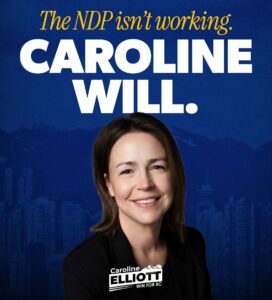
For VanRamblings (and her leadership campaign manager, Kory Teneycke), it is almost impossible to believe that a competent, articulate, younger, electable Caroline Elliott lost to Kerry-Lynne Findlay
As provincial affairs columnist Vaughn Palmer noted in the Vancouver Sun, Ms. Findlay topped Ms. Elliott by a mere 60 raw votes out of more than 22,000 ballots cast. Under the party’s riding-weighted system, this translated to a 51% to 49% victory — the narrowest possible margin for democratic legitimacy.
More telling than the margin is the geographic and demographic divide it exposed:
- The Urban-Rural Split: Ms. Findlay’s victory was not built in the urban or suburban centres of the Lower Mainland. In Vancouver proper, she captured just 17% of first-round support, and only 14% in West Vancouver-Sea-to-Sky;
- The Northern Surge: Her true base of power lay in the northern, rural, and resource-dependent heartlands. In ridings like Stikine-Bulkley Valley — a region dotted with heavily Christian towns and areas deeply entangled in resource development debates — Ms. Findlay dominated, capturing 59% of the vote.
By rejecting the more centrist visions put forward by her former rivals — current MLA Peter Miloba, former BC Liberal MLA Iain Black, and Ms. Elliott herself — Ms. Findlay consolidated a populism rooted outside the major metropolitan areas.
The Ghost of 2025: Elections Canada Allegations
Compounding the structural divisions within her party is a serious external vulnerability. Ms. Findlay enters her provincial leadership under a distinct legal and ethical cloud stemming from her recent political past.
During the 2025 federal election, Ms. Findlay lost her seat as the Member of Parliament for South Surrey — White Rock. However, the fallout from that campaign continues to loom large. An ongoing Elections Canada investigation features severe allegations regarding her campaign’s financial and operational conduct:
The Allegations Under Investigation:
- Undeclared Corporate Benefits: It is alleged that Ms. Findlay’s campaign received $75,000 in undeclared and unpaid services from a private corporation;
- Quid Pro Quo: Investigators suggest these corporate services were provided in exchange for promises of lucrative federal contracts down the road;
- Foreign National Canvassing: Perhaps most damagingly, the investigation further suggests that approximately 50 individuals described as foreign nationals without legal status actively canvassed on behalf of Ms. Findlay during the campaign. Ms. Findlay has dismissed the investigation as standard political friction, but the potential for formal sanctions provides constant ammunition for her political opponents.
Pulling the Party to the Right: The Culture War Focus
In a comprehensive profile for the online journal The Tyee, journalist Jen St. Denis highlighted the fundamental shift occurring under the new leadership, run under the stark headline: Findlay Pulls BC Conservatives to the Right.
Ms. Findlay’s platform leans heavily into “faith, family, and freedom,” a rhetorical framework that critics argue mirrors American-style populist movements. Observers describe her as a Trump-adjacent “MAGA Maple” figure, highly focused on divisive culture war issues rather than traditional policy consensus.
The Battle Over SOGI 123

A central pillar of Ms. Findlay’s ideological brand is her fierce opposition to the Sexual Orientation and Gender Identity (SOGI 123) curriculum implemented in British Columbia schools. Ms. Findlay has campaigned on entirely dismantling the programme, aligning herself with anti-trans and parental rights groups.
This position puts her in direct opposition to empirical academic research.
A landmark study led by Dr. Elizabeth Saewyc, a professor at the University of British Columbia (UBC), demonstrated that SOGI 123 has proved highly effective. Dr. Saewyc’s findings revealed that SOGI-inclusive education successfully reduced bullying and sexual orientation discrimination across B.C. schools, yielding safer environments for both LGBTQ+ and heterosexual students alike.
By entirely rejecting Dr. Saewyc’s findings, Ms. Findlay has signaled that ideological alignment takes precedence over academic consensus.
A House Divided: Internal Purges and Controversial Allies
Upon seizing the leadership, Ms. Findlay wasted no time restructuring the party in her own image, executing an uncompromising internal purge. She immediately fired all legislative and party staff who had any lingering connections to the former BC United / BC Liberal apparatus or its former leader, Kevin Falcon.
Furthermore, Ms. Findlay’s inner circle and candidate roster have drawn intense scrutiny for harboring far-right, anti-vaccine, and conspiracy-driven viewpoints.
The Inner Circle
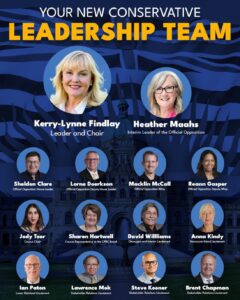
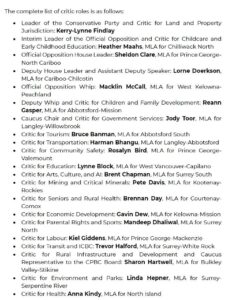
- Brent Chapman: Findlay’s own husband, now the MLA for Surrey South, has a well-documented history of controversy. During the 2024 provincial election campaign, a series of his historical social media posts were unearthed, revealing deeply Islamophobic and racist content that generated widespread public condemnation;
- Sheldon Clare (House Leader): Ms. Findlay appointed the MLA for Prince George-North Cariboo as her newly minted House Leader. Mr. Clare, a reserve army officer and the former president of the National Firearms Association (NFA), briefly ran for the leadership himself before dropping out to back Ms. Findlay. He brings a brand of staunchly uncompromising, hard-right gun-rights populism to the legislative floor;
- Heather Maahs (Leader of the Opposition): Because Ms. Findlay does not currently hold a seat in the BC Legislature, she cannot personally serve as the Leader of the Official Opposition. To fill this vital constitutional role, she bypassed proven, moderate legislative leaders like former interim leader Trevor Halford and former House Leader Áʼa:líya Warbus — a move provincial affairs columnist Vaughn Palmer criticized as dumping seasoned veterans for her hard-right backers. Instead, she installed Heather Maahs, the MLA for Chilliwack North. Maahs, who spent 16 years on the Chilliwack school board, is an unabashed pro-life advocate who recently drew fire for hosting a legislative session with an advocacy group that explicitly regards homosexuality as “immoral.”
This hard-right consolidation has created what former insiders describe as a hostile environment. Former Conservative MLAs Elenore Sturko and Amelia Boultbee both publicly stepped away from the party apparatus, citing a “toxic work environment” driven by ideological extremism, subsequently becoming vocal critics of Findlay’s direction.

The Actuarial Reality of a 2028 Campaign
Beyond the ideological friction, Ms. Findlay faces an inescapable reality: the passage of time. When the next British Columbia provincial election is called in late 2028, Findlay will be entering her 74th year. Should she win and serve a full four-year term as Premier, she would be in her 78th year by its conclusion.
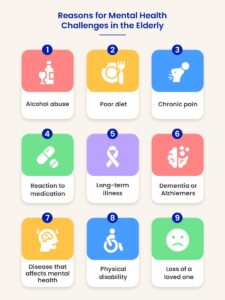
While age alone does not dictate capability, gerontologists and medical institutions like the Mayo Clinic emphasize the compounding physical and cognitive challenges that accompany leadership at this stage of life, as observed globally in political figures like Joe Biden and Donald Trump, or in our 70s as VanRamblings has experienced ourself approaching our 76th birthday, now only 40 days away.
- Factor: Potential Impact on High-Stress Leadership;
- Cognitive Function: Gradual declines in cognitive processing speed, reaction time, and the ability to multitask can affect the management of complex, rapid-fire executive daily tasks.;
- Physical Vitality. A combination of physical fatigue, chronic health conditions (such as arthritis or cardiovascular changes), and sensory declines in vision and hearing that can restrict mobility and lower overall energy reserves;
- Neurotransmitter Changes: Age-related reductions in serotonin levels that can increase emotional vulnerability, while chronic pain or fatigue can manifest as heightened irritability or agitation under pressure.
Navigating the grueling, 24-hour news cycle of a provincial election and managing a sprawling government requires physical and mental stamina, posing a practical question mark over her long-term tenure.
The Mainstream Disconnect
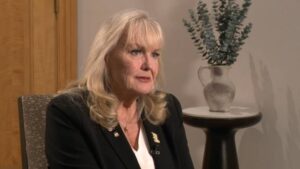 Would you vote for the woman pictured above to become British Columbia’s 38th Premier?
Ultimately, Kerry-Lynne Findlay’s political future depends on whether her brand of unapologetic populism can survive outside her rural interior voting base.
British Columbia’s electorate has historically favoured a pragmatic, centrist approach to governance. By leaning so heavily into the culture wars, opposing established Indigenous rights frameworks, and platforming fringe rhetoric, Ms. Findlay risks alienating the vital moderate voters of the Lower Mainland and Vancouver Island — voters who decide majorities.
Ms. Findlay enters the arena significantly weighed down. The cloud of the federal Elections Canada investigation remains unresolved, her internal mandate is mathematically microscopic, and her party is deeply divided after the alienation of its moderate wing.
In a province currently grappling with an acute affordability crisis — where the cost of housing remains out of reach, grocery prices continue to skyrocket across every community, and gas prices pinch working families at the pumps — Ms. Findlay’s intense focus on social grievances risks looks profoundly out of touch.
If the B.C. Conservative Party cannot offer reassuring solutions to the daily economic anxieties of the mainstream voter, Ms. Findlay’s hard-right experiment may find itself entirely rejected at the ballot box in 2028.
Can Kerry-Lynne Findlay successfully expand her narrow rural coalition to win over moderate urban voters in the 2028 provincial election? We’re not so sure.