There is something faintly ridiculous about living in Vancouver and complaining that “there’s nothing to do.”
Nothing to do?
For 11 days every October, Vancouver becomes one of the great movie cities of North America. More than 160 films descend upon theatres scattered across the city.
Filmmakers arrive from around the world. Actors, critics, programmers, students, obsessives and people who simply love sitting in a dark room while somebody else’s story unfolds gather together.
And then, 11 days later, we go back to pretending that Vancouver is a city where nothing ever happens.
Enough of that.
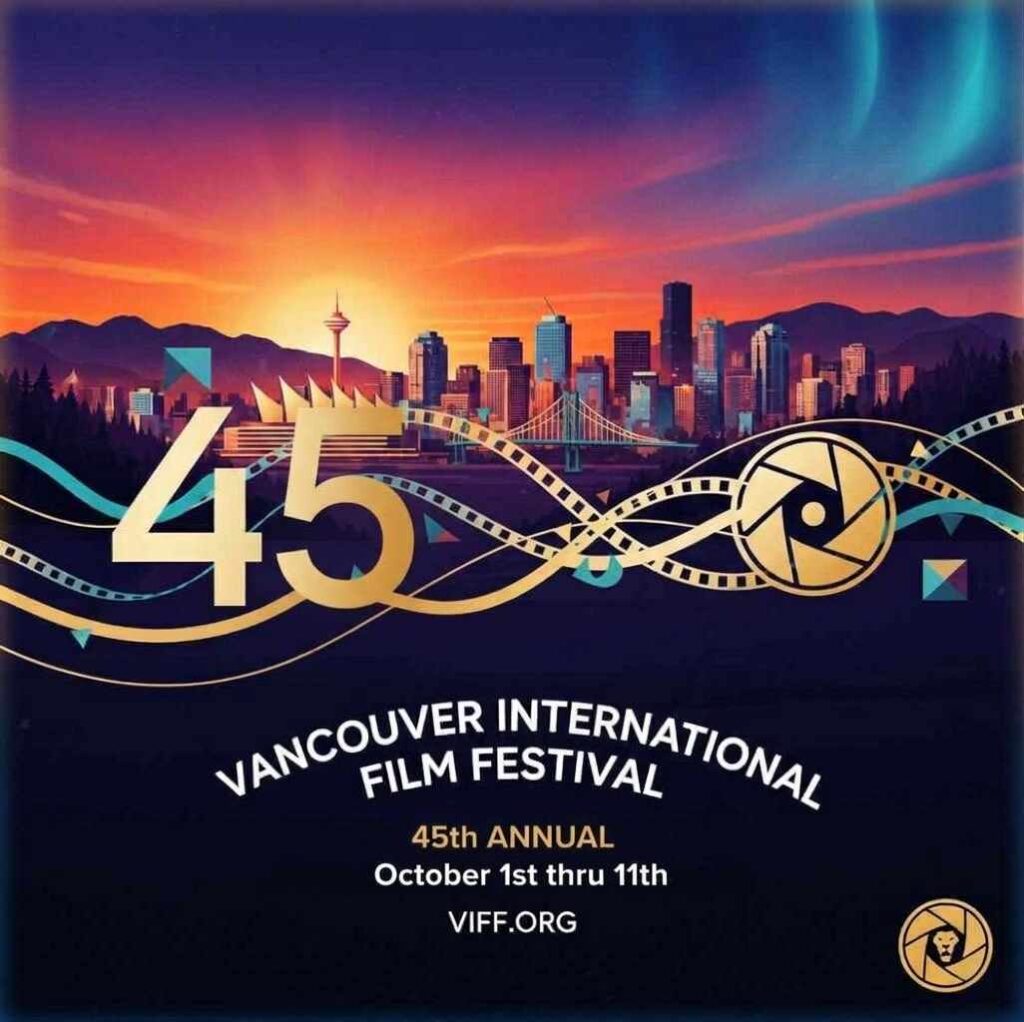
The 45th annual Vancouver International Film Festival, running October 1st through October 11th, is back — and this year’s edition is shaping up to be one of those festivals where the problem isn’t finding something worth seeing.
The problem is deciding what you can possibly miss.
VIFF’s 2026 programme brings together more than 160 features and dozens of shorts, alongside VIFF Talks, live performances, special events, industry programming and conversations with some of the people actually making the movies and television that shape our culture. VIFF itself describes the festival as a showcase of exceptional cinema from around the globe, and the breadth of the programme makes that description difficult, near impossible, to dispute.
But let’s start where any serious cinephile should start:
The Galas and Special Presentations
This is the section where VIFF essentially says: Here are the movies everybody will be talking about.
And, frankly, it has put together a hell of a list.
THE PALME D’OR COMES TO VANCOUVER
Cristian Mungiu’s Fjord is the obvious place to begin.
The Romanian filmmaker — already a Palme d’Or winner for 4 Months, 3 Weeks and 2 Days — returns with another morally complicated drama, this time about a conservative family confronting the progressive values of a Norwegian community.
Sebastian Stan and Renate Reinsve lead the cast, and the film’s central conflict concerns parenting, religion, state scrutiny and the increasingly uncomfortable question of where tolerance ends.
This isn’t the sort of movie that tells you who the good guys are.
Thank God.
Mungiu is interested in the uncomfortable grey territory where decent people make questionable decisions and societies convinced of their own righteousness discover that tolerance can become a very complicated thing indeed.
Fjord won the Palme d’Or at Cannes. It is exactly the kind of movie that makes a film festival matter.
And, yes, this is one of the films VanRamblings would put very high on the “see it before everybody starts talking about the Oscars” list.
THEN THINGS GET DARK
If Fjord is morally knotty, Andrey Zvyagintsev’s Minotaur is downright ominous.
Set against the fallout from Russia’s invasion of Ukraine, the film follows a corporate executive attempting to keep the consequences of war outside his home — until his wife’s infidelity sends his carefully constructed life crashing down.
Zvyagintsev won the Grand Prix at Cannes, and Minotaur has the kind of icy, mythic quality that makes a domestic thriller feel considerably larger than the marriage at its centre.
This is a movie about betrayal.
But it is also about power.
And corruption.
And a political culture in which violence doesn’t remain outside the front door simply because the protagonist would prefer it to.
If Minotaur sounds bleak, well, Zvyagintsev isn’t exactly known for making Paddington.
But he is one of contemporary cinema’s great observers of what happens when private lives collide with rotten political systems.
VIFF gives Vancouver audiences three opportunities to see it, including screenings at The Park Theatre, Granville Island and the Vancouver Playhouse.
PAWLIKOWSKI’S POSTWAR EUROPE
Then there’s Fatherland, from Paweł Pawlikowski.
Pawlikowski won the Oscar for Ida, received three Academy Award nominations for Cold War, and has established himself as one of the most visually distinctive filmmakers working today.
Fatherland may be his most explicitly historical film.
Nobel laureate Thomas Mann returns to postwar Germany with his daughter Erika, confronting the moral wreckage of a country struggling to understand what it has become.
Shot in exquisite black and white, Fatherland won Pawlikowski the Best Director prize at Cannes.
The subject is Germany.
But the questions are universal:
What does it mean to return home?
What does it mean to be complicit?
Can a country reckon with its past without rewriting it?
And can a family?
Sandra Hüller, one of European cinema’s most extraordinary actors, is here too.
Put this one on your calendar.
CANNES ALSO GAVE US CLUB KID
Then, thankfully, VIFF gives us Club Kid, Jordan Firstman’s audacious début.
A hedonistic New York club promoter suddenly discovers that he has a 10-year-old son he never knew existed.
Cue chaos.
The premise sounds like the setup for a Hollywood comedy.
Firstman has something considerably stranger in mind.
Club Kid mixes queer New York nightlife, comedy, parenthood, redemption and unexpected tenderness. It is exuberant without being empty, funny without being disposable.
Cannes embraced it.
VanRamblings suspects Vancouver will too.
And this is where the great pleasure of VIFF begins.
You come for the Palme d’Or winner.
You stay because some filmmaker you’ve never heard of knocks you sideways.
MIKE LEIGH’S POSSIBLE FAREWELL
There is another film in this year’s Special Presentations that carries an entirely different kind of weight.
Tender Loving Care, from Mike Leigh.
Leigh is one of the great humanist filmmakers of the last half-century. His films have always been interested in people who don’t necessarily command headlines but whose lives contain entire universes.
Here he follows Amy and Rosie, best friends and social workers caring for some of society’s most dispossessed people.
Funny.
Sad.
Tender.
Sometimes all three at once.
And perhaps most significantly, this may be Leigh’s final film.
If so, Tender Loving Care becomes more than another Special Presentation. It becomes a farewell from one of British cinema’s essential chroniclers of ordinary human beings.
VIFF is giving audiences several opportunities to see it.
HELLO, OSCARS

And now we arrive at the annual VIFF parlor game:
Which of these films will we be talking about when the Academy Award nominations are announced?
The answer, of course, is that nobody knows.
But that doesn’t stop us from having fun.
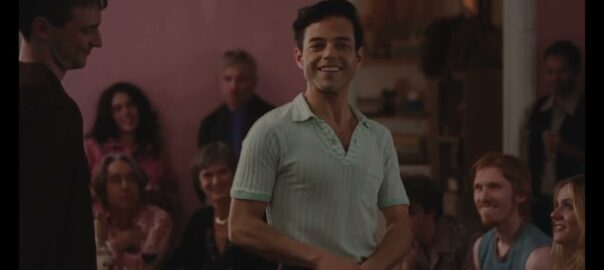
Jesse Eisenberg’s The Début, starring Julianne Moore and Paul Giamatti, opens VIFF with an Invitation-Only Gala at the Vancouver Playhouse, followed by public screenings.
Moore plays Mona, a meek woman who gets cast in a community musical and gradually becomes consumed by the character she is playing.
It sounds funny.
It also sounds increasingly unhinged.
And Julianne Moore doing psychologically complicated, emotionally vulnerable, slightly dangerous is exactly the sort of thing that can get an Academy voter’s attention.
VanRamblings is not predicting an Oscar nomination.
We’re just saying watch Julianne Moore.
There is a difference.
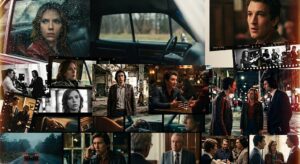
Then there’s James Gray’s Paper Tiger, starring Adam Driver, Scarlett Johansson and Miles Teller.
1986 Queens.
Two brothers.
A Russian criminal syndicate.
Family.
Loyalty.
Ambition.
And the inevitable realization that American dreams have a nasty habit of becoming American nightmares.
Gray has spent his career making intimate crime stories that are really family dramas. Little Odessa, The Yards, We Own the Night, The Immigrant — his films understand that crime isn’t really about guns and money.
It’s about what people will do to the people they love.
Paper Tiger looks like classic Gray territory.
And that is very good news indeed.
DON’T IGNORE THE FILMS MADE HERE

Then comes Vancouver’s own Mina Shum with Whatcha Want.
A wealthy Hong Kong trophy wife discovers her husband’s infidelity and begins rediscovering her passion for dance.
Shum, whose Meditation Park was another beautifully observed portrait of Asian-Canadian life, returns with a hip-hop-infused film that is unmistakably Vancouver while reaching far beyond Vancouver.
This is precisely why VIFF matters to this city.
We are not merely importing movies from the rest of the world.
We are making movies that belong to the world.
Whatcha Want is one of them.
AND THEN THERE ARE ALL THE OTHER MOVIES
Here’s the thing.
We could keep going.
And going.
And going.
Because the Special Presentations are only one part of VIFF.
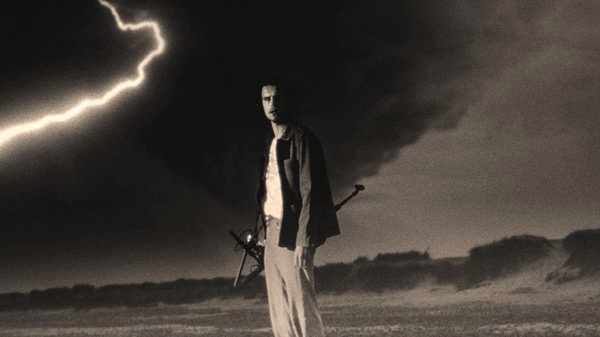
There is All of a Sudden, Ryûsuke Hamaguchi’s nearly three-hour meditation on mortality, care and human connection.
There is Pedro Almodóvar’s Bitter Christmas, a mischievous comedy about autofiction and the dangers of filmmakers stealing their friends’ lives for art.
There is Your Mother Your Mother Your Mother, with Mahershala Ali and John Cho, an action thriller involving an assassin, single parenthood and a far-right religious militia.
There is I Play Rocky, Peter Farrelly’s account of Sylvester Stallone betting everything on the screenplay that became Rocky.
There is The Liberation, starring Carrie Coon and Lily James.
There is Kore-eda Hirokazu’s tender Look Back.
There is Lukas Dhont’s Coward.
And there is Andrew Haigh’s A Long Winter, set in the Rockies in the 1950s.
That is before we even leave the Gala section.
Beyond it, VIFF spreads into Showcase, Panorama, Focus, Vanguard, Northern Lights, Insights, Spectrum, Portraits, Altered States, Leading Lights, Short Forum and MODES.
In other words:
Bring comfortable shoes.
DON’T FORGET THE SHORTS
And please, for the love of cinema, don’t treat the shorts as filler.
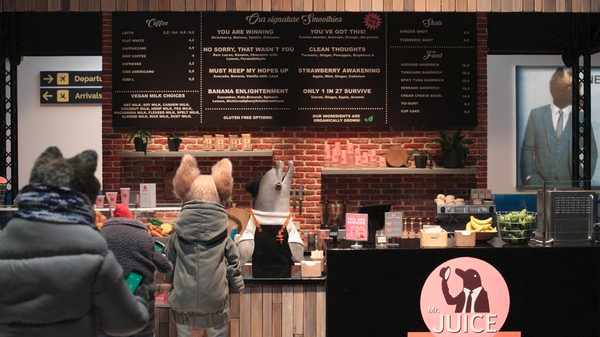
VIFF Short Forum offers programmes with titles such as The Scarier One, Anthropomaxx, Workers of the World, Immanence: A Life, Somewhere Else, Archive Lives!, War at Home, Queer Magic and Big Time Sensuality.
These are not cinematic leftovers.
They are where filmmakers take risks because they don’t need 120 minutes to justify them.
One Short Forum programme, Workers of the World, brings together films exploring working-class life and a system that has betrayed its promises.
Archive Lives! examines the relationship between memory and what eventually becomes history.
Queer Magic asks, rather wonderfully, whether magic is something we might actually believe in.
This is the stuff you discover at festivals — films you didn’t know existed, filmmakers whose names mean nothing to you at breakfast and everything to you by dinner.
AND VIFF IS MORE THAN MOVIES
 Carrie Coon is this year’s recipient of the VIFF Luminary Award
One of the things that has increasingly distinguished VIFF is that it understands film culture isn’t confined to the screen.
The VIFF Talks series brings directors, writers, producers, showrunners, composers and other craftspeople into conversation with audiences.
This year’s programme includes Carrie Coon, recipient of a VIFF Luminary Award, and a conversation with composer and DEVO co-founder Mark Mothersbaugh, whose work has ranged from Rushmore and The Royal Tenenbaums to Thor: Ragnarok.
And then there is VIFF Live, which this year explores what the festival describes as “reworlding” — bringing music, electronic performance, comedy and other forms of live culture into the cinematic experience.
Among the offerings is an evening with composer Cristóbal Tapia de Veer and Derrick Gee’s Radio Hour.
This is a film festival refusing to pretend that cinema exists in isolation.
It doesn’t.
Cinema is music.
Cinema is performance.
Cinema is politics, architecture, photography, costume, editing, sound, history and memory.
Cinema is culture.
HOW TO SURVIVE VIFF
Now for the boring but necessary part.
Tickets are on sale now.
A regular adult ticket is $22, seniors are $20, students/youth $19 and accessible tickets $17, before GST.
Six-ticket packs are $126; 10-ticket packs are $200.
The Festival Pass and Senior Festival Pass are currently sold out, while the Platinum Pass is $1,300.
The VIFF Centre is at 1181 Seymour Street, but during the festival every VIFF theatre serves as a box office.
That is important.
You don’t have to trek back downtown every time you need a ticket.
The theatres open their box offices 30 minutes before the first screening of the day; the Vancouver Playhouse opens 45 minutes beforehand. Most venues are cashless.
And don’t panic when a film says Sold Out.
VIFF releases additional ticket allotments closer to screenings when available, and there are standby lines.
The festival’s advice is essentially simple: get there early.
VanRamblings’ advice is even simpler:
Don’t arrive at 7:58 for an 8:00 movie on the other side of town.
Vancouver traffic has no respect for cinema.
WHERE TO GO
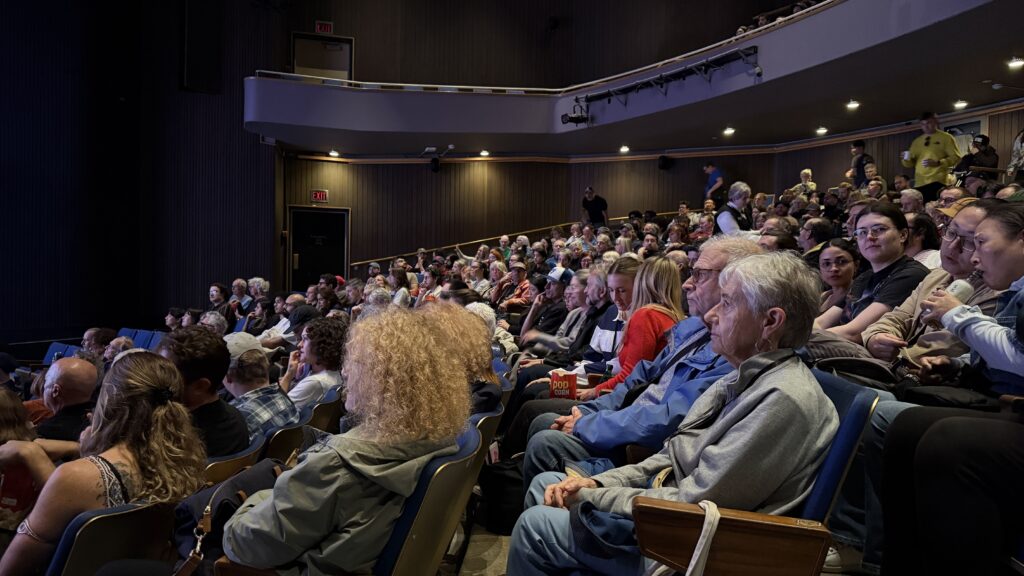 A full VIFF audience in attendance at the Vancouver Playhouse, one of VIFF’s première venues
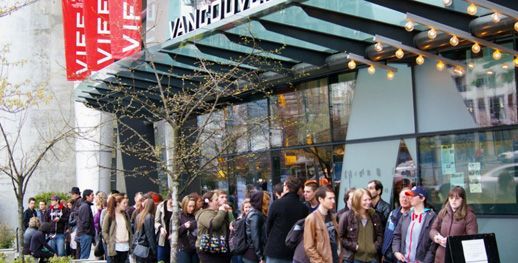
VIFF’s venues stretch from the Vancouver Playhouse and VIFF Centre to The Cinematheque, International Village, The Rio, The Park Theatre, Fifth Avenue Cinemas, Granville Island, SFU Woodward’s and Alliance Française.
Some venues are 19+ — notably The Rio, Park and Fifth Avenue — so check before taking the kids.
The geographic spread is actually part of the fun.
International Village means Chinatown is downstairs and around the corner.
The Rio puts you in the middle of Commercial Drive.
The Park gives you Cambie.
Granville Island gives you, well, Granville Island.
The Cinematheque puts you downtown.
The VIFF Centre gives you the closest thing to festival headquarters.
And all of these neighbourhoods offer food.
Lots of it.
So don’t think of the gap between films as dead time.
It is the festival.

Go for dim sum.
Grab coffee.
Have dinner.
Argue about whether the ending worked.
Then go back into another theatre and discover that the film you thought you were seeing at 9 p.m. has absolutely nothing to do with the film you just spent two hours discussing.
That’s the point.
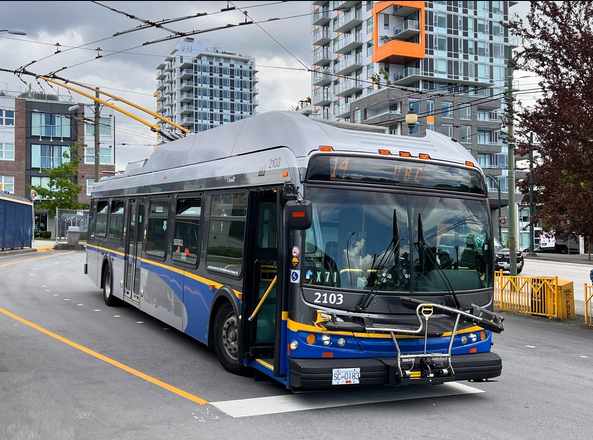
Transit is also your friend. VIFF directs audiences to TransLink for routes and schedules, and with venues spread across Vancouver, public transportation is generally preferable to attempting to drive and park between multiple screenings.
Accessibility is another important part of the festival. VIFF cinemas have hearing-assistance systems, selected screenings offer closed captions, and the festival provides accessibility information for individual venues.
THE REAL REASON TO GO
You can attend VIFF because Fjord won Cannes.
You can attend because Pawlikowski won Best Director.
You can attend because Julianne Moore might be in the Oscar conversation.
You can attend because Adam Driver, Scarlett Johansson and Miles Teller are in Paper Tiger.
You can attend because Mike Leigh may be saying goodbye.
You can attend because Mina Shum is bringing Vancouver to the world.
But those aren’t really the reasons to go.
You go because you don’t know what you’re going to discover.
A film festival is one of the last places in modern life where discovery still happens without an algorithm telling you what you are supposed to like.
Netflix knows what it thinks you want.
YouTube knows what it thinks you want.
Spotify knows what it thinks you want.
VIFF doesn’t care.
VIFF says:
Here. Watch this.
And sometimes the movie is magnificent.
Sometimes it’s infuriating.
Sometimes it’s boring.
Sometimes you walk out wondering what the hell you just watched.
And occasionally — gloriously — you walk out knowing you have just seen something you will remember for the rest of your life.
That’s why the 45th Vancouver International Film Festival matters.
Because for eleven days, Vancouver becomes something more than a city of glass towers, mountains and expensive real estate.
It becomes a meeting place.
A Romanian filmmaker meets a Vancouver audience.
A Japanese filmmaker meets a Canadian family.
A Palestinian story meets somebody who has never been anywhere near Palestine.
A Russian film asks uncomfortable questions about power.
A Korean film makes us laugh.
A Norwegian story makes us reconsider tolerance.
A Vancouver filmmaker tells a Hong Kong story.
A stranger sitting beside us laughs at precisely the same moment we do.
Someone cries.
Someone applauds.
Someone hates the movie.
Someone else thinks it is the greatest thing they’ve ever seen.
And for those two hours, none of that matters.
The lights go down.
The world comes in.
We sit together in the dark.
Borders disappear.
Languages cease to be barriers.
The lives of people we have never met become, briefly, our lives.
That is the extraordinary, almost old-fashioned magic of cinema.
And that is the real gift of VIFF.
It isn’t simply that Vancouver gets to see the world.
It is that, for eleven days, the world gets to remind Vancouver that we are part of it.
So forget the rain.
Forget the traffic.
Forget the usual Vancouver complaint that there’s nothing to do.
Buy a ticket, or two or three, or a pass.
Take the SkyTrain.
Walk into a theatre.
Sit down beside a stranger.
And let the lights go down.
For a little while, in the darkness, we are all watching the same world.
And maybe — just maybe — we will walk back out into it seeing one another a little differently.