If the first instalment of VanRamblings’ look at the 45th Vancouver International Film Festival was about the sheer breadth of cinema arriving in Vancouver, Galas & Special Presentations is where the festival’s glamour, ambition and awards-season muscle really begin to show.
This is the section for the films that have already made noise somewhere else — at Cannes, Telluride, Venice — or at the Toronto and New York Film Festivals. It is where filmmakers with Oscars, Palme d’Ors, Golden Globes and cinematic credibility share the screen with first-time directors whose careers may be about to explode.
And there is an extraordinary amount of talent here.
Pedro Almodóvar returns with Bitter Christmas. Ryûsuke Hamaguchi follows his Oscar-winning Drive My Car with the three-hour All of a Sudden. Paweł Pawlikowski, whose Ida won the Oscar for Best Foreign Language Film and whose Cold War earned three Oscar nominations, arrives with Fatherland. And Andrey Zvyagintsev — director of Leviathan and Loveless — returns after a lengthy absence with Minotaur, winner of the Grand Prix at Cannes 2026.
Then there is James Gray’s Paper Tiger, starring Adam Driver, Scarlett Johansson and Miles Teller; Peter Farrelly’s I Play Rocky, the true story behind the making of Rocky; and Bassam Tariq’s ferocious Your Mother Your Mother Your Mother, starring two-time Oscar winner Mahershala Ali.
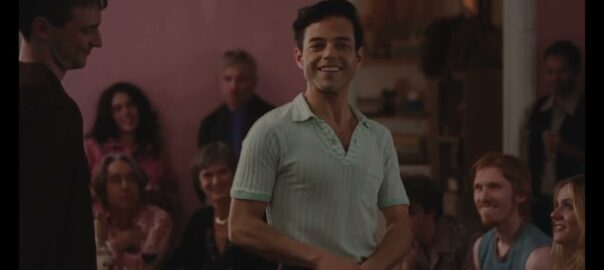
And finally there is Club Kid, the movie that arrived at Cannes unknown and promptly became one of the festival’s genuine discoveries. Jordan Firstman’s exuberant feature debut was embraced as a surprisingly tender story of redemption, parenthood and queer millennial life. VIFF itself calls it a “wondrous triumph at Cannes.”
What makes this year’s Galas and Special Presentations programme particularly exciting is the way Vancouver sits almost perfectly in the middle of the international festival calendar. Several of these films have already survived Cannes. Some have just passed through Telluride or Venice. Others are opening or playing at TIFF as you read this. Several will move on to New York later this month.
In other words, VIFF 45 isn’t merely showing movies.
It is showing us the movies that the rest of the world is already talking about.

Club Kid — Jordan Firstman
If there is one film in this section that feels tailor-made for the festival moment, it is Club Kid. Jordan Firstman writes, directs and stars as Peter, a washed-up New York party promoter whose hedonistic existence is abruptly interrupted when the 10-year-old son he never knew he had arrives in his life following the death of the boy’s mother. Cara Delevingne, Diego Calva and newcomer Reggie Absolom co-star.
Firstman arrives as a genuine cinematic wild card. A social-media phenomenon during the pandemic, he appeared in Sebastián Silva’s Rotting in the Sun and more recently in I Love LA. Club Kid is his feature directing début, shot on 35mm on a relatively tight budget.
Cannes responded enthusiastically, with Vogue calling it a rare bright spot in a notably serious competition and praising its emotional heft. It was nominated for the Caméra d’Or and Queer Palm, and subsequently played Telluride — hardly a bad place to begin an Oscar-season journey.
The film is also playing TIFF and will screen at the New York Film Festival in October. If there is a breakout indie here, this may be it.
Minotaur — Andrey Zvyagintsev
Few directors have returned to the international stage with quite the force of Andrey Zvyagintsev. Minotaur is his first film in a decade, his first made outside Russia, a politically charged drama about corruption, violence and moral collapse during wartime Russia.
The Cannes reaction was formidable: Minotaur won the Grand Prix, the festival’s second-highest prize. Zvyagintsev is hardly an unknown quantity. The Return won the Golden Lion at Venice; Leviathan won Cannes’ Best Screenplay and received an Oscar nomination; Loveless won Cannes’ Jury Prize and also received an Academy Award nomination.
This is serious awards-season territory. The film also appeared at Telluride and is part of the New York Film Festival’s 2026 Main Slate.
Fatherland — Paweł Pawlikowski
Pawlikowski’s Fatherland is another Cannes heavyweight. Sandra Hüller and Hanns Zischler portray Erika and Thomas Mann as father and daughter travelling across post-war Germany in 1949, confronting a divided country and an even more fractured family.
The film won Pawlikowski the Cannes Best Director prize, shared with another filmmaker, continuing a remarkable run that includes Ida and Cold War.
Hüller — Oscar-nominated for Anatomy of a Fall — gives the film another awards-season calling card. Fatherland screened at Telluride and will play New York’s festival.
Your Mother Your Mother Your Mother — Bassam Tariq
Mahershala Ali plays a devout hitman whose wife’s sudden death thrusts him into single parenthood while putting him on a collision course with a far-right religious leader, played by John Cho. Giancarlo Esposito also stars.
It is an audacious follow-up for Bassam Tariq, whose Mogul Mowgli won the International Critics Prize at Berlin and earned a BAFTA nomination. His documentary Ghosts of Sugar Land also won the Sundance Short Film Jury Prize.
The film is a TIFF Special Presentation, giving it an important early North American awards platform, and Tariq is receiving TIFF’s Rising Talent Award.
Ali already owns two Oscars, this is one of VIFF’s clearest potential acting-season titles.
I Play Rocky — Peter Farrelly
Peter Farrelly, the Oscar-winning director of Green Book, turns to the true story of how an unknown Sylvester Stallone fought to write, star in and get Rocky made.
Anthony Ippolito plays Stallone, with Stephan James, AnnaSophia Robb and Matt Dillon among the supporting cast. Amazon MGM describes it as the story of Stallone fighting to bring his screenplay to the screen — and insisting that he play Rocky himself.
The film had its world première at TIFF, making Toronto its first major awards-season test. And with the Academy’s new casting category now part of the Oscar landscape, the casting alone gives I Play Rocky an intriguing awards hook. Early TIFF previews have already singled out Ippolito’s uncanny resemblance to the young Stallone.
Paper Tiger — James Gray
James Gray returns to the crime territory of Little Odessa and We Own the Night with Paper Tiger, a 1986-set New York thriller about two brothers who become entangled with the Russian mafia.
The brothers are played by Adam Driver and Miles Teller, with Scarlett Johansson as Hester Pearl.
Gray has returned to the Cannes competition five times, and Paper Tiger received its world premiere there before becoming the Opening Night film of the 64th New York Film Festival on September 25. Film at Lincoln Center calls it a “career-best achievement.”
That is an extraordinary endorsement. With Driver, Johansson and Teller in the cast, Paper Tiger deserves to be watched closely when Oscar nominations begin to take shape.
All of a Sudden — Ryûsuke Hamaguchi
At 196 minutes, All of a Sudden is not exactly a casual evening at the movies. But Hamaguchi has earned the right to ask audiences for patience.
The director of Drive My Car — which won the 2021 Cannes Screenplay prize and became an Oscar Best Picture nominee — turns here to a French care-home director and a Japanese theatre director battling cancer, exploring mortality, dignity, friendship and the possibility of humane care.
At Cannes, Virginie Efira and Tao Okamoto shared the Best Actress prize. Critics were largely enthusiastic, although some found the film overly meditative. It currently carries a remarkably strong critical profile.
The film is playing TIFF and will also screen in the New York Film Festival.
Bitter Christmas — Pedro Almodóvar
And then there is Pedro Almodóvar — which is almost enough said.
His latest film is an elaborate film-within-a-film meditation on grief, artistic betrayal, memory and the uneasy relationship between fiction and reality. Bárbara Lennie and Leonardo Sbaraglia lead the cast, with the story moving between an actress’s life and the filmmaker who is transforming that life into a screenplay.
At Cannes, Bitter Christmas won the Soundtrack Award. Critics were divided on its intricate, self-referential construction, although the film enjoyed a strong reception.
The film is a TIFF Special Presentation and will receive its U.S. première in New York.
Whether it becomes an Oscar player is harder to predict. But with Almodóvar, Bárbara Lennie, Sbaraglia and five decades of cinematic history behind it, Bitter Christmas is precisely the sort of film that demands to be seen before the awards conversation is over.

C’mon back next Friday for the third installment of VIFF 45’s Galas and Special Presentations film programme.