I loved university. In the 1970s, I loved attending classes at Simon Fraser University, talking hours on end with classmates sharing obscure insights into arcane literature, or why anarchism is the most humanist political philosophy, or spending hours in the library, or finding some quiet corner to type out the dozens of essays that were due each semester.
I was so curious about the world around me, so committed to learning everything I could on any given subject presented to me by my various approachable and erudite professors and radicalized teaching assistants, in the books I was reading or from folks in the pub at whatever stage of their university career, who over a beer would good-naturedly engage with me in philosophical arguments, whatever the topic of the moment.
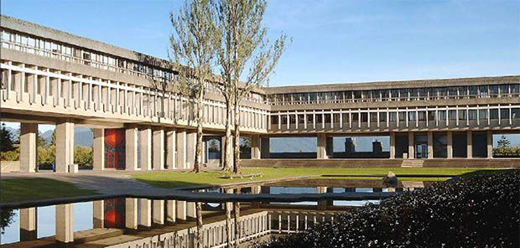
Louis Riel House family student residence at Simon Fraser University on Burnaby Mountain, circa 1972
Attending classes and living at Louis Riel House — sometimes not leaving Burnaby Mountain for months on end — attending Simon Fraser University was for me the happiest and most rewarding time of my life.
Not so much for Cathy, my long-suffering wife.
Cathy made no secret of the fact that she wanted to get away, to explore new lands, to be adventurous and anonymous thousands of miles away.
In February 1972, I was enrolled in my 5th consecutive semester at SFU, having identified my areas of interest for my studies — political science, sociology and anthropology, part of SFU’s radical PSA department — as well as English literature.
Much to my astonishment, I was achieving straight A’s in school, my grade point average past my first year 4.0, and in this fifth semester I was on a roll, most of my course work completed by early February, as I prepared to ready myself with the reward of five more A’s, bursaries and scholarships, and further down the academic road enrollment in a Master’s programme.
Arriving home mid-afternoon Tuesday, February 8th, 1972, opening the door and walking into our student apartment, Cathy standing in the living room, rather than approaching me to give me a kiss, she stood stock still, looking down, then looking up and directly at me, and said,
“We’re leaving for Mexico next Monday, for two months.
Get your head around it.”
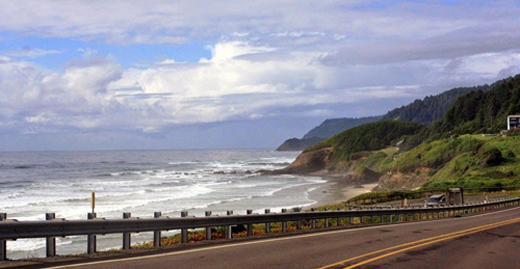
Cathy and I traveling along the Oregon coast, headed to California, and then Mexico
I knew there was no arguing with her about her dictum. Cathy had sacrificed so much for me that it was quite clear: it was her turn now.
The next Monday morning we jumped into our 1970 Datsun 510 — a wedding gift from her mother. Hours later we found ourselves barrelling down the coast of Oregon heading towards Los Angeles, where arrangements had been made to stay with our friend, Bachi — with whom I had attended almost all my classes my first four semesters, and who was my best friend, Manuel Vittorio Esquivel, handsome, swarthy, adventuresome, and the best friend anyone could wish for.
While in Los Angeles, Cathy and I listened to KRLA, southern California’s rock ‘n roll giant
Cathy didn’t like driving, so I drove the entire 1500 miles (I love driving!) to our L.A. destination, arriving two days after we’d left our Burnaby Mountain home, as we found our way to the Chicano area of Los Angeles, a Latino and Latina East L.A. of boom boxes and low-riders, a vibrant Mexican community with which we fell in love, as we did Bachi’s mother’s cooking — eating mole chicken and lime-cilantro rice for the first time while consuming gallons of fresh-squeezed orange juice available at farmer’s markets in two quart containers, for only a dollar, driving along the freeways in the jasmine-scented night air, KRLA radio at full volume blasting into the warm night air, free and in love, and enjoying the time of our young lives.
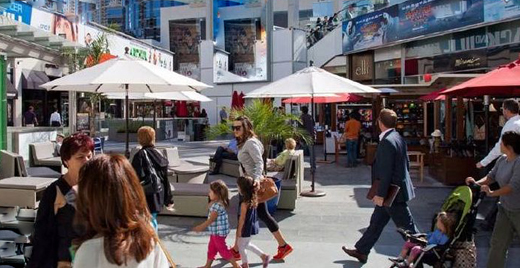
The sunny open air shopping mall located in wealthy, beach-fronted Santa Monica
All was not perfect, though.
One afternoon while awaiting dinner and sitting in the living room, Bachi’s 18-year-old sister, Maria — one of the most beautiful and self-possessed young women I’d ever met, who was enrolled in her second semester at a nearby college, and who worked as a sales clerk at a department store in a mall in the wealthy Santa Monica neighbourhood to help pay for her tuition — came home crying, sobbing, inconsolable, wracked with pain, broken and disconsolate, collapsing onto the sofa, curled up into a heaving ball of sobs and pain, bereft of hope, for the moment not of this world, not of any world, alone and withdrawn.
Maria worked in the shoe department at Macy’s. Earlier that afternoon, a wealthy woman in her early 30s had arrived at the shoe department, miserable, abusive, racist, on the attack and demanding service — pointing at Maria — to “that dirty Chicana over there, who oughta be sent back to where she came from, but if she’s gonna be here, she damn well better serve me, and get her ass over here. Now!”
The manager stood nearby, but didn’t come to Maria’s aid, instead directing the abusive woman over to where Maria stood, now quivering, saying to the irate-for-no-good-reason shopper, “Of course, ma’am. Maria is here to serve you. She will find you anything you need. Now hop to it, Maria.”
The situation devolved from there, with Maria finding one pair of shoes after another for this abusive woman, responding to the demands of the woman to …
“Get down on your knees, don’t look at me, put those shoes onto my feet now, don’t look up, and you better be careful when fitting those shoes, or I’ll have your job.”
The woman remained in the shoe department for an hour, loudly and abusively making Maria’s life a hell on earth, before finally leaving the department store harrumphing, having made no purchase. Maria finished her shift, and drove home.
Once home, after her mother intervened, Maria spent the rest of the evening in her bedroom, while Bachi, Cathy and I left his home, leaving Maria — whose young life had been a litany of the kind of abuse she had suffered that afternoon — in the care of her mother, as the three of us drove to a nearby drive-in for a burger and fries, staying away until late.
That evening, Cathy and I decided we would leave for Mexico the next day.
After an early breakfast of heuvos rancheros prepared by Bachi’s mom, Maria still in her bedroom, not wishing to join us at the kitchen table, leaving our car in the garage attached to Bachi’s home, Bachi drove us in his own vehicle to the Mexican border, just north of Tijuana.
Cathy had mapped out our journey, which involved us taking a bus to Mexicali, where we would board a train for the 2,000 kilometre journey to Guadalajara.
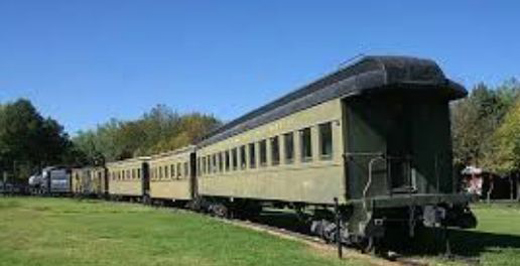
The above, very much like the train Cathy and I traveled on throughout Mexico
Both Cathy and I, once we’d boarded the train in Mexicali for the first leg of our Mexican adventure — we were planning on staying in Guadalajara for a few days, then planned to make our way over to the west coast, and come back to Guadalajara before heading to Mexico City.
Ours was, though, a largely unplanned adventure, where we both felt secure that we’d meet good folks, and learn something about a country about which knew little — were surprised that there were 20 young Americans traveling in the same car as us, hippies who’d shorn there hair, as I had, in order to get a visa, the men letting their hair and beards grow once we’d made it across the border.
As is almost always the case when traveling in a group — not that any one of us knew one another, or anyone else in our car — one of our 20 ‘fellow travelers’, in this case a gaunt young man with an adventurous spirit who had traveled to Mexico previously, suggested to us all that upon arriving in Guadalajara, we immediately make our way over to La Peñita, along the coast, 72 kilometres north of Puerto Vallarta, where we could stay for a dollar a day, swim, get to know the townspeople, and enjoy ourselves away from the hubbub of Puerto Villarta.
Sounded good to all of us — we now had a destination.
Now, traveling as a financially itinerant train and bus traveler in the 1970s was fraught with adventure. Why fraught?
Well, because revolution was the order of the day, throughout Europe, throughout central and South America, and most certainly in Mexico, where guerilla groups fought with the Mexican army, farmers led by ex-teacher Lucio Cabañas fighting against landholder impunity and oppressive police practices in rural Mexico, the guerillas carrying out ambushes of the army and security forces, and blowing up train tracks throughout northern Mexico — as proved to be the case on the first leg of our collective journey into the heart of Mexico.
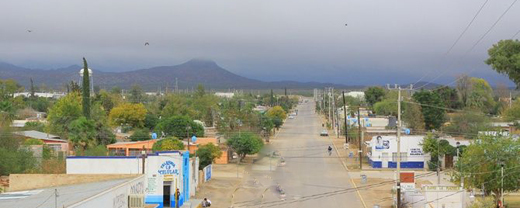
Above, a contemporary photo of Benjamin Hill, in the northern Sonora state of Mexico
Upon arriving in Benjamin Hill, in the northern Mexico state of Sonora, approximately 714 kilometres south of Mexicali, the train conductor informed us that there would be a day or two layover in Benjamin Hill, as the tracks 30 kilometres to the south had been blown up by guerillas. When we arrived in Benjamin Hill, midday, the sun was bright, the day sweltering.
We all alighted from the train to take a look around at the dusty little village.
We debated whether or not we’d each rent a room in one of the mud shacks off the main street. One of our companions, who had kept a close watch on me since we’d boarded the train in Mexicali, a ‘sexual freedom leaguer’ traveling with her boyfriend, she a stunningly gorgeous young Asian woman, her boyfriend a nerdy-looking, quiet guy, looked at me and looked at Cathy, and then set about to announce to everyone gathered around in the boldest possible fashion …
“I want to fuck him,” then looking at me said, “I want to fuck you. Let’s go find a room in that building over there.”
I looked over at Cathy, who was rolling her eyes, looking heavenward, then looking at me, exclaiming …
“You want to fuck her, go ahead.
I’m not fucking her boyfriend, though.”
Me, I’m not good in situations such as the one I was now being confronted with.
Would I liked to have gone off with this beautiful young woman for a sweaty afternoon of sexual frolic?
Sure — but that would mean leaving Cathy behind, and I wasn’t prepared to do that, so I just said, “You’re invitation is very kind, and I appreciate it, but I’m going to stay with Cathy,” at which statement the young sexual freedom leaguer grabbed her boyfriend’s hand, marching off to rent a room in a sun-baked mud building.
As it happens, the twenty-two of us remained in Benjamin Hill for only about six hours, as the authorities had identified an alternative route to get around the tracks that had been destroyed. By late evening, we were all on our way again, the night chill, Cathy wrapped securely in my arms, under a blanket we’d purchased in town for about three dollars.
Two days later, we arrived in Guadalajara, the twenty-two of us alighting from the train, seeking food and drink. “No water,” our appointed leader told us — “Stay with Coke, you’ll be better off. You can trust it because it’s bottled by Americans under strict standards. Drink the water, or anything washed in local water, and you’re going to find yourself in trouble.”
So, we found a street food cart — all along the way from Mexicali to Guadalajara, we’d fed ourselves from the food carts at stops along our journey south.
We looked for, and found the bus station, all of us purchasing tickets to La Peñita for the five-hour, 262 kilometre pilgrimage to our coastal village destination, arriving around 7pm, night and dark, although the near full moon above shone bright.
Once in La Peñita, we secured our accommodation — spacious houses about 200 yards back from the beachfront water, several of us staying in each of three houses we rented for what would be our one-week stay in the rural village, our new home.
Having left our pack sacks in our new domiciles we all went back into town, where we were accosted by a group of 6, 7, 8 and 9-year-old boys who wanted us to play foosball with them, for a peso a game — if they won, we gave them a peso (equivalent to about one cent), the game free to play.
The first game I played was with one of the 6-year-old boys, who wasn’t tall enough to even see the top of the foosball table. “This is gonna be easy,” I thought to myself, “Poor kid.” I meant to win, and show this boy how it’s done — although I’d never played foosball before. Five minutes in, the game was over, I hadn’t scored once, the boy’s facing beaming, looking up at me saying, “De nuevo, señor, de nuevo.” Over the course of the next hour, I played each of the boys, as did the men in our group, losing each game successively more quickly, as was the case with each of my companions, now 20 pesos poorer than when I’d begun the night, the women standing nearby by shaking their heads, going off to look at the “shops” nearby (stalls, really), the young boys now gleeful.
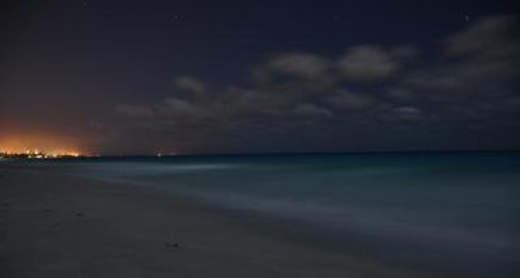
Our leader, the gaunt young American man, rounded us all up, and said, “Let’s go for a swim,” and we did, some of the women going back to our new homes to find blankets to lay on the sand, but not swim suits, as this was to be a naked swim in the ocean, all twenty-two of us running toward and splashing in the warm, sparking water, the moon above glistening in the purple night sky, the light of the moon reflecting off the gentle waves of the ocean water.