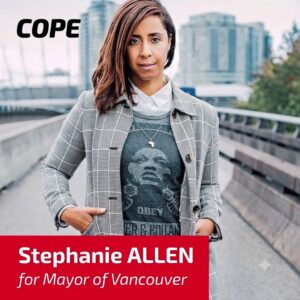
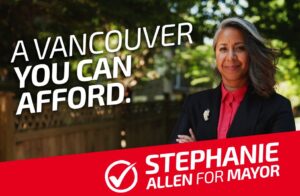
Stephanie Allen. Along with Kareem Allam, by far our favourite candidate for Mayor of Vancouver, a boots on the ground visionary, a fiscally responsible, well schooled, non-pedantic knows her stuff politico, who possesses much — perhaps unparalleled — insight into how government functions (although we would say she may have met her match in Kareem Allam), and after years of working in British Columbia’s provincial government knows how to implement true change for the better — the real deal Zohran Mamdami running in the current 2026 Vancouver civic election — COPE scored a major coup in landing the absolutely tremendous Stephanie Allen as the municipal party’s standard bearer in the 2026 Vancouver civic election (thank you Shawn Vulliez, COPE’s absolutely brilliant campaign manager, for convincing Ms. Allen to run for the office of Vancouver Mayor)!
Now, you may know Stephanie Allen from her critically important role as Vice-President of BC Housing, or — following the untimely death (from cancer) of VanRamblings’ friend and neighbour, Brenda Prosken, who we first met and worked with at Vancouver City Hall in her role as General Manager of Community Services — when Stephanie Allen stepped up to the plate in 2020 / 2021 to find housing and homes for those who were resident in the Strathcona Park encampment (following on Brenda’s work on the decampment of Oppenheimer Park, when she located housing for all of the encampment’s residents), but there’s more …
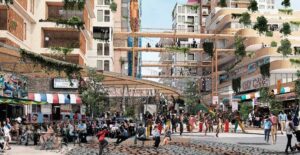
A re-imagining of Hogan’s Alley, Vancouver’s first enclave for some of the Vancouver’s early Black Canadian immigrants, located within a T-shaped intersection at what is now the easternmost end of the Dunsmuir and Georgia viaducts — immediately south of Chinatown | Stephanie ALLEN.
Hogan’s Alley, the early 1900s community in and around the Strathcona neighbourhood — framed today by Main Street to the west, Union Street to the north, Jackson Avenue to the east, and Prior Street to the south — where it eventually became the cultural hub of the community, the former neighbourhood known for being home to Nora Hendrix, the grandmother of rock legend Jimi Hendrix, and a cook at Vie’s Chicken and Steak House, a Hogan’s Alley’s culinary institution.
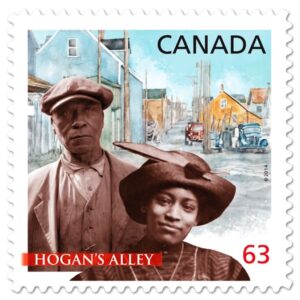
The latter half of the 1960s marked the neighbourhood’s demise, when city blocks of homes and businesses that formed Hogan’s Alley were demolished for the replacement Georgia Viaduct, which itself is set to be demolished later this decade.

And, gosh, who do you think it was who developed the concept of a renewed Hogan’s Alley? Could it be Stephanie ALLEN, COPE’s absolutely tremendous candidate for Mayor of the City of Vancouver? Yep, yep, we believe that is the case.
Time to introduce you to another high profile candidate for Mayor of Our City
William Azaroff. Running for Mayor of Vancouver under the banner of OneCity Vancouver, VanRamblings first met Mr. Azaroff in June 2019 soon after he was appointed CEO of the Brightside Community Homes Foundation (a prominent non-profit in Metro Vancouver), where he leads a team that manages 26 buildings encompassing over 1,100 affordable homes for seniors, families, and persons with disabilities across the Metro Vancouver region.
Recently, the Vancouver & District Labour Council (VDLC) endorsed Mr. Azaroff for Mayor in this year’s Vancouver municipal election, announcing its endorsement on May 20, 2026, while simultaneously urging the Green Party and COPE to reconsider their Mayoral campaigns to consolidate the so-called “progressive” vote.
That night, COPE’s very able (and, dare we say, brilliant) campaign manager, Shawn Vulliez posted a brief note to VanRamblings in which he averred, “There’s a secret meeting going on tonight where, I’m told, One City Vancouver and the VDLC are going to jettison the co-operative agreement reached by OneCity, the Greens and COPE that would have us work together, as we have in the past, where the VDLC is going to formally endorse OneCity.”
As British statesman Benjamin Disraeli observed “in politics, as in love, there is no honour,” pointing to a world where strategy, leverage, and party alignment often take precedence over unbending morality.
As renowned philosopher Hannah Arendt once observed …
“In matters of the heart, the adage “all is fair in love” suggests that strong passions can lead to irrational choices, which I would argue in politics is fundamentally incompatible with logical, rational reasoning. Love requires vulnerability and deep personal investment, while politics often demands strict detachment or ideological pragmatism. When the two collide, devotion to political figures or ideologies can sometimes overshadow the love and respect shared between partners, be they political or lovers.”
VanRamblings is here to say two things …
- We absolutely and definitively will not support nor endorse William Azaroff as Vancouver’s next Mayor. We believe Mr. Azaroff is Ken Sim redux in casual wear, a bully, a sort of ne’er-do-well, and although better informed and more accomplished than Mayor Ken Sim, in practice is a kind of despicable, self-serving politico, a non-collaborative fellow, with the potential to be an intimidating and coercive oppressor who will bring to Vancouver City Council the same sort of dysfunction and disunity that has proved to be Ken Sim’s stock-in-trade. Read more on our rationale below.
- At reading the paragraph above, we believe VDLC President Stephen (pronounced “Stefan”) von Zychowski — who we like and respect — will be apoplectic. Soon, we will ask for Mr. von Zychowski’s permission to reprint the statement he has made on social media as to the rationale of the VDLC in choosing to support William Azaroff as our next Mayor, as well as his OneCity Vancouver civic party. Fair’s fair, after all.
On February 12th, Mr. Azaroff defeated First United Church Executive Director Amanda Burrows in OneCity Vancouver’s Mayoral nomination race, securing 1329 votes or 60% of the vote total, with Ms. Burrows coming in second with 929 votes, or 40% of the vote. Nomination battles are always a numbers game.
Upon winning the OneCity Mayoral nomination, did Mr. Azaroff reach out to Ms. Burrows and say …
“You ran a good race, a great race. I learned so much from you as we both sought to secure the OneCity Vancouver Mayoral nomination. I think the success of OneCity in this year’s election demands candidates of quality, discernment and accomplishment, all of which you embody. I believe going forward it is critical you remain on the OneCity team, and that you secure a nomination for Council, which I will heartily endorse. Working together, there is so much good that we can accomplish.”
Did William Azaroff reach out to Amanda Burrows, congratulate her on a well-run campaign, and ask her to join his OneCity Vancouver team to seek a Council nomination, which he would heartily support? Nope, gentleman that he isn’t, he did not approach her. Instead, he left Ms. Burrows to twist in the wind.
Note. Amanda Burrows did not seek a OneCity Council nomination.
From the outset there was very little enthusiasm within COPE (the Coalition of Progressive Electors), for the Mayoral candidacy of William Azaroff, should he secure the OneCity Mayoral nomination.
Even so, in signing a OneCity Vancouver / Greens / COPE co-operative agreement COPE — which was represented by campaign manager, Shawn Vulliez — at the behest of the VDLC, COPE made a commitment to consider backing various of the “progressive” non-COPE candidates should these candidates “pull ahead.”
COPE’s Executive did not want to risk the potentiality of Stephanie Allen’s Mayoral bid should all go well — as was heartily hoped would occur — given the possibility Ms. Allen might emerge as the successful consensus “progressive” Mayoral choice, thereby garnering support from OneCity, the Greens and the VDLC.
There was to be no ill will expressed, nor acted upon, nor any misunderstanding(s).
COPE conducted itself in an honourable matter.
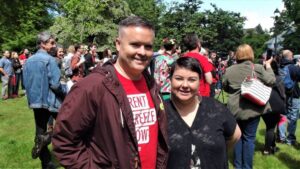
Derrick O’Keefe, COPE School Board candidate (l), and his activist partner, Andrea Pinochet-Escudero
Why then was there opprobrium among some in COPE for an Azaroff candidacy?
If one reads various social media accounts, and speaks directly with a broad cross-section of COPE’s membership, one learns that many members of COPE have experienced mulish interactions with Mr. Azaroff, such that he is considered by many COPE members to be the Evictor in Chief in the affordable housing sector, as he displaces vulnerable tenants from their homes.

VanRamblings has covered municipal, provincial and federal elections for 60 years.
In all that time, there is no Mayoral candidate or party leader — federally, provincially or municipally — who did not put his or her imprint on the party they lead, deciding who would constitute members of her or his team going into an election.
For instance, when Kirk LaPointe became the Mayoral nominee for the NPA in 2014, he dismissed all of the vetted candidates for Council, Park Board and School Board — this at the end of a long, arduous and thorough vetting process, when all of the successful candidates were in place, as he secured his own team to run as candidates at all three levels of civic governance, Council, Park Board and School Board.
Did William Azaroff put his imprint on OneCity Vancouver after winning the Mayoral nomination, indicate he believed their star candidate, longtime civic affairs journalist Frances Bula, must be a member of his team, that her nomination for Council would be a critical element in OneCity’s success at the polls in October?
No, he did not.
Can you imagine Mark Carney or David Eby lying back and taking no interest in who would be running for their respective parties in a coming election? In early 2020, longtime NDP Executive Director Raj Sihota had the support of the Vancouver-Hastings constituency executive and the members of the riding, and was their chosen candidate to represent the party in the upcoming election.
Next thing you know, Premier John Horgan — at the insistence of then NDP Attorney General, David Eby — parachuted in former Vancouver Park Board Chair, Niki Sharma, to seek the Vancouver-Hastings NDP nomination, with the full support of the provincial party. Next thing you know, Ms. Sharma secures the Vancouver-Hastings NDP nomination, emerges as the victor in the October 24, 2020 provincial election, shortly after which she was appointed our province’s Attorney-General, when David Eby took on the housing portfolio.
William Azaroff a leader? We think not.
Colleen Hardwick. Yep, she’s running for Mayor again, and doesn’t much of a chance of winning. Think: lost cause.
VanRamblings has written kindly and lovingly about our longtime friend.
But no more.
At a recent luncheon with a weathered confidante of the esteemed Ms. Hardwick, VanRamblings offered the comment …
“Colleen Hardwick can be difficult to get along with.” The rejoinder by our luncheon companion, said with a chuckle in his voice, “Raymond, Raymond, Colleen is not difficult to get along with, she is impossible to get along with.”
We continue to like Ms. Hardwick’s core message: neighbourhood empowerment, and community involvement in the development of new and updated neighbourhood community plans. That she is the only candidate to voice such policy, gets her no little support from us. Sadly, though, Colleen Hardwick is an imperfect messenger for her policy proposals. Speaking with friends we ran across while sauntering down West Broadway, our friend Helen — as we were speaking about the upcoming civic election — offered the following comment, unbidden …
“Colleen is sharp. And I don’t mean that in a kindly way. There is an edge to everything she says, almost an inherent meanness, an ‘I know better than you’ ethos that is off-putting, that causes me to think, ‘I kind of like what she has to say, but I don’t like at all how she goes about saying it’. For me, Colleen is an unpleasant character, and someone who I could not begin to support, no matter how much I like her message.”
Recently, Katie Hyslop, writing in The Tyee, published an article titled, Colleen Hardwick Is Running for Mayor Again. Midway through the article, Ms. Hyslop asked Colleen Hardwick a question about affordable housing, and homelessness.
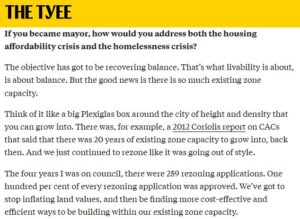
Have you ever read such utter nonsense in your entire life?
Who, which voters, given a damn about “recovering balance” (whatever the heck that means). Not to mention, who gives, which voters and where are they, give a flying f-ck about “zone capacity” or the ” 2012 Coriolis report”?
We mean, really?
Who does Colleen Hardwick — running for Mayor again, don’tcha know — think her audience is, who are the voters — outside of pointy-headed, so called “intellectuals” at the universities in our region — is she attempting to communicate with, to garner their support, that she’s the right candidate to become the Mayor of Vancouver in 2026, that she can “recover balance” and change “zone capacity”?
Colleen Hardwick might well have said …
“Affordable housing must be addressed through the construction of housing co-operatives, where members pay no more than 30% of their income for their homes, where they are empowered to make decision-making on the Co-op’s finance, membership or maintenance committees. Where housing co-ops are built on a 99-year-leasehold basis, on city-owned land, or provincial or federal Crown land. Construction and materials are paid for through the Community Amenity Contributions made by developers building high rise condominiums. All this would be overseen by Thom Armstrong, who heads both the Co-operative Housing Federation of British Columbia, and the Community Land Trust. On top of that, the City would charge no development fees for the construction of this crucial affordable housing, saving millions.”
Or, in addressing the issue of homelessness, Ms. Hardwick could have reminded readers of the 2022 platform for TEAM for a Livable Vancouver, when she stated …
“There are 277 social agencies on the Downtown Eastside, located in the square mile around Hastings and Main. 277 very well-paid Executive Directors, Vice-Presidents, Directors of Human Resources, Property Managers, Directors of Supportive Housing, and more, staffed in each of these agencies, who engage in redundant work each and every day, putting money in their pocket at the expense of the vulnerable citizens they are charged to support. No wonder that for years, many in the community have called those who are employed by these agencies “poverty pimps”. Merge these agencies, leaving 40 agencies. TEAM wants to hire a “czar” — as David Eby has often said is the key to provide service to our city’s most vulnerable citizens, rather than line the pockets of the senior administrators. Billions of dollars could be saved, services rationalized, better service could be provided with savings applied to social housing construction.”
But did she say that, did she actually answer the question that was asked of her, in plain and simple language that all of us could understand? Could have been a great answer to a simple question. But Ms. Hardwick seems not capable of that.
Y’know, Ms. Hardwick, not every voter is a PhD candidate, as you are, or grew up with a silver spoon in their mouth, living in a home where their parents are a respected, tenured professor at the University of British Columbia, and their mother sat on the Vancouver Park Board as a multi-term Commissioner.
According to Statistics Canada, the “average level” of education in Vancouver-Point Grey / Vancouver Quadra is second year university. East of Main Street, the “average level” of education is Grade 8. There are 264 distinct ethnic communities in Vancouver where the first language spoken in the home is neither French nor English. No wonder in Vancouver, there’s a paltry 36% turnout of eligible voters — if that — when a Vancouver City election is called every four years.
Fortunately, there’s a Mayoral candidate — and a couple of civic parties — in the current Vancouver City municipal election who are running a stealth campaign to get the vote out among people in those 264 under-represented communities who don’t go to the polls — but will in 2026 — when it comes time to cast their ballot for a new Mayor, a new and vibrant Vancouver City Council, and a grassroots, community-oriented Vancouver Park Board, and Vancouver Board of Education.
And we’re here to tell you, folks, that it ain’t Mayoral aspirant Colleen Hardwick, and her gang of well-meaning, and perhaps, under qualified candidate TEAM.
Muhammad Ahmad. VanRamblings predicts that Mr. Ahmad, and his recently created, AI generated (according to a friend of ours who has spoken with Mr. Ahmad) Bright Futures Vancouver municipal party will secure less than 2% of the vote come the evening of Saturday, October 17th. Chances are, though, that you are likely going to see Mr. Ahmad on at least some of the stages where Mayoral all-candidates meetings are being held, on various dates throughout September and October.
Part 1 of the column on current Vancouver Mayoral aspirants may be found here.
.
Now, we’re going to say this again and again: there is no more honourable activity than offering yourself for public office, as a serious and well-experienced candidate with a vision, and a more than passing familiarity with civic governance, and how our city is run, who the important administrative staff at Vancouver City Hall are and what it is they do, that you’ve attended a surfeit of Vancouver City Council meetings, or if you’re running to become one of the nine elected trustees on Vancouver’s Board of Education (who are elected to office every four years) that you are a regular attendee at School Board meetings and have been for years, or if you’re running to become a Vancouver Park Board Commissioner that you’ve done your homework, that you have a OneCard stuffed in your wallet, your purse, or your shirt or blouse pocket, and know almost everything there is to know not just about Park Board governance but about Vancouver’s many community centres — where it is critical that you are a member of your local community recreation centre and make regular use of the facility, which is kind of a second home for you.
See you back here tomorrow, when we write about the recently concluded 79th annual Cannes Film Festival, which for years has acted as a predictor as to which films will emerge as Oscar contenders the following January, as was the case with the Grand Prix winner at Cannes in 2025, Sentimental Value, or Best Actor Oscar contender Wagner Moura, who won the Best Actor award at the 78th Cannes Film Festival in 2025 for his role as a dissident on the run in the political thriller The Secret Agent (directed by Kleber Mendonça Filho), among a host of others, not the least of whom was the Best Supporting Actor Oscar winner, Stellan Skarsgård, for his role as an acclaimed filmmaker and absent father, in Sentimental Value.