Category Archives: Vancouver

#BCPoli | Ridings in Contention | North Shore, Vancouver, Richmond, Burnaby and New West

As the 2024 British Columbia election campaign heats up, key ridings across the North Shore — comprised of West Vancouver, and North Vancouver — Vancouver city proper, Richmond, Burnaby, and New Westminster have come into focus.

These regions, traditionally home to strong B.C. New Democratic Party and B.C. Liberal (transformed into the now defunct B.C. United) representation, in 2024 are witnessing fierce competition, especially with the rise of the insurgent B.C. Conservative Party under leader John Rustad.

The political dynamics across these urban and suburban ridings will play a crucial role in determining whether Premier David Eby’s B.C. NDP holds onto power, or John Rustad’s B.C. Conservatives, alongside a surfeit of former B.C. United candidates, now identifying as Independents — given the demise of B.C.  United — in the 2024 British Columbia election, can carve out a significant share of the electorate.

The North Shore: West Vancouver-Sea to Sky | West Vancouver-Capilano | North Vancouver-Lonsdale | North Vancouver-Seymour

The North Shore, with its blend of affluence and environmental activism, is often seen as a bellwether for middle-class urban voters.


To read Vote Mate candidate profiles of the West Vancouver-Sea to Sky candidates, click here.

In West Vancouver-Sea to Sky, B.C. NDP candidate Jen Ford, a Whistler municipal Councillor, faces stiff competition from B.C. Greens candidate Jeremy Valeriote, and B.C. Conservative candidate, Yuri Fulmer. This riding is marked by its environmentally-conscious electorate, which aligns with Valeriote’s strengths, particularly given his party’s history in the riding. However, the B.C. NDP, buoyed by Ford’s local reputation and the B.C. NDP’s progressive climate policies, could make inroads. The wildcard here is Fulmer, representing the B.C. Conservatives, who may attract right-leaning voters disillusioned with B.C. United’s recent collapse.

Moving to West Vancouver-Capilano, the race is even more complex.

High profile Independent Karin Kirkpatrick, formerly a B.C. United MLA, is mounting a well-funded, high energy campaign. Her decision to run as an Independent threatens to split the centre-right vote, complicating the path for the B.C. Conservatives’ Lynne Block, who also faces competition from another Independent, Jaclyn Aubichon, who insists she is the true B.C. Conservative candidate. The B.C. NDP’s Sara Eftekhar and the B.C. Greens’ Archie Kaario are hoping this division on the right opens a narrow path to victory, but Kirkpatrick’s sterling local reputation and deep ties to the riding make her the likely frontrunner.

In North Vancouver-Lonsdale, B.C. NDP incumbent Bowinn Ma, a high-profile Minister and advocate for housing and transit, remains a strong contender. However, with the B.C. Conservatives fielding a serious challenge —  in the form of David Splett, a seasoned Chartered Professional Accountant with over 30 years of international experience in financial and operational management within large organizations — in this suburban riding, Ma will need to fend off attacks on affordability and public safety. In North Vancouver-Seymour, NDP MLA Susie Chant faces a similar battle. Both North Shore ridings are typically competitive, but the fragmentation on the right may play to the B.C. NDP’s advantage here, as Ma and Chant can leverage their incumbency and the government’s progressive record.

Richmond: Crime and Economic Uncertainty

Richmond, a traditionally right-leaning suburb, delivered an unexpected triumph for the B.C. NDP in 2020 when they claimed three out of four ridings.

In Richmond-Queensborough, B.C. NDP incumbent Aman Singh faces an uphill battle, with crime emerging as a central issue. Steve Kooner of the B.C. Conservatives is making crime and public safety the core issues of his campaign, hoping to appeal to voters frustrated with perceived rising crime rates. Global B.C.’s Richard Zussman has identified this riding as a bellwether riding, and suggests that this riding could determine whether David Eby or John Rustad form government post October 19th election night. To win, Aman Singh will need to hold onto the diverse coalition that propelled him to victory in 2020, to retain his seat.

In Richmond-Steveston, NDP MLA Kelly Greene is in a similarly tough race. Her challengers include former B.C. United candidate Jackie Lee — who was an incredible fundraiser for B.C. United, but now running as an Independent Mr. Lee doesn’t have access to the monies he raised — and B.C. Conservative Michelle Mollineaux. Still and all, Mr. Lee is a known quantity. Kelly Greene won a squeaker in 2020; in 2024, with the vote on the right split, it would seem likely that with a fragmented opposition, Greene’s incumbency may give her an edge. Still and all, as is the case in Richmond-Queensborough, crime, alongside economic uncertainty, will dominate the conversation in Richmond-Steveston.

Unless the B.C. NDP can respond to crime and public safety effectively, Ms. Mollineaux could emerge victorious on election night.

However, in Richmond Centre — where former B.C. United candidate Wendy Yuan is mounting a high profile, effective campaign, with an army behind her to help get out the vote (they’ve already identified they’re vote, which is important), again with a split on the right, incumbent B.C. NDP candidate Henry Yao could take the riding on election night. In Richmond-Bridgeport, the resurgence of the B.C. Conservatives, especially with former B.C. United MLA Teresa Wat now running under Rustad’s Conservative banner, adds unpredictability. Wat’s candidacy is especially notable, as she could potentially recapture her base from the splintered B.C. United, making Richmond a pivotal region on election night.

Vancouver: An NDP Stronghold Under Threat?

Vancouver has been the bedrock of B.C. NDP support in recent elections, but the emergence of the B.C. Conservatives has introduced uncertainty, especially in ridings like Vancouver-Quilchena, where the departure of B.C. United leader Kevin Falcon has left the field wide open for the B.C. Conservative’s Dallas Brodie, who is assured of victory in this affluent, traditionally right-leaning riding. A significant win for the B.C. Conservatives that could signal broader gains across the city.

Global B.C.’s Richard Zussman has called Vancouver-Yaletown a top 10 riding to watch on election night. The two candidates: two time Vancouver City Councillor Melissa De Genova running with the B.C. Conservatives, and retired Vancouver Police Department Inspector, Terry Yung, running with the B.C. NDP. Read the riding profile we published on September 4th for extensive insight into this riding.

In Vancouver-South Granville, Brenda Bailey, a prominent Minister in the Eby government, is running for re-election. She faces B.C. Conservative candidate Aron Lageri, whose campaign could tap into growing frustrations over housing and crime. Ms. Bailey will win this riding, the demographic data leaning heavily NDP.


For insight into the Vancouver-Little Mountain race, click here.

Meanwhile, in Vancouver-Little Mountain, Vancouver City Councillor Christine Boyle, having secured the B.C. NDP nomination in a hard fought contest with former Vision Vancouver City Councillor, Andrea Reimer, is running against former Vancouver Park Board Chair John Coupar, one of the first potential candidates B.C. Conservative leader approached to run with his nascent B.C. Conservative Party. This race highlights the ongoing battle for progressive votes in the city, with Boyle’s deep connections to local politics providing her an advantage, although Coupar’s early recruitment by Rustad signals a strong conservative push, and a likely Cabinet position for Mr. Coupar should the Conservatives form government.

Vancouver-Langara also warrants attention, with B.C. NDP candidate Sunita Dhir running against controversial B.C. Conservative Bryan Breguet. Breguet’s inflammatory comments on race and crime have made this a particularly charged contest. The NDP hopes to capitalize on his divisiveness to hold the riding.

One of the most competitive ridings is Vancouver-Fraserview, where long-serving NDP MLA George Chow, a longtime B.C. NDP Minister, is being challenged by B.C. Conservative Jag S Sanghera. If the B.C. Conservatives manage to turn this election into a wave election, Fraserview could flip — as it did in 2013, when B.C. Liberal Suzanne Anton won the riding, going on to become Attorney General in the administration of B.C. Liberal Premier Christy Clark. The B.C. Greens’: a perennial Green candidate and teacher, Françoise Raunet is unlikely to mount a serious challenge.

VanRamblings will focus on Premier David Eby’s Vancouver-Point Grey riding, at the top of tomorrow’s column, in a post which may or may not explore ridings in contention in Surrey-Delta, the Tri-Cities out to Chilliwack, north of the Fraser River, and ridings in contention in the Fraser Valley. At this point, we think we’re gonna get carried away writing about the contest in Vancouver-Point Grey.

One candidate has some ‘splain’ to do.

Burnaby and New Westminster: NDP Heartland in Flux?

Burnaby has been a stronghold for the B.C. NDP, but cracks may be appearing.

Burnaby-North, where incumbent Janet Routledge is running for re-election, is particularly vulnerable. Her B.C. Conservative opponent, entrepreneur Michael Wu, could pose a serious challenge, especially if the election turns into a wave election for the Conservatives. The other Burnaby ridings, such as Burnaby Centre and Burnaby South-Metrotown, are more secure for the NDP, although shifting voter demographics and discontent over housing affordability make these ridings worth watching on election night.

Jennifer Whiteside, B.C. NDP candidate in New Westminster-Coquitlam

In New Westminster-Coquitlam, NDP MLA and Minister in the Eby government, Jennifer Whiteside, looks secure in her seat, with the B.C. Conservative’s Ndellie Massey and B.C. Greens’ Maureen Curran unlikely to mount significant threats. However, New Westminster’s stability may not reflect broader trends if the B.C. Conservatives make gains across the province.

Will Urban British Columbia Hold the Key to Victory?

As the election progresses, the urban ridings: the North Shore, Vancouver, Richmond, Burnaby and New Westminster will be critical election determinants.

While the B.C. NDP remains strong in these areas, the resurgence of the B.C. Conservatives and the presence of well-funded Independents introduce volatility.

Should the B.C. Conservatives succeed in turning the election into a wave election, or even a tsunami election, many of the ridings we have written about today — long considered safe ridings for the B.C. NDP — could be up for grabs.

On Election Night, Saturday, October 19th, these key battlegrounds will likely tell the story of whether David Eby can hold onto government, or if John Rustad’s insurgent campaign can propel the B.C. Conservatives to power.


2024 British Columbia Provincial Election | Regional Riding Analysis

Part 1 | Vancouver Island | Five Ridings in Contention, and Subject to Change

Part 2 | The Interior, the North and the Kootenays | Battleground Ridings


The Hotel Pacifico podcast will broadcast daily, Monday thru Friday, throughout the 2024 election

The good folks at Air Quotes Media’s Hotel Pacifico podcast — featuring Mike McDonald, Christy Clark’s campaign manager in 2013; Geoff Meggs, Premier John Horgan’s Chief of Staff; and Kate Hammer, a former Globe and Mail British Columbia legislative reporter — will “broadcast” on the B.C. Election each day, Monday through Friday. Find the latest episode above.

VanRamblings will post the podcast, for your edification and enjoyment.

#BCPoli | Affordable Housing Plan | Part 2 |
BC New Democratic Party

Premier David Eby and the B.C. New Democratic Party (NDP) have developed a comprehensive housing plan aimed at addressing British Columbia’s escalating affordability crisis. The second plank in the B.C. NDP’s housing plan specifically targets individuals and families earning between $30,000 and $88,000 annually, aiming to provide affordable co-operative housing on a large scale.

The B.C. New Democrats’ housing plan emphasizes the use of municipal, provincial, and federal Crown land for the construction of housing co-ops, offering long-term leases — typically on a 66-or-99 year leasehold basis — to keep costs down.


The Railyard Housing Co-operative, built on Crown land, 135-units, with bachelor-1-2-3-and-4 bedroom units, priced well below the market. Includes two child care centres, with spaces for up to 130 children.

Additionally, municipalities would forego development fees — saving up to $1.5 to $4.5 million, depending on the size of the housing co-op, and number of units — significantly reducing the cost of building, thereby allowing these newly-built housing co-op homes to remain affordable for middle-income earners.

The strategy to build co-operative housing on government land is a notable aspect of the B.C. NDP’s approach to solving the housing crisis.

Co-operative housing, which offers more stability and community engagement than traditional rental housing, is a model where residents collectively own the housing but do not own individual units.

This model has proven successful in other parts of Canada and Europe, providing long-term affordability and community-driven management.

One of the key elements of the plan is its focus on affordability through leasehold arrangements on public land.


A town house-style housing co-operative built on Crown land in Vancouver’s River District

By leasing land rather than selling it outright to developers, the government can ensure that the affordability of these homes is maintained for generations. The 66- or 99-year lease term provides security for families and individuals, allowing them to build long-term roots without the fear of skyrocketing rent or property values.


The 65-unit purpose built rental building at 2nd and Larch in Vancouver, with 14 studio, one, two and three-bedroom units set aside at CMHC’s median market rental rate, at $1000 – $1250 per month

The B.C. NDP has also introduced a provincial mandate that requires all new purpose-built rental housing to allocate 20% of units at the Canada Mortgage and Housing Corporation (CMHC) median market rental rates.

These CMHC rates are typically much lower than the market rates in hot real estate markets like Vancouver and Victoria.

By ensuring that a portion of new rental units are priced affordably, the provincial government hopes to address the growing rental affordability gap.

This is particularly significant as purpose-built rental housing often commands higher rents than older rental stock, leaving many renters — especially families — struggling to find affordable, stable homes.

In addition to building new housing, the B.C. NDP has a long-standing policy of purchasing existing apartment buildings to preserve affordable housing.

By acquiring older buildings, the government prevents private developers from converting them into luxury condos or raising rents beyond the means of current tenants. This approach has been lauded for ensuring that affordable housing remains available across municipalities, where market pressures often push lower-income residents out of desirable urban areas.

Premier David Eby has stated that the B.C. NDP will continue this strategy, helping to protect vulnerable renters from displacement due to real estate speculation.

In stark contrast, John Rustad’s B.C. Conservative Party has yet to present a comprehensive housing plan. The absence of a clear policy to address the affordability crisis leaves many wondering how the party intends to tackle one of the most pressing issues facing British Columbians.


Premier David Eby addresses a gathering of real estate and urban development professionals Thursday, Sept. 12, 2024, at the Paradox Hotel Vancouver | Photo: Rachel Thexton

Premier David Eby believes the B.C. Conservatives should release more particulars of their housing policies, with the October 19th election just over one month away.

Speaking at a meeting of real estate and urban development professionals last Thursday, the B.C. NDP leader said voters deserve to know what exactly the Conservatives intend to do on housing if they win a majority in the upcoming vote and form a new government.

“I would like to know what the Conservative housing plan is,” Eby told the audience at an industry event hosted by Urban Land Institute BC. “I think for housing to be on the ballot for people, they have to actually understand what their choices are that are coming forward.”

While Rustad has criticized the B.C. NDP for their housing initiatives, he has offered little in the way of a concrete solution. The B.C. Conservatives’ silence on this issue is particularly concerning given the housing crisis’s impact on the province’s middle- and lower-income families.

Moreover, the B.C. Conservative Party’s proposals related to rental housing would exacerbate the housing affordability problem.

Rustad’s party advocates for removing the cap on rent increases, a move that would disproportionately harm renters, particularly those on fixed or lower incomes.

Without rent control, landlords would have the freedom to increase rents at will, further straining families who already struggle to afford housing. This policy would worsen inequity in a rental market that already heavily favours landlords.

Additionally, the B.C. Conservatives have proposed further empowering landlords, potentially reducing tenant protections and making it easier for landlords to evict tenants or raise rents. This shift would create an even more unequal dynamic between landlords and tenants, where renters — many of whom are low- or middle-income families — would have little recourse against rent hikes or evictions.

Families relying on affordable rental housing would be hit hardest, with fewer options to find stable, affordable homes.

— David Eby (@Dave_Eby) September 16, 2024

In contrast, Premier David Eby’s B.C. NDP housing plan aims to strike a balance between affordability and housing supply, ensuring families earning between $30,000 and $88,000 can access housing without being priced out of the market.

David Eby’s emphasis on co-operative housing, along with the mandate for affordable rental units in new developments, represents a long-term strategy to combat housing unaffordability in British Columbia. This stands in direct opposition to the B.C. Conservatives’ pro-landlord, anti-renter policies, which would likely lead to higher rents, more evictions, and an exacerbation of the housing crisis.

The contrast between the B.C. NDP and the B.C. Conservatives on housing is stark.

While the B.C. NDP have laid out a multi-faceted plan that seeks to provide affordable housing to middle-income families, protect renters, and increase housing supply, Rustad and the B.C. Conservativesoffer a vision that favours landlords, weakens tenant protections, and risks pushing more families into housing insecurity.

As the housing crisis continues to dominate the political landscape in British Columbia, voters will need to decide which approach best addresses their needs — an inclusive, affordable, multi-faceted housing strategy, or a hands-off market approach that prioritizes developers and property owners over renters.


The B.C. NDP’s Housing Plan, Part 1 — Dignified Supportive Housing

#BCPoli | The Impact of The Age of Grievance and Complaint Culture in 2024

The age of grievance and the culture of complaint have become defining features of contemporary political discourse in Canada and beyond.

In Frank Bruni’s The Age of Grievance, the New York Times’ Opinion columnist and Duke University professor, outlines how political figures have weaponized grievances to galvanize support, shift public sentiment, and redirect anger into votes.

This culture of dissatisfaction, cynicism, and victimhood has seeped into the Canadian political landscape, informing the strategies of major conservative figures, including Pierre Poilievre, the leader of the Conservative Party of Canada, and John Rustad, leader of the Conservative Party of British Columbia.

Understanding how this age of grievance shapes political campaigns is crucial to grasping the shifting nature of voter behaviour, particularly as it pertains to the rise of far-right or populist sentiments.

Pierre Poilievre and the Politics of Grievance

Poilievre has skillfully harnessed the culture of grievance as a key political strategy.

At the heart of Poilievre’s appeal is his ability to frame issues as part of a broader narrative where everyday Canadians have been wronged by government elites, bureaucrats, or a distant political class. By positioning himself as the voice of “common sense,” he taps into frustrations felt by many Canadians — whether it’s over affordability, housing, inflation, or perceived loss of personal freedoms.

Bruni’s The Age of Grievance highlights how figures like Poilievre manipulate these sentiments to create a sense of urgency.

Poilievre frequently paints a picture of a country under siege by wokeism, government overreach, and inflationary policies. He taps into a sense of national victimhood, where Canadian values and identity are under attack, positioning himself as the solution to restore these lost values. This isn’t merely a campaign tactic, but a broader effort to reshape Canadian political consciousness.

Bruni notes that “in a grievance-fueled culture, anger becomes the rallying cry, and solutions are often secondary to the preservation of outrage.”

This applies perfectly to Poilievre’s style.

His criticism of Prime Minister Justin Trudeau’s handling of the economy, energy policy, and pandemic restrictions follows a pattern of inflaming grievances rather than offering concrete, nuanced solutions. In doing so, Poilievre consolidates support not by offering optimism, but by fanning the flames of dissatisfaction.

British Columbia and the Politics of Complaint

In British Columbia, the age of grievance has similarly found fertile ground.

The current provincial election has become a battleground for competing narratives of grievance, with John Rustad of the BC Conservative Party emerging as a central figure exploiting this atmosphere for political gain.

British Columbia, a province often associated with progressive politics, has seen increasing polarization. The polarization between the BC New Democratic Party (NDP), which has governed for years, and rising conservative forces, such as Rustad’s BC Conservatives, reflects the influence of a growing culture of dissatisfaction. Voter frustration over affordability, housing crises, healthcare shortages, and environmental policies has coalesced into a broader sense of disillusionment with the political establishment.

Rustad’s campaign has capitalized on this sense of grievance, positioning his party as the “real alternative” to the governing NDP.

Rustad frames the government as “out-of-touch elites” who care more about woke policies, such as climate action, than about the daily struggles of British Columbians. In echoing Poilievre’s national campaign strategy, Rustad paints a picture of a province where citizens have been ignored and betrayed by the government. By presenting himself as the antidote to this betrayal, he has tapped into a well of voter dissatisfaction.

As Bruni notes, “leaders who exploit grievances do not seek resolution, but rather fuel the perception of perpetual crisis, ensuring that discontent becomes a permanent political currency.” Rustad’s campaign exemplifies this. He doesn’t offer a transformative vision for British Columbia but rather sustains a sense of crisis — over taxes, land use, or environmental regulations — that keeps grievances alive.

The Grievance Mindset and Populist Shift

The age of grievance has had a marked impact on voter behaviour, not only in British Columbia but across North America.

Many voters who feel alienated or left behind by the status quo are drawn to conservative or even far-right parties that exploit their frustrations. This is evident in how Rustad’s party, much like Poilievre’s federal campaign, attracts voters by offering simple answers to complex problems, such as opposing carbon taxes or claiming that crime and drug use are rampant due to “soft-on-crime” policies.

Bruni warns that in such a grievance-driven environment, “voters can be seduced by voices that promise a return to simpler times, even when those promises are illusory.” This has been true for British Columbia voters who, dissatisfied with the NDP’s handling of the housing crisis or healthcare system, may turn toward a party that doesn’t represent their best interests but resonates with their frustrations.

The age of grievance thus contributes to a political atmosphere where voters are more likely to make choices based on anger or cynicism rather than long-term policy benefits. This phenomenon explains why populist and even far-right movements, which exploit dissatisfaction but offer few concrete solutions, have gained traction even among voters who might otherwise support progressive policies.

David Eby and the Progressive Response

For David Eby and the British Columbia New Democratic Party, the challenge is how to counter this grievance-fueled narrative.

The key may lie in offering a vision of hope and forward-thinking solutions, rather than merely responding to grievances with defensive rhetoric. As Bruni suggests, “the antidote to grievance is not more grievance, but a reassertion of optimism and constructive action.”

Eby’s task is to convince voters that their frustrations — though real — are best addressed through thoughtful governance, rather than reactionary policies.

By focusing on housing, healthcare, and climate action, David Eby can remind voters that while grievances may persist, real solutions require sustained effort and collaboration. Moreover, Eby must highlight the dangers of grievance politics, pointing out that figures like Rustad are more interested in sustaining voter anger than in solving the province’s problems.

The age of grievance has become a dominant force in both federal and provincial politics in Canada. Conservative leaders like Pierre Poilievre and John Rustad have capitalized on this culture to galvanize support, while progressive parties like the B.C. New Democrats must find ways to navigate this political landscape without succumbing to the cynicism that defines it.

By offering solutions that go beyond complaint, leaders like David Eby can potentially counter the divisive forces that have emerged in this era of grievance-driven politics, and form government post Election Day, on Saturday, October 19th.

#VIFF24 | VanRamblings’ Vancouver International Film Festival Column

The 43rd Annual Vancouver International Film Festival

Since opening in 1981, with a handful of films in just one theatre — the lost and lamented Ridge Theatre, at 16th and Arbutus — the Vancouver International Film Festival has taken on a vital role for local filmmakers and film lovers.

As it celebrates its 43rd anniversary this year, today VanRamblings will provide insight into the award-winning films that will screen at VIFF this year, as well as provide information on this year’s venues, ticket acquisition, and more.

With 150 feature films running over 11 days, although VIFF 2024 isn’t as complex as once was the case — as it runs from September 26th thru October 6th, it’s now shorter than the 16 day length it maintained for many years — navigating the sprawling festival can still be a little daunting.

VIFF is best approached like a multi-country overseas vacation: with pre-planning, and lots of it.

What movies to choose?

On viff.org , you’ll find films organized by programme (Showcase, Panorama, Vanguard, Northern Lights, Insights, Spectrum, Portrait and Altered States) by country of origin, by genre, and  by director. See what intrigues you!

Also, check to see which films have a guest attending (noted on each film’s individual page), which might mean an interesting Q&A.

You can also peruse the hard copy VIFF guide, which will soon be available at your favourite local bookstore, at regional and neighbourhood libraries and the nine venues where films will be screened, as well as at coffee shops across the Metro Vancouver region. Note should be made that the most accurate and up-to-date  information about guests is available online only.

Award-Winning Must-See Films

(Underlined titles of films link to the VIFF page for the film, which will provide you with more information on the film, as well as allow you the opportunity to buy tickets for the film, if you’re of a mind to do so).

Anora. Sean Baker’s Anora won the Palme d’Or at Cannes, in the director’s most searing and shattering film yet, with a breakout performance from Mikey Madison. Not to mention, a thoroughly fun and provocative time at the movies.

All We Imagine as Light. Grand Prix winner, Cannes 2024. IndieWire’s Anne Thompson says this film is her favourite this year, as she exclaims: “All We Imagine is an exquisite, spellbindingly hypnotic, a poignantly lyrical film that transcends form and style, full of enriching humanity and gentleness, joy and sadness and languorous eroticism, with a captivating beauty rarely seen on film.”

The Seed of the Sacred Fig. Iranian director Mohammad Rasoulof’s Special Jury and FIPRESCI Prize winner at Cannes offers a mesmerizingly gripping parable in which paranoia, misogyny and rage of the Iranian state are mapped seamlessly onto an ordinary family unit.

Conclave. Oscar nominees Ralph Fiennes and Stanley Tucci lead a brilliant ensemble cast in All Quiet on the Western Front director Edward Berger’s adaption of Robert Harris’ high-stakes drama, in which Cardinals gather at the Vatican to elect a new Pope, the film emerging as a psychologically complex morality tale.

The End. Tilda Swinton and Michael Shannon sing for their lives in Joshua Oppenheimer’s post-apocalyptic musical, with the director offering a staggering meditation on how we live with ourselves at the end of the world.

No Other Land. Best Documentary Award, Berlin 2024. A vital and wrenching documentary about Israel’s often barbaric efforts to expel a Palestinian community, co-directed by a collective of Israeli and Palestinian filmmakers, No Other Land offers a ground-level view of an occupation in action.

How and where do I buy tickets?

The easiest way to purchase tickets is to go online to viff.org, put the name of the film you’re interested in in the search engine, and click on Buy — from there it’s easy, allowing you to print your tickets at home. Or, you can call the Festival Infoline at 604-683-3456 from noon til 6 p.m. daily through October 6th. (Online is quicker.) Note that there is a service charge for online and phone orders: $1 per single ticket, up to $8 per order.

Required by the provincial government (because VIFF films screen unrated) you’ll need to purchase a one-time $2 VIFF membership.

Tickets can be purchased at the venues, as well, during operating hours. As of September 26th, all festival venues (VIFF Centre, The Chan Centre for Performing Arts, The Cinematheque, Fifth Avenue Cinemas, Cineplex International Village, The Orpheum, The Rio Theatre, SFU Goldcorp, and The Vancouver Playhouse) will have a box office open daily, one hour before the day’s first screening.

How early do I have to show up?

If you’re picky about where you sit, the earlier the better: An hour isn’t too early for a film that’s popular. But even if you don’t mind being in the back (or front) row, show up at least 15 minutes before showtime: At the 10-minute mark, unoccupied seats are counted and sold to those in the standby line.

What line do I stand in?

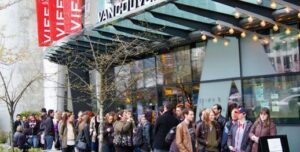
Each VIFF screening will have three separate queues: a pass-holder line (for those with passes hanging around their necks), a ticket-holders line (for those with tickets in hand) and a rush line. Standby tickets, for screenings that are sold out, go on sale 10 minutes before showtime, at full price.

Stand in the wrong line at your peril. (There will be signage, and helpful VIFF volunteers in VIFF T-shirts, if you’re confused.)

Can I bring my lunch?

Technically, no; VIFF venues do not allow outside food. Theoretically, yes, if you’re discreet about it. (Or just eat while waiting in line.)

Can I save a seat for a friend?

If you’re saving a seat at a sold-out screening, you might be asked to relinquish it if your friend is late, so tell them not to be.

What about bus routes and parking?

Translink / Coast Mountain buses are the best way to get around, although most of the venues are within walking distance of one another. Skytrain will whisk you to The Rio in no time flat. There’s parking at Cineplex International Village, but you’re going to want to check in with Festival staff (they’ll be wearing bright yellow VIFF T-shirts) to register your vehicle.

What about crowds?

There will be crowds, particularly at the better-known films; not a lot you can do about that. Maybe you’ll meet somebody nice in line; it happens often. Weekday screenings generally have shorter lines, particularly for less well-known films.