Category Archives: News

#BCPOLI | Two Months Out from British Columbia’s 43rd Provincial Election

Two months from today, at 9pm on the chilly mid-autumn evening of Saturday, October 19th, British Columbians will be apprised of who will form government in the coming four years, from November 2024 through October 2028.
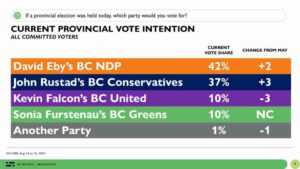
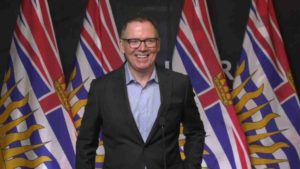
According to David Coletto’s August 16th Abacus poll, David Eby’s BC NDP maintain a comfortable 5-point lead over John Rustad’s novice BC Conservative Party. BC United leader Kevin Falcon and BC Greens leader Sonia Furstenau remain in the also ran category, with no hope of forming government post October 19th.

VanRamblings has been told that Quitto Maggi will release his latest Mainstreet poll later this week, weighing in on British Columbia’s provincial election, following an in-the-field survey of 2000+ prospective voters across the province.

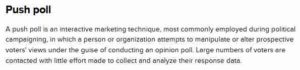
Mainstreet gives John Rustad’s BC Conservative Party a 5-point lead over David Eby’s BC NDP — which reads to VanRamblings as more of a push poll, commissioned by the BC Conservative Party and designed to influence prospective voters still sitting on the fence as to who they will cast a ballot for this upcoming October.
Back to David Coletto’s, more credible, Abacus August 16th poll.
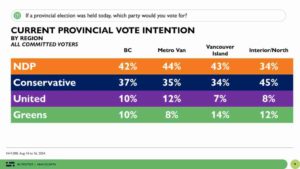
According to Mr. Coletto, David Eby’s BC NDP maintain an even more comfortable 9-point lead over John Rustad’s upstart BC Conservative Party in the vote rich Metro Vancouver region out to Chilliwack, where there are 52-seats up for grabs, which will constitute 58% of the 93 seats in the next session of the British Columbia Legislature.

Further, David Eby’s BC NDP maintains an almost insurmountable lead of nine points over John Rustad’s woefully unprepared BC Conservative Party across the entirety of Vancouver Island, where 17 seats are up for grabs, all but two of which are currently held by BC NDP incumbents.

VanRamblings has been told the BC Conservatives are polling better north of Nanaimo, and could very well pick up Courtenay-Comox and the North Island.
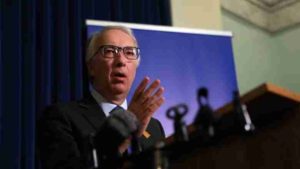

John Rustad, leader of the upstart British Columbia Conservative Party, which is currently polling well.

Although John Rustad’s BC Conservative Party holds an 11-point lead over David Eby’s BC NDP outside of the Lower Mainland — in the Okanagan, the Interior and in the North —  there are only 24 seats that the BC Conservatives could possibly win. Nathan Cullen, currently the wildly popular BC NDP Member of the Legislative Assembly representing the Stikine, and current Minister of Water, Land and Resource Stewardship and Minister Responsible for Fisheries in David Eby’s BC NDP government hardly constitutes a winning seat up north for the BC Conservative Party, so John Rustad would likely be denied a sweep of the ridings outside of Metro Vancouver.
All is not lost for John Rustad and the BC Conservative Party, though, which VanRamblings will write about later in the week.


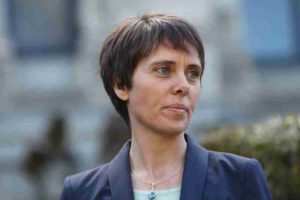
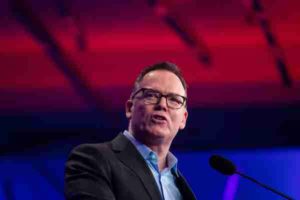
Kevin Falcon, the beleaguered leader (at least for now) of the down in the dumps BC United Party.

Apropos of nothing in particular, VanRamblings has also been told by a generally reliable source that BC United leader Kevin Falcon will tender his resignation as party leader later this week or early next week, and most certainly before month’s end.

We don’t find the information respecting Mr. Falcon’s pending, apparent, resignation to be credible. In tomorrow’s VanRamblings, we’ll express why, while going into some detail as to why we believe Mr. Falcon is not faring better in the lead-up to the 43rd BC provincial election.
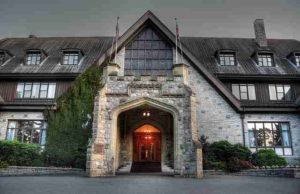

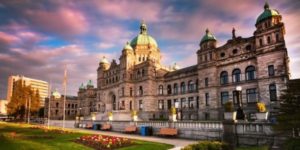
Government House, home of BC Lieutenant Governor Janet Austin, where Premier David Eby will visit   September 14 to ask Ms. Austin to dissolve the Legislature and call for B.C.’s  43rd provincial election.

As we wrote last week, the Writ will be dropped on Sunday, September 14th, at which point what is sure to be an uncommonly “pointed” (read: vicious and unsettling) 35-day election cycle will commence, with the four main British Columbia political parties fighting hammer and tong for victory, whatever the nature of that “victory” might mean— for BC United, survival and six seats would suffice to keep the party alive, as would be the case with the BC Greens, who would be thrilled were they to secure two seats in the next session of the Legislature.
#BCElection | Who Will Form Government Post October 19? | Who Knows?


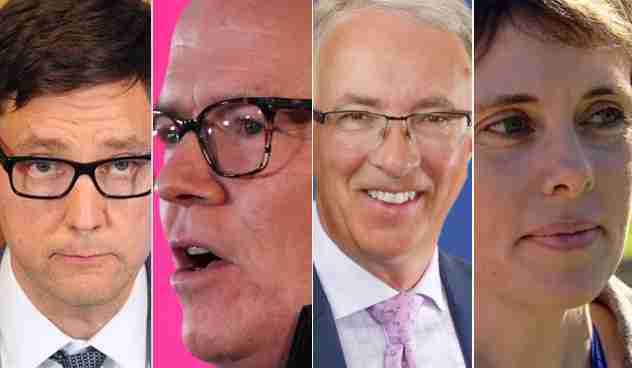
L-r, Premier David Eby;  Kevin Falcon, BC United; John Rustad, BC Conservatives; Sonia Furstenau, Green Party BC

One month from today, on Saturday, September 14th, Premier David Eby will visit the Lieutenant Governor, the Honourable Janet Austin, and ask her to dissolve the Legislature and arrange for a Saturday, October 19th B.C. provincial election.

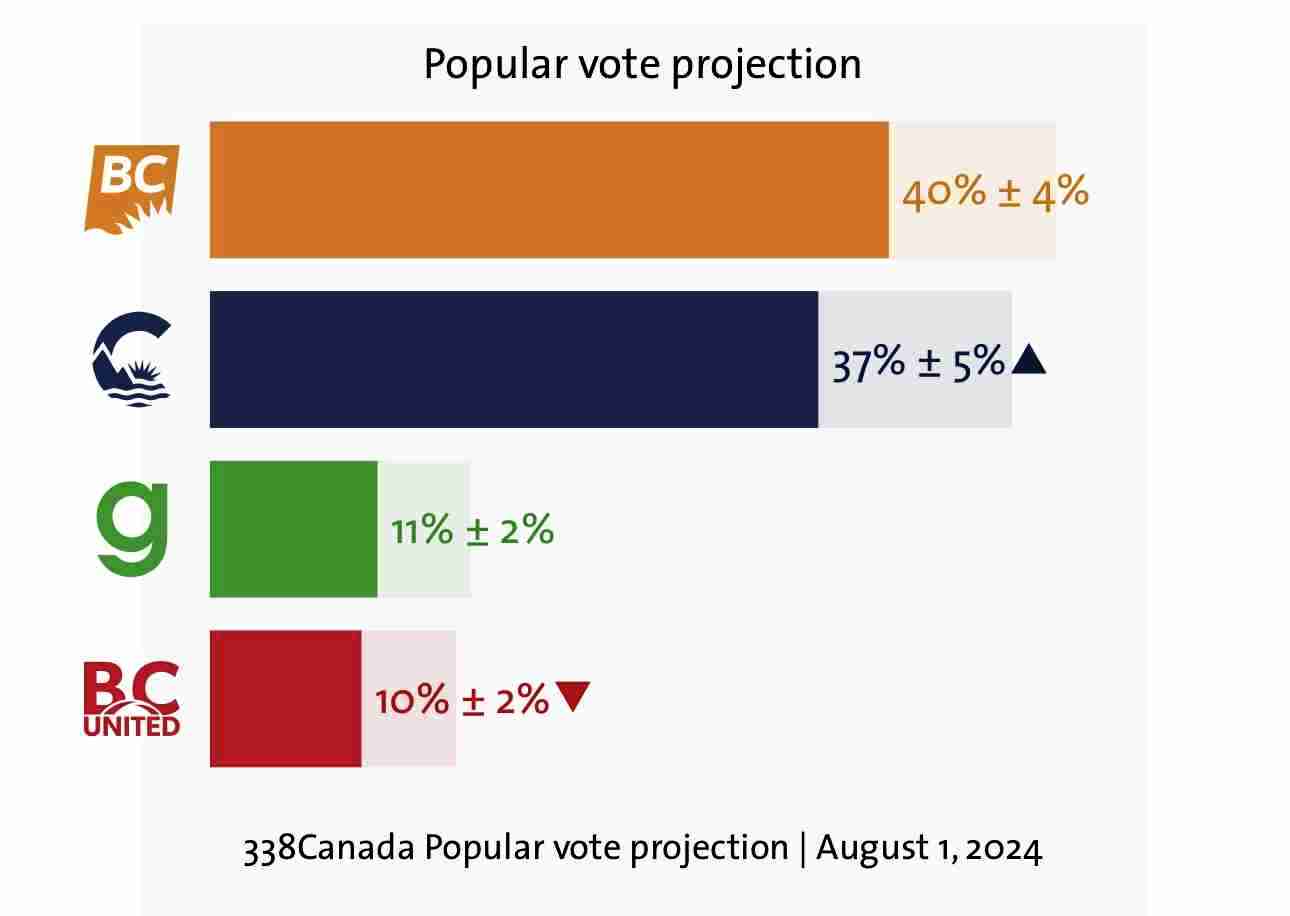
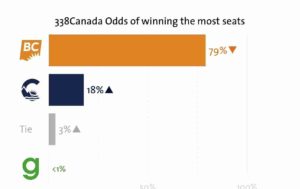
The latest compilation poll from 338.com has David Eby’s BC NDP, and John Rustad’s surging BC Conservatives in a statistical dead heat.

Of course, we’re still 67 days away — which is to say, a lifetime in politics — from knowing the outcome of the October 19th B.C. provincial election. All indications at this point suggest the coming election will be hard fought, the results close.

Unless …


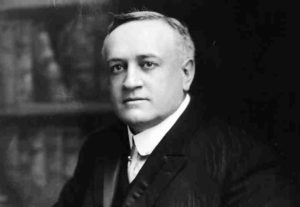
William John Bowser, the 17th Premier of British Columbia & last elected Conservative Party Premier

The BC Conservatives sweep the election, riding on the popularity coattails of federal Conservative Party leader, Pierre Poilievre, causing not just a wave election, but a tsunami of support for novice party leader John Rustad, resulting in a Conservative Party of British Columbia forming majority government in the province for the first time since 1915, when William John Bowser swept to power for a near one-year period, from December 15, 1915 to November 23, 1916.


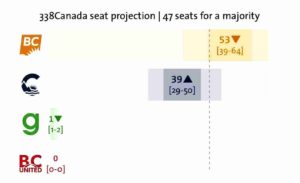
Here’s the bottom line: the coming election will be hard fought, it’ll be a tight race for government between David Eby’s well-funded BC NDP, and the B.C. Conservatives (now, surprisingly) well-organized campaign, the latter about which we will write next week.

Chances are that Kevin Falcon’s B.C. United will be all but wiped out, although some polls have B.C. United winning as many as six seats.

As for the Green Party: leader Sonia Furstenau is running in the riding of Victoria Beacon Hill, currently held by Grace Lore, Minister of Children and Family Development, the riding held by former BC NDP leader Carole James from 2005 through 2021, when Ms. James resigned from government for health reasons.

We predict Sonia Furstenau will lose in Victoria Beacon Hill. Well-respected B.C. Green Party incumbent Adam Olsen has indicated he will not run for re-election.

The B.C. Green Party post October 19th could be no more. Sad. But there it is.

Over the course of the next month, we’ll cover the coming B.C. election’s pre-Writ period — for instance, we intend to write about the closely fought races that will occur in the new provincial ridings of Vancouver-Yaletown, and Vancouver-Little Mountain — while delving into Vancouver municipal politics and the sorry state of Ken Sim’s ABC Vancouver civic party, what’s going on federally with Justin Trudeau’s beleaguered federal Liberal Party, and Pierre Poilievre’s ‘certain to form government’ post the 2025 federal election Conservative Party (we’re not a big fan), while addressing any number of other topics which catch our fancy.

Want to know what’s going on in federal politics? You’ll want to watch …

See you here tomorrow, and often we hope after that, and for the next 67+ days …

Vancouver Broadway Plan, and Its Impact on the Kitsilano Neighbourhood

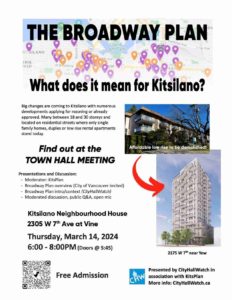
This past Thursday evening, in an event sponsored by CityHallWatch — the online activist civic affairs journal — in a crowded, overflow event held at Kitsilano Neighbourhood House, a broad spectrum of speakers addressed the Broadway Plan — an extensive development plan for the future of Vancouver’s Broadway corridor, a growth plan that envisions an additional 50,000 residents who will take up residence along the corridor from Clark to Arbutus streets, between 1st and 16th avenues — and the implications of the Plan on the Kitsilano neighbourhood.


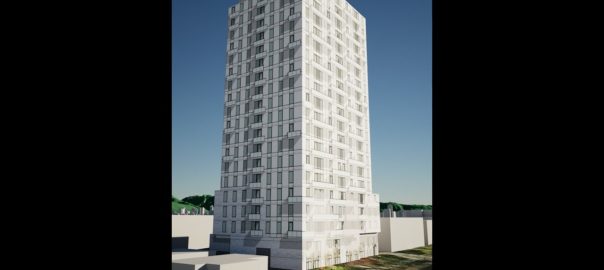
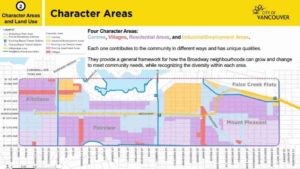
The Broadway Plan will provide a framework for the types of buildings, with towers between 20 to 40 storeys allowed in the light blue ‘centres’. The graphic above was supplied by the City of Vancouver.

The evening was MC’d by Larry Benge, a co-founder and co-Chairperson of the Coalition of Vancouver Neighbourhoods — an alliance of more than 20 community and residents’ associations, who have long sought and continue to seek a respectful relationship between the powers that be at City Hall,  and the 23 neighbourhood communities that comprise and are at the heart of the City of Vancouver.


Video | Vancouver’s Broadway Plan: What does it mean for Kitsilano? Townhall Meeting March 14, 2024

Well-informed, respected and accomplished speakers at Town Hall included …

    • Brian Palmquist, a Vancouver-based architect, and publisher of the ‘you must subscribe to’ City Conversations substack, an in-depth journal that provides detailed coverage of development in the City of Vancouver, and its implications for the health, safety and well-being of those of us who reside in the city;
    • Arny Wise, an urban planner, retired developer, and mediator of municipal housing disputes in Vancouver;
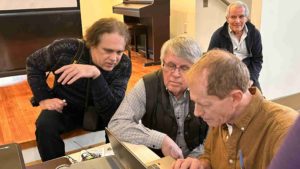
      In front, l-r: Stephen Bohus, Brian Palmquist, Randy Helten. In behind: Arny Wise.
    • Michael Geller, an urban planner, real estate consultant and property developer, who serves on the adjunct faculty of Simon Fraser University’s Centre for Sustainable Development and School of Resource and Environmental Management. His blog may be found at gellersworldtravel.blogspot.ca;
    • Scot Hein, a retired senior urban designer employed by the City of Vancouver for more than 30 years, and at present an Adjunct Professor in the Master of Urban Design Programme at UBC where he works with his colleague …
    • Patrick Condon, the James Taylor chair in Landscape and Livable Environments at the University of British Columbia’s School of Architecture and Landscape Architecture, and the founding chair of the UBC Urban Design programme.

    In addition to those named above, during the question, answer and commentary portion of the meeting, former Vancouver City Councillor Colleen Hardwick spoke about the lack of civic democracy, while an architect present with his family in attendance spoke of the work of an old Simon Fraser University pal of VanRamblings, the University of Victoria’s Robert Gifford, a Professor of Psychology and Environmental Studies, who in his paper titled The Consequences of Living in High-Rise Buildings [PDF], writes …

    “… high-rises are less satisfactory than other housing forms for most people, are sub-optimal environments to raise children, social relations within high-rise towers tends to be more impersonal and less than satisfactory than is the case with more ground-oriented housing forms, there is an increased incidence of crime and fear of crime among those who reside in high-rise developments, social cohesion is more difficult and substantively less present in tower developments, while independent studies have found that tower high-rise living may well be a strong contributory and determinative factor that can lead to an increased incidence of suicidal ideation and actual suicide among residents who live in concrete, steel and glass tower constructed buildings.”


    The future of the Kitsilano neighbourhood along the West Broadway / West 4th Avenue corridors

The thrust of Arny Wise’s address to those gathered at the Kitsilano Neighbourhood House Town Hall was that the advent of environmentally unsound steel, concrete and glass towers to increase density in the Kitsilano neighbourhood is simply not an optimal form of development to achieve the density desired by planners at Vancouver City Hall.

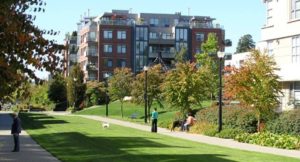
Scot Hein made reference to the Arbutus Walk neighbourhood, west of Arbutus Street and West 12th Avenue that, originally, was presented by the Molson-Carling developers and planners back in the day at Vancouver City Hall as three 50-storey concrete and steel towers — a development which the neighbourhood residents very much objected to — that under Mr. Hein’s watch was transformed into a neighbourhood-friendly and livable townhouse, 3-5-and-10 storey condominium and affordable housing development, with a walkable green space centering the development, and a 10-storey housing co-op established in the northwest corner.

It should be noted in passing that the final Arbutus Walk neighbourhood achieved much higher densification, overall, than would have been the case had the originally planned three 50-storey podium and tower development gone forward.


Two final notes for today (there’s more coming tomorrow) …

As UBC’s Patrick Condon pointed out at meetings’ end …

“Vancouver has tripled the number of housing units in our city since the 1970s, more than any other urban centre on the continent, certainly a laudable and unprecedented development feat, far outstripping the number of developments elsewhere. Yet, if supply is “the answer”, why is it that even with a 300% increase in development in Vancouver, we have the poorest supply of affordable housing for residents, the highest land prices, the highest rents of any jurisdiction across the continent, and the most expensive condominiums? Supply, alone, is not the answer.”

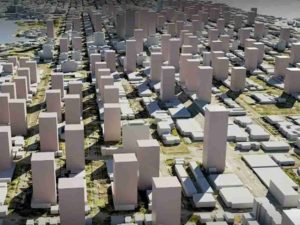
And, finally, on a somewhat hopeful note: both Arny Wise and Brian Palmquist pointed out during their presentations that the Planning, Urban Design and Sustainability Department at City Hall has had a change of heart respecting tower development along the Broadway corridor. No longer will citizens face the prospect of dark corridors lined with towers on either side of arterial streets.


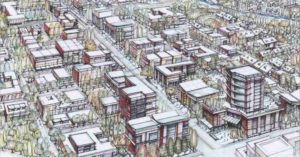
Sensitive Urban Infill Charette Report City of Surrey. Drawing: Neda Roohnia, Landscape / Urban Design

Rather, arterial streets like the Broadway corridor will allow six storey developments, while the allowable 20-to-40-storey tower developments will be situated one block behind either side of the arterial street, so as “to prevent shadowing” and obviate the dark arterial corridor residents have made known in no uncertain terms to Vancouver City Hall that, that under no circumstance they want or desire.

Arterial streets must remain walkable, and neighbourhood friendly.

Not good news, of course, for those residents who live along the tree-lined streets, off Broadway (9th Avenue), along West 10th and West 8th Avenues.

But there you have it, for what it’s worth. As we say above, more tomorrow.

Grifters, The Mirror World, The Far Right & Late Stage Conspiracy Capitalism


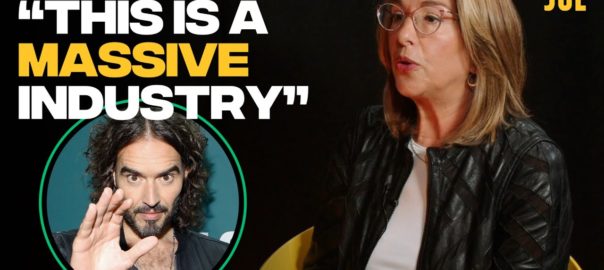
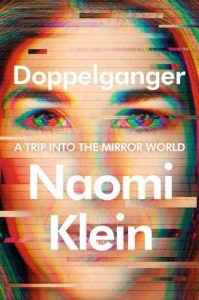
UBC professor Naomi Klein: revered academic, author, social activist and filmmaker in a wide-ranging conversation, talks with PoliticsJoe’s Oli Dugmore about her 2023 book Doppelganger, A Trip Into the Mirror World, diving into the industry of conspiracy theory & right-wing propaganda in the digital age.

In the video above, University of British Columbia Associate Professor Naomi Klein — whose work within the university’s Department of Geography focuses on the intersection of crisis and political transformation, and the large-scale shocks which follow — sits down with Oli Dugmore, PoliticsJoe’s Head of Politics and News for a wide-ranging, insightful and subtly exploratory conversation on “truth” in politics.


In large measure, moreso than in Klein’s well-received previous books —  1990’s No Logo, 2007’s The Shock Doctrine, and 2017’s This Changes Everything, to name just three — Doppelganger, A Trip Into the Mirror World offers more of a first-person memoir,  the book an in-depth critique and analysis of late-stage capitalism.


Down the Rabbit Hole Equation, How The Right Has Gained a Foothold Among So Many of Our Friends

Narcissism [grandiosity] x social media addiction + mid-life crisis ÷ public shaming = right wing meltdown.


Don’t be put off by the high falutin’ words above. Naomi Klein is a wonderfully engaging and entirely human scale —  and dare we say, vulnerable — interview subject, whose life is not too dissimilar to yours or mine, believe it or not. Ms. Klein puts on no airs as she helps us understand where we stand as a society in the early part of the 21st century, what bedevils us, the lies which have taken in too many among us, and the threat of the far right to our increasingly fragile democracy.

For VanRamblings, the most distressing aspect of the first half of the interview above arises from the discussion Mr. Dugmore and Ms. Klein have on the attacks, the unrelenting casual cruelty to which Ms. Klein is subject — and has been subject for a very long time — from those on the right, as well as the left, as if offering an opinion, and verifiable truths, somehow translates into committing a crime, leaving Ms. Klein open to death threats and other challenges to her personal safety.

Call us naïve, but VanRamblings has never understood the motivation of those who choose cruelty over kindness as a way of bringing themselves to the world, who choose to attack over finding common cause, and acknowledging our common humanity, and our innate oneness. We find the cruelty to which Ms. Klein is subject to be disturbing, abhorrent and utterly unbecoming in a civil society.


As Angela Y. Davis, author of Freedom Is a Constant Struggle writes “Doppelganger swirls through the bewildering ideas of the ultra-right that often appear as a distorted mirror of left struggle and strategy,” as Klein’s book sets about to distill the political economies of corruption, crisis in our time, and necessary remediation.

Why Doppelganger? You’ll have to listen to the interview, or buy the book for the answer to that pungent, provocative, easily answered and heartrending question.