Tag Archives: new york film festival

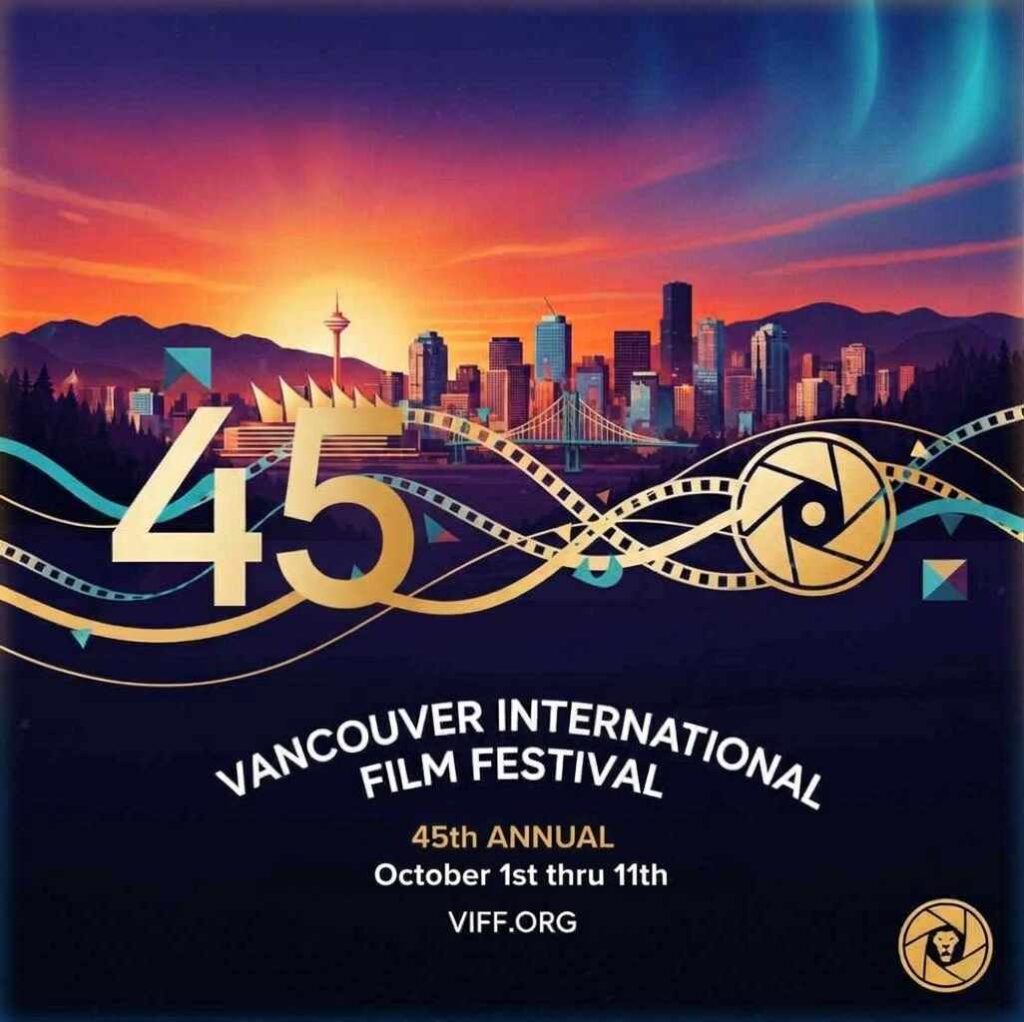
#VIFF45: A Festival to Remember — The Films, the Discoveries, and the Magic of Cinema

A three-part VanRamblings wrap-up of the 45th Vancouver International Film Festival | October 1–11, 2026

Part One: A Final Weekend Worth Celebrating
There is something gloriously bittersweet about the final weekend of the Vancouver International Film Festival. For 10 days, Vancouver’s moviegoing community has been living inside a world of discovery, moving from one cinema to another, comparing notes over coffee, arguing about performances, falling hopelessly in love with films we could never have anticipated, and wondering how on earth we are going to fit just one more screening into an already impossibly crowded schedule.

And then, suddenly, the end is in sight.

The 45th annual Vancouver International Film Festival has given Vancouver audiences an embarrassment of cinematic riches, with films arriving from Cannes, Berlin, Venice, Telluride, Toronto and the New York Film Festival. The final weekend offers one last opportunity to catch some of the year’s most accomplished international films, several of which have already become personal favourites here at VanRamblings.

Friday, October 9, begins with a particularly tantalizing double bill at the Park Theatre. At 6:15 p.m., Japanese master Hirokazu Kore-eda’s Look Back offers another opportunity to experience the director’s extraordinary gift for finding tenderness in the everyday. Kore-eda has spent a career exploring the fragile bonds between parents and children, the families we inherit and the families we create. Here, he turns his attention to youth and the nature of storytelling, bringing his customary grace and emotional intelligence to a film that understands how imagination can transform the lives of young people. His work has a way of making the apparently ordinary feel quietly miraculous.

The Friday double bill continues with James Gray’s Paper Tiger, which has attracted considerable attention on the festival circuit. The intimate crime drama features Adam Driver, Scarlett Johansson and Miles Teller, three performers whose contrasting screen personas promise a compelling study in loyalty, ambition and the dangerous entanglements of criminal life. Gray is a filmmaker fascinated by family, betrayal and the moral compromises people make in pursuit of security. With a cast of this calibre, Paper Tiger is a particularly enticing prospect.

The final weekend also brings a remarkable collection of films shared with the prestigious New York Film Festival. Friday’s offerings include Once Upon a Time in Harlem and 9 Temples to Heaven at Fifth Avenue, with Marine Atlan’s La Gradiva at International Village 9 at 8 p.m. and Andrey Zvyagintsev’s Minotaur at the Lindsay Family Stage on Granville Island at 8:30 p.m. For festivalgoers who relish the experience of discovering a film before it reaches a wider audience, these screenings are precisely what VIFF is all about.

And then there is Lukas Dhont’s Coward, VanRamblings’ favourite film at VIFF 45, screening Friday evening at the Park Theatre. The Belgian filmmaker’s First World War drama, whose stars Emmanuel Macchia and Valentin Campagne shared the Best Actor prize at Cannes, is a work of breathtaking emotional delicacy. More about that extraordinary film in Part Two of VanRamblings final column on VIFF 45.

At 9 p.m. Friday, the Vancouver Playhouse welcomes La Bola Negra, Javier Calvo and Javier Ambrossi’s ambitious historical melodrama, which won the Audience Award at this year’s Toronto International Film Festival. Moving between 1932, 1937 and 2017, the film interweaves the lives of three gay protagonists, giving a traditional historical epic a thrillingly contemporary queer sensibility. The filmmakers also shared the Best Director prize at Cannes. It is precisely the sort of ambitious, emotionally expansive storytelling that makes international cinema so rewarding.

Saturday, October 10, brings another remarkable sequence of screenings. At 11 a.m., The Only Living Pickpocket in New York opens the day’s programme at the Vancouver Playhouse. At 1:45 p.m., Ryûsuke Hamaguchi’s All of a Sudden, Japan’s Oscar submission, offers a quietly expansive meditation on human connection. Making his French-language debut, Hamaguchi explores the fragile structures that bind us to one another, with luminous, Cannes-recognized performances from Virginie Efira and Tao Okamoto. This is cinema that understands the expressive power of conversation, observation and silence.

The evening’s centrepiece is Martin McDonagh’s Wild Horse Nine, VIFF’s Closing Gala, at 6:15 p.m. at the Vancouver Playhouse. With John Malkovich leading the cast, the film arrives amid considerable awards-season anticipation. McDonagh’s gift for combining dark humour, moral unease and unpredictable human behaviour makes this a fittingly provocative way to approach the festival’s conclusion.

And for those determined to make the absolute most of Saturday, there is a 9:15 p.m. screening of NAZA at the Park Theatre. Directed by Yuval Abraham and Rachel Szor, the investigative documentary examines Israeli military targeting practices in Gaza through interviews with military insiders. The title refers to a reported intelligence euphemism for anticipated civilian deaths in airstrikes. Produced by Jonathan Glazer and James Wilson, the team behind The Zone of Interest, NAZA has become one of the festival’s most controversial and politically urgent films. Its filmmakers argue that the systems used to calculate civilian casualties reveal a devastating process of dehumanization; its claims and implications have provoked fierce debate. The film received the Special Jury Prize at Venice. Whatever one’s response, this is documentary filmmaking that insists audiences confront uncomfortable questions about technology, accountability and the human cost of war.

Sunday, October 11, is the final day of VIFF 45, and the schedule is hardly a gentle winding-down. La Gradiva returns at the Lindsay Family Stage, while Everytime screens at Fifth Avenue. Mina Shum’s Whatcha Want brings a distinctly Vancouver perspective to the final day’s offerings at the Rio Theatre at 3:30 p.m. Meanwhile, Minotaur, Zvyagintsev’s Grand Prix winner at Cannes, offers another opportunity to experience the work of a formidable contemporary filmmaker.

At the Park Theatre, Mike Leigh’s Tender Loving Care screens at 6 p.m., followed by Pedro Almodóvar’s Bitter Christmas at 9:15 p.m. And at 6:15 p.m., the Rio Theatre screens I Play Rocky, one of VanRamblings’ other personal favourites of the festival.

The beauty of VIFF, of course, is that the festival’s final screening need not be the final opportunity to see a film. Programmer Tom Charity and the VIFF Centre regularly help bring festival discoveries back to Vancouver audiences, while other titles secure conventional theatrical engagements across Metro Vancouver. It is worth keeping an eye on the VIFF Centre’s subsequent programming rather than assuming that missing a festival screening means missing a film forever.

But first, there are two films that deserve a special place in this year’s festival conversation.

Coward: Lukas Dhont’s Most Beautiful Film Yet

VanRamblings’ favourite film of VIFF 45 | Directed by Lukas Dhont | Belgium, France, Netherlands

Some films move you. Others quietly rearrange the furniture of your heart. And then there is Lukas Dhont’s Coward, an achingly beautiful, tenderly observed, emotionally transporting work of cinema that left VanRamblings with the extraordinary conviction that we had just encountered one of the finest films of the year — of any year.

At the 79th Cannes Film Festival, Dhont’s First World War drama earned the Best Actor prize for its remarkable young stars, Emmanuel Macchia and Valentin Campagne. Their performances are the beating heart of a film that could easily have succumbed to the familiar conventions of the tragic queer period drama, yet instead finds something infinitely more generous, more courageous and ultimately more life-affirming.

Set amid the brutal realities of the Belgian trenches, Coward introduces us to Pierre (Macchia), a young soldier arriving at the front eager to prove himself in a world in which courage is measured in blood, obedience and the willingness to march towards almost certain death. But Pierre’s understanding of the world begins to change when he meets Francis (Campagne), a fellow soldier with an unexpected idea: to stage a theatrical performance for their comrades.

It is an audacious proposal in a place where imagination might seem like an unaffordable luxury. Yet the makeshift theatre becomes something extraordinary — a sanctuary of beauty, laughter and human connection amid the machinery of destruction. And between Pierre and Francis, something tender and transformative begins to emerge.

Dhont, whose Girl and Close established him as one of contemporary cinema’s most sensitive observers of adolescent vulnerability, has made his most mature film to date. Here, his storytelling possesses an emotional restraint that makes every fleeting glance, every tentative touch and every moment of physical closeness feel almost unbearably precious.

The chemistry between Macchia and Campagne is simply magnificent. Dhont has a tactile, compassionate understanding of how men — queer men especially — watch other men, the way attraction and affection can reveal themselves in a look held a second too long, or in a gesture whose significance cannot safely be spoken aloud. Coward is, by turns, breathtakingly violent and sweetly, shiveringly sensual. Its most intimate moments feel less like conventional romantic scenes than like the discovery of an entirely new language.

And what a relief it is that Dhont refuses to drown that love in tragedy.

Unlike so many period tales of forbidden queer affection, Coward is not interested in dripping its canvas in despair. Dhont wants to leave us with a glimmer of hope. Actually, more than a glimmer: a wry smile of anticipation, a suggestion that all is not lost, that love can find a way even when the world seems determined to extinguish it.

This is a recuperation of queer representation as resilient and hopeful. Happiness — or, perhaps more importantly, contentment — is possible when we seek it and seize it. That assertion feels quietly radical in a film set amid the carnage of the First World War, where tenderness itself becomes an act of resistance.

Dhont does not minimize the horror surrounding his characters. Rather, he understands that the existence of beauty in terrible circumstances does not diminish suffering; it makes the preservation of our humanity all the more urgent. The theatre they create becomes an emblem of what art can accomplish when the world has seemingly abandoned its obligations to the living.

There is something almost miraculous about the film’s tonal balance. The violence is genuinely frightening, the romance achingly delicate, the humour unexpectedly liberating. Dhont allows the film to breathe, trusting his actors and the emotional intelligence of his audience. He never insists that we feel something when a glance or a silence can accomplish so much more.

And when Coward reaches its final passages, its hopefulness feels neither sentimental nor cheaply won. It emerges from everything these men have endured, from the risks they have taken and from the simple, extraordinary recognition that another person can make a life worth living.

This is sensitive storytelling at its most affecting: sweetly played, elegantly mounted, reaching towards hope not in light of war’s horrors, but in spite of them.

For VanRamblings, Coward is the film of VIFF 45. It is a reminder that cinema’s greatest achievement is not always to break our hearts.

Sometimes, it is to show us how beautifully they can mend.

VanRamblings Grade: A+


Fatherland: A Haunted Masterpiece of Memory and Exile

VanRamblings feels strongly Fatherland is the best film to screen at VIFF 45, one of the best films of the year | Directed by Paweł Pawlikowski | Poland, Germany, Italy, France

If Coward is the film that most tenderly captured VanRamblings heart at VIFF 45, Paweł Pawlikowski’s Fatherland is the film that most completely convinced us of cinema’s extraordinary power to transform history into poetry.

Pawlikowski, the modern master behind Ida and Cold War, has fashioned another immaculate black-and-white work of European cinema, an 82-minute elegy of such precision, intelligence and emotional depth that its brevity feels almost audacious.

Winner of the Best Director prize at Cannes, Fatherland is a gorgeous, gripping drama whose resonance extends far beyond its carefully chosen postwar setting.

The film centres on Nobel Prize-winning writer Thomas Mann (Hanns Zischler) and his daughter Erika (Sandra Hüller), the actress, writer and rally driver. In the summer of 1949, sixteen years after fleeing Nazi Germany for the safety of the United States, Mann returns to his native country. Accompanied by Erika, he embarks on an emotionally fraught road trip in a black Buick, traveling from American-controlled Frankfurt to Soviet-controlled Weimar through a Germany devastated by war and divided by ideology.

It is a journey across a shattered nation, but also across the wreckage of a family.

Pawlikowski understands that the aftermath of catastrophe is not merely a matter of rebuilding cities or redrawing borders. It is also about confronting the moral compromises of the past, the things people did, the things they failed to do, and the stories they tell themselves to make those failures bearable.

Mann is a towering literary figure, a man whose opposition to Hitler forced him into exile. Yet the film is not content to celebrate the Nobel laureate as a convenient moral monument. His relationship with Erika reveals a more complicated figure, a father whose public stature and intellectual authority cannot protect him from the consequences of private shortcomings.

Hüller, one of contemporary cinema’s most compelling actors, is extraordinary as Erika. Her performance is a study in intelligence, resentment, wit and barely contained pain. She gives the film its emotional counterweight, suggesting a lifetime of accumulated disappointment beneath the surface of an apparently formidable woman. Zischler is equally compelling, creating a Mann whose authority is unmistakable but whose capacity for self-understanding remains uncertain.

The relationship between them is the film’s beating heart. Every exchange seems to carry the weight of conversations that have never taken place, apologies never offered, affection expressed too late or withheld altogether.

Shot by cinematographer Łukasz Żal in exquisitely chiselled monochrome, Fatherland is a visual marvel. The landscape passes through the car windows like a wounded memory, the ruins and the uneasy coexistence of two political systems rendering history tangible. Pawlikowski’s compositions are austere but never sterile; his camera finds beauty in the contours of a devastated landscape without ever pretending that beauty can erase what happened there.

As the journey progresses eastwards, the film becomes increasingly preoccupied with grief and the responsibility of the artist. What does it mean to create art in the aftermath of catastrophe? Can intellectual achievement compensate for emotional failure? And what obligation does a celebrated writer have to the people closest to him, rather than to the abstract ideals he represents?

These questions converge in a beautiful, sad epiphany, delivered with the divine economy that distinguishes Pawlikowski’s finest work.

There are moments when Fatherland feels chilly, even deliberately withholding. But that restraint is part of its achievement. Pawlikowski trusts us to recognize what remains unspoken, to find the sorrow in a pause, the tenderness in an awkward gesture, the devastation in an exchange that appears almost incidental.

The result is a film of haunted, ravaged beauty. Its mournful meditation on national identity, private tragedy and the dangers of trying to remain apolitical in deeply political times speaks directly to our own fractured moment. The cultural riches that survive catastrophe offer no easy redemption, but they can provide small, crucial forms of solace.

Fatherland is an elegant, engrossing masterpiece, an extraordinarily economical film that leaves behind an emotional echo far greater than its running time might suggest.

If VIFF 45 has offered a reminder of why we go to the movies, Pawlikowski’s film supplies one of the most compelling answers: to experience the past not as a distant abstraction, but as a living, breathing presence in the room.

This is a gorgeous poem of a film, and, for VanRamblings, the best film to screen at this year’s festival.

VanRamblings Grade: A+


Part Three: The Movies, the Memories, and the Promise of What’s Next

What, then, has VIFF 45 achieved?

First, it has reminded us that the Vancouver International Film Festival remains one of this city’s most important cultural institutions. For eleven days, it has created a space in which audiences can encounter stories beyond their own experience, discover filmmakers they might otherwise never have encountered, and engage with works that challenge, provoke, entertain and occasionally change the way we see the world.

Second, this year’s festival has offered compelling evidence that 2026 may be one of the strongest years for cinema in a decade, both domestically and internationally.

From the moral complexities of Cristian Mungiu’s Fjord to the exquisite emotional restraint of Coward, from Pawlikowski’s haunted Fatherland to the imaginative daring of films arriving from Japan, Spain and elsewhere, the year’s finest work has demonstrated that ambitious filmmaking is alive and flourishing. Cannes’ awards have been especially revealing, recognizing films that are artistically adventurous while remaining profoundly attentive to the human condition.

And what a year for Canadian cinema, too. Mina Shum’s Whatcha Want is a welcome reminder of the importance of Vancouver filmmakers telling stories that emerge from the communities they know, while the festival’s wider Canadian programme has offered audiences opportunities to encounter the country’s extraordinary range of voices and perspectives. A healthy film culture depends not simply on importing the world’s best work, but on creating the conditions in which our own filmmakers can flourish.

There is, of course, a practical challenge awaiting us after the closing credits roll. How do we sustain the excitement? How do we ensure that these films find audiences beyond the festival’s eleven-day window?

The work of VIFF Centre programmer Tom Charity, and the subsequent theatrical engagements that some festival titles will secure across Metro Vancouver, is essential. A festival should be a beginning, not an ending. The conversation that starts in a crowded cinema ought to continue over dinner, in the pages of publications such as VanRamblings, and in the choices we make when deciding what to watch next.

Most importantly, VIFF reminds us that watching movies together is an act of community. We sit in the darkness beside strangers, laughing at the same unexpected joke, holding our breath through the same moment of suspense, or emerging into the Vancouver night with tears in our eyes and the sudden urge to talk to someone about what we have just experienced. For a few precious hours, another person’s story becomes part of our own.

That is the enduring magic of cinema. It allows us to inhabit lives we have never lived, to recognize ourselves in people whose circumstances are utterly unlike our own, and to discover that tenderness, courage, grief, longing and hope are not the possessions of any one nation or culture. They belong to all of us.

As VIFF 45 draws to a close, VanRamblings find ourselves thinking again about Coward, about those young soldiers who discover a measure of beauty in a world consumed by violence, and about Fatherland, with its wounded landscapes and its insistence that the past must be confronted if we are to make sense of the present. These films are very different, yet both understand that art can preserve something precious when the world seems determined to destroy it.

And perhaps that is the most hopeful thing we can take away from this year’s festival.

In a time of political division, technological upheaval and genuine uncertainty about the future, filmmakers continue to make works of astonishing beauty, intelligence and compassion. Audiences continue to seek them out. Cinemas continue to fill with people willing to give themselves over to a story.

For eleven days, Vancouver has been a city of movie lovers, united by curiosity and the shared pleasure of discovery. The festival ends, but the films remain with us, becoming part of our private histories, our conversations and our understanding of one another.

Here’s to VIFF 46. Here’s to the filmmakers who will surprise us, the performances that will break our hearts, and the stories that will remind us what we share.

And here’s to the simple, extraordinary miracle of sitting in a darkened cinema, surrounded by strangers, and discovering that, for a little while, we are all watching the world together.
#VIFF45 | #NYFF65 | When New York Comes to Vancouver For 11 Days

There is a certain romance to New York in the fall.

The leaves begin to turn. The evenings come earlier. The city seems to acquire an extra layer of electricity. Manhattan becomes, for a few glorious weeks, the cinematic capital of the world as filmmakers, critics, actors, programmers, cineastes and assorted movie obsessives descend upon Lincoln Center for the New York Film Festival.

And then there is Vancouver.

Which, if you are lucky enough to be here during the Vancouver International Film Festival, is not such a bad place to be.

In fact, this year, it may be one of the best places in the world.

For 45 years — essentially from the beginning of VIFF in 1981 — Vancouver and New York have shared films, creating an extraordinary transcontinental cinematic conversation. The relationship was once considerably more complicated than it is today. In the 1990s, when movies arrived in enormous metal film cans, a shared NYFF/VIFF title could become a logistical ballet worthy of its own documentary.

A film might screen in New York on Sunday evening. Almost before the audience had left the theatre, its precious reels would be hustled away for shipment north. Victoria Shipping, then deeply involved in distributing film cans to cinemas throughout British Columbia, would get the reels moving toward Vancouver. By Monday evening, the same movie might be flickering on a VIFF screen.

And then, remarkably, the process would reverse.

The reels would be rushed back to New York for a Tuesday screening.

For VIFF staffers such as the late Cathy Evans and Selina Crammond —the latter who would later become director of Vancouver’s DOXA Documentary Film Festival — this was not romantic at all. It was a logistical nightmare.

Today, thankfully, the movies travel rather more elegantly.

The film can has largely disappeared, replaced by the Digital Cinema Package — those encrypted files residing on a CRU hard drive — and, increasingly, by the instantaneous movement of cinema through high-speed fibre or satellite transmission.

But something more important has remained.

The connection.

And this year, the connection is extraordinary.

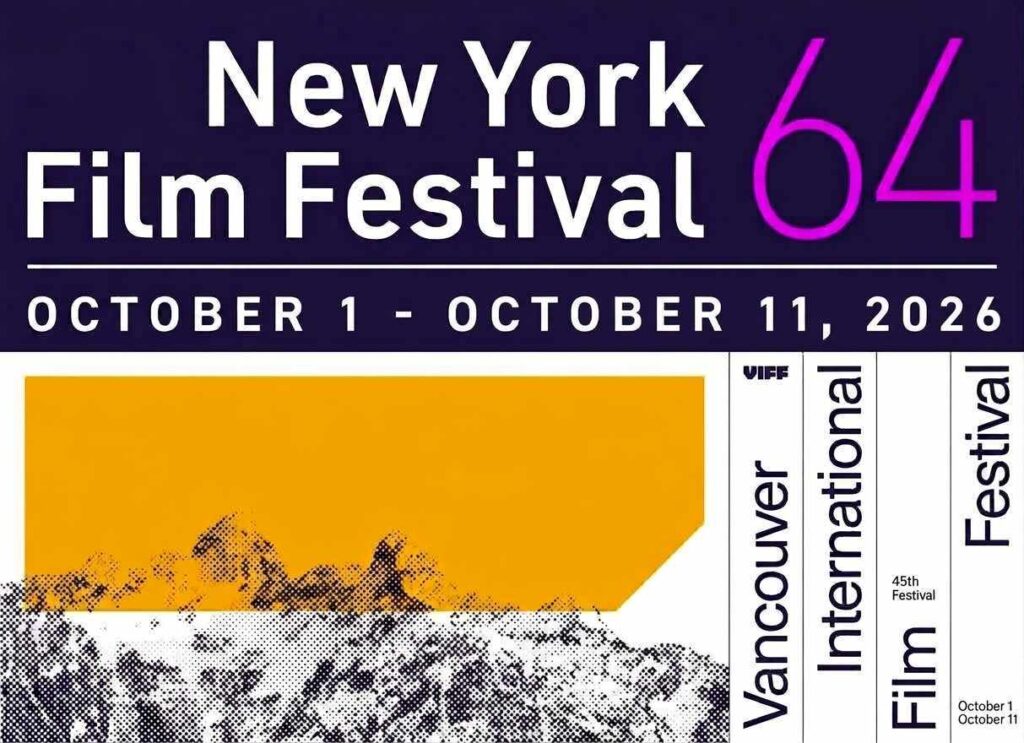
A small correction before we begin: the 2026 New York Film Festival is the 64th edition, not the 65th; VIFF 2026 is indeed celebrating its 45th anniversary edition. And what a 45th it is. New York and Vancouver are sharing 23 films, an unusually rich cross-border exchange that makes VIFF 45 feel, in a very real sense, like a West Coast extension of the great New York cinematic conversation.

So, cinéastes of Vancouver, take note.

You don’t have to fly to New York.

This year, New York is coming to you.

THE LONELIEST MAN IN TOWN

Tizza Covi and Rainer Frimmel’s quietly devastating portrait of Austrian blues musician Al Cook is one of those films that seems to have wandered into the festival from another, more tactile age of cinema. Cook, playing a fictionalized version of himself, faces eviction from the apartment that has become an archive of his life — VHS tapes, records, photographs, newspapers, memories. The filmmakers turn the threatened demolition of a building into something larger: a meditation on disappearing cultures, ageing and the terrifying realization that the physical world we knew is being erased around us. The film won the Giuseppe Becce Award and a Special Mention from the Guild of German Arthouse Cinemas at Berlin.

PAPER TIGER

James Gray returns to New York — his spiritual home as a filmmaker — with an atmospheric crime drama starring Adam Driver, Miles Teller and Scarlett Johansson. Set in 1986 Queens and Brooklyn, it begins with an apparently ordinary middle-class family becoming entangled with Russian criminals through an ill-advised business scheme. But Gray, as always, is less interested in crime than in family, loyalty, ambition and the terrible consequences of wanting a better life. NYFF chose it as its Opening Night film, and the festival calls it a “brilliant New York thriller.” Vancouver gets to see why.

ALL OF A SUDDEN

Ryûsuke Hamaguchi, the Oscar-winning director of Drive My Car, has made a 196-minute film about care, mortality, friendship and the strange intimacy that develops between people who might otherwise never have met. Virginie Efira and Tao Okamoto shared the Best Actress prize at Cannes, playing an eldercare director and a terminally ill Japanese playwright. Hamaguchi’s great gift is making conversation feel like action and silence feel like dialogue. All of a Sudden is patient, humane and quietly immense — exactly the kind of film for which festivals were invented.

BEHEMOTH!

Tony Gilroy, director of Michael Clayton and creator of Andor, steps away from political espionage for a surprisingly personal drama about music. Pedro Pascal plays Alex, a brilliant cellist whose career and personal life have come apart, forcing him back toward family, memory and the unfinished business of his past. NYFF selected Behemoth! as its Centerpiece and describes Pascal’s performance as the best of his career. The film’s nine-composer musical collective gives the picture an unusually rich sonic architecture. It is a movie about music that understands something crucial: sometimes the score isn’t accompanying the emotion. The score is the emotion.

MINOTAUR

Andrey Zvyagintsev’s return is one of the major events of the festival year. The Russian master — now living in exile — won the Grand Prix at Cannes for this dark, mordantly funny tale of corruption, patriarchy and political power. Set in Russia in 2022, Minotaur follows a wealthy businessman whose suspicion that his wife is having an affair collides with an increasingly ominous political reality. Zvyagintsev invokes Claude Chabrol, but the film’s moral atmosphere is unmistakably his own: chilly, elegant, furious. After Leviathan and Loveless, this is another devastating anatomy of a society eating itself alive.

EVERYTIME

Sandra Wollner’s Everytime won the Un Certain Regard Prize at Cannes, and it is one of those films whose description cannot prepare you for its emotional effect. Following a mother, younger daughter and boyfriend after a shocking accident, Wollner creates a suspended world in which grief seems to dissolve the boundaries between memory, reality and dream. The film eventually travels to Tenerife, where the past and present become almost indistinguishable. Gregory Oke’s cinematography is breathtaking, but the real achievement is tonal: Everytime feels like grief itself — beautiful, disorienting, tender and impossible to escape.

POSSIBLE LOVE

Lee Chang-dong’s first film since Burning is already one of the year’s essential Korean films. Two couples from radically different economic circumstances become connected when a wealthy documentary filmmaker turns her camera toward a working-class couple whose lives have been shattered by a factory layoff. The result is part relationship drama, part class critique, part inquiry into the ethics of documentary filmmaking. It won the Silver Lion at Venice and is South Korea’s submission for the 2027 Academy Awards. Lee has always understood that social inequality becomes most powerful when it enters the bedroom, the dining room and the intimate spaces of ordinary lives.

CLUB KID

Jordan Firstman’s feature début is one of the year’s great surprises: a wildly funny, sometimes outrageous New York comedy that gradually reveals a surprisingly tender heart. Firstman plays Peter, a washed-up thirtysomething club promoter whose hedonistic existence is interrupted by the arrival of the 10-year-old son he never knew he had. Suddenly, the professional party boy is responsible for another human being. NYFF calls it “wildly funny and remarkably assured,” and that seems exactly right. Club Kid begins as satire and ends somewhere much more affecting: as a story about the possibility that growing up can happen very, very late.

FATHERLAND

Paweł Pawlikowski’s Fatherland is one of those films that makes black-and-white cinematography feel less like a stylistic choice than a moral necessity. Set in 1949, it follows Nobel laureate Thomas Mann and his daughter Erika traveling through a Germany still physically and morally shattered by the war. Sandra Hüller is extraordinary as Erika, simultaneously daughter, conscience and prosecutor. Pawlikowski won Best Director at Cannes, while Łukasz Żal’s austere images recall Ida and Cold War. Poland’s Oscar submission, Fatherland is a miniature — just 82 minutes — that somehow contains an entire country’s struggle with memory and guilt.

DAO

Alain Gomis’ Dao is cinema as ritual. Two ceremonies — a mourning gathering in Guinea-Bissau and a wedding in Paris — become intertwined in a formally adventurous film that moves between documentary and fiction, memory and performance, grief and celebration. Gomis’ camera observes Black French women speaking about identity and history before plunging us into ceremonies where life and death, tradition and modernity, performance and reality become inseparable. At 192 minutes, Dao asks for patience, but rewards it with something increasingly rare: the sensation of discovering a cinematic language rather than merely watching a movie.

ONCE UPON A TIME IN HARLEM

This may be the most precious piece of cinema in the entire 23-film exchange. In 1972, legendary filmmaker William Greaves assembled luminaries of the Harlem Renaissance at Duke Ellington’s townhouse and filmed their extraordinary conversation. More than half a century later, his son David Greaves has transformed that footage into a living archive of Black American intellectual and artistic life. The film has already won the Library of Congress Lavine/Ken Burns Prize for Film, worth $200,000. It is not simply a documentary. It is time travel — an invitation to sit in a room with people history has taught us to revere.

ROSE

Sandra Hüller is having one of those years actors dream about. In Rose, she plays a 17th-century woman who disguises herself as a male soldier after the Thirty Years’ War and attempts to build an entirely new life. Markus Schleinzer’s austere, beautifully composed historical fable won Hüller the Silver Bear for Best Leading Performance at Berlin and became Austria’s Oscar submission. The film is about gender, faith and intolerance, but also about the intoxicating possibility of becoming someone society has told you that you cannot be. Hüller gives the role an extraordinary mixture of severity, vulnerability and defiance.

CLARISSA

Virginia Woolf’s Mrs. Dalloway travels to contemporary Nigeria in this ambitious, tender adaptation from twin filmmakers Arie and Chuko Esiri. Sophie Okonedo plays Clarissa, preparing for an elaborate party while memories of old loves and unresolved emotions rise to the surface. The parallel story of a traumatized soldier brings Woolf’s exploration of interiority into the contemporary realities of Nigeria. It is an audacious transplantation: rather than treating Woolf as sacred literary property, the Esiris discover the universality underneath the geography. The result is intimate, political and unexpectedly moving.

FJORD

Cristian Mungiu has done it again. The Romanian master won his second Palme d’Or at Cannes for this searing drama about a Romanian family who immigrates to Norway and finds itself under suspicion after an allegation of child abuse. Sebastian Stan and Renate Reinsve give performances of remarkable restraint as parents trapped between cultures, religious belief and the increasingly judgmental gaze of their adopted community. Mungiu refuses easy answers. What begins as a question of parental responsibility becomes a much more disturbing examination of prejudice, cultural difference and the moment when care becomes control. This is precisely the kind of morally uncomfortable cinema that stays with you long after the lights come up.

THE DREAMED ADVENTURE

Valeska Grisebach’s The Dreamed Adventure won the Jury Prize at Cannes and begins like one kind of film before quietly becoming another. An archaeologist returns to a Bulgarian border town searching for a vanished former lover. Gradually, the story slides into the territory of crime, masculinity and violence. Grisebach’s great achievement is the way she combines vérité observation with genre filmmaking. Like her acclaimed Western, the movie understands that borders are never simply geographical. They are emotional, cultural and psychological. At 170 minutes, it is deliberately immersive — a film that asks you to cross the border with it.

TENDER LOVING CARE

Mike Leigh may be approaching the end of his extraordinary filmmaking career, but Tender Loving Care suggests that his gaze remains as humane and penetrating as ever. Set in post-Brexit England, the film follows social workers Amy and Rosie as they struggle to care for people abandoned by increasingly fragile institutions. Leigh avoids easy political preaching, instead constructing a mosaic of lives — funny, desperate, stubborn, loving. The performances are superb, the humour wonderfully dry, and the compassion never sentimental. It is, perhaps, a fitting film for a filmmaker who has spent decades insisting that ordinary people are every bit as worthy of our attention as kings, politicians and movie stars.

BITTER CHRISTMAS

Pedro Almodóvar turns the cinema of autofiction inside out in Bitter Christmas, a deliciously complicated hall of mirrors about artists stealing from life — and then discovering that life may have been stealing from them all along. Bárbara Lennie and Leonardo Sbaraglia play filmmakers whose work becomes increasingly entangled with the lives of their friends and collaborators. The result is simultaneously comedy, melodrama, self-parody and confession. NYFF describes it as a meditation on the artist’s relationship with fiction and reality; VIFF calls it a “mischievously meta mea culpa.” Both are right. Almodóvar has spent five decades turning emotional chaos into cinematic colour, and he remains magnificently himself.

THE ONLY LIVING PICKPOCKET IN NEW YORK

There could scarcely be a more New York movie in this collection. John Turturro plays Harry Lehman, an ageing Bronx pickpocket whose profession has become almost obsolete in a cashless, digital city. When a theft goes wrong, Harry finds himself racing through the boroughs trying to repair the damage. Noah Segan’s film is both crime story and elegy — for an older New York, an older kind of movie and an older kind of human connection. NYFF calls it an “elegant love letter to New York.” RogerEbert.com calls it a film attempting to conjure the spirit of an era. It succeeds beautifully.

THE DEBUT

Jesse Eisenberg’s The Debut — VIFF 45’s Opening Gala — gives Julianne Moore the kind of role actors live for. She plays Mona, an overlooked middle-aged housewife who impulsively auditions for a community musical and finds herself transformed by the stage. Paul Giamatti plays the theatre director who may be mentor, bully, genius or all three. Eisenberg walks a remarkable line between satire and genuine affection, skewering community theatre while celebrating the strange liberation that can happen when ordinary people suddenly find themselves illuminated by a spotlight. The result is funny, uncomfortable, unexpectedly moving — and a terrific way to open a festival.

NOWHERE TO LAY MY EYES

Hong Sangsoo’s 35th feature is another of those deceptively simple films in which almost nothing happens — and everything happens. A filmmaker returns to Jeju Island to visit her estranged mother, encountering a new stepfamily and the uncomfortable emotional geography of old wounds. Hong’s stripped-down visual style allows the smallest shifts in conversation to become revelations. The film won Best Direction at Locarno, while Kim Min-hee took the festival’s Best Performance prize. At only 72 minutes, it is a miniature Hong Sangsoo masterpiece: awkward, funny, melancholy and quietly profound.

9 TEMPLES TO HEAVEN

Sompot Chidgasornpongse’s feature début takes a simple premise and turns it into a spiritual road movie. After a fortune teller warns that his elderly mother may soon die, Sakol gathers his family and sets out on a pilgrimage to nine Buddhist temples in a single day. The film combines family squabbling, Thai architecture, ritual and mortality with the patient observational style associated with the filmmaker’s mentor, Apichatpong Weerasethakul. Selected for Cannes’ Directors’ Fortnight and Thailand’s Oscar submission, it is less a conventional narrative than a journey into the sacred and the everyday. A film about death that is, paradoxically, deeply alive.

THE DIARY OF A CHAMBERMAID

Radu Jude’s modern reimagining of Octave Mirbeau’s The Diary of a Chambermaid is quintessential Jude: political, mischievous, self-aware and quietly furious. Ana Dumitrașcu plays Gianina, a young Romanian woman working for a wealthy French family while yearning to return to her daughter in Romania. The great twist is that Gianina is also rehearsing the role of a chambermaid in an amateur theatrical adaptation of the very novel whose world she inhabits. Jude turns class resentment into comedy, then lets the comedy curdle. With a 94% critics’ score on Rotten Tomatoes, it is among his more warmly received recent films.

LA GRADIVA

Marine Atlan’s feature debut is one of the great discoveries of Cannes 2026. A school trip takes a group of French teenagers to Naples and Pompeii, where the ancient landscape becomes the backdrop for a contemporary eruption of desire, jealousy, class anxiety and adolescent cruelty. Atlan, working as her own cinematographer, won the Grand Prize at Critics’ Week, and the film’s precision is astonishing. Every glance, gesture and silence seems deliberately placed. What begins as a school trip becomes something closer to a coming-of-age fever dream, in which the ruins of Pompeii become a metaphor for young people discovering that desire can be as dangerous as Vesuvius.


TWO CITIES. ONE CINEMA.

There is something wonderfully old-fashioned about this relationship between New York and Vancouver.

Before streaming. Before the infinite libraries of films available at the touch of a button. Before a movie could cross an ocean without anybody physically touching a film can. There was simply the movie, the screen, the audience — and the people desperately trying to get the movie from one city to another.

New York would see something first.

Vancouver would wait.

Then the reels would arrive, battered and precious, carrying with them the faint romance of another city: Manhattan streets after midnight, Lincoln Center reflected in rain, the conversations in Greenwich Village cafés, the arguments among critics outside a theatre, the whispered conviction that this movie — this particular movie — might be the one everyone remembers.

And now, 45 years after VIFF began, the miracle is that we don’t need to cross the continent to experience that feeling.

The cinema comes here.

It arrives at the Vancouver Playhouse, the Park, the Rio, International Village, the Fifth Avenue, SFU Woodwards, the VIFF Centre. It arrives in the darkness, carried not in steel canisters but in streams of data, transformed once again by the oldest technology of all: a room full of strangers staring together at a rectangle of light.

That is the real romance of VIFF.

New York may have the skyline.

It may have Lincoln Center.

It may have the autumn leaves and the taxis and the midnight screenings and the feeling that somewhere around the corner, Martin Scorsese or Paul Schrader or some impossibly elegant European filmmaker might be sitting at the next table.

But Vancouver has the mountains.

Vancouver has the rain.

And, for eleven days in October, Vancouver has New York.

More precisely, it has the cinema that New York has chosen to embrace.

Twenty-three films crossing the continent. Twenty-three little acts of cinematic diplomacy. Twenty-three reminders that movies have always been travelers, moving from country to country, festival to festival, audience to audience — carrying stories with them like passports.

Once upon a time, those stories traveled in film cans.

Today they travel through fibre-optic cables.

But when the lights go down, nothing has really changed.

There is still a screen.

There is still darkness.

There is still the extraordinary hush that falls over an audience just before the first image appears.

And somewhere, thousands of kilometres away, another audience may be watching the very same image.

New York.

Vancouver.

Two cities separated by a continent, joined by a beam of light.

And for a few glorious weeks each autumn, if you listen carefully enough, you can almost hear Manhattan breathing through the speakers of a Vancouver cinema.

You don’t have to go to New York.

New York has already come to you.


#VIFF2024 | The 62nd Annual New York Film Festival Comes to Town

Each year, the prestigious, heavily-juried and world class New York Film Festival unspools the films in the festival’s Main Slate , at the same time as occurs each year at our homegrown and raucously dynamic Vancouver International Film Festival.

In 2024, VIFF43 shares 13 films on the NYFF62 Main Slate, which is what we will write about today on VanRamblings. Can’t afford the flight to the Big Apple? No problem. The Vancouver International Film Festival brings New York to you.

Here, then, are the 13 films Vancouver and New York share in 2024.
(Click/tap, on the underlined  titles to access the VIFF page for the film, to buy tickets if you wish)

  • Payal Kapadia
  • 2024
  • France/India/Netherlands/Luxembourg
  • 118 minutes
  • Malayalam and Hindi with English subtitles

The light, the lives, and the textures of contemporary, working-class Mumbai are explored and celebrated with a vivid, humane richness by Payal Kapadia, who won the Grand Prize at this year’s Cannes Film Festival for her revelatory fiction feature début about three working-class women dealing with professional and romantic disruptions.

Showtimes

Saturday, September 28th
9:30 PM
Vancouver Playhouse

Tuesday, October 1st
3:00 PM
Vancouver Playhouse

Anora

  • Sean Baker
  • 2024
  • U.S
  • 138 minutes

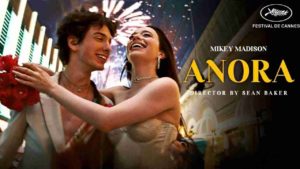
Sean Baker’s screwball comedy about sex, love, and money stars Mikey Madison as an exotic dancer from Brighton Beach thrust into the lap of luxury when she’s whisked away on a whirlwind romance with a wealthy young customer. Winner of the Palme d’Or at Cannes Film this year.


Showtimes

Friday, September 27
8:45 PM
Vancouver Playhouse

Tuesday, October 1st
9:15 PM
Vancouver Playhouse

Caught by the Tides

  • Jia Zhangke
  • 2024
  • China
  • 111 minutes
  • Mandarin Chinese with English subtitles

The pre-eminent dramatist of China’s rapid 21st-century growth and social transformation, Jia Zhangke has taken his boldest approach to narrative yet with Caught by the Tides, assembled from footage shot over a span of 23 years. The always captivating Zhao Tao carries this marvelous film about cinema’s ability to capture the passage of time and the persistence of change.

Showtimes

Saturday, September 28th
1:00 PM
International Village, Cinema 10

Sunday, September 29th
8:45 PM
Fifth Avenue, Cinema 3

Thursday, October 3rd
2:30 PM
Vancouver Playhouse

Saturday, September 29th
8:45 PM
SFU Woodwards

Saturday, October 5th
3:45 PM
Vancouver Playhouse

Saturday, October 5th
8:30 PM
International Village 10

Sunday, October 6th
1:00 PM
Fifth Avenue, Cinema 3

Here are the 8 other NYFF62 films that will screen at VIFF43 …

  • Grand Tour | Monday, September 30th | 2:45 PM | Vancouver Playhouse

  • On Becoming a Guinea Fowl | October 1sts | 9:15 PM | Int. Village, Cin 9 | |
    October 6th | 6:30 PM | Vancity Theatre, VIFF Centre

  • Happyend | September 28 | 3 PM | Vancouver Playhouse | |
    October 3rd | 9 PM | Fifth Avenue, Cinema 3

  • Misericordia | September 27th | 8:45 PM | International Village, Cin 9 | |
    September  30th | 3:30 PM | SFU Woodwards

  • No Other Land | September 28th | 3:30 PM | SFU Woodwards | |
    October 1st | 6:30  PM | Fifth Avenue, Cinema 3

  • Pepe | September 28th | 4 PM | Vancity Theatre, VIFF Centre | |
    October 2nd | 6:15 PM | The Cinematheque

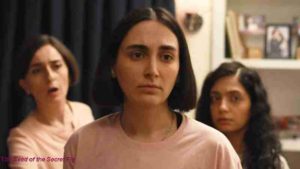
  • The Seed of the Secret Fig | October 3rd | 8:45 PM | Vancouver Playhouse | |
    October 5th | 6:30 PM | SFU Woodwards | |
    October 6th | 12:00 PM | SFU Woodwards

  • A Traveler’s Needs | October 5th | 6:15 PM | SFU Woodwards | |
    October 6th | 2:30 PM | Vancouver Playhouse

VIFF 2021 | NYFF59 and VIFF2021 Share 17 Films

As has long been the case, the prestigious, oh-so-heavily juried and highly and lovingly curated New York Film Festival, and our local, homegrown Vancouver International Film Festival share many films, as is the case once again this year.

Today on VanRamblings, our annual virtual visit to the Big Apple / Gotham City, and the very fine New York Film Festival.

Here are the 17 films the NYFF59 and VIFF40 share in 2021 … enjoy!