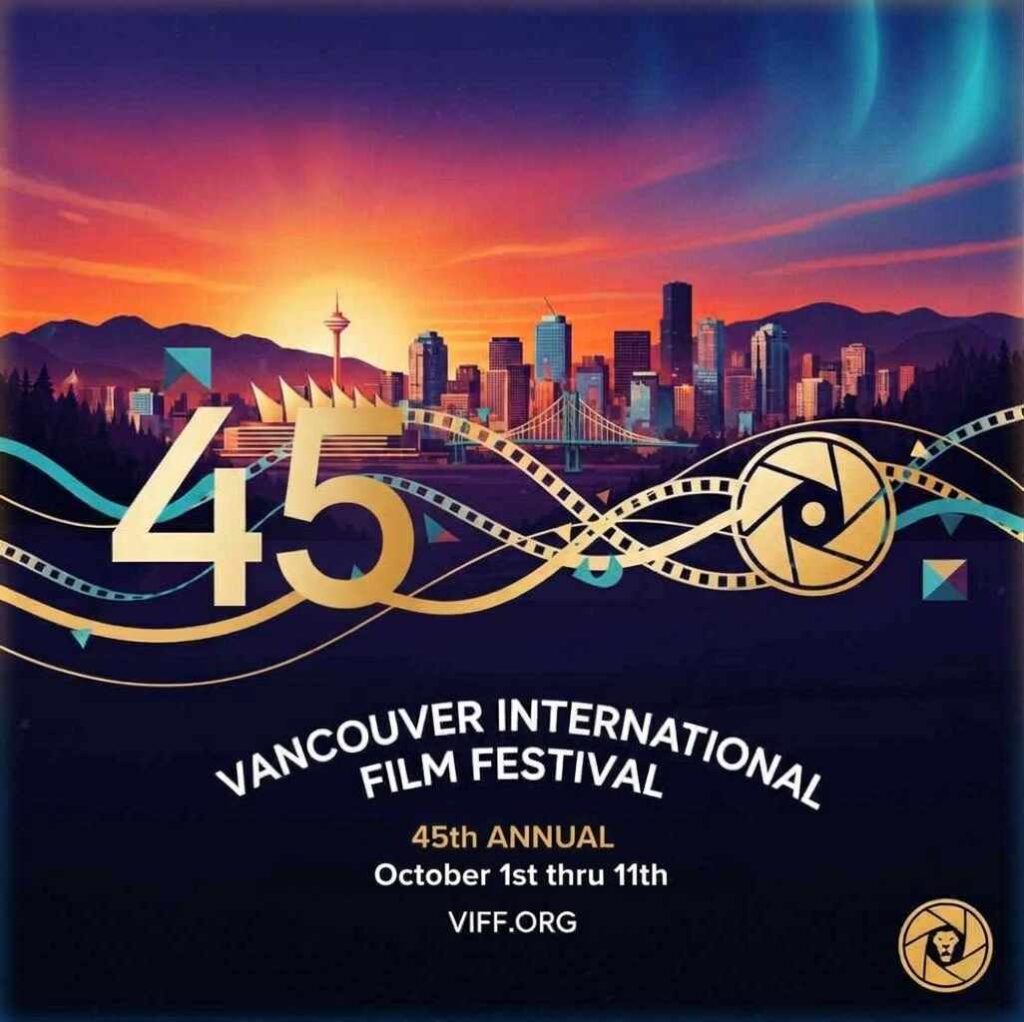
A three-part VanRamblings wrap-up of the 45th Vancouver International Film Festival | October 1–11, 2026
Part One: A Final Weekend Worth Celebrating
There is something gloriously bittersweet about the final weekend of the Vancouver International Film Festival. For 10 days, Vancouver’s moviegoing community has been living inside a world of discovery, moving from one cinema to another, comparing notes over coffee, arguing about performances, falling hopelessly in love with films we could never have anticipated, and wondering how on earth we are going to fit just one more screening into an already impossibly crowded schedule.
And then, suddenly, the end is in sight.
The 45th annual Vancouver International Film Festival has given Vancouver audiences an embarrassment of cinematic riches, with films arriving from Cannes, Berlin, Venice, Telluride, Toronto and the New York Film Festival. The final weekend offers one last opportunity to catch some of the year’s most accomplished international films, several of which have already become personal favourites here at VanRamblings.
Friday, October 9, begins with a particularly tantalizing double bill at the Park Theatre. At 6:15 p.m., Japanese master Hirokazu Kore-eda’s Look Back offers another opportunity to experience the director’s extraordinary gift for finding tenderness in the everyday. Kore-eda has spent a career exploring the fragile bonds between parents and children, the families we inherit and the families we create. Here, he turns his attention to youth and the nature of storytelling, bringing his customary grace and emotional intelligence to a film that understands how imagination can transform the lives of young people. His work has a way of making the apparently ordinary feel quietly miraculous.
The Friday double bill continues with James Gray’s Paper Tiger, which has attracted considerable attention on the festival circuit. The intimate crime drama features Adam Driver, Scarlett Johansson and Miles Teller, three performers whose contrasting screen personas promise a compelling study in loyalty, ambition and the dangerous entanglements of criminal life. Gray is a filmmaker fascinated by family, betrayal and the moral compromises people make in pursuit of security. With a cast of this calibre, Paper Tiger is a particularly enticing prospect.
The final weekend also brings a remarkable collection of films shared with the prestigious New York Film Festival. Friday’s offerings include Once Upon a Time in Harlem and 9 Temples to Heaven at Fifth Avenue, with Marine Atlan’s La Gradiva at International Village 9 at 8 p.m. and Andrey Zvyagintsev’s Minotaur at the Lindsay Family Stage on Granville Island at 8:30 p.m. For festivalgoers who relish the experience of discovering a film before it reaches a wider audience, these screenings are precisely what VIFF is all about.
And then there is Lukas Dhont’s Coward, VanRamblings’ favourite film at VIFF 45, screening Friday evening at the Park Theatre. The Belgian filmmaker’s First World War drama, whose stars Emmanuel Macchia and Valentin Campagne shared the Best Actor prize at Cannes, is a work of breathtaking emotional delicacy. More about that extraordinary film in Part Two of VanRamblings final column on VIFF 45.
At 9 p.m. Friday, the Vancouver Playhouse welcomes La Bola Negra, Javier Calvo and Javier Ambrossi’s ambitious historical melodrama, which won the Audience Award at this year’s Toronto International Film Festival. Moving between 1932, 1937 and 2017, the film interweaves the lives of three gay protagonists, giving a traditional historical epic a thrillingly contemporary queer sensibility. The filmmakers also shared the Best Director prize at Cannes. It is precisely the sort of ambitious, emotionally expansive storytelling that makes international cinema so rewarding.
Saturday, October 10, brings another remarkable sequence of screenings. At 11 a.m., The Only Living Pickpocket in New York opens the day’s programme at the Vancouver Playhouse. At 1:45 p.m., Ryûsuke Hamaguchi’s All of a Sudden, Japan’s Oscar submission, offers a quietly expansive meditation on human connection. Making his French-language debut, Hamaguchi explores the fragile structures that bind us to one another, with luminous, Cannes-recognized performances from Virginie Efira and Tao Okamoto. This is cinema that understands the expressive power of conversation, observation and silence.
The evening’s centrepiece is Martin McDonagh’s Wild Horse Nine, VIFF’s Closing Gala, at 6:15 p.m. at the Vancouver Playhouse. With John Malkovich leading the cast, the film arrives amid considerable awards-season anticipation. McDonagh’s gift for combining dark humour, moral unease and unpredictable human behaviour makes this a fittingly provocative way to approach the festival’s conclusion.
And for those determined to make the absolute most of Saturday, there is a 9:15 p.m. screening of NAZA at the Park Theatre. Directed by Yuval Abraham and Rachel Szor, the investigative documentary examines Israeli military targeting practices in Gaza through interviews with military insiders. The title refers to a reported intelligence euphemism for anticipated civilian deaths in airstrikes. Produced by Jonathan Glazer and James Wilson, the team behind The Zone of Interest, NAZA has become one of the festival’s most controversial and politically urgent films. Its filmmakers argue that the systems used to calculate civilian casualties reveal a devastating process of dehumanization; its claims and implications have provoked fierce debate. The film received the Special Jury Prize at Venice. Whatever one’s response, this is documentary filmmaking that insists audiences confront uncomfortable questions about technology, accountability and the human cost of war.
Sunday, October 11, is the final day of VIFF 45, and the schedule is hardly a gentle winding-down. La Gradiva returns at the Lindsay Family Stage, while Everytime screens at Fifth Avenue. Mina Shum’s Whatcha Want brings a distinctly Vancouver perspective to the final day’s offerings at the Rio Theatre at 3:30 p.m. Meanwhile, Minotaur, Zvyagintsev’s Grand Prix winner at Cannes, offers another opportunity to experience the work of a formidable contemporary filmmaker.
At the Park Theatre, Mike Leigh’s Tender Loving Care screens at 6 p.m., followed by Pedro Almodóvar’s Bitter Christmas at 9:15 p.m. And at 6:15 p.m., the Rio Theatre screens I Play Rocky, one of VanRamblings’ other personal favourites of the festival.
The beauty of VIFF, of course, is that the festival’s final screening need not be the final opportunity to see a film. Programmer Tom Charity and the VIFF Centre regularly help bring festival discoveries back to Vancouver audiences, while other titles secure conventional theatrical engagements across Metro Vancouver. It is worth keeping an eye on the VIFF Centre’s subsequent programming rather than assuming that missing a festival screening means missing a film forever.
But first, there are two films that deserve a special place in this year’s festival conversation.
Coward: Lukas Dhont’s Most Beautiful Film Yet
VanRamblings’ favourite film of VIFF 45 | Directed by Lukas Dhont | Belgium, France, Netherlands
Some films move you. Others quietly rearrange the furniture of your heart. And then there is Lukas Dhont’s Coward, an achingly beautiful, tenderly observed, emotionally transporting work of cinema that left VanRamblings with the extraordinary conviction that we had just encountered one of the finest films of the year — of any year.
At the 79th Cannes Film Festival, Dhont’s First World War drama earned the Best Actor prize for its remarkable young stars, Emmanuel Macchia and Valentin Campagne. Their performances are the beating heart of a film that could easily have succumbed to the familiar conventions of the tragic queer period drama, yet instead finds something infinitely more generous, more courageous and ultimately more life-affirming.
Set amid the brutal realities of the Belgian trenches, Coward introduces us to Pierre (Macchia), a young soldier arriving at the front eager to prove himself in a world in which courage is measured in blood, obedience and the willingness to march towards almost certain death. But Pierre’s understanding of the world begins to change when he meets Francis (Campagne), a fellow soldier with an unexpected idea: to stage a theatrical performance for their comrades.
It is an audacious proposal in a place where imagination might seem like an unaffordable luxury. Yet the makeshift theatre becomes something extraordinary — a sanctuary of beauty, laughter and human connection amid the machinery of destruction. And between Pierre and Francis, something tender and transformative begins to emerge.
Dhont, whose Girl and Close established him as one of contemporary cinema’s most sensitive observers of adolescent vulnerability, has made his most mature film to date. Here, his storytelling possesses an emotional restraint that makes every fleeting glance, every tentative touch and every moment of physical closeness feel almost unbearably precious.
The chemistry between Macchia and Campagne is simply magnificent. Dhont has a tactile, compassionate understanding of how men — queer men especially — watch other men, the way attraction and affection can reveal themselves in a look held a second too long, or in a gesture whose significance cannot safely be spoken aloud. Coward is, by turns, breathtakingly violent and sweetly, shiveringly sensual. Its most intimate moments feel less like conventional romantic scenes than like the discovery of an entirely new language.
And what a relief it is that Dhont refuses to drown that love in tragedy.
Unlike so many period tales of forbidden queer affection, Coward is not interested in dripping its canvas in despair. Dhont wants to leave us with a glimmer of hope. Actually, more than a glimmer: a wry smile of anticipation, a suggestion that all is not lost, that love can find a way even when the world seems determined to extinguish it.
This is a recuperation of queer representation as resilient and hopeful. Happiness — or, perhaps more importantly, contentment — is possible when we seek it and seize it. That assertion feels quietly radical in a film set amid the carnage of the First World War, where tenderness itself becomes an act of resistance.
Dhont does not minimize the horror surrounding his characters. Rather, he understands that the existence of beauty in terrible circumstances does not diminish suffering; it makes the preservation of our humanity all the more urgent. The theatre they create becomes an emblem of what art can accomplish when the world has seemingly abandoned its obligations to the living.
There is something almost miraculous about the film’s tonal balance. The violence is genuinely frightening, the romance achingly delicate, the humour unexpectedly liberating. Dhont allows the film to breathe, trusting his actors and the emotional intelligence of his audience. He never insists that we feel something when a glance or a silence can accomplish so much more.
And when Coward reaches its final passages, its hopefulness feels neither sentimental nor cheaply won. It emerges from everything these men have endured, from the risks they have taken and from the simple, extraordinary recognition that another person can make a life worth living.
This is sensitive storytelling at its most affecting: sweetly played, elegantly mounted, reaching towards hope not in light of war’s horrors, but in spite of them.
For VanRamblings, Coward is the film of VIFF 45. It is a reminder that cinema’s greatest achievement is not always to break our hearts.
Sometimes, it is to show us how beautifully they can mend.
VanRamblings Grade: A+
Fatherland: A Haunted Masterpiece of Memory and Exile
VanRamblings feels strongly Fatherland is the best film to screen at VIFF 45, one of the best films of the year | Directed by Paweł Pawlikowski | Poland, Germany, Italy, France
If Coward is the film that most tenderly captured VanRamblings heart at VIFF 45, Paweł Pawlikowski’s Fatherland is the film that most completely convinced us of cinema’s extraordinary power to transform history into poetry.
Pawlikowski, the modern master behind Ida and Cold War, has fashioned another immaculate black-and-white work of European cinema, an 82-minute elegy of such precision, intelligence and emotional depth that its brevity feels almost audacious.
Winner of the Best Director prize at Cannes, Fatherland is a gorgeous, gripping drama whose resonance extends far beyond its carefully chosen postwar setting.
The film centres on Nobel Prize-winning writer Thomas Mann (Hanns Zischler) and his daughter Erika (Sandra Hüller), the actress, writer and rally driver. In the summer of 1949, sixteen years after fleeing Nazi Germany for the safety of the United States, Mann returns to his native country. Accompanied by Erika, he embarks on an emotionally fraught road trip in a black Buick, traveling from American-controlled Frankfurt to Soviet-controlled Weimar through a Germany devastated by war and divided by ideology.
It is a journey across a shattered nation, but also across the wreckage of a family.
Pawlikowski understands that the aftermath of catastrophe is not merely a matter of rebuilding cities or redrawing borders. It is also about confronting the moral compromises of the past, the things people did, the things they failed to do, and the stories they tell themselves to make those failures bearable.
Mann is a towering literary figure, a man whose opposition to Hitler forced him into exile. Yet the film is not content to celebrate the Nobel laureate as a convenient moral monument. His relationship with Erika reveals a more complicated figure, a father whose public stature and intellectual authority cannot protect him from the consequences of private shortcomings.
Hüller, one of contemporary cinema’s most compelling actors, is extraordinary as Erika. Her performance is a study in intelligence, resentment, wit and barely contained pain. She gives the film its emotional counterweight, suggesting a lifetime of accumulated disappointment beneath the surface of an apparently formidable woman. Zischler is equally compelling, creating a Mann whose authority is unmistakable but whose capacity for self-understanding remains uncertain.
The relationship between them is the film’s beating heart. Every exchange seems to carry the weight of conversations that have never taken place, apologies never offered, affection expressed too late or withheld altogether.
Shot by cinematographer Łukasz Żal in exquisitely chiselled monochrome, Fatherland is a visual marvel. The landscape passes through the car windows like a wounded memory, the ruins and the uneasy coexistence of two political systems rendering history tangible. Pawlikowski’s compositions are austere but never sterile; his camera finds beauty in the contours of a devastated landscape without ever pretending that beauty can erase what happened there.
As the journey progresses eastwards, the film becomes increasingly preoccupied with grief and the responsibility of the artist. What does it mean to create art in the aftermath of catastrophe? Can intellectual achievement compensate for emotional failure? And what obligation does a celebrated writer have to the people closest to him, rather than to the abstract ideals he represents?
These questions converge in a beautiful, sad epiphany, delivered with the divine economy that distinguishes Pawlikowski’s finest work.
There are moments when Fatherland feels chilly, even deliberately withholding. But that restraint is part of its achievement. Pawlikowski trusts us to recognize what remains unspoken, to find the sorrow in a pause, the tenderness in an awkward gesture, the devastation in an exchange that appears almost incidental.
The result is a film of haunted, ravaged beauty. Its mournful meditation on national identity, private tragedy and the dangers of trying to remain apolitical in deeply political times speaks directly to our own fractured moment. The cultural riches that survive catastrophe offer no easy redemption, but they can provide small, crucial forms of solace.
Fatherland is an elegant, engrossing masterpiece, an extraordinarily economical film that leaves behind an emotional echo far greater than its running time might suggest.
If VIFF 45 has offered a reminder of why we go to the movies, Pawlikowski’s film supplies one of the most compelling answers: to experience the past not as a distant abstraction, but as a living, breathing presence in the room.
This is a gorgeous poem of a film, and, for VanRamblings, the best film to screen at this year’s festival.
VanRamblings Grade: A+
Part Three: The Movies, the Memories, and the Promise of What’s Next

What, then, has VIFF 45 achieved?
First, it has reminded us that the Vancouver International Film Festival remains one of this city’s most important cultural institutions. For eleven days, it has created a space in which audiences can encounter stories beyond their own experience, discover filmmakers they might otherwise never have encountered, and engage with works that challenge, provoke, entertain and occasionally change the way we see the world.
Second, this year’s festival has offered compelling evidence that 2026 may be one of the strongest years for cinema in a decade, both domestically and internationally.
From the moral complexities of Cristian Mungiu’s Fjord to the exquisite emotional restraint of Coward, from Pawlikowski’s haunted Fatherland to the imaginative daring of films arriving from Japan, Spain and elsewhere, the year’s finest work has demonstrated that ambitious filmmaking is alive and flourishing. Cannes’ awards have been especially revealing, recognizing films that are artistically adventurous while remaining profoundly attentive to the human condition.
And what a year for Canadian cinema, too. Mina Shum’s Whatcha Want is a welcome reminder of the importance of Vancouver filmmakers telling stories that emerge from the communities they know, while the festival’s wider Canadian programme has offered audiences opportunities to encounter the country’s extraordinary range of voices and perspectives. A healthy film culture depends not simply on importing the world’s best work, but on creating the conditions in which our own filmmakers can flourish.
There is, of course, a practical challenge awaiting us after the closing credits roll. How do we sustain the excitement? How do we ensure that these films find audiences beyond the festival’s eleven-day window?
The work of VIFF Centre programmer Tom Charity, and the subsequent theatrical engagements that some festival titles will secure across Metro Vancouver, is essential. A festival should be a beginning, not an ending. The conversation that starts in a crowded cinema ought to continue over dinner, in the pages of publications such as VanRamblings, and in the choices we make when deciding what to watch next.
Most importantly, VIFF reminds us that watching movies together is an act of community. We sit in the darkness beside strangers, laughing at the same unexpected joke, holding our breath through the same moment of suspense, or emerging into the Vancouver night with tears in our eyes and the sudden urge to talk to someone about what we have just experienced. For a few precious hours, another person’s story becomes part of our own.
That is the enduring magic of cinema. It allows us to inhabit lives we have never lived, to recognize ourselves in people whose circumstances are utterly unlike our own, and to discover that tenderness, courage, grief, longing and hope are not the possessions of any one nation or culture. They belong to all of us.
As VIFF 45 draws to a close, VanRamblings find ourselves thinking again about Coward, about those young soldiers who discover a measure of beauty in a world consumed by violence, and about Fatherland, with its wounded landscapes and its insistence that the past must be confronted if we are to make sense of the present. These films are very different, yet both understand that art can preserve something precious when the world seems determined to destroy it.
And perhaps that is the most hopeful thing we can take away from this year’s festival.
In a time of political division, technological upheaval and genuine uncertainty about the future, filmmakers continue to make works of astonishing beauty, intelligence and compassion. Audiences continue to seek them out. Cinemas continue to fill with people willing to give themselves over to a story.
For eleven days, Vancouver has been a city of movie lovers, united by curiosity and the shared pleasure of discovery. The festival ends, but the films remain with us, becoming part of our private histories, our conversations and our understanding of one another.
Here’s to VIFF 46. Here’s to the filmmakers who will surprise us, the performances that will break our hearts, and the stories that will remind us what we share.
And here’s to the simple, extraordinary miracle of sitting in a darkened cinema, surrounded by strangers, and discovering that, for a little while, we are all watching the world together.