Tag Archives: colleen hardwick

Autocracy and the End of Democracy — But Not Yet


Scot Hein, retired senior designer, City of Vancouver. Adjunct Professor, University of British Columbia.

When Scot Hein spoke at last Thursday’s #KitsPlan Town Hall, held at the Kitsilano Neigbourhood House at West 7th and Vine, to discuss the Broadway Plan, and its implications for our beloved Kitsilano neighbourhood, he bemoaned the fact that in recent years citizens throughout Vancouver have been locked out of the decision-making process that affects the communities where they and we live.
Here is what Scot Hein had to say on the matter of civic democracy …

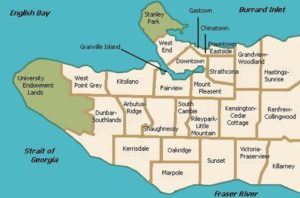
“As little as 15 years ago, the City of Vancouver regularly engaged in a thorough, often years long, one-on-one, in-person consultation process with citizens, when the City worked toward developing community plans for the future of neighbourhoods across the City, be that in the Grandview-Woodlands, Riley Park-Little Mountain, Kensington-Cedar Cottage or Granville-Fairview communities, or any other Vancouver neighbourhood.

In recent years, consultation and community involvement in the development process in the City of Vancouver has devolved into a top down process, where the community is not — or rarely — consulted, but are rather called out to a community meeting, where white boards are placed on walls at a community centre, announcing the planners’ conception for the development future of a neighbourhood, a development fait accompli if you will, sans any meaningful engagement with the community, or citizens who live in one of the twenty-three neighbourhoods that are the heart of Vancouver.”

Sadly, as former Vancouver City Councillor Colleen Hardwick has often averred …

“The members of City Council have often expressed that organizations like the Coalition of Vancouver Neighbourhoods, or the community resident associations who are members of the Coalition, are extra-legal forms of civic governance, unsanctioned and without mandate, that all civic authority autocratically rests solely and unabashedly with the Mayor and 10 City Council members.”


On February 13th, David Eby’s government launched the BC Builds programme to build rental housing for “middle-income earners”, geared towards  those earning between $134,000 and $284,000 annually.

Whether it’s Premier David Eby and his Housing Minister, Ravi Kahlon, or Mayor Ken Sim and the members of Vancouver City Council or, down south, Republican MAGA candidate for President Donald Trump, or in Canada should Conservative Party leader Pierre Poilevre form government following the 2025 federal election, for almost two decades now democracy has been in peril, where high-handed governments impose their will on an increasingly angry and woefully disenfranchised electorate, counterintuitively driving turn out down at the polls during the election period — only 36.3% of eligible Vancouver voters cast a ballot in our City’s 2022 municipal election — as more and more, decision-making is left to the elites.
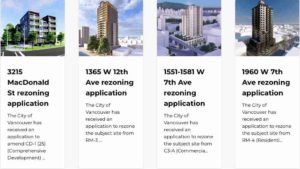
The thrust of last week’s #KitsPlan Town Hall was to reverse the “trend” towards disenfranchisement, for the community to regain its collective power to influence change for the better, for themselves and their families, to demand a voice and input that would be incorporated into civic and provincial affairs decision-making.

While a diverse crowd attended the Town Hall — encompassing a broad cross-section of the Asian and other communities of colour and ethnicities who reside in Kitsilano, with a demographic representation of the parents of young families also voicing their concerns about the tower-driven Broadway Plan, and what it means for the livability of the Kitsilano neighbourhood — many of those in attendance were comprised of members of the seniors community, and were Caucasian.
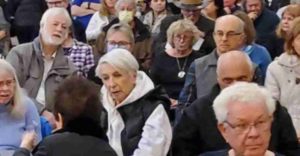

An unrepresentative, selectively misleading photo of #KitsPlan Town Hall attendees, posted on X

The Abundant Housing, in-the-pocket of developers “We’ve never met a tower-driven development we didn’t like” naysayers posting on Elon Musk’s X (formerly Twitter) cesspool were quick to selectively call out the attendees at the Town Hall as “universally white” and old. Of course, that was not the case, as we pointed out.
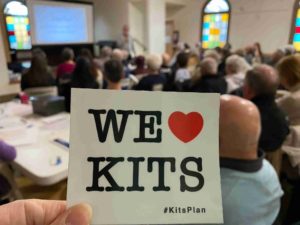
Of course, there was a big online hue and cry that referred to #KitsPlan Town Hall attendees as that most awful of things, a NIMBY (as in Not In My Back Yard). The NIMBY appellation is little more than untoward name-calling and a misrepresentation of the truth. Desiring to maintain a livable community — and an agreed upon and very much desired much more dense community that encompasses a variety of environmentally-sound housing forms — can hardly be called NIMBYism.

You know, too, there was a time in the not-so-distant past when younger members of our community valued those who comprise our seniors community, as elders possessed of wisdom, gained across a lifetime of activist community involvement.

Sadly, no longer it would seem. #FightAgeism and intolerance, VanRamblings says.

In fact, if you were to survey the majority of the seniors who were in attendance at the #KitsPlan Town Hall,  you would more than likely find an engaged population of longtime died-in-the-wool community activists, who throughout their lives have fought for a better, a richer, a more diverse and a more inclusive community, who are in point of fact situated on the progressive side of history, and after a lifetime of fighting for better, are unwilling to allow City Hall to steamroll over them and their families, their neighbours, their colleagues and members of the Kits community.

In the days, weeks, months and years to come, there will be more #KitsPlan Town Halls, next time and beyond — as the movement grows — in increasingly larger venues, as members of the Kitsilano community, in increasing numbers, rally in support of the preservation of Kitsilano as a livable, if increasingly dense, family neighbourhood, where all members of the community are valued, where we might live in harmony and good health, where we know our neighbours, where our streets are friendly and safe, where we know the shop keepers in our Kitsilano neighbourhood and enjoy the restaurants we have come to love, where Jericho and Locarno beaches and Spanish Banks are but a hop, skip and a jump away.
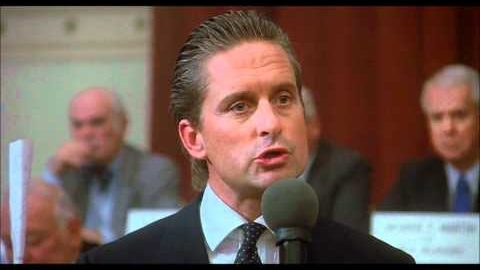
#SaveOurParkBoard | 80s Redux | Greed is Good

Tom Campbell, Mayor of Vancouver, 1966 - 1972
Tom ‘Not So Terrific’ Campbell, controversial Vancouver mayor, in office from 1966 to 1972

In 1966, running as an independent, a brash Tom Campbell defeated sitting Non-Partisan Association Mayor Bill Rathie to become Vancouver’s 31st mayor.

From the outset, Campbell’s ascension to the Mayor’s office heralded a pro-development ethos that would make even our current ABC Vancouver-dominated City Council blush, with Campbell — and his now ‘on board’  NPA colleagues — advocating for a freeway that would cut through a swath of the Downtown Eastside, require the demolition of the historic Carnegie Centre at Main and Hastings, and bring about the construction of a luxury hotel at the entrance to Stanley Park.

Vancouver's West End, 1960s, pre high-rise development
Vancouver’s West End neighbourhood, 1960, pre-high-rise construction. Photo, Fred Herzog.

In the West End, where Campbell owned substantial property — a wealthy, successful developer, Campbell was reputed to own one-third of the land located between (south to north) Davie and Georgia streets, and east to west, Denman Street and Stanley Park — the newly-elected Mayor all but ordered the demolition of almost the entirety of the well-populated West End residential neighbourhood — housing mostly senior citizens in their single detached homes — as he set about to make way for the rapid construction of more than 200 concrete high-rise towers.

In six short years, Mayor Tom Campbell and the Non-Partisan Association transformed a single family dwelling West End neighbourhood, irrevocably and forever.

That all of these “changes” augered controversy among large portions of the populace was a given, leading to regular, vocal and sometimes even violent protests throughout Campbell’s treacherous tenure as Mayor, finally lead to his overwhelming defeat at the polls in the November 1972 Vancouver “change” civic election.


Oct. 22, 2022 | Newly-formed civic party, ABC Vancouver, wins an overwhelming victory at the polls

Why raise ancient history now?

Not since the late 1960s / early 70s have Vancouver voters — seemingly, unknowingly — elected a more greed-inspired (this, on behalf of their financial backers), and wildly pro-development slate of lock step Vancouver City Councillors to office, at the heart of our city’s seat of municipal government at 12th and Cambie.

In early 2024, Vancouver sits on the wary edge of massive tower development, as promulgated by the “super majority” ABC Vancouver civic administration installed by Vancouverites at City Hall only 15 short months ago today. If Tom Campbell’s greed was able to destroy a single family-oriented West End neighbourhood 50+ years ago over six short years in power, imagine what the current ABC Vancouver-led municipal government can achieve over the course of the next 32 months?


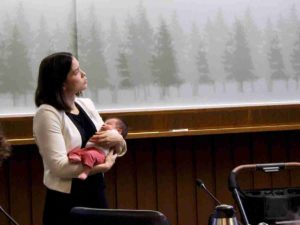
Vancouver Park Board Commissioner at Vancouver City Hall, holding her new, month old baby

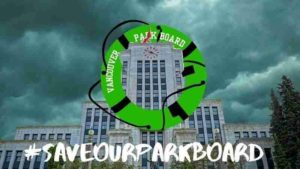
Click on this link to hear (former, and now independent) ABC Vancouver Park Board Commissioner Laura Christensen address the whole of Vancouver City Council on December 13, 2023 —  including her ABC Council running mates —  on the initiative of the political party she ran with to eliminate the elected Vancouver Park Board.

In her address to Council, Ms. Christensen pointed out to her now former ABC Vancouver City Council colleagues that there are 242 parks in the City of Vancouver, only 142 of which are designated as parks — leaving these latter non-designated “parks” open for development, including such beloved parks as Burrard Inlet’s Sunset Beach, Locarno Park, and Spanish Banks East and West.


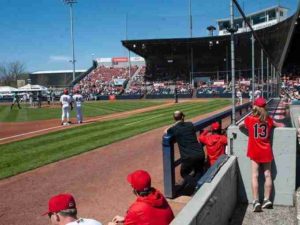
Fans enjoy the Vancouver Canadians at Nat Bailey Stadium. Could the city-owned stadium be put up for sale? A report suggests sport & cultural venues should be shed by the city. Photo: Jason Payne /PNG

In an article published in the Vancouver Sun on Saturday, the Sun’s civic affairs reporter Dan Fumano writes that a …

“… budget task force assembled last year by ABC Vancouver Mayor Ken Sim delivered its report with 17 recommendations on how the city could improve its financial health while reducing pressure to increase on property taxes.

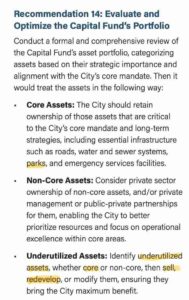
One recommendation suggests the city look at divesting some of its “non-core assets.”

When Fumano asked ABC Vancouver Councillor Brian Montague, one of two ABC Councillors who served on the task force’s advisory panel, if the “non-core assets” in the report would include include community centres, libraries, civic theatres, and sports facilities, Montague replied …

“I think it’s something we need to talk about, because there might be assets where divestment is the best approach.”

Former Vancouver Park Board Chairperson John Coupar clarified the matter on X:

Former Vancouver City Councillor Colleen Hardwick, and 2022 TEAM Mayoral candidate writes …

So, that’s it.

The reason for dismantling an elected Park Board?

A cynical and egregious land grab, a decision demanded by ABC Vancouver’s avaricious financial backers, who fancy adding billions of dollars more to their already ungainly wealth, all at the cost of: environmental devastation and climate change unchecked, a degraded quality of life in Vancouver for decades to come, reduced access to our public beaches — or, in some cases, no access at all to what were once but would no longer be “public beaches”— and long dark corridors of black towers lining the arterials and Vancouver’s beach fronts, all across the city.


Click / tap on the graphic above to sign  the Save Our Park Board Petition started by Sarah Blyth

#VanElxn2022 | TEAM Announces Innovative Affordable Housing Plan

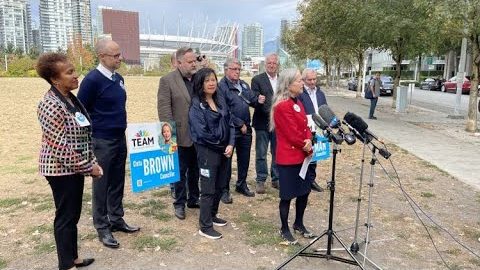
Yesterday morning, Vancouver civic election Mayoralty candidate Colleen Hardwick, and members of her TEAM … for a Livable Vancouver slate of Council candidates introduced their viable and innovative affordable housing plan.

Within 18 months of being elected to office, a majority TEAM … for a Livable Vancouver Council would bring forward a binding referendum to ask the citizens of Vancouver to allow TEAM to borrow $500 million dollars — amortized over a 35-year borrowing plan — to build 2,000 co-operative housing units in neighbourhoods across the city, providing homes for up to 5,000 Vancouver residents (many of those who would reside in Co-op housing would be families with children — as a rule of thumb when constructing new housing a 2.5 multiplier is employed).

Co-operative Housing Built By Bosa Development as a Community Amenity ContributionCo-operative Housing Built By Bosa Development as a Community Amenity Contribution

Ms. Hardwick also suggests that should the federal and provincial governments come on board to support and match the expenditure of monies proposed by TEAM … for a Livable Vancouver, as most assuredly would be the case, we’d be looking at 6000 new units of Co-op homes, housing up to 15,000 Vancouver citizens, before the end of the next municipal term of government — that means affordable housing for you, your children and your grandchildren, low income seniors, wage earners, and more, who are currently underhoused, or are considering leaving the city because there’s simply no affordable housing to be found.

As you will hear in the video of the press conference located at the top of today’s post, Mayoralty candidate Hardwick expresses the housing mix of future Co-op owners (co-op housing is owned collectively, under Canada Mortgage and Housing Corporation guidelines) as one-third, one-third, one-third.

A Collective Vision for Non-Market, Affordable Co-op Housing in Vancouver

Here’s what the one-third, one-third, one-third mix of residents in a housing co-op means: one third of members who live in a housing Co-op receive a deep subsidy — this group usually involves seniors on a meagre pension income, those persons in single parent households, and persons with disabilities. The second one-third grouping consists of wage earners, and persons in the creative industry, who earn an income of under $60,000 annually. Subsidy is provided to Co-operatives across Canada through a Federal Housing Co-operative Subsidy Fund.

The final third in the housing co-operative resident mix are those earning between $60,000 and $80,000 a year. These persons pay a low-end of median market rental rate — an explanation of which is available in VanRamblings’ Sept. 6, 2022 post. The CMHC-determined median market rental rate is generally half of the market rate.

As VanRamblings has resided in a housing co-operative for forty-plus years, allow us to explain how Co-ops work, and what TEAM … for a Livable Vancouver intends.

Housing Co-ops: The Solution to Vancouver's Affordable Housing Crisis

Co-operative housing was developed by the Pierre Elliott Trudeau-led federal Liberal government in the 1970s as a means of providing affordable housing for wage earners, members of the creative community, seniors and persons with disabilities, as well as for persons earning under $80,000 a year — the latter group paying a low-end-of-market housing charge rate, subsidizing those with lower incomes. 2500 housing co-ops were developed across Canada over a 10-year span, providing affordable housing to 135,000 Canadians, in every region of our nation.

Here’s how housing co-ops work. Each member of a co-op is owner of her or his home — sometimes it’s a townhouse, other times it’s row housing, or an apartment / condominium style housing typology. A member makes a refundable share purchase on being accepted into the Co-op — generally, the share purchase amounts to one month’s housing charge. For those who struggle to pay the share purchase, often the Co-op will add a portion of the share purchase to a household’s monthly housing charge — alternatively, the CCEC Credit Union offers a no interest share purchase loan to prospective Co-op members.

Co-op Housing: The Non-Market Solution to Vancouver's Affordable Housing Crisis

Housing co-operatives require member participation in the operation of the Co-op.

  • An Executive Committee — a President, Vice-President, Secretary and Treasurer — are elected at the Annual General Meeting of the Co-operative. The Executive is the Co-operative’s legally responsible body, under British Columbia’s Society Act, that ensures the good operation of the Co-operative. The Executive is responsible for the economic rectitude of the Co-operative, and must arrange for the conduct of an annual audit of the Co-operative’s fiscal operation. Every member — often, that includes children — must participate in the life of the Co-operative, and sit on one of three Co-op Committees: the Finance, Membership or Maintenance Committee.

Generally, there are work parties twice a year, collective Co-op cleaning activities, usually held in the autumn, and again in the early spring. The work required of members is rarely onerous — rather it’s a grassroots means for members to participate in the affairs of the Co-op that contributes to the livability of the Co-operative.

Two housing co-ops located on the south shore of Vancouver's False Creek
Phase 2 housing co-ops: co-operative housing built along the south shore of False Creek in the 70s/80s

Quite honestly, TEAM … for a Livable Vancouver’s affordable housing plan is the only viable affordable housing plan VanRamblings has seen published as policy in any of the 10 civic party’s policy handbooks, whose affordable housing policies are little more than a chimera, an ephemera trotted out as a faux election promise only.

Tomorrow, VanRamblings will be writing about the Vancouver International Film Festival, which kicks off its glorious, much-anticipated 41st annual edition today.

As we won’t be back writing about the election until Monday, October 3rd, for perusal over the upcoming weekend, we’ll leave you with …


Video of the Business in Vancouver Mayoral Forum held at The Terminal City Club on Tuesday evening, September 27th, with all five Mayoral candidates on hand, the event moderated by Kirk LaPointe.

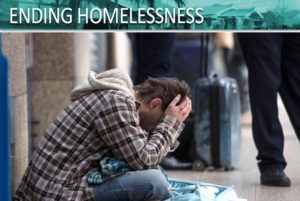
#VanPoli | Homelessness + Housing | A Series | Part 3

British Columbia, should candidate to lead the BC NDP become our province’s 37th Premier, David Robert Patrick Eby — and the City of Vancouver, as well, should TEAM … for a Livable Vancouver Mayoral candidate Colleen Hardwick be elected as Vancouver Mayor this upcoming October 15th — may be on the verge of adopting a revolutionary new approach to the provision of care for, and provision of housing for, our province’s homeless population, once and for all eliminating the scourge of a homelessness crisis that has for so long bedevilled our city, and our province.

In 2008, the Vancouver Police Department released a 56-page prescriptive visioning report titled Lost in Transition: How a Lack of Capacity in the Mental Health System is Failing Vancouver’s Mentally Ill and Draining Police Resources, that cogently argued for a near revolutionary reformation of the service model the VPD felt must be adopted to better provide for the necessary care for all those persons in need who are resident in the square mile around Main and Hastings, a report compiled and written by a particularly illustrious and celebrated cabal of PhD holding Vancouver police officers, long in the employ of the Vancouver Police Department.

In essence, the Lost in Transition report argued for the provincial appointment of a czar to oversee the provision of social services on the DTES. When the Lost in Transition report was updated in 2013, the world czar was replaced with the phrase, “the provincial appointment of an individual with the authority of a Deputy Minister”, and in the 2018 update of the Lost in Transition report, that individual was now called a Commissioner, a provincial appointee who would be given the authority to oversee a radical reformation of the DTES social services model.

In 2012, Charles Campbell — a former editor of The Georgia Straight — was commissioned by Vancouver Coastal Health to author a report on the provision of services on the DTES. Mr. Campbell’s report, Working With Health Agencies and Partners On Vancouver’s Downtown Eastside [PDF}, identified 277 social agencies providing services to those in need who were resident on the downtown eastside.

Arising out of the publication of both the Lost in Transition and Partners reports, a serious-minded and goal-oriented discussion on a reformation of the social services model that had long been in place on the DTES commenced in earnest.

This past weekend, TEAM … for a Livable Vancouver Mayoral candidate Colleen Hardwick apprised VanRamblings of a discussion she’d had with Chief Constable of the Vancouver Police Department, Adam Palmer, where the two touched on what might constitute a radical reformation of the social services model provided to habitués of the DTES, in order that those in need might receive better and more appropriate care, and how — working with the province — a plan might be developed that could eliminate homelessness across the city of Vancouver.

VanRamblings believes — based on what David Eby told The Vancouver Sun’s Katie DeRosa last Friday, and may also have arisen from TEAM … for a Livable Vancouver Mayoral candidate Colleen Hardwick’s discussion with VPD Chief Adam Palmer — the following aspects of a revisioning of the social services model for the DTES may be on the table …

  • As David Eby told Ms. DeRosa last week, “There really hasn’t been a co-ordinated strategy or a plan about how we get out of the problems of the Downtown Eastside. I think … putting an invisible fence around the neighbourhood and saying ‘this is the best we can do’ and just hope that things work out, it’s a strategy that will no longer carry us forward.” Eby said if he’s successful in his bid to replace Premier John Horgan … he’ll co-ordinate a long-term response to the issues in the Downtown Eastside with help from the federal government, the city & concerned groups;
  • In 2008, discussion surrounding the publication of the Lost in Transition report touched on / recommended consideration of the following: merging the 277 social services agencies on the DTES into 30 umbrella organizations. Each of the 277 social agencies employs an Executive Director, Director of Finance, Director of Human Resources, Manager of Supported Housing, among other senior administrative staff — each earning up to $325,000 annually — a duplication of services and administration funded by the province, at a cost of almost $1 billion dollars, annually. The initial 2008 VPD Lost in Transition report questioned if such duplication of services properly served the interests of those who are resident, and cared for, on the DTES;
  • There was also discussion upon the publication of the Lost in Transition report, and a recommendation within the report, that argued for the provincial appointment of a Commissioner who would oversee the reformation of the provision of services on the DTES, a person with the authority of a Deputy Minister who would report only to a provincially appointed Board of Directors who would oversee the transition of the current service model, reporting as well as to the office of the Premier.

For a great long while, there has been much talk about the DTES on the perpetuation of a “poverty pimp industry” within the community, an “industry” that pays well upwards of a billion dollars annually to fund a social services administrative structure on the downtown eastside that better serves the interests of those highly paid administrators over those persons who our society is truly meant to care for.

At present, as well, and impeding change are the various unions representing their members: there are 10,000 union employees who work on the DTES, represented by the BCGEU, HEU, CUPE and the Health Sciences Association, whose members fill union coffers with 2.7% of their gross pay each and every two week pay period.

At one social services agency where VanRamblings was employed, senior staff worked fewer — and were available on site for fewer — than 30 weeks a year. Each time an administrator traveled to Nova Scotia, or some other locale, for a 3-day conference — air fare, accommodation and expenses provided by the employer (that’d be you and me) — each day away meant the banking of two days in compensatory “vacation pay”, or more than one week of paid time off. Same thing for attending evening meetings, and working “overtime”, wherein the administrator banked more paid days off. Nice work if you can get, paid for at taxpayer expense.

And don’t get us started on the absenteeism rate for employees working on the DTES, averaging 6 paid days off per month, despite what the union contract says, replaced by on-call staff who generally work more hours than full-time employees.

As a final note today on VanRamblings’ four-part series on homelessness and housing: Premier-to-be (let’s face it, come December, we all know who will become British Columbia’s 37th Premier) David Eby has made a commitment to moving away from a corrupted and wholly unsuitable SRO (Single Resident Occupancy) housing model providing shelter for B.C.’s homeless population, while moving towards something akin to Finland’s ‘Housing First’ concept, where those who are affected by homelessness are provided with a self-contained apartment — with their own bathroom, bedroom / sleep area, kitchen / dining room, fully furnished with amenities provided for — and counseling, without any preconditions.

Four out of five of those previously affected homeless persons, in time, make their way back into a stable life, re-joining our society as productively happy citizens.

All this represents a responsible, fiscally sound model of service provision to those in need, so much better than accepting homelessness, and perpetuating an administratively corrupt model that has for far too long ill-served indigent persons.