Stories of a Life | Redux | Raised By My Aunt Freda

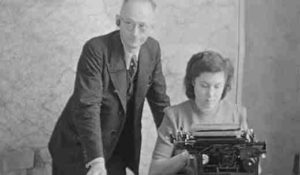
My aunt Freda was a vagabond, but a vagabond who typed at 80 words a minute, and took shorthand at up to 120 words a minute — her stenographic skills much in demand across all of Canada, for many many years.

For 50 years, my aunt traveled the country — there was no city or medium-sized town where she didn’t work, and given her skill set, jobs were easy to come by, references at the ready from previous employers.

My aunt would work two or three jobs a year for two to three months each time — in St. John’s Newfoundland (the only place she ever worked twice), Regina, Edmonton, Hamilton, Windsor, Saskatoon, Halifax and Victoria.

My aunt Freda would write to me from these far flung places across Canada where she’d taken employment, promising always to return in “just a few weeks.”
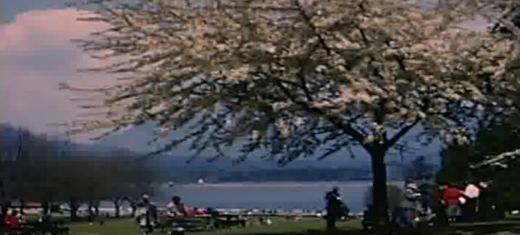
Vancouver's crown jewel, the 1000 acre Stanley Park, this photo taken in 1958
Vancouver’s crown jewel, the 1000 acre Stanley Park, the photo above taken in 1958

Throughout my young life, my primary caregiver was my aunt Freda.

Given that my mother, almost throughout the entirety of my life, worked three jobs at the same time, 16 hour days six days a week and a 24-hour day on the seventh day, I rarely saw her, she simply wasn’t a presence in my life or in my home, with the exception of summer, when we — my sister, my mother and I — would travel for a two-week vacation to wherever my aunt was located.

During the first 10 years of my life, my Aunt Freda cared for my sister and I, fed us, bathed us, took us to Stanley Park in the years we lived in Vancouver, took us on summer vacations, made sure that we enjoyed ourselves, and would learn about the world during the days, weeks and months that she cared for us, and otherwise provide love for the both of us.

Generally, my aunt would stay in our family home three times a year, sometimes more, for an average of six weeks on each visit.

In fact, my Aunt Freda was the only person who ever told my sister and I that she loved us. My father didn’t do that or even hint at it, love seeming to be a word not in his vocabulary, and most certainly my mother never told my sister and I that she loved us — although I think she showed it in many ways — and neither did anyone other than my Aunt Freda.

Aunt Freda was, for all intents and purposes, my mother — that’s the role she chose to play.

I was her favourite — any depth of insight into life, I gained from her.

Our conversations lasted hours — she wanted to introduce me to the world, to make me aware of my environment, to help me to see that I was part of a human collective of those who lived around me, and as the years went by, farther afield, as she helped me to see that I was part of the world community.

In the summer months, as I write above, my mother, sister and I would travel to whichever western Canadian city she was working in — in the summer, she always took employment in an easily accessible by rail western Canadian city .

My mother, sister and I would stay with her in her small, one-room “apartment” (more like a tiny hovel, but still), in order that we might attend Klondike Days in Edmonton, or the Calgary Stampede, or the Red River Exhibition in Winnipeg, or whichever town had a fair that summer that my aunt felt was recommendable and worthy of my family — always sans my father — visiting and staying with her, always enjoying our truncated time together.
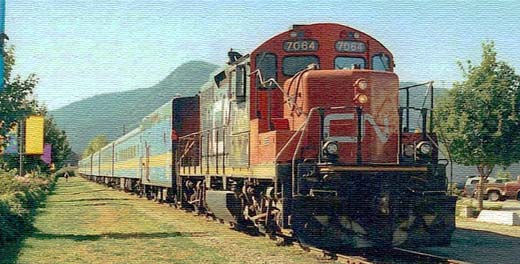
Passenger rail train travel in the 1950s and 1960s with Canadian National Railways

Of course, part and parcel of that was the train ride to and from whichever western Canadian city we were visiting, but that’s a story for another day.

When my family — including my father — moved to Edmonton in the summer of 1959, I spent the month of July in High River, Alberta staying with my grandfather on his massive family farm, and much of August in Lethbridge with my aunt Anne, uncle Dave and their children, my cousins, before moving into the rental home my parents had found for us in Edmonton, where I began Grade 4 in September 1959 — a fortuitous circumstance that would change my life.

In the late 1950s, Alberta had legislated an academic programme of excellence for students into which I was enrolled. In British Columbia, the province had adopted two educational streams: academic and vocational.

If you happened to live in a working class area of Vancouver, you were almost automatically streamed into the vocational programme.

When I returned to Vancouver for Grade 7, in the late summer of 1962, as I had been enrolled, and done well in Alberta’s Enterprise Programme of Excellence — as it was called at the time — upon my return to Vancouver to attend Templeton Secondary school, of all my friends with whom I had attended Grades One through Three, I was the only child / student who now found himself enrolled in the academic programme at Templeton.

I recall at the graduation ceremony in 1968, how disappointed many students were to find that graduating in the vocational programme did not make them eligible for entry into college or university, that they’d have to start all over again.

Rank class discrimination, that’s what it was plain and simple — kids came from poor families, and they’d become the “worker bees” as we were so often told while attending Templeton Secondary.

Two stories about my aunt, both of which are Edmonton-based.

Borden Park, in northwest Edmonton, at 148 acres one of the city's largest parks
Borden Park, in northwest Edmonton, at 148 acres one of the city’s largest parks

In the summer of 1960, after my family had moved to north Edmonton from the inner city, on my August 11th birthday that year, my parents had taken my sister and I down to play at Borden Park, in northwest Edmonton, not too far from where we lived, a massive green space in that area of the city, sometimes used as fairgrounds, with a community centre, tennis courts, a pool, and two outdoor pools, one for younger children, another for teenagers and adults.

The day was sunny and bright, the sky a deeper and richer blue that I can ever recall having seen prior to that date.

As it happened that year, my aunt Freda had not come to stay with us during the first seven months of the year — her services were required in St. John’s, as she found herself working on an inter-governmental project of some great import to both the province and the federal government. Of course my aunt wrote to me frequently, but beautifully handwritten letters aside, I missed the dickens out of her, and in my letters to her, I begged her to come and stay with us in Edmonton.

But it was not to be, for all the reasons she explained in her correspondences.

A roundabout, a sort of self-propelled merry-go-round you used to find on many playgrounds

While playing on the park’s roundabout, along with a number of other children pushing the roundabout to go faster, despite the hot sun beating down from above, I felt a chill run through my body, a pang that was so chilling as it shot through my veins that I alighted from the roundabout, and moved away onto a quieter green space nearby, just standing there shivering, for a moment wondering what was happening to me.

Turning away from the screaming children on the roundabout I began, alone, to walk north, away from my sister. Neither my younger sister Linda nor I had seen my parents in awhile, who’d told us they had some business to attend to, that we’d be fine in their absence, and I was to take care of my sister Linda.

I continued to move north along the green grasses, at first slowly, hesitatingly, when looking off into the far distance, I saw three figures walking closely together, indefinable figures, the sun obscuring my vision, the distant figures almost apparitions, as another pang of cold shot through my body, at which point I began to run, to run faster in the direction of the three apparitions than I had ever run in my life, because I knew who the middle person of the three was, even if I could not properly see who it was.

And I began to cry, running across the green field sobbing, running as fast as I could in the northerly direction of the three figures who I could not quite make out, but I knew were my parents and my aunt, and I ran and ran and ran, tears now gushing down my cheeks on that 10th birthday summer’s afternoon in August of 1960, on a day I will never ever forget.

And when I was upon my parents and my aunt, I jumped into my aunt’s arms, wrapping myself around her, my head on her right shoulder, the two of us holding each other as tightly and closely as we could, both of us now crying, my parents standing back in wonderment, their faces lit up smiling.

Placing me back on my feet, my aunt looked at me and said, “Raymond, I have arrived in Edmonton just this day, only an hour or so ago, so that I could be here for your birthday, to take you and your parents and Linda to dinner tonight. And I have presents for you, as well, which I will give you when we return to your home, and before we go to dinner tonight.”
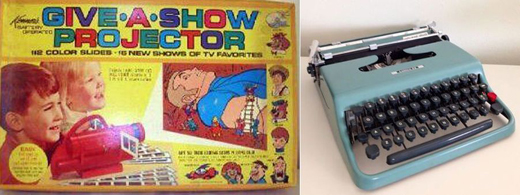
1960: The Give-a-Show 8mm projector, and a portable Underwood typewriter

The presents? There were two, as promised: an Underwood typewriter that would allow me to type ever longer letters to my aunt as she found herself in some far flung location in Canada — with the facility to type easily and well, a salutary talent and much-used skill I employ to this day — the second present, a toy 8mm movie projector that both reinforced my love for film, and a device that would bring me much joy in the months to come.

Running across that green field in Borden Park on the day of my 10th birthday resides in me still as a much cherished event in my young life, making me aware, if I was not already, that there are more than three dimensions in our existence — because I knew that my aunt was in the park minutes before I saw her and ran into her arms, when she told me she loved me, as I knew she did, and as I loved her.

My aunt stayed with my family to the beginning of my Grade 5 school year at Eastglen Elementary School, after which she was off again, this time to Saskatoon, where she worked through until February, when she returned to Edmonton for three weeks, then after traveling back to Saskatoon, where my mother, sister and I would spend the better part of July 1961 with her.

In the winter of 1962, my aunt made one of her now more infrequent visits to stay with my family, my mother working three jobs still, my father working at the Post Office, my sister and I alone at night.

One near frozen mid-winter February evening, after making and serving dinner to my sister and I, a dinner almost needless to say in which a delicious salad was featured prominently in the dinner — having arranged with a neighbour for babysitting for my sister, my aunt asked me if I’d like to go to see a film with her on the south side of Edmonton, near the University of Alberta campus.

Of course, I said yes.

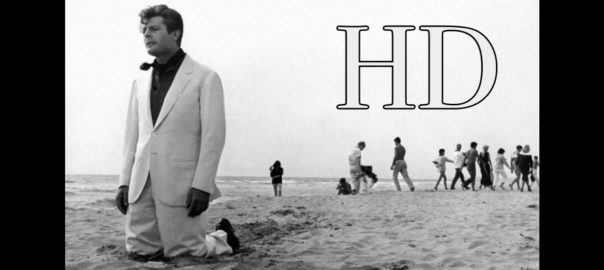
That evening, I saw my first foreign film, my first Fellini film, and a film that would go on to win the Best Foreign Language Film Academy Award late the very next month: La Dolce Vita, a film I fell in love with, as did my aunt, a film my aunt and I talked about all the way home on the bus, a film that began my life long love affair with sensuous European women onscreen, with foreign language & world cinema.

In all the years of my young life there was love in my life only when my aunt Freda would arrive to stay with us in our home. Not until I met Cathy in late 1969 did I feel love from anyone other than my beloved aunt Freda.

My aunt remained a fixture in my life through all the years of my attendance at university and throughout the years of my marriage, my aunt Freda the woman I look upon as my “real” mother, the mother who loved me, and cared for me, who knew me better than any other person in this world, and the person — along with each of my two children — I will always love most.
#Cinema | The Slow, Excruciating Death of Hollywood, and Cinema

Every three decades, or roughly once a generation, Hollywood experiences a seismic shift. The transition from silent films to talkies in the 1920s. The rise of broadcast television in the 1950s. The raucous cable boom of the 1980s.

It’s been happening again, for some while now, as most folks have observed.

The long-promised streaming revolution — the next great leap in how the world gets its entertainment — is finally here in all its glory.


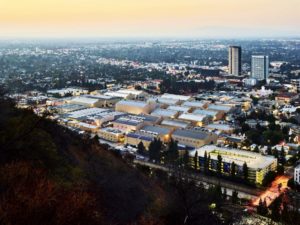
Warner Bros. Discovery studio in Burbank, Califoria, one of the oldest and largest Hollywood studios

In the 115-year history of the American film industry, never has so much upheaval arrived so fast and on so many fronts, leaving many writers, directors, studio executives, agents and other movie workers disoriented and demoralized. These are melodramatic people by nature, but talk to enough of them and you will get the strong sense that their fear is real this time.

“The last four years have shaken the movie business to its bones,” Jason Blum, the powerhouse producer whose credits range from The Purge series to Get Out and the BlacKkKlansman.” recently told Los Angeles Times film writer, Justin Chang.

Streaming, of course, has been disrupting the entertainment business for some time. Netflix started delivering movies and TV shows via the internet in 2007.

In 2024, however, the shift towards streaming has greatly accelerated, with Netflix, Disney+, Apple TV, Crave/HBO, Prime Video, YouTube Premium, CBC Gem and Kanopy, among other streaming platforms, competing for your movie attention.

Adding to Hollywood’s misery is the abrupt changing of the guard in Hollywood’s highest ranks. Nine of the top 20 most powerful people in show business have left their jobs, including Universal’s Ron Meyer, whose 25-year Universal career ended in 2021. David Zaslav is now in firm control of Warner Bros. Discovery, with Kevin Tsujihara exiting his role as chairman and CEO of Warner Bros. Entertainment, a job he held for six years. Paramount Global CEO Jim Gianopulos was removed, in favour of Bob Bakish, also now on the way out, with the company up for sale.

“It’s not clear that full normal will return even well into the fourth quarter of 2024,” Warner Bros. Discovery Chairman David Zaslav, told Chang in an interview on how Hollywood is faring against the streaming wars, and the slow recovery from the pandemic.


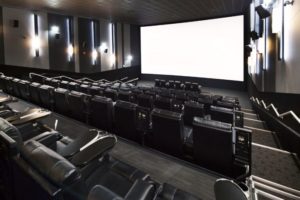
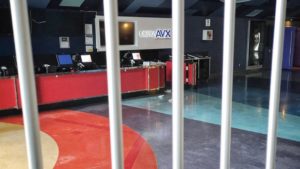
An empty cinema with no patrons. Is this picture an indication of what presages cinema in the future?

Will young people — trained during the pandemic to expect instant access to new movies — get into the habit of going to the movies like their parents and grandparents did? Generation Z forms a crucial audience: About 33% all moviegoers in 2023 were under the age of 24, according to the Motion Picture Association.

“Cinema as an art form is not going to die,” Michael Shamberg, the producing force behind films like Erin Brockovich and The Big Chill” told the New York Times’ Manohla Dargis in a recent interview. “But the tradition of cinema that we all grew up on, falling in love with movies in a theatre, is over.”

In other words, the art may live on, but the myth of big screens as the be-all and end-all is being dismantled in a fundamental and perhaps irreversible manner.

Know Your Local Ruling Class

#VanPoli | Kareem Allam

That handsome, despicable fellow you see pictured above is Kareem Allam.

We’re kidding. Honest. Just joshing. Sheesh, no one can take a joke these days.


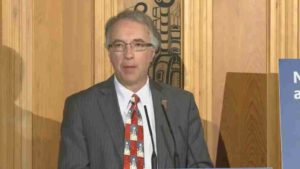
Afford yourself the pleasure of listening to / watching B.C.’s most accomplished politico, Kareem Allam

Who is Kareem Mahmoud Abbas Allam?

Most political folks will recognize Mr. Allam as the architect of ABC Vancouver’s overwhelming victory at the polls on October 15, 2022, in that year’s decisive municipal election, where every ABC Vancouver candidate was elected to office.

Clearly, Kareem Allam is a master strategist, a superior motivator and a campaign manager par excellence, an individual who means to win, not necessarily at all costs, but still — and, if we might suggest, a man of principle and integrity who fights the good fight, in 2022 on behalf of the beleaguered citizenry of Vancouver.

In 2022, post pandemic, an irritated Vancouver public had become fed up with a do nothing, whiny, Kennedy Stewart-led (if in anyone’s wildest imagination, Mr. Stewart might have the appellation of ‘leader‘ applied to him) administration, where he worked within a disparate and wildly dysfunctional civic administration.  Mr. Stewart is, fortunate for us,  now back at the post from whence he came, as the defrocked and much mocked Simon Fraser University Political Science professor.

If you go to the Fairview Strategy website — where Mr. Allam is employed, Fairview Strategy an integrated public relations company which offers government relations liaison and expertise, communication, media relations, digital communication, Indigenous relations, and market research — you will read this …

With two decades of private and public sector experience in public affairs, Kareem has successfully leveraged his knowledge of people, policy and community into triumphant political campaigns at the municipal, provincial and federal levels.

Kareem managed the winning Kevin Falcon for BC Liberal Leader campaign and the ABC Vancouver municipal campaign, electing 19 out of 19 candidates, including Mayor Ken Sim. In 2023, Kareem achieved #9 status on Vancouver Magazine’s annual Power 50 list.

Kareem has served as a member of the Board of the Fraser Health Authority, and as a member of the Translink Screening Panel, among other appointments which serve the community interest.


Sarah Blyth, community advocate and organizer, founding member of the Overdose Prevention Society

Did we mention that Sarah Blyth holds Mr. Allam in the highest possible esteem?

One year ago, Mr. Allam left his post as Chief of Staff to Mayor Ken Sim. Suffice to say that Mr. Allam’s leave-taking — he was very unhappy — was none too pleasant.

Well worth watching and listening to the Hotel Pacifico podcast interview with Kareem Allam that you’ll find above — given that Mr. Allam will continue to be long into the future, a British Columbian of wit, intelligence, perspicacity and accomplishment, who will endure as an individual who will make a difference for the better in each of our lives, in the many, many years to come. Best to get to know Mr. Allam a little better now, to help provide a bit of context for your confounding life, and perhaps even inject a smidgen of hope for a better collective future for all of us.

#BCPoli | The Speech from the Throne | Preparation for the October Election

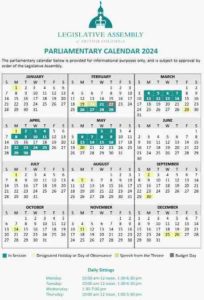
As of this writing, the British Columbian electorate are 241 days away from our province’s 43rd general election, set to take place on Saturday, October 19th.

Members of the British Columbia Legislature will sit for a total of 37 days in the spring session.


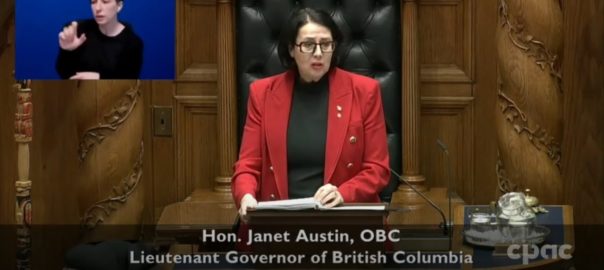
All 41 minutes and 2 seconds of Lieutenant Governor Janet Austin’s Speech from the Throne

The Throne Speech read in the Legislature by Lt. Gov Janet Austin on Tuesday kicks off a 10-week spring legislative session.

On Thursday, the government will unveil their budget, a compressed timeline in 2024 to accommodate a session that’s two weeks shorter than usual, in this the final session of the Legislature before the upcoming October provincial election.

In the Vancouver Sun, Legislative reporter Katie DeRosa writes, “The throne speech did give a hint that the 2024 budget is expected to be heavy on social spending “because leaving people to fend for themselves does not work. It did not work before. And it will not work now. It would mean deep cuts that weaken the services we rely on.”

In her speech — that was drafted in the Premier’s office —  the Lieutenant Governor began her address to British Columbians by emphasizing the actions government is taking, and will continue to take, to boost the number of middle-class homes available across the province.


On Tuesday, Prime Minister Justin Trudeau made a housing funding announcement with B.C. Premier David Eby, and Vancouver Mayor Ken Sim to expand the province’s B.C. Builds programme, to construct between 8,000 & 10,000 units, on an expedited timeline, over the next 5 years.

Programmes like BC Builds were touted as a way the government is reportedly taking underused land, grant money and low-cost financing to lower the cost of construction. On Tuesday, the federal government announced it would invest $2 billion in additional financing into the programme, on top of the $2 billion announced by the province last week.

Lt. Gov Austin also highlighted expanding infrastructure the province is building to accompany the growing housing supply, including projects that are set to increase the region’s SkyTrain network by 27 per cent. Other priorities outlined in the Throne Speech included public health care, such as the addition of hundreds of new doctors and thousands of new nurses in the province in the last year.

Lt. Gov Austin also referred to the medical school being built at Simon Fraser University’s Surrey campus, which will be the first new medical school in Western Canada in more than 50 years. She also alluded to actions the government will continue to take to build on its ten-year cancer plan.

Relieving cost-of-living for British Columbians and leveraging B.C.’s natural resource sector were also mentioned as areas where action will be taken in the upcoming budget, set to be announced Thursday.  The Lt. Gov gave B.C. Hydro as an example, as it attempts to expand B.C.’s electrical grid, and the new E-One Moli facility in Maple Ridge where battery production will be ramping up in the province.


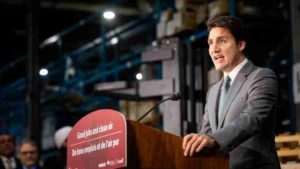
Prime Minister Justin Trudeau at the E-One Moli manufacturing plant in Maple Ridge to announce a billion-dollar battery cell production plant that will produce up to 135 million batteries each year as part of Canada’s push toward clean technology. (Justine Boulin/CBC)

References were also made to the government’s plan to manage the droughts and wildfires continuing to plague B.C.’s warmer seasons.

“The climate crisis is here, we have seen it all around us these last few years,” Lt. Governor Janet Austin said.

One of the highlights of Tuesday’s kick-off to the upcoming Legislative session were the cries — welcomed by Lt. Gov. Austin, mid-speech — of Azalea, the young daughter of British Columbia’s Minister of Emergency Management and Climate Readiness Minister, Bowinn Ma.

The response to the Throne Speech by the Opposition B.C. United Party

Todd Stone, BC United Member of the Legislature for Kamloops-South Thompson; Official Opposition House Leader; and Shadow Minister for Jobs weighed in with …

John Rustad, B.C. Conservative Party leader (pictured above) had this to say

“It’s been 16 years of the BC Liberals and now the seventh year of the NDP and we have a crisis in housing, we have an affordability crisis, we have a health crisis, we have a crisis in drugs and crime. The province quite frankly is in crisis.

It’s about time quite frankly that people became the focus of governments rather than what we are seeing, which is ideologies and other types of approaches that have failed every time they have been tried.”

B.C. Green Party leader / Cowichan Valley MLA Sonia Furstenau  had this to say

All said, the David Eby government — despite the slew of ads from B.C. United that cross our dinnertime news programmes, and desultory commentary from the B.C. Conservatives and B.C. Greens — continue to sit in the catbird seat according to the polls, in what would appear to be a near wipe out vote for the opposition parties.