#BCPOLI | Two Months Out from British Columbia’s 43rd Provincial Election

Two months from today, at 9pm on the chilly mid-autumn evening of Saturday, October 19th, British Columbians will be apprised of who will form government in the coming four years, from November 2024 through October 2028.

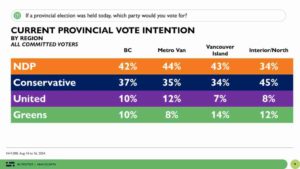
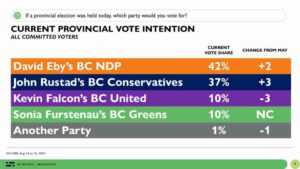
According to David Coletto’s August 16th Abacus poll, David Eby’s BC NDP maintain a comfortable 5-point lead over John Rustad’s novice BC Conservative Party. BC United leader Kevin Falcon and BC Greens leader Sonia Furstenau remain in the also ran category, with no hope of forming government post October 19th.

VanRamblings has been told that Quitto Maggi will release his latest Mainstreet poll later this week, weighing in on British Columbia’s provincial election, following an in-the-field survey of 2000+ prospective voters across the province.

Mainstreet gives John Rustad’s BC Conservative Party a 5-point lead over David Eby’s BC NDP — which reads to VanRamblings as more of a push poll, commissioned by the BC Conservative Party and designed to influence prospective voters still sitting on the fence as to who they will cast a ballot for this upcoming October.

Back to David Coletto’s, more credible, Abacus August 16th poll.

According to Mr. Coletto, David Eby’s BC NDP maintain an even more comfortable 9-point lead over John Rustad’s upstart BC Conservative Party in the vote rich Metro Vancouver region out to Chilliwack, where there are 52-seats up for grabs, which will constitute 58% of the 93 seats in the next session of the British Columbia Legislature.

Further, David Eby’s BC NDP maintains an almost insurmountable lead of nine points over John Rustad’s woefully unprepared BC Conservative Party across the entirety of Vancouver Island, where 17 seats are up for grabs, all but two of which are currently held by BC NDP incumbents.

VanRamblings has been told the BC Conservatives are polling better north of Nanaimo, and could very well pick up Courtenay-Comox and the North Island.


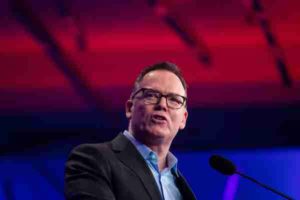
John Rustad, leader of the upstart British Columbia Conservative Party, which is currently polling well.

Although John Rustad’s BC Conservative Party holds an 11-point lead over David Eby’s BC NDP outside of the Lower Mainland — in the Okanagan, the Interior and in the North —  there are only 24 seats that the BC Conservatives could possibly win. Nathan Cullen, currently the wildly popular BC NDP Member of the Legislative Assembly representing the Stikine, and current Minister of Water, Land and Resource Stewardship and Minister Responsible for Fisheries in David Eby’s BC NDP government hardly constitutes a winning seat up north for the BC Conservative Party, so John Rustad would likely be denied a sweep of the ridings outside of Metro Vancouver.

All is not lost for John Rustad and the BC Conservative Party, though, which VanRamblings will write about later in the week.


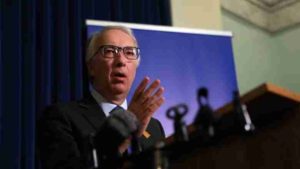
Kevin Falcon, the beleaguered leader (at least for now) of the down in the dumps BC United Party.

Apropos of nothing in particular, VanRamblings has also been told by a generally reliable source that BC United leader Kevin Falcon will tender his resignation as party leader later this week or early next week, and most certainly before month’s end.

We don’t find the information respecting Mr. Falcon’s pending, apparent, resignation to be credible. In tomorrow’s VanRamblings, we’ll express why, while going into some detail as to why we believe Mr. Falcon is not faring better in the lead-up to the 43rd BC provincial election.


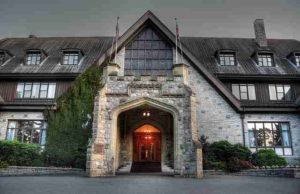
Government House, home of BC Lieutenant Governor Janet Austin, where Premier David Eby will visit   September 14 to ask Ms. Austin to dissolve the Legislature and call for B.C.’s  43rd provincial election.

As we wrote last week, the Writ will be dropped on Sunday, September 14th, at which point what is sure to be an uncommonly “pointed” (read: vicious and unsettling) 35-day election cycle will commence, with the four main British Columbia political parties fighting hammer and tong for victory, whatever the nature of that “victory” might mean— for BC United, survival and six seats would suffice to keep the party alive, as would be the case with the BC Greens, who would be thrilled were they to secure two seats in the next session of the Legislature.

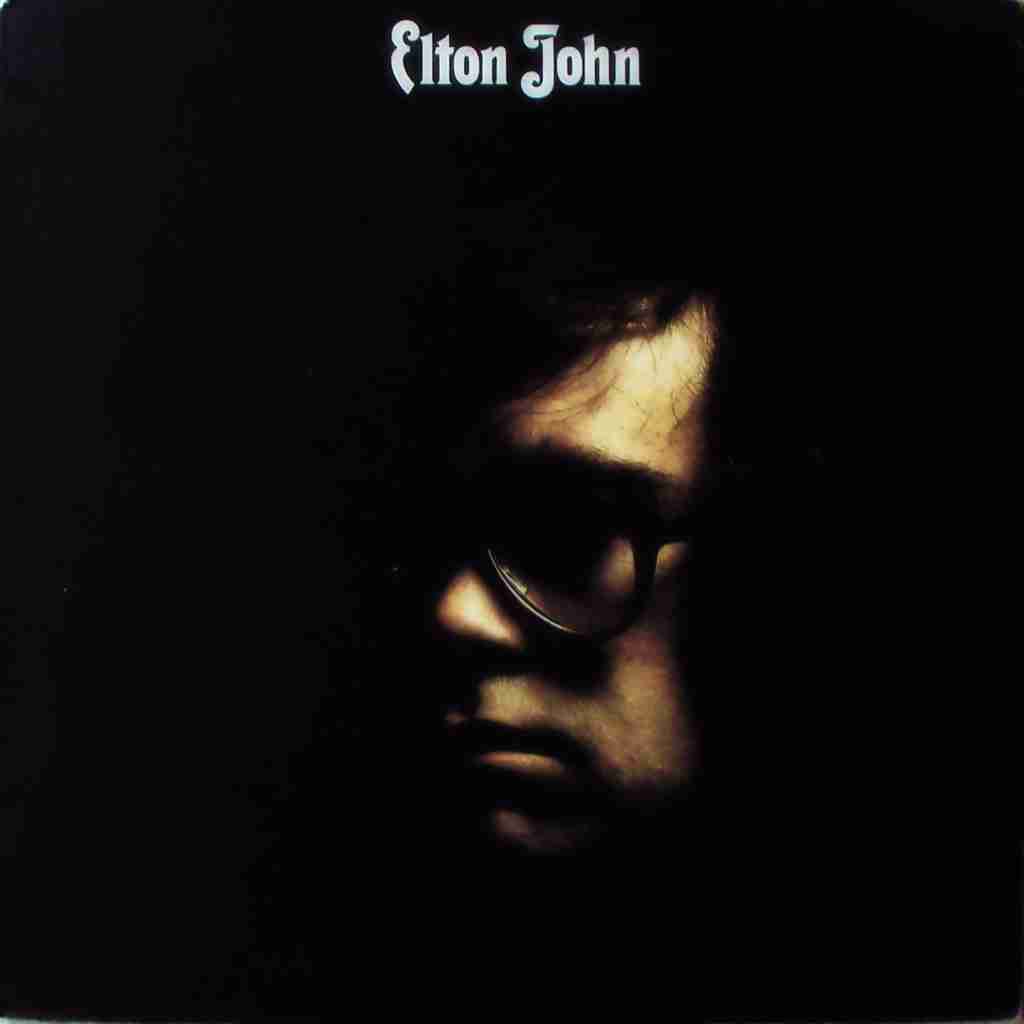
Sunday Music | Elton John | 1970 | Eponymous Album

Each summer, from the late 1960s through the 1980s, legendary broadcaster Terry David Mulligan traveled to Great Britain, in search of new music, breaking artists, and the “next big thing.”

In 1970, the next big thing was Reginald Kenneth Dwight aka Elton John.


Love Song, side2, track 7, my favourite Tumbleweed Connection song, that got lots of radio play from me

Elton John’s self-titled début constituted his introduction to North American audiences. Tumbleweed Connection was his first British release, and went on to (lesser acclaim than his 1970 album) become his second North American album release.

At the time, Terry was employed by CKVN (that station had been, and would be again, be CFUN, a giant of pop radio in Vancouver).

Arriving back in Vancouver, Terry was excited to spin Elton John’s disc for all the jocks at the station, who — in the main — were as enamoured with the then unknown Elton John, as was the case with a gregariously enthusiastic TDM.

The number one smash hit off the album was Your Song, which became a staple at weddings of the era — including mine to Cathy, on December 19, 1970.

To this day, Elton John’s eponymous début remains my favourite Elton John album, a serious, incredibly well-composed, almost operatic album, much at variance with the more pop-oriented albums and songs Elton John would compose and release — with lyrics by Taupin — over the next 50 years.

“The album which I am quite proud of is the very first one [I did with Elton]. The ‘black album’ was all done in a week. If I could go through that week again, I would just love it to death.”

Gus Dudgeon, Producer

Elton John is a classic, Top 100  album in the pantheon of rock music.

John and lyricist Bernie Taupin’s songwriting had an immediacy ingrained in the music, sharper and more diverse than Tumbleweed Connection, or any music the two released after 1970.

Taupin is all about American mythology and old men’s regrets. Elton likes his harps and harpsichords. Together they gaze beyond England.

Listen to the music. Elton and Taupin clearly have their hearts in the South.

Take Me to the Pilot, a rocking gospel piece where John’s driving piano takes centre-stage over the strings may not make much sense lyrically, but John’s good sense ground its willfully cryptic words with a catchy blues-based melody.

Next to the increased sense of songcraft, the most noticeable change on Elton John is the addition of Paul Buckmaster’s grandiose string arrangements.

“It only took the first hearing for me to call Elton’s manager and express my enthusiasm. I heard the potential of what he and Bernie had written. I had already begun to hear what I was going to do with Your Song, for a start. It was the sort of thing that I was dying to have a go at.”

Paul Buckmaster

Buckmaster’s orchestrations are never subtle, but they never overwhelm the vocalist, nor do they make the songs schmaltzy.


First Episode At Hienton, one of my favourite songs on Elton John, one I often sing to. I know that I am still alive and thriving, when  I can hold the extended note (wwwooooommmaaannnn) at 4:13 in.

Instead, they fit the ambitions of John and Taupin, as the instant standard Your Song illustrates.

Even with the strings and choirs that dominate the sound of the album, John manages to rock out on a fair share of the record. Though there are a couple of underdeveloped songs, Elton John remains one of his best records.

In a rather uneventful period in rock music, John’s music emerged as so staggeringly original that it wasn’t obvious that he was merely operating within a given musical field (such as country or blues or rock) but, like Randy Newman and Laura Nyro among others, creating his own field, borrowing from country, rock, blues, folk and other influences, but mixed in his own way.

Aretha Franklin would hardly have covered Border Song — a great gospel tune with a bombastic arrangement — if she’d sensed an artificiality.

The resulting songs are so varied in texture that his music defied classification.

While his voice, in those days, mostly resembled Jose Feliciano, there were also detectable touches of Leon Russell and Mick Jagger.

Sitting behind his own piano, with Nigel Olsson on drums and Dee Murray on bass, John’s new sound was much earthier than his earlier work, even if there was an essential sweetness to his heavily orchestrated North American début album.

All these years later, in 1970 and fifty-four years on, with Elton John’s arrival on the music scene, the sense existed then that in Reginald Kenneth Dwight here was a legendary artist destined to play a featured role in the history of rock ‘n roll.

Stories of a Life | Redux | Jude, Megan and Me | Movies | 80s and 90s

Cinema | Megan and Jude Tomlin, and their dad, love cinema, love the movies, stories of a life

Film has always been a central, organizing force in my relationship with both my daughter, Megan, and my son, Jude.

Our collective love of the cinema, attending film festivals and discussing what we saw following the various screenings we attended (usually at the Fresgo Inn on Davie, which was alive no matter the time of night or early morning) was, over the years, a central feature of our relationship — the relationship between son and daughter, and dad — that allowed us to delve deep into discussions of the meaning of life, and our collective responsibility to work towards creating a fairer and more just world for everyone.

Heart and deep caring for humanity was at the centre of our love of film, and at the centre of our loving familial relationship, informing the choices we made about how we would conduct ourselves in the world, and the projects and causes to which we would devote our time and our energies.

In the 1980s, when Cathy and I were going through a rancorous divorce, film brought us together.

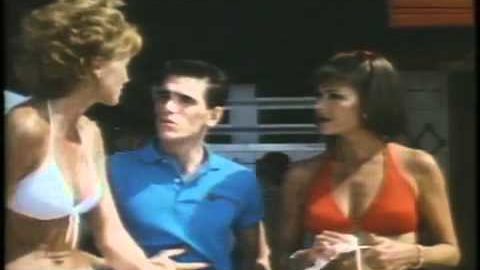
When in Seattle — which we visited frequently, always staying on the non-smoking 33rd floor of the Weston twin towers — in 1984, we took in a screening of Garry Marshall’s The Flamingo Kid — the story of a working class boy (Matt Dillon) who takes a summer job at a beach resort and learns valuable life lessons.

Megan was seven years of age, and Jude 9 — both were uncertain about the efficacy of our trip south (without their mother’s permission — we called her upon arriving at our hotel), but the screening alleviated and, finally, repaired any of their concerns, and all went well that weekend. Fortuitously, too, upon our return, the divorce proceedings inexplicably moved forward into a more reasonable and thoughtful direction, reflective of all our collective concerns.

Whenever there was “trouble” in our relationship — generated, most usually, by their mother — film served to salve the wounds of dysfunction, allowing us to find our collective centre while healing the wounds that rent all of our lives during a decade-long, million dollar custody dispute.

Film spoke to us, made us better, took us out of the drudgery of our too often protean daily and, more often, troubled lives, and engaged us while putting our lives into a broader and more human scale perspective. Never once was there a film that we saw together when we didn’t come out of the screening feeling more whole, and more at one with ourselves and the world.

Such was true, at the screenings of Glenn Close and John Malkovich’s Dangerous Liaisons over the holiday period in 1988, or months later at the screening of Kevin Costner’s Field of Dreams, which we took in at the Oakridge Theatre, a favourite and comforting cinema haunt of ours.

When Megan wanted some “alone time” with me, it almost always revolved around watching a film together, although as Megan matured (and as her love for film matured), Megan made it plain that she was present in the theatre to watch the film, not “share time” with me, choosing always to sit in a whole other section of the theatre (it drove her crazy in the times that we were sitting together in a theatre that I would check in occasionally with her, looking at her to determine how she felt about the film — talking during a film was an unforgivable sin, so that was never going to happen).

Some days, Megan would call and say, “Dad, take me to a film.”

And because I was a film critic at the time, and had a pass to attend at any cinema in North America, off the two of us would traipse to see Kathy Bates’ Fried Green Tomatoes (1991) or Johnny Depp’s Benny & Joon (1993) at the old 12-theatre complex downstairs in the Royal Centre mall.

Other times, post dinner and after Megan had finished her homework, I’d say to Megan out of the blue, “I’m heading out to attend a screening of a film. Do you want to come along with me?” Megan would ponder my question for a moment before asking, “Which film?”

In 1991, one very long film screening we attended was Kevin Costner’s directorial début, Dances With Wolves, about which we knew nothing other than it starred one of our favourite actors, and off the two of us went.

At screening’s end (Megan and I actually sat together at this particular screening, which took place in the huge Granville 7 Cinema 7, because the preview theatre screening room was just packed), Megan turned to me, and said, “Dad, I knew this was going to be a great film.” And it was. “And, you know what else? It’s going to pick up a raft of Oscars this year, too, and be considered one of the, if not the best, films of the year.”

Jude and Megan also attended film festival screenings with me.

Almost inevitably, Vancouver International Film Festival founder, and co-owner of Festival Cinemas Leonard Schein was present with his wife Barbara, and at a screening’s end, Megan would make her way over to wherever Leonard and Barbara were sitting to enquire of him whether or not he intended to book the film into either the Varsity, Park or Starlight.

Following screenings of Neil Jordan’s 1992 putative multiple Oscar award winner, The Crying Game or, that same year, Baz Luhrmann’s Strictly Ballroom, Megan marched over to Leonard, and asked him boldfacedly, “What do you think?”

When Leonard indicated that he thought the films were not quite his cup of tea, that both films would have difficulty finding an audience, and that it was unlikely he’d be booking either film into one of his cinemas, Megan lit into Leonard with a passion and a vehemence I had rarely observed coming from her, saying …

“Are you out of your mind? Strictly Ballroom and The Crying Game are wonderful films, and just the sort of films that not only should you book, but that you MUST book — these are both groundbreaking films that will only serve to reinforce your reputation as an arts cinema impresario, but will also make you a tonne of money, and we all know that you’re all about the money. Either you book these films into The Varsity, or believe me when I tell you that there’ll be hell to pay when you see me next.”

And with that, Megan marched off.

At the 1990 Vancouver International Film Festival, I’d caught a screening of Whit Stillman’s directorial début, Metropolitan, in preview, and knew that this would be a film Megan would just love (and be astounded by, at the revelation of one of the characters, mid-film).

I made arrangements to pick Megan up from University Hill Secondary at 3pm sharp on the day of the festival screening, we drove downtown, found a parking spot, and rushed over to The Studio Cinema on Granville to catch the 4pm screening of Metropolitan — which as I had predicted, Megan loved.

In early December 1993, on a particularly chilly and overcast day, at 10am in Cinema 2 at the Granville 7 theatre complex, I caught a screening of Jonathan Demme’s groundbreaking new film, Philadelphia — a film about which I knew little, and a film that knocked me out (along with the handful of film critics in attendance at the theatre for the screening).

Emerging from the theatre just after noon, making my way onto Granville, I looked for the nearest telephone in order that I might call Megan at school.

I called the office at University Hill Secondary, and asked them to find Megan and bring her to the phone. When Megan asked, “Dad, is everything all right?”, I told her about the film I had just seen, and that when it opened in January, I wanted to take her and Jude to a screening at the Granville 7. We talked about the film for a few minutes, with her saying about 10 minutes in, “I’m holding up the school phone, and calls coming in. Let’s get together after school. Come and pick me up, and we can continue our conversation. I’ll see you then, Dad. I love you.”

There are gifts we give our children. From my parents, it was what would emerge as a lifelong love for country music. For Jude and Megan, my gift was a love of music, a love of the ballet, and an abiding love for film.

#OscarWatch | The Late Summer / Fall Film Festival Season Is Almost Upon Us

Each late summer / early autumn brings the four major film festivals where 80% of the future Oscar contenders for the year début.

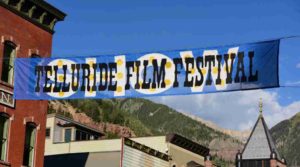
First up, there’s the Telluride Film Festival, high atop the mountains of Colorado, that gets underway at the end of August, where 40+ prestige films will make their début, from Friday, August 30th through Sunday, September 2nd. Organizers keep the titles of the films set to début under wraps until opening day.

Occurring almost simultaneously: the 81st annual Venice International Film Festival, to be held on the Lido di Venezia over an eleven day period, commencing on August 28th, and drawing to a conclusion on September 7th.

Venice is the star-studded film festival.

The lineup for the 81st edition of the festival includes new films starring Brad Pitt, George Clooney, Angelina Jolie, Nicole Kidman, Daniel Craig and Jude Law, all of whom will be present for the world début of their new films.

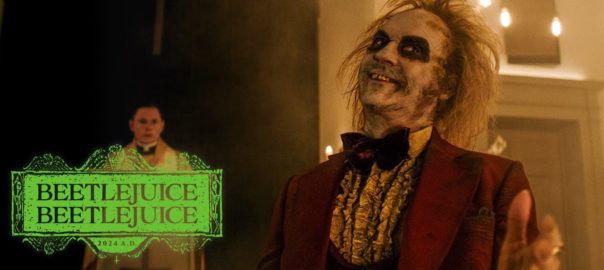
The 81st edition kicks off August 28th with the world première of Tim Burton’s Beetlejuice, Beetlejuice. All of the main cast, including Michael Keaton, are expected to grace the red carpet.

Filmmaker Todd Phillips is returning to Venice with a sequel. Joker: Folie à Deux, the highly anticipated follow-up to the 2019 blockbuster comic book film that won the Golden Lion (Best Film) in Venice,  a multiple Oscar award winner, starring Oscar-winning Best Actor Joaquin Phoenix as the mentally ill Arthur Fleck, and Lady Gaga as Harley Quinn.


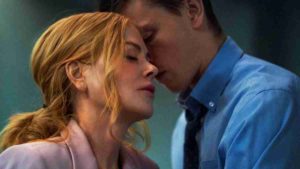
The erotic thriller Babygirl, starring Kidman and Harris Dickinson, from filmmaker Halina Reijn

Among the films playing alongside Joker 2 in competition are Pablo Larraín’s Maria Callas film Maria, starring Jolie; Walter Salles’ I’m Still Here; the erotic thriller Babygirl, starring Kidman and Harris Dickinson, from filmmaker Halina Reijn; Luca Guadagnino’s William S. Burrough’s adaptation Queer, with Craig and Jason Schwartzman; and Pedro Almodóvar’s first English-language film, The Room Next Door, starring Julianne Moore and Tilda Swinton.

Seven episodes of Alfonso Cuarón’s psychological thriller series Disclaimer will also première at the festival, which will also screen at the Toronto Film Festival once the Venice Film Festival concludes. The AppleTV+ series is based on a novel about a documentary journalist and a secret she’s been keeping. It stars Cate Blanchett and Kevin Kline and will début on the streamer on October 11th.

Venice is a significant launching ground for awards hopefuls and the first major stop of a busy fall film festival season, alongside the Toronto, Telluride and the New York Film Festivals.

In respect of this year’s Toronto International Film Festival, TIFF will run from September 5th through 15th

New films from such internationally renowned auteurs as America’s Steven Soderbergh, South Korea’s Hong Sangsoo, Japan’s Kiyoshi Kurosawa, Iran’s Mohammad Rasoulof and a number of acclaimed Canadian directors will screen at the 49th edition of the Toronto International Film Festival in September.

Highlights include Soderbergh’s new thriller Presence, starring Lucy Liu and Julia Fox, which premièred at the Sundance Film Festival at the beginning of the year; the drama The Friend, an adaptation of Sigrid Nunez’s acclaimed novel, starring Bill Murray and Naomi Watts; By the Stream, the latest microbudget film from minimalist master Sangsoo; the hotly anticipated psychological thriller Cloud, from Kurosawa, best-known for his landmark 1997 horror film Cure.

Also on tap at TIFF: the documentary Will & Harper, featuring Will Ferrell; the papal thriller Conclave, starring Ralph Fiennes and Stanley Tucci; the concert doc Road Diary: Bruce Springsteen and The E Street Band; the Lego-animated biopic Piece by Piece, tracing the life and career of Pharrell Williams; the post-apocalyptic musical The End, starring Tilda Swinton and Michael Shannon; and Rasoulof’s The Seed of the Sacred Fig, which won over audiences at Cannes this past spring days after its director escaped impending imprisonment by the Iranian regime.

Meanwhile, the prestigious and heavily juried 62nd annual New York Film Festival kicks off on Friday, September 27th and runs through Monday, October 14th.


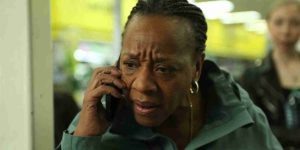
British director Mike Leigh’s Hard Truths, starring Marianne Jean-Baptiste

This year’s festival lineup includes new works from returning NYFF directors, such as David Cronenberg with The Shrouds, Alain Guiraudie with Misericordia, Mike Leigh with Hard Truths and Paul Schrader with Oh, Canada. Several directors will make their festival début, including Brady Corbet with The Brutalist, RaMell Ross with Nickel Boys and Kapadia with All We Imagine as Light.

“The festival’s ambition is to reflect the state of cinema in a given year, which often means also reflecting the state of the world,” said Dennis Lim, New York Film Festival’s artistic director. “The most notable thing about the films in the main slate is the degree to which they emphasize cinema’s relationship to reality. They are reminders that, in the hands of its most vital practitioners, film has the capacity to reckon with, intervene in, and reimagine the world.”

Many of the films listed in today’s VanRamblings column will also screen at this year’s Vancouver International Film Festival — which I will begin writing about on August 30th, amidst my coverage of the upcoming provincial election — set to get underway Thursday, September 26 and run through Sunday, October 6th.