Vessi Shoes | Local Pop-Up Store | 100% Waterproof Footwear

Vessi Footwear Pop-Up Shoppe | Vancouver | 1151 Robson Street | December 14, 15, 16 2018

While the members of our federal and provincial governments, and our newly-elected City Council, Park Board and School Board set about to do the work of the angels to make ours a freer, more welcoming, fairer and more just nation, province, city and region, the “big issues” of the day — given that for the first time in nearly 50 years, we are experiencing progressive governance at all three levels of government — are auspiciously and dutifully (if haltingly, at times) being taken care of, which is all to the good for Canadians, and particularly meaningful for all of us during this most festive and warm-hearted of seasons of good will.

Have you ever noticed, though, that while in the larger world — at work, with family, or with friends or neighbours — all goes well, it is the annoying little things that will tend to get you down, causing frustration and irritation (even if in the greater scheme of these things they don’t really matter): the jar that won’t open no matter what you do, the door that won’t close, the car that won’t start, and your shoes, socks and feet that get completely soaked when you step off a curb into a puddle, because there’s just no other option if your going to move forward.

Well, I’ve got the solution for the latter: no wet feet, no wet socks, no wet shoes ever, ever, ever again. Watch this video …

Vessi shoes for women or men mean no more soaked feet during the long winter rainy (or, on some days, snowy) season, no more stepping into puddles or slush and walking to your destination with absolutely freezing cold, soaked feet — that’s a thing of the past with Vessi footwear.

Here’s what I’ve found …

  • The fashionable and ultra-comfortable Vessi shoes are light as a feather, slip onto your feet and then hug the sides of your feet just below your ankle, allowing no water ingress no matter how many puddles you jump through;
  • They’re incredibly easy to clean, almost cleaning themselves;
  • The heel and arch support are just great, and the Vessi shoes are perhaps the most comfortable shoes I’ve ever owned.

So, why bring Vessi shoes to your attention now? Here goes …

Vessi Footwear Pop-Up Shoppe | Vancouver | 1151 Robson Street | December 14, 15, 16 2018

Tomorrow, Saturday and Sunday, the good folks at Vessi Footwear will host one of their very occasional pop-up shoppes, where you can purchase a pair (or more) of their shoes, usually at a deep discount ($99 Canadian, usual price $135 U.S. plus shipping). Vessi Footwear is a Vancouver-based company, started by two, young UBC scientists, who distribute their shoes worldwide — after having raised a million and a half dollars on Kickstarter a couple of years back — and because Vessi is Vancouver-based, we’re the only jurisdiction worldwide where Vessi hosts pop-up shoppes for customers, so that’s good for all of us who live in Vancouver.

So, tomorrow, Saturday and Sunday, from 11am til 9pm each day, at 1151 Robson right near the London Drugs, between Thurlow and Bute, you can pick up a pair, or two, of the must-have shoes if you’re a Vancouverite, and if you’re at all interested in keeping your feet warm and dry this winter.

$35 iPhone Battery Replacement Program Ends December 31st

iPhone 8 Plus

Own an iPhone SE or later & having battery issues? Or, maybe you want to get in on Apple’s iPhone battery replacement programme that, no questions asked, will give you a brand new battery for your iPhone for free — if you’ve got Apple Care — or, otherwise, for the relatively paltry sum of $35 Canadian ($29 U.S.), about half the regular price for battery replacement.
Apple is still offering $35 battery replacements for the iPhone SE, 6, 6 Plus, 6s, 6s Plus, 7, 7 Plus, 8, 8 Plus, and X. All of these devices are eligible for a discounted $35 battery following the processor slowdown scandal that Apple faced earlier this year.

After December 31, 2018, replacement iPhone batteries will return to their regular price. For most iPhones, replacement batteries will be priced at $65, with the exception of the iPhone X. Apple will charge $99 for an iPhone X battery replacement.
How to Initiate a Battery Replacement

iPhone lithium ion battery

To initiate a battery replacement, use Apple’s battery support site. You can take your iPhone to an Apple retail store, an Apple Authorized Service Provider, or send it in for replacement at an Apple Repair Centre. In my case, after clicking on Start a Battery Replacement, I chose the Bring in for Repair option, signed in with my Apple ID, on the next screen put in my postal code and my mobile service provider, clicked Go, chose an Apple repair location (in my case, I chose Apple, Oakridge Centre), and chose a convenient time for me to bring in my iPhone for the battery replacement.
Upon arrival, I checked in at the Genius Bar, spoke with one of the Apple Care staff, who asked me a few questions before taking the phone away for repair — the process from beginning to end taking about an hour and a half. When I purchased my iPhone about 15 months ago, the salesperson suggested I take my iPhone into my nearest Apple Care Centre once a year for a thorough cleaning. The number one problem iPhone customers experience concern dirty and / or plugged ports — to preserve the life of your phone, and to ensure a continued good experience of your phone, an annual cleaning is a necessity, I was told. Best aspect of the cleaning — it’s absolutely free! When I was given my phone back, it was sparking clean.

iPhone in hand

All iPhones will eventually face battery degradation issues due to the nature of lithium ion batteries. While performance management software was initially limited to the iPhone 5 SE, 6, 6 Plus, 6s, 6s Plus, 7, 7 Plus, and SE, Apple in iOS 12.1 added it to the iPhone 8, 8 Plus, and X to prevent future shutdowns should these devices suffer from failing batteries.
In the iPhone 8, 8 Plus, and X, performance management features introduced due to degraded batteries “may be less noticeable” because of their “more advanced hardware and software design.”
iPhones, including the XS, XS Max, and XR, will also eventually receive performance management software, until battery technology improves.
Final note: even If you’re not experiencing battery issues with your iPhone, it probably remains best to get your battery replaced before the programme ends, so you can avoid potential problems after December 31.

The Music of One’s Life | Tom Waits | Closing Time +

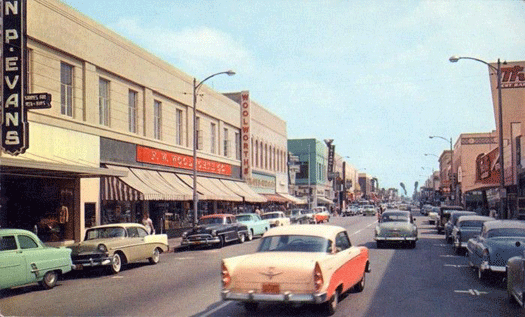
Pomona, California, 1950s, birthplace of singer-songwriter Tom WaitsPomona, California, Los Angeles county, 1950s, birthplace of songwriter Tom Waits

Thomas Alan Waits was born on the 7th of December in 1949, in Pomona, California, a little town located between the Inland Empire and the San Gabriel Valley, situated within Los Angeles County. His father, Jesse Frank Waits — about whom Waits would later say … “he was a tough one, always an outsider” — taught Spanish at a local school and was an alcoholic, while his mother Alma was a housewife and regular church-goer.
Waits was the second of three siblings, having both an older and younger sister, raised (as he’s often said) in a middle-class household, his “a pretty normal childhood”. He attended Jordan Elementary and later on Hilltop High School, where he was bullied. It was at Hilltop, though, where he learned to play the bugle and the guitar, while his father had earlier taught him to play the ukulele. Summers, more often than not, he visited maternal relatives in Gridley or Marysville, both small towns about 50 miles north of Sacramento, in northern California. Waits recalls that it was an uncle’s raspy, gravelly voice that inspired the manner in which he later sang.
In 1959, Waits’ parents separated and his father moved away from the family home; it was a traumatic experience for the 10-year-old boy. Alma took her children and relocated to Chula Vista, a middle-class suburb of San Diego. In Chula Vista, he fronted a rhythm and blues school band, The Systems, where he developed a love of soul singers like Ray Charles, James Brown, and Wilson Pickett, as well as country music and Roy Orbison. Later on, Bob Dylan became a catalytic influence, with Waits placing transcriptions of Dylan’s lyrics on his bedroom walls.

Novelist Jack Kerouac, listening to the beat of a new generationNovelist Jack Kerouac listening to the beat of a new generation, where as he wrote, “The only people for me are the mad ones, the ones who are mad to live, mad to talk, mad to be saved, desirous of everything at the same time, the ones who never yawn or say a commonplace thing, but burn, burn, burn, like fabulous yellow roman candles exploding like spiders across the stars.” Excerpted from Kerouac’s 1956 novel, On The Road.

In high school, Waits was a self-described “amateur juvenile delinquent”, interested in “malicious mischief” and breaking the law, a “rebel against the rebels”, as he eschewed the hippie subculture then growing in popularity, inspired instead by the 1950s Beat generation, with a great love for the work of Beat writers like Jack Kerouac, Allen Ginsberg, and William S. Burroughs. In 1968, at age 18, he dropped out of high school.

The Howl, Allen Ginsburg, September 1956

I saw the best minds of my generation destroyed by madness, starving hysterical naked, dragging themselves through the negro streets at dawn looking for an angry fix, angelheaded hipsters burning for the ancient heavenly connection to the starry dynamo in the machinery of night, who poverty and tatters and hollow-eyed and high sat up smoking in the supernatural darkness of cold-water flats floating across the tops of cities contemplating jazz, who bared their brains to Heaven under the El and saw Mohammedan angels staggering on tenement roofs illuminated, who passed through universities with radiant cool eyes hallucinating …

Waits spent much of the next three years traveling, picking up odd jobs here and there, taking college classes in photography, while all the while pursuing his musical interests, including learning the piano, all of which led to gigs along California’s coast, opening for acts like Tim Buckley, and Sonny Terry and Brownie McGhee.

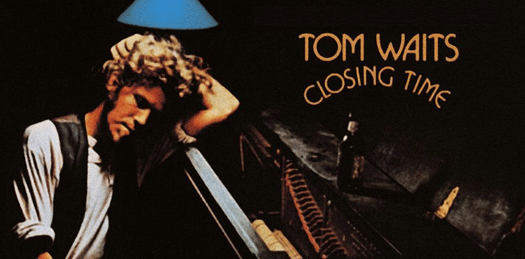
Tom Waits, debut album, Closing Time, March 1973

Early in 1972, Tom Waits landed a gig at the Troubadour in West Hollywood, where he came to the attention of Herb Cohen, a music impresario, record company executive, music publisher, and personal manager for Linda Ronstadt, Frank Zappa, Buckley, and Odetta, among other artists. Cohen signed Waits to a publishing contract with Troubador Records — it was at Troubador that Waits came to the attention of David Geffen, who gave Waits a recording contract with his Asylum Records, the recording sessions taking place in Hollywood’s Sunset Sound studios, the resulting album titled Closing Time, released in March 1973. The rest, as they say, is history.

In a down period of my life, living in a tiny apartment in Coquitlam, teaching school, my Master’s programme falling apart, and the state of my marriage — if such a thing even existed anymore — undecided at best, I took solace with music from Waits’ 1980 album Blue Valentine, most particularly his version of Leonard Bernstein’s Somewhere, from West Side Story (which, for me, is the definitive version of the song). As you can hear, by this point in his career, Tom Waits had developed his signature raspy and heartrending voice. Both songs remain among my favourites to this day.

Stories of a Life | How Can You Locomote Yourself from A to B?

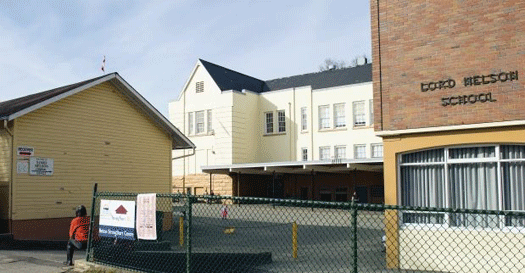
Lord Nelson Elementary School in Vancouver

Lord Nelson Elementary School, on Vancouver’s eastside, where I attended Grades 1 thru 3. The portable on the left is where I experienced a happy and rewarding Grade 2, in Mrs. Goloff’s class (I liked her, I thought there was a solid goodness about her and a genuine affection, as well as a deep respect, for students) from September 1957 thru June 1958.

In the summer of 1959, after I’d completed Grade 3 at Lord Nelson Elementary School in Vancouver (my memory of Grade 3 only slight), in August of ’59, my parents moved from Vancouver to Edmonton to be closer to family — on both my mother’s and father’s sides of the family.
In Alberta at the time, the provincial government had adopted what they called an “Enterprise Programme,” a focused academic programme meant to engage students intellectually while providing them with the tools they would require to compete successfully at post-secondary university. While all other Canadian provinces had adopted a two stream programme, one academic (university bound), the other vocational (meant to prepare students to work in the trades), Alberta was having none of that — educational achievement at the highest possible level was Alberta’s goal, the curriculum requirements rigorous, demanding and challenging, and consistently above grade level. The Enterprise Programme was defined by competition and the striving to become the best possible student — failure was never an option, doing your best was expected and required, academically and socially. Future leaders were being trained in Alberta.

“The provincial government meant to produce the best and the brightest, informed by a progressive educational ideology that Alberta was the first Canadian province to adopt in the 1950s, an educational philosophy that was child-centred, subject-integrated, with an activity-based approach, known in Alberta as the Enterprise Programme, focused on content centered courses in History, Geography, and Civics integrated into a new course: Social Studies, which was taught across all grade levels, this new subject emphasizing the development of democratic, co-operative behaviour, and inquisitiveness through experiential learning.”

Lynn Speer Lemisko & Kurt W. Clausen, Connections, Contrarities and Convolutions: Curriculum and Pedagogic Reform in Alberta; Faculty of Education, SFU, March 1, 2017

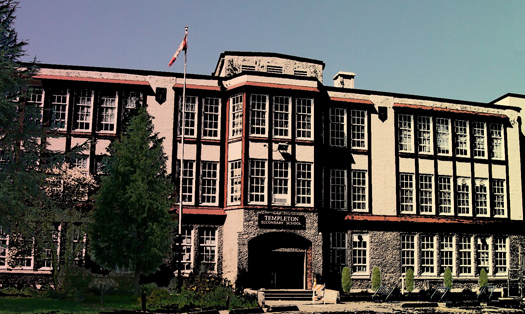
In the summer of 1962, my parents made the decision to return to Vancouver — the reasons are unclear to me, but whatever the case, in the summer of 1962, living at 2136 Venables Street, I found myself enrolled at Templeton Secondary School, then the toughest school in Vancouver (that mantle would soon be claimed by VanTech — but in 1962, Templeton was the school where all the toughest “juvenile delinquents” were enrolled, although truth to tell, many of the tougher students found themselves behind lock and key at the Brannen Lake Juvenile Correctional Facility).

Templeton Secondary School in Vancouver circa 1963

From Grades 7 through Grade 12, I attended Templeton Secondary. Based on my experience in Alberta, I was enrolled in the academic programme at Templeton, whereas every person I’d attended Grades 1 thru 3 with at Lord Nelson found themselves enrolled in the vocational stream. Odd, I thought to myself at the time. Another odd thing I found: from the spring of 1963 on, my grades never soared about a C-average — whereas in Alberta, I’d been a straight A student. Unlike most others enrolled in the academic programme, I was required to take vocational classes — and from Grade 8, I was enrolled in typing and secretarial classes, unlike any other student in the academic stream. Although a typing speed of 160wpm would serve me well later in life, I still found it odd, and just a bit concerning, that I was required to take three clerical classes each year through to graduation.
From Grade 8 on, I was also concerned that when I submitted an essay in Social Studies or one of my English classes, it either came back to me with a C, a D or a fail — with a comment from my teacher that someone other than me had written the essay, or I had either plagiarized or copied directly the work of someone else. By the time I reached Grade 12, where I had achieved an A- average in French, was taking the lead in the school plays, and editing the student newspaper, I was surprised and disappointed to receive a D in English, and a fail in History and Geography.
I recall one spring afternoon in 1968, the teacher having turned down the lights, with soft music playing in the background, the teacher asking the students in my Grade 12 English class to write a stream of consciousness essay, which I was only too happy to do. When I submitted the essay to the teacher, she took a glance at the essay and tore it up, saying to me, “You didn’t write this. You either copied it from someone else or had the essay prepared in advance (note. there had been no notice of a stream of consciousness essay taking place in class that day). You receive a fail for the essay. I’m disgusted with you.”

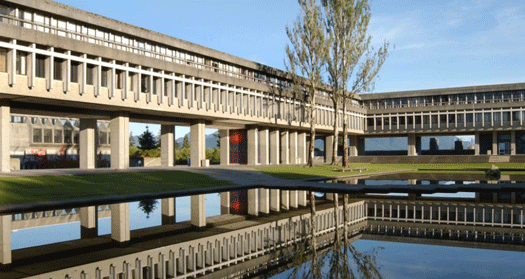
Simon Fraser University, Burnaby Mountain campus

A dozen years later, I was the Assistant Director of Teacher Training, PDP 401-402 at Simon Fraser University (a position I held while working on my Master’s degree). The English teacher referred to above had taken a seconded position as a PDP Faculty Associate — in essence I was her boss. When we first connected, in September, at the outset of the 1980 academic school year, almost the first words out of her mouth were, “I had a student with your name at Templeton Secondary. How odd that you should both have the same name,” at which point I informed her that the Raymond Tomlin she had taught, and the person standing in front of her was one and the same person. She looked aghast, stammering, “But how?”
I told her I had a 3.8 grade point average and two undergraduate degrees, and was currently enrolled in a Master’s programme at the university, letting her in on what I am about to write and record for posterity now …
In June of 1968, when I was about to graduate, as was the case with all of the other graduating students, I met with Ken Waites, the patrician, white-haired Principal at Templeton Secondary School, in his office with the door closed, and this is what he said to me …

“Well, Raymond, even though you’re a couple of courses short of graduation, given your failing grades in History and Geography, I am nonetheless going to graduate you anyway — because any kind of academic future is clearly not in the cards for you. I want to tell you something that we’ve kept from you for the past five years: for each of those years, you were recorded as having the lowest IQ of any student enrolled in the Vancouver school district, not just at Templeton, but city wide. Your teachers and I had often wondered, given your low IQ, how it is that you locomoted yourself from point A to point B. Someone with as low an IQ as you shouldn’t even be able to speak — but here you are.

You’ve probably wondered to yourself, why you were required to take three clerical courses each of the past five years. The answer is easy: you spell well, and it was clear early on that you had an aptitude for secretarial work, your typing speed and accuracy superior. Your guidance counsellor and I determined a long time ago that the best course in life for you would be to enter the clerical field, to be a secretary — because, clearly, you are possessed of no academic skill whatsoever, although you seem to have done well in French.

I have had these meetings with all graduating students, providing what I believe to be sound advice on how each student should proceed with his life following graduation. In your case, your best — and I would say, your only — hope is as a secretary. Thank you for meeting with me this afternoon, Raymond. All the best in your future.”

In 1970, my new wife insisted I enroll at Simon Fraser University, where students with an inferior academic record were being accepted, in order to build the student body. In my first semester at SFU, I achieved 3 C’s and two B’s. In my second semester, 3 B’s and 2 A’s — and every semester after that, straight A’s (not that I ever cared about grades, as did many of my fellow students — I was just hungry for knowledge, and curious about the world, eager to learn as much as I could, at one point early on not leaving SFU’s Burnaby campus over an 18-month period). I loved to read, I loved to write, I loved to learn, I was curious about everything — being at Simon Fraser University and hanging out with and being challenged by the best and the brightest was like a dream come true for me.
My curiosity about life, about all aspects of our existence on Earth remains to this day — I want to read all of the papers of record every day (and I do!), to engage with nation builders and city builders, to work with persons of conscience, to work towards better, fairer, more just. And I am afforded that opportunity each and every day, surrounded (outside of my plangent housing co-op life) by strong-willed persons of conscience who mean to build a better and more just world. As such, my life is near filled with joy!