Category Archives: Food & Health

COVID-19 | The Path | Outbreak, Epidemic, Pandemic, and Endemic

Not all infectious disease terms are created equal, though often they’re mistakenly used interchangeably.

The distinction between the words “pandemic,” “epidemic,” and “endemic” is often blurred, even by doctors. This is because the definition of each term is fluid and changes as diseases become more or less prevalent over time.

The word “endemic” is regularly mentioned, especially among public health leaders and experts as they discuss potential future scenarios. So, it’s important to define exactly what it would mean for COVID to be endemic.

Scientists predict COVID will become endemic over time but there will still be sporadic outbreaks where it gets out of control. The transition from pandemic to endemic will play out differently in different locations around the world.

While conversational use of these words might not require precise definitions, knowing the difference is important to help all of us better understand public health news and appropriate public health responses.

First let’s recap the public health terms Canadians have been increasingly using in conversation over the last 19 months. These words cover the lifecycle of disease and include “outbreak”, “epidemic”, “pandemic” and “endemic”.

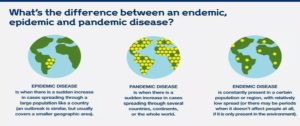
An outbreak is a rise in disease cases over what is normally expected in a small and specific location generally over a short period of time, as occurred in Wuhan, China in late 2019 and early 2020. Food borne diseases caused by Salmonella contamination provides another example of the outbreak phenomena.

Epidemics are outbreaks without tight geographical restrictions. The Ebola virus that spread in 3 West African countries from 2014–2016 was an epidemic.

A pandemic is an epidemic that spreads across many countries & continents around the world, as has been the case with COVID-19 over the course of the past 19 months. Past pandemic examples include those caused by influenza A(H1N1) or the “Spanish Flu” in 1918, HIV/AIDS, SARS-CoV-1 and the Zika virus.

What’s the usual path from pandemic to endemic?

A simple way to understand the difference between an epidemic and a pandemic is to remember the “P” in pandemic, which means a pandemic has a passport. A pandemic is an epidemic that travels.

But what’s the difference between epidemic and endemic?

An epidemic is actively spreading; new cases of the disease far exceed what is expected. More broadly, it’s used to describe any problem that’s out of control, such as “the opioid epidemic.”

An epidemic is localized to a region, but the number of those infected is significantly higher than normal. For example, when COVID-19 was limited to Wuhan, China, it was an epidemic. The geographical spread turned it into a pandemic.

Endemics, on the other hand, are a constant presence in a specific location. Malaria is endemic to parts of Africa. Ice is endemic to Antarctica.

Over time and arising from public health orders from mask wearing to vaccination, the pandemic could disappear like small pox and polio did — or it might gradually become endemic. The latter, most scientists agree, is the more likely scenario. Host, environment and virus factors combine to explain why some viruses are endemic while others are epidemic.

When we look at the SARS-CoV-2 virus that causes COVID, we see it is infecting human hosts with no prior immunity.

In terms of environment, the virus transmits better in cold, dry, crowded, close-contact, confined settings with poor ventilation. Each virus has its own characteristics, from speed of virus replication to drug resistance. The new COVID strains are transmitted faster and cause different symptoms.

Viruses are more likely to become endemic if they become adapted to a local environment and/or have a continuous supply of susceptible hosts. For COVID these would be hosts with low or zero immunity.

How long will it take for COVID-19 to become an endemic?
Most public health officials currently agree COVID is here to stay rather than likely to disappear like small pox. Scientific mathematical modelling provides some idea of likely COVID epidemic outcomes.

Globally, the road from pandemic to endemic will be a rocky one.

https://twitter.com/EDenhoff/status/1448531678561931269?s=20

In Canada, the federal government and provincial Premiers some time ago announced plans to re-open businesses, and soon that will be the case with borders, as well. The process of having done this has worked out better in some provinces than others. In the prairie provinces of Alberta and Saskatchewan, the fourth wave of COVID has taken a particularly strong foothold — resulting in a virulent and devastating epidemic renewal of COVID.

People are dying, and our health care system has been challenged.

Vaccination rates will protect many — as will the vaccine passports that have been issued in all provinces across the country — but there are still those who won’t get vaccinated, which puts all of us at much greater risk.

With time, though, scientists predict COVID will become more like the common cold coronaviruses. Despite periodic spikes in caseloads each season or immediately after relaxation of economic, social, and travel restrictions, COVID will eventually become more manageable, and by next spring we could very well be out of the worst of COVID-19, and the worst impacts of the Delta variant.

Countries will not enter an endemic phase at the same time because of variable host, environmental, virus factors including vaccination rates. Because of Canada’s high vaccination rate, our country is much more likely to proceed to the endemic stage than our neighbours to the south.

The availability and roll-out of booster vaccine shots each year or season will also shape the path towards the transition to an endemic. Poor vaccine coverage could allow the virus to continue at an epidemic level for longer — as would appear to be the case in the northern health, Fraser Valley East and Interior / Okanagan and Kootenay regions of our province.

Once we see a stable level of SARS-CoV-2 transmission indicating a new “baseline” of COVID, we will know the pandemic has ended and the virus is endemic. This will include seasonal trends as we see now with flu, and next autumn a dual flu and COVID shot, currently being developed by Pfizer and NovaVax.

The most important thing all of us can do to help reach a safe level of endemic COVID is to ensure that our families and each of us gets vaccinated and that we continue to adhere to COVID-safe practices, like social distancing, mask wearing and staying home when we’re not feeling well.

By doing so we protect ourselves, our families, all those around us, as together we move collectively towards an endemic phase of the COVID-19 virus that has had us in its grip since March 2020.

If we fail to work together in common cause, things could turn for the worse very quickly and prolong the end of the pandemic — which none of us want.

Over 50? You Need to Get A Shingles Shingrix Shot.

Are You Over 50? Then, You Need to Get a Shingles Shingrix Shot SOON !!!(Republished as a public service, a VanRamblings repost of an April 22, 2018 column)

Today is Earth Day. How can you play your part?

Well, if you’re a senior, or over the age of 50, maybe by not dying prematurely from the stress and pain associated with the varicella zoster virus (shingles) or postherpetic neuralgia, so you can be around to witness, participate in and contribute to making ours a greener and more environmentally sound planet.

Are you over the age of 50, or do you have a parent, friend, spouse, relative, neighbour or colleague who is over the age of 50? If so, you or someone close to you will want to make arrangements this coming week to have the new Shingrix vaccine administered at your, or their (if it’s someone you’re advising) doctor’s office, or local pharmacy.

Those aged 50+ are susceptible to contracting shingles, probably the single most painful and sustaining malady a middle-aged or older person might experience.

Many millions of North Americans, especially those aged 50+, are susceptible to an attack of shingles, caused by the same virus that causes chickenpox.

Once the varicella zoster virus infects a person, it lies dormant for decades in nerve roots, ready to pounce when the immune system is weakened, say, by stress, medication, trauma or disease. One-third of North Americans eventually contract shingles, but the risk rises with age; by age 85 half of adults will have had at least one outbreak of shingles.

Just have a look at the following testimonials (as always, click on the preceding link) …

Comment from Francie, age 66

I had the worst pain from shingles, it was just off the charts! I was unable to sleep, eat, walk, or talk for three months.

Comment from David, age 70

On March 26, 2015, I had my first annual anniversary with the horrible and constant pain of post herpetic neuralgia (shingles). The first 9 months was a nightmare; especially at night. It’s in my armpit, and all along my shoulders; so it’s too painful to have clothing or even a sheet touching my skin. Nothing helped even as new medications appeared. My doctor tried everything and couldn’t understand why my shingles just got worse. He told me he’s had patients who suffered with shingles for 7 years. So by the time this goes, I’ll be dead; or want to be.

Once you’ve contracted shingles, there’s nothing you can do about it, except live as best you can with the pain and the prejudiced lifestyle.

Shingles: blisters, fatigue, infection, pain, itching, red rash, virus, burning

However, there is something you can do to prevent contracting shingles.

Merck’s Zostavax was first brought to the market in 2008, with an efficacy rate that reduced the risk of shingles by 51%, and a 67% preventive rate of contracting shingles a second time. Good, but not good enough.

This year, however, a new medication from Glaxo-Kline, called Shingrix, came onto the market, that studies indicate reduces the risk of contracting shingles by 97% for people in their 40s, 50s and 60s, and 91% for those in their 70s and 80s, also reducing the risk of contracting shingles again by 86%, lasting much longer than its Zostavax predecessor, which starts to lose its protection after only 3 years.

Needless to say, we had the Zostavax vaccine administered some years ago, and have now had the first of two Shingrix shots administered.

Sharon Livingstone, a gerontologist, is 'adamant' that people get the Shingrix vaccine.
Sharon Livingstone, a gerontologist, is ‘adamant’ people get the Shingrix vaccine. She herself got the Zostavax shot 10 years ago but, as can happen, she contracted shingles four years ago. She now encourages the seniors she sees to be vaccinated with the new and more effective Shingrix vaccine.

The headline in the January 1, 2018 Globe and Mail article, by health reporter André Picard, called Shingrix “a game changer” …

More than 130,000 Canadians are diagnosed with shingles each year — most of them seniors.

Anyone who has had chickenpox — which is about 90% of people born before 1995 — can develop shingles later in life, and about one-third do. The varicella zoster virus lies dormant for years, or decades, and erupts for reasons that are unclear, usually after age 50.

The pustules on the skin are bad enough, but one in eight of those afflicted with shingles suffer post-herpetic neuralgia, the medical term for lingering and sometimes debilitating nerve pain. The virus can also destroy nerves, causing blindness or deafness and, in rare cases, lead to grave infections such as meningitis and flesh-eating disease. Shingles also increases the risk of heart attack and stroke.

Yet, the misery that befalls so many is largely preventable.

Now there is a new vaccine, Shingrix, that dramatically improves protection — showing itself to be up to 97 per cent effective in large clinical studies.

“This is a game-changer,” says Dr. Iris Gorfinkel, a Toronto physician.

The blisters arising from a shingles incident tend to heal in a week or two to form crusty scabs that eventually fall off. But for about 15% of people, shingles does not end there. Instead, it leaves them with deep, searing nerve pain — a condition called postherpetic neuralgia, or PHN — that can last for months or years and has no treatment or cure. More than half the cases of PHN affect people over 60.

Make arrangements this week with your family doctor to get the new Shingrix vaccine

VanRamblings first became aware of shingles when a neighbour contracted the infection 5 years ago. For a period of one year, he couldn’t move out of his co-op apartment, couldn’t sleep (except when he passed out from exhaustion), wearing any kind of clothing was near impossible, and having anything touch his skin brought him excruciating pain. Every male in VanRamblings’ housing co-op, and all of VanRamblings’ close friends, made arrangements to have the $180, one time, Zostavax vaccine administered.

Now that Shingrix is on the market — requiring two shots, two to six months apart, at $150 apiece — all of VanRamblings’ close associates have either had the Shingrix shot, or are making arrangements to do so. Note should be made that — thanks to our new New Democrat government over in Victoria — British Columbia is the only province in Canada that allows pharmacists to administer the Shingrix vaccine (which is where we got the first of our two shots on Wednesday this past week).

You will need a prescription from a doctor, though. And, yes, as the video below suggests, there is some (ouch!) pain involved — even five days later — and a lingering malaise. But, hey, VanRamblings is still posting everyday, so it can’t really be that bad, can it (it’s not, we’re just a big baby)?

And, oh yeah, make arrangements this week to get your first Shingrix shot.

COVID-19 | Twindemic | Run, Don’t Walk, To Get Your Flu Shot This Autumn

Dr. Brian Conway has advice for anyone thinking about getting a flu shot this fall.

“Run! Don’t walk to get your flu shot,” he said, speaking from his office at the Vancouver Infectious Disease Centre. “I think there is great consensus behind the statements that there will be a significant influenza season going forward.”

Getting your flu shot may do more than just protect you against the influenza virus — it may also prove to be protective against the most severe effects of COVID-19, according to an extensive new analysis presented online at the European Congress of Clinical Microbiology & Infectious Diseases (ECCMID) in August.

The study, titled “Examining the potential benefits of the influenza vaccine against SARS-CoV-2: A retrospective cohort analysis of 74,754 patients,” was published in the peer-reviewed scientific journal PLoS One on August 3rd. This was the largest study of its kind and analyzed deidentified patient records from around the world, which strongly suggested that the annual flu shot reduces the risks of stroke, sepsis, and deep vein thrombosis (DVT) in patients with COVID-19. Patients with COVID-19 who had been vaccinated against the flu were also significantly less likely to visit the emergency department or be admitted to intensive care.

“Only a small fraction of the world has been fully vaccinated against COVID-19 to date, and with all the devastation that has occurred due to the pandemic, the global community still needs to find solutions to reduce morbidity and mortality,” said senior study author Devinder Singh, M.D., a professor of clinical surgery at the Miller School.

“Having access to the real-time data of millions of patients is a powerful research tool,” added Dr. Singh, who conducted the study with medical residents Susan Taghioff and Benjamin Slavin, M.D., both of whom were lead authors. “Together with asking important questions, my team has been able to observe an association between the flu vaccine and reduced morbidity in COVID-19 patients.”

“Continued promotion of the influenza vaccine has the potential to help the global population avoid a possible ‘twindemic’ — a simultaneous outbreak of both influenza and coronavirus,” Taghioff said. “Regardless of the degree of protection afforded by the influenza vaccine against adverse outcomes associated with COVID-19, conserving global health care resources by keeping the number of influenza cases under control is reason enough to champion efforts to promote influenza vaccination worldwide.”

The egregious flu season researchers see looming on the horizon is due, in part, to last fall and winter when influenza was effectively eliminated in British Columbia and across Canada, thanks to COVID-19 health orders preventing gatherings and travel, while promoting physical distancing, mask-wearing and hand-washing.

But, with social life now returning to normal, zero flu last season will have consequences this season: the population is likely now more susceptible to the virus.

“People don’t have any built-up immunity that they might have [developed] from a flu season last year, or from getting their [flu] shots last year, or both,” said Conway. “So we’ll go from the best year on record for influenza to something other than that.”

Two companies, Moderna and Novavax, have announced they are working on a combined flu and COVID-19 vaccine, which Conway believes will be the future.

“There’s an expectation that COVID is going to be around for a while. Flu, obviously, has been around for a long while and will be around and we’re just going to be vaccinating people for both on a yearly basis,” Conway said. “But for now, please run and get your flu shot.”

The B.C. Centre for Disease Control said the flu shot is expected to be widely available by mid-October, either at your doctor’s office or through your local pharmacy.

#COVID19 | Canada Falls Behind | Number of Vaccinations Low

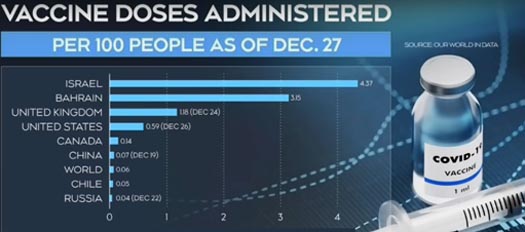
Canada falling behind in vaccine doses administered, in comparison with other countries

In comparison with other countries across the globe, Canada’s roll-out of the two approved COVID-19 vaccines, Pfizer-BioNTech and the Moderna coronavirus vaccine has proved significantly more challenged, and much slower when compared with vaccine roll-outs in many other countries.
Oxford University’s online tool Our World in Data, from which the information in the graphic at the top of today’s column was obtained, has Canada listed far below other countries like Israel and Bahrain, when measuring vaccines administered per 100 people …

  • Canada at 0.14

  • United States at 0.59
  • United Kingdom at 1.18
  • Bahrain at 3.23
  • Israel at 4.37

In Canada, the slow pace is being blamed on limited supply, poorly planned vaccination programmes in some provinces, and the technical deep-cold storage required for the Pfizer vaccine.
Approximately 242,000 doses of the Pfizer vaccine and 168,700 doses of the Moderna vaccine, for a total of just over 410,000 overall vaccines had arrived in Canada by early this week.

President-elect Joe Biden has promised that 100 million American will be immunized in first 100 days of office

In the United States, President-elect Joe Biden has promised Americans that by the end of his first 100 days in office, or near the end of April, more than one hundred million COVID-19 immunizations across the U.S. will have been administered. To meet that goal, which works out at a million immunizations a day, Biden acknowledged that his administration would need to move several times faster than Trump administration roll-out, and vowed to invoke the Defense Production Act to accelerate vaccine production and launch an education campaign to tackle vaccine hesitancy.
In other words, before the end of April 2021, one-third of all Americans over the age of 18 will have been immunized against COVID-19. Biden has promised that by June 30, every American who wants a vaccine will have received a coronavirus immunization, to protect them and their families.

British Columbia plans to immunize 400,000 B.C. residents by March 31, 2021

Meanwhile, in British Columbia, Public Health Officer Dr. Bonnie Henry has stated that B.C. plans on immunizing 400,000 people against COVID-19 by late March of 2021, with priority given to residents and staff of long-term care homes and health-care workers — that would be fewer than 10% of British Columbians over the age of 18 will be vaccinated by March 31st.
Federally, in a sombre pre-Christmas Day message, Prime Minister Justin Trudeau told the populace roughly 375,000 Canadians, or one per cent of the Canadian population, should be vaccinated with the two-dose Pfizer shot by January 30th, with all Canadians who wish to be immunized due to be vaccinated by September 30, 2021 — three long months behind the U.S.

Canadian federal election in spring 2021 thought to be a strong possibility

Meanwhile, for all the bluster among federal political leaders about not wanting an election any time soon, the political truth is as cold as the winter’s wind: the potential for a spring 2021 Canadian election will, in all likelihood, become a reality, as Canadians once again head to the polls.
And what will emerge as the key issue in the upcoming 2021 federal election? Could it be the painfully slow, behind every other developed country in the world, “botched” roll-out of the life-saving COVID-19 vaccine to Canadians anxious to return to some sort of normalcy, sooner rather than later, in 2021 — with the possibility that Canadians might experience an almost usual summer season full of music festivals, Hollywood blockbusters, travel across our great nation sans the necessity of having to wear a mask, a Canada that will allow us to once again congregate with our family, our friends, our neighbours and colleagues in safety and good cheer.

Prime Minister Justin Trudeau expected to call a spring 2021 federal Canadian election

In addition to the already approved Pfizer-BioNTech and Moderna novel coronavirus vaccines, in the coming month Health Canada is expected to approve the following COVID-19 vaccines …

  • Oxford-AstraZeneca: 20 million doses;

  • Johnson & Johnson: up to 38 million doses;
  • Novavax: up to 76 million doses; with …
  • Medicago (up to 76 million doses), and Sanofi and GlaxoSmithKline (up to 72 million doses) also in the pipeline.

If Canada’s roll-out of the life-saving novel coronavirus vaccines is, indeed, slow, you can reasonably predict that Canadians will be not just disconsolate but might find themselves more raucously up in arms, and perhaps even bloody pissed that Canada has proved so slow off the mark.
If there’s no crying in baseball, there ain’t no winning in politics, either.