
After 265 arduous and often painful days of my recovery from prostate cancer surgery at Vancouver General Hospital, I can report to VanRamblings’ readers today that I am well on the way to a full recovery and that, at present, there are no hurdles in respect of my once upon a time prostate cancer that is of concern to me.
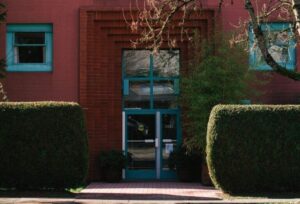
The front entrance to Broadview Housing Co-operative, in the heart of the Kitsilano neighbourhood
Today, then, allow me to provide you with some insight into my eight-plus month recovery journey, commencing in early November 2025, when I was bedridden and in immense pain, cared for by friends and neighbours — in particular regarding the latter group, my Broadview Housing Co-operative comrades and in-house health saviours / providers: Heather Redfern and Kevin Stewart, in particular, but also Judi Burley, Laurie Reid, Max Burley, Jordan Patrich, Bobby Asgari, Laurette Yelle, and Libbi Dowd — without whose caring, able assistance and dedication to working with me towards my recovery, I might very well not be here today.
 Meaghan, pictured above, was also a core saviour, the light in my life, during my recovery
Meaghan Brister also played a significant — dare I say, pivotal — role before and in the many months after my prostate cancer surgery. I’ve previously published a photo of Meaghan and her husband Alasdair’s 2-year-old daughter, Elliott, sitting at the bottom, on the left hand side, of my bed, an ever present Teague the dog nearby. The whole family have long been very close friends of mine (lucky me!).
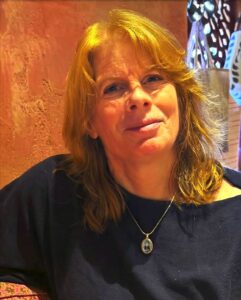 Perhaps most important of all over the past 16 months, my personal health saviour, Kelly Ryan
In the time to come, I will dedicate a whole column to Kelly, as I will to Heather — these two angels from heaven, more than any of my other deeply devoted caregivers and friends — were the difference makers in my life these past eight-plus months, who ensured I was eating enough to keep me alive (I had no appetite for months, my weight dropping to 135 pounds from 175 pounds a month prior to my October 31, 2025 prostate cancer surgery, and from an initial 225 pounds when I was first diagnosed with Stage 4 prostate cancer on September 5, 2024).
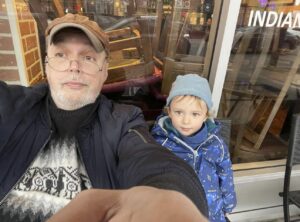 Raymond and Fergus when I weighed 225 pounds, when Fergus was 3 years (he’s 7 years old now)
Each month of my recovery brought some new variation and often uncomfortable transformation, very rarely pleasant, more often troubling and painful in the month of November 2025, requiring that I be hospitalized three times that month, carried out on a stretcher, and rushed to Vancouver General Hospital.

In the month of November, I suffered three hematomas, my bed and my apartment covered in blood prior to my being taken to hospital in an ambulance, Heather, Kelly and Kevin standing by to provide whatever assistance to the paramedics that was deemed necessary.
A hematoma is a sac of pooling blood — composed of red and white blood cells, platelets and fibrin and plasma — that accumulates when a blood vessel becomes damaged and then ruptures, causing blood to rush outside the body from deep within tissues, internal organs and various other body spaces, kind of like a burst blood clot, but messier and more concerning, not necessarily dangerous but should the deep bleeding emanate from inside the abdomen — which is where my invasive prostate surgery took place — can cause severe internal blood loss, leading to life-threatening shock.
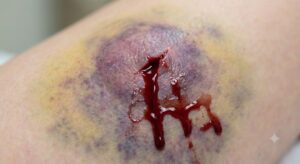
Each of my hematomas, once burst, poured blood from my body’s right side for hour upon hour, such that I woke up covered in blood, my bed soaked — like the scene from The Godfather, when the movie producer wakes up covered in blood — and as I attempted to get up, blood tracked throughout my apartment.
Finally, towards the end of November, upon my third hospitalization, urologic oncologist Dr. Amy Sherman came to visit me in my hospital bed, harrumphed and said, “Enough of this!”
Dr. Sherman then proceeded to “sew” up my wound subcutaneously, which served to permanently stop the blood flowing from my body.
I asked her, “Why are you the first doctor to come up with a subcuteneous resolution to my hematomas,” to which she replied (with a twinkle in her eye), “Because they are not as good, as skilled and knowledgeable a doctor as I am.”
Throughout November and December, I received daily care at home from a home care assistant — mainly responsible for cleaning me up, and bathing me in bed, while exploring the potential for a problem that required medical intervention.
In addition, a registered wound care nurse — who, as a group, are very well respected for the work they do — who visited weekly.
Just to wrap this up, and get to the “end”, if November was the month of hematomas, December was the month of fecal incontinence (don’t ask, it was messy), and January (for me, the worst month) a month of constipation that was painful and unrelenting.
February, as Heather visited her sister in Grand Forks for the first two weeks of the month, celebrating her birthday over on Vancouver Island during the latter two weeks of February — something she and her husband, Jason, have done for years — I was pretty much on my own, and left to my own devices.
Truth to tell, my appetite began to return (my neighbour Libbi, who herself was being treated for cancer, told me, “Raymond, the secret to recovering your appetite: the Filet O’ Fish at McDonald’s … and so it proved to be).
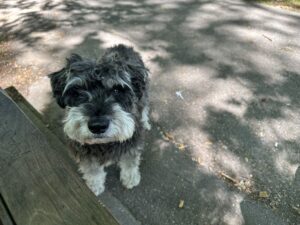
In February I was up and walking Teague the dog, slowly and fitfully, but walking throughout my Kitsilano neighbourhood nonetheless, initially with a walker and then with a cane, and eventually — much to my family physician Brad Fritz’s chagrin — I was walking, if a little unsteadily, sans cane or other mobility devices.
Three more notes of interest before I bring today’s Health Update post to a close …
-
- In early December, on my way to the washroom I passed out, falling to the floor. For six hours, I “slept” on the cold laminate flooring in my home. At the time, my apartment door was always open. At 7am, after my neighbour Jordan had been up all night wrestling with 2-year-old Wynn and 4-year-old Orlo to get them to sleep, he decided to look in on me. Seeing me sprawled out on the floor, Jordan — a husky, fit guy in his early 40s, and the only Broadview member strong enough to perform strength-requiring physicality — gently lifted me off the floor and into his arms, carrying me to my bed, whereupon he covered me up, as I fell back to sleep. Heather arrived precisely at 9am — as she did every day, 7 days a week, for three solid months — to feed me, do the dishes, clean the floors and put in a wash, emptying the garbage and doing the recycling, as well, finally leaving exhausted for her home on the third floor — having been informed by Jordan of my overnight “event;”
- Incontinence. Yep, one loses control of their bladder in the months, up to a year and a half after prostate cancer surgery (which, by the way, turns one into a eunuch which, truth to tell at near 76 years of age, has come as a welcome relief in my dotage). Recently, at Khatsalano Day making my way up West 4th Avenue from Macdonald Street, where I visited each of the political booths that had been set up, I was alarmed to discover the my entire front was soaked (in urine, both Donald Trump and I, alas). I took an EVO home, took a shower, and changed into clean clothing. I have come up with a resolution to the incontinence “leaking” — I wear a diaper, of course, but I place bamboo / cotton boxer protective underwear over top of the diaper, and voilà, no more embarrassing and compromising “leakage”;
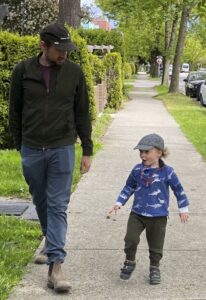 Alasdair and Fergus, ‘football’ and rugby stars both
- Saving the best for last. When I left hospital November 1 2025 — Alasdair and Fergus picking me up from the fourth floor urology recovery floor (a story all in itself) — to bring me home, as we were leaving, I was told that come the autumn of 2026, as my surgical team had not caught all the cancer, I would be subject to five weeks of, five-day-a-week radiation therapy at the B.C. Cancer Agency.
This past Monday, expecting a call from Dr. Miles Mannas, my skilled prostate cancer surgeon, my expectation was that I would be negotiating a date after the upcoming October 17 municipal election for my radiation therapy, which both Dr. Brad Fritz and my friend Roni Jones suggested should occur in the afternoon, because I would be beat in the morning, and barely able to get out of bed …
Roni, in response to my question, “How am I going to get to and from my apartment five days a week to arrive at the B.C. Cancer Agency, and then be ferried home more than a little worse for wear — both Roni and Brad told me that the latter three weeks I would be bedridden (gosh, just like last November). Roni came up with the suggestion of HandyDART for transportation!
At any rate, at 11:45am on Monday morning an ebullient Dr. Miles Mannas called me, cheerful, friendly, voluble and warm of spirit and cadence to say, as I began my radiation therapy negotiation, Dr. Mannas kindly interrupting me …
“Raymond, I don’t know who told you you’d be going in for radiation therapy in the fall, that we hadn’t caught all the cancer during your surgery last autumn. All of your current tests indicate you are cancer free, we caught it all. There is no necessity for you to subject yourself to radiation therapy, it’s simply not necessary.”
We spoke for awhile more, Dr. Mannas asking …
“So, how many diapers are you going through a day? ‘One’, I told him. “Only one,” he asked, a tone of surprise in his voice. “Yep,” I replied. “And how are you feeling these days, “Pretty darn good,” I replied. “I’m writing again, walking up to and beyond five kilometres a day with my dog, socializing with friends, and all and all, I feel as good as I did before I was diagnosed with prostate cancer almost two years ago.”
“And what about your pain medication, the hydromorphone? Have you found your way clear to reducing your pain medication intake?” I replied that I had not taken a hydromorphone tablet in over two months, and prior to that I had reduced my intake to a 1mg tablet most, and then, some days, that I was good.
We spoke for awhile more, as I said to him …
“As you may be aware, prior to my surgery last year, each of the four nurses, two of the anaesthesiologists, three of the surgeons who would be assisting you, and a number of other medical professionals who would be present in the operating theatre during my surgery, told me of how skilled you are, and how fortunate I was to have you as my surgeon. But they said more …
Each individual who visited me prior to my surgery told me how much they loved you, of your wry and boisterous sense of humour, how you always remembered their birthdays, how collegial and supportive you have been in regards to their careers, and their deep and abiding affection for you. We don’t always know what people are saying about us when we’re not around, not in the room. I thought it right to let you in on how much your colleagues respect and admire you, and how much you have added to the quality of their lives, and their work experience at VGH.”
There was a momentary pause, after which Dr. Mannas said …
“Thank you, Raymond. Your words mean a great deal to me. Really, I had no idea. Thank you for your kindness in letting me know. You’ve made my day!”
I thanked him for his skill and all the work he had put in, all of the tests and interventions in which he had engaged on my behalf over the past eighteen months, since he first began treating me in early January of 2025.
And with that, our call came to an end.

And now, all these months later, I am over the moon!