Category Archives: Food & Health

#SaveOurParkBoard | 80s Redux | Greed is Good

Tom Campbell, Mayor of Vancouver, 1966 - 1972
Tom ‘Not So Terrific’ Campbell, controversial Vancouver mayor, in office from 1966 to 1972

In 1966, running as an independent, a brash Tom Campbell defeated sitting Non-Partisan Association Mayor Bill Rathie to become Vancouver’s 31st mayor.

From the outset, Campbell’s ascension to the Mayor’s office heralded a pro-development ethos that would make even our current ABC Vancouver-dominated City Council blush, with Campbell — and his now ‘on board’  NPA colleagues — advocating for a freeway that would cut through a swath of the Downtown Eastside, require the demolition of the historic Carnegie Centre at Main and Hastings, and bring about the construction of a luxury hotel at the entrance to Stanley Park.

Vancouver's West End, 1960s, pre high-rise development
Vancouver’s West End neighbourhood, 1960, pre-high-rise construction. Photo, Fred Herzog.

In the West End, where Campbell owned substantial property — a wealthy, successful developer, Campbell was reputed to own one-third of the land located between (south to north) Davie and Georgia streets, and east to west, Denman Street and Stanley Park — the newly-elected Mayor all but ordered the demolition of almost the entirety of the well-populated West End residential neighbourhood — housing mostly senior citizens in their single detached homes — as he set about to make way for the rapid construction of more than 200 concrete high-rise towers.

In six short years, Mayor Tom Campbell and the Non-Partisan Association transformed a single family dwelling West End neighbourhood, irrevocably and forever.

That all of these “changes” augered controversy among large portions of the populace was a given, leading to regular, vocal and sometimes even violent protests throughout Campbell’s treacherous tenure as Mayor, finally lead to his overwhelming defeat at the polls in the November 1972 Vancouver “change” civic election.


Oct. 22, 2022 | Newly-formed civic party, ABC Vancouver, wins an overwhelming victory at the polls

Why raise ancient history now?

Not since the late 1960s / early 70s have Vancouver voters — seemingly, unknowingly — elected a more greed-inspired (this, on behalf of their financial backers), and wildly pro-development slate of lock step Vancouver City Councillors to office, at the heart of our city’s seat of municipal government at 12th and Cambie.

In early 2024, Vancouver sits on the wary edge of massive tower development, as promulgated by the “super majority” ABC Vancouver civic administration installed by Vancouverites at City Hall only 15 short months ago today. If Tom Campbell’s greed was able to destroy a single family-oriented West End neighbourhood 50+ years ago over six short years in power, imagine what the current ABC Vancouver-led municipal government can achieve over the course of the next 32 months?
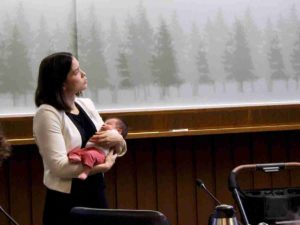

Vancouver Park Board Commissioner at Vancouver City Hall, holding her new, month old baby

Click on this link to hear (former, and now independent) ABC Vancouver Park Board Commissioner Laura Christensen address the whole of Vancouver City Council on December 13, 2023 —  including her ABC Council running mates —  on the initiative of the political party she ran with to eliminate the elected Vancouver Park Board.

In her address to Council, Ms. Christensen pointed out to her now former ABC Vancouver City Council colleagues that there are 242 parks in the City of Vancouver, only 142 of which are designated as parks — leaving these latter non-designated “parks” open for development, including such beloved parks as Burrard Inlet’s Sunset Beach, Locarno Park, and Spanish Banks East and West.


Fans enjoy the Vancouver Canadians at Nat Bailey Stadium. Could the city-owned stadium be put up for sale? A report suggests sport & cultural venues should be shed by the city. Photo: Jason Payne /PNG

In an article published in the Vancouver Sun on Saturday, the Sun’s civic affairs reporter Dan Fumano writes that a …

“… budget task force assembled last year by ABC Vancouver Mayor Ken Sim delivered its report with 17 recommendations on how the city could improve its financial health while reducing pressure to increase on property taxes.

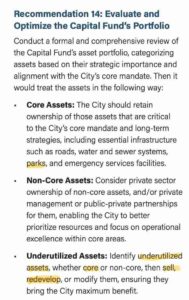
One recommendation suggests the city look at divesting some of its “non-core assets.”

When Fumano asked ABC Vancouver Councillor Brian Montague, one of two ABC Councillors who served on the task force’s advisory panel, if the “non-core assets” in the report would include include community centres, libraries, civic theatres, and sports facilities, Montague replied …

“I think it’s something we need to talk about, because there might be assets where divestment is the best approach.”

Former Vancouver Park Board Chairperson John Coupar clarified the matter on X:

Former Vancouver City Councillor Colleen Hardwick, and 2022 TEAM Mayoral candidate writes …

So, that’s it.

The reason for dismantling an elected Park Board?

A cynical and egregious land grab, a decision demanded by ABC Vancouver’s avaricious financial backers, who fancy adding billions of dollars more to their already ungainly wealth, all at the cost of: environmental devastation and climate change unchecked, a degraded quality of life in Vancouver for decades to come, reduced access to our public beaches — or, in some cases, no access at all to what were once but would no longer be “public beaches”— and long dark corridors of black towers lining the arterials and Vancouver’s beach fronts, all across the city.


Click / tap on the graphic above to sign  the Save Our Park Board Petition started by Sarah Blyth

#CDNPoli | Canada’s New Dental Care Programme


Don Davies, NDP member of Parliament for Vancouver Kingsway, since 2015.
Father of Canada’s new Dental Health Care Programme, and Dental Care for Canadians.

On Monday, December 11, 2023, the Canadian government announced a new Dental Care Programme that will cover the 9 million Canadians who do not, at present, have dental coverage.

“Far too many people have avoided getting the care that they need simply because it was too expensive, and that’s why the Dental Care Programme is essential to the health of Canadians,” federal Health Minister Mark Holland told the news conference held in early December 2023, introducing the new programme.

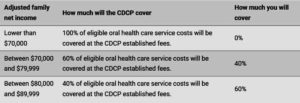
The Canadian Dental Care Programme when fully implemented will provide dental care to families whose annual net income is less than $90,000, and who don’t have access to private insurance. Full coverage, with no co-pay will be available to families whose annual net income falls below $70,000, while Canadian families with an income between $70,000 and $90,000 will pay a co-pay fee, as per the chart above.

Canada’s federal Finance Minister, Chrystia Freeland, set aside and has budgeted $13 billion over a five-year period, commencing in early 2024, to pay for Canada’s new Dental Care Programme, introduced in her most recent budget, on Tuesday, March 28, 2023, or $2.6 billion per year drawn from Canada’s current annual federal budget of $497 billion dollars, which is to say, 0.523139 per cent of our annual federal budget, just a tad over half a per cent to fully cover the 9 million Canadians across our land who currently suffer without any dental coverage.

The introduction of Canada’s new Dental Care Programme occurs as a consequence of the Supply and Confidence Agreement struck on March 22, 2022 between the governing Liberals and the opposition New Democrats, that since its implementation has affected legislation introduced by Justin Trudeau’s federal Liberal party, ranging from legislation that bans the use of replacement workers (scabs) in federally regulated workplaces during a strike or lockout; Bill C-58 preventing employers from hiring “scabs” to do the work of unionized employees on strike or locked out, to the implementation of a groundbreaking dental care programme that will cover 9 million Canadians currently without dental care coverage.

Negotiation for an inclusive Canada-wide dental care programme began shortly after the signing of the Supply and Confidence Agreement, the negotiation involving then federal Liberal Health Minister Jean Yves-Duclos, and the New Democratic Party’s well-respected Health Care critic, Vancouver-Kingsway MP, Don Davies.

For much of the past two and a half years, the negotiation for an expansive and inclusive, publicly-funded Canadian dental care plan was an uphill battle for NDP Health Care critic Don Davies, as Jean Yves-Duclos and Mr. Davies parried back and forth, the process of realizing the new programme an at times arduous, unresponsive and unforgiving one. All that changed for the better, though, in recent months.

Don Davies is, indeed, Canada’s dental health care warrior, and the father of publicly-funded dental health care in Canada, as Tommy Douglas was the father of Medicare. For Don Davies, patience and persistence has paid off for all Canadians.

Final negotiation for the introduction and implementation of Canada’s new Dental Care Plan began in earnest when Don Davies’ good friend, former Liberal House Leader Mark Holland was appointed as Canada’s Health Minister, in September.

Mark Holland and Don Davies are known on Parliament Hill as Batman and Robin, are very good friends, and on the same page when it comes to social legislation. When making the announcement of Canada’s new dental care programme last month, very much together on the same stage, at the same podium, you could see their obvious affection for one another, as well as pride and joy at a job well done.

Canada’s new Dental Care Plan will be phased in over the course of the next year.

Now: the details of the phase in strategy, how and how much dentists will be paid, and what the new Dental Care Plan will cover, as told to VanRamblings by Don Davies at a Town Hall conducted in his riding, in November, just prior to the federal government’s announcement of the implementation of one of the largest, most inclusive pan-Canadian social programmes legislated into being in the past 50 years.

Mr. Davies told those assembled at the Town Hall that in 2022 – 2023 an exhaustive search took place to identify an insurance corporation that could efficiently and effectively administer Canada’s proposed new Dental Care Programme.

In June 2023, Mr. Duclos and Mr. Davies made the decision to turn over the administration of Canada’s proposed new Dental Care Plan to Sun Life Canada, one of our country’s largest public companies, and at present one of the world’s largest multi-national life and health insurance, and asset management companies.

The following is the mandate of Sun Life, the task they have been charged with by the federal government that will lead to the realization of Canada’s new Dental Care Plan, covering the 9 million Canadians currently without dental insurance …

  • Sign up 90% of Canadian dentists to the country’s new Dental Care Plan. Dentists will be paid 85% of their province’s Dental Fee Schedule. Sun Life is to reimburse dentists within 48 hours of dentists submitting their claim to Sun Life Financial;
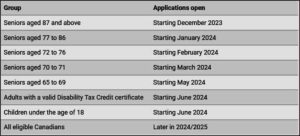
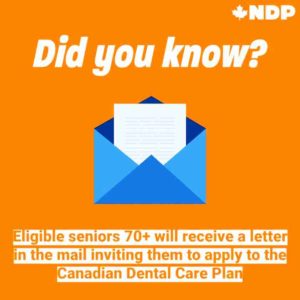
  • In December 2023, Sun Life began signing up all eligible Canadians aged 87 and older, with eligible seniors set to be contacted and signed up in March 2024. Dental coverage for the former group is set to begin as early as May 2024;
  • Effective June 2024, Sun Life will begin to sign up all eligible Canadian children, birth to 18 years of age, dental coverage for this cohort to begin this late summer;
  • All remaining eligible Canadians will be registered for Canada’s new Dental Care Programme effective this autumn, with implementation of coverage for this cohort to start at the beginning of, or early in 2025.

Thus far, the roll-out of Canada’s new Dental Care Programme moves on apace, with the sign-up of Canadian dentists moving ahead as projected, with the sign-up of Canadians also moving ahead as projected, the Dental Care Programme set to be fully realized by the end of 2024, covering the 9 million eligible Canadians.

Applications will open in phases, starting with seniors aged 87, which began in December 2023, followed by other age groups as per the chart above.

Coverage under the Canada’s new Dental Care Plan will commence as early as May 2024, with seniors being the first group eligible. The actual start date for accessing oral health care will depend on the specific group you belong to, the timing of your application, and when your enrolment is processed.

Now for the part you’ve been waiting for: what dental procedures will be covered ?

  • Oral surgery services, including tooth extractions;
  • Restorative services, including fillings for cavities, cracks, and broken teeth;
  • Crowns, but as Mr. Davies told VanRamblings last week, “only if medically necessary.” As an example, if you have a crown, but the gums beneath the crown become infected and in order to resolve the infection, the existing crown must be removed, and replaced, such would be considered “medically necessary”, and the expense involved in the dental work, taking an impression of the crown/tooth, and the manufacture and subsequent Crown placement in your mouth would be fully covered;
  • Repairing a chipped tooth, bonding the most likely repair route your dentist will likely recommend;
  • Root canals (endodontic therapy), the dental treatment for infections in tooth pulp, the innermost layer of your teeth;
  • A full and in-depth teeth cleaning, including scaling, sealants, a flouride treatment (if so desired) and polishing;
  • Dental X-rays, to evaluate your dental health;
  • General anesthesia, also known as deep sedation dentistry, if required;
  • Partial and complete dentures;
  • Orthodontic services, including braces and retainers, and much more;
  • Periodontal care, the branch of dentistry that focuses on the health of your gums and jawbone — the tissues that support your teeth. A periodontist is a gum specialist.

At present, the only dental procedures that will not be covered — unless they are considered medically necessary — are veneers and tooth implants, which are considered to be cosmetic dentistry, rather than a medically necessary procedure.

In somewhat related good news, federal Conservative Party leader, Pierre Poilievre, who last spring in Parliament, and in front of crowds at the Trump-like rallies he holds, was adamant that the first two “fiscally prudent” measures he would take upon becoming Prime Minister would be to cancel $1.3 billion in annual funding for the CBC, cutting as well the annual $2.6 billion funding for public dental care, has for the latter — according to Lisa Raitt, former Minister of Transport / Labour / Natural Resources during the 10-year term of the Stephen Harper government — in a recent discussion on CTV News Channel’s Power Play with Vassy Kapelos, told Ms. Kapelos that Mr. Poilievre, recognizing that by the time the next federal election rolls around in the fall of 2025 that Canada’s new Dental Care Programme will be fully implemented and popular with Canadians across the land, and because becoming Prime Minister is of paramount importance to him, has reversed himself on his commitment to cancel the Dental Care Programme …

” … as Erin O’Toole did in 2019, when initially he told Canadians that a key plank in his platform would be to cancel the wildly popular Canada Child Benefit, reversing himself on the matter before the 2021 federal election, lest it become an issue that would cause his defeat. Canada’s new Dental Care Plan is here to stay,” Ms. Raitt told Ms. Kapelos, and her fellow panel members.

Once enrolled, Canadian residents who qualify will be sent a welcome package by Sun Life, with a member card and a starting date for when their oral health care services will be covered. Those Canadians who are eligible for enrolment in the new Dental Care Plan will be able to start experiencing oral health-care as early as May 2024, as above, commencing with coverage for Canada’s seniors population.

COVID-19 | Omicron | Winter of Our Discontent

Amidst rising COVID-19 cases — mostly the less virulent, but 3 to 5 times more transmissible Omicron variant — with reimposed restrictions by public health authorities, more stringent mask mandates, a speeded up mRNA booster programme (at least in some Canadian jurisdictions, if not in British Columbia), more testing, renewed travel advisories, the closure of bars and gyms, and the likely prospect of increased infections and restrictions in the days to come and over the next couple of weeks, Christmas 2021 is quite not what most people had hoped it might be.

A couple of weeks back, on the day federal Finance Minister Chrystia Freeland presented her budget update, Politico Canada’s Nick Taylor-Vaisey reported that while interviewing senior government officials in lock up, the Deputy Ministers of Health and Finance, as well as representatives from the Prime Minister’s office, told the gathered journalists that the federal government doesn’t foresee Canada “getting a handle on” COVID-19 until the summer of 2023, at the earliest.

Although the likelihood is great that late spring and early summer 2022 will see a reduction in the number of COVID-19 infections — as was the case in the summers of 2020 and 2021 — next autumn and winter, including the holiday season in 2022, will in all likelihood mirror what we’ve all experienced over the course of the past almost 22 months. Sad and disappointing news, but our new collective reality.

British Columbia’s Public Health Officer, Dr. Bonnie Henry, told British Columbians last Tuesday that all British Columbians will likely become infected with the Omicron variant, clarifying her statement this past Friday, saying that, “All British Columbians will come into contact with Omicron in January.”

Jens von Bergmann, data scientist with British Columbia’s COVID-19 Modelling Group

For the moment, Dr. Henry is choosing to ignore the advice of the B.C. COVID-19 Modelling Group. In an article published in the Vancouver Sun last week, the member scientists in the modelling group told reporter Lisa Cordasco that …

“An Omicron tidal wave is coming, hospitals will be overwhelmed — although 20 to 40 per cent fewer people will end up in hospital, as Omicron cases skyrocket our health care system will be challenged,” said Jens von Bergmann, a data scientist and a member of the modelling group, who went on to say that “although most people who are vaccinated will suffer only mild symptoms from the Omicron variant, the sheer number of people becoming infected across British Columbia will mean that many of our fellow citizens will suffer severe illness and death.”

“It is not clear to me that we have done enough and I think there is a very good chance that it is not (enough),” said von Bergmann. “If we have large indoor gatherings, these are opportunities for super spreader events. That certainly includes large sporting events like Canucks games, or going to restaurants to dine.”

The member scientists in British Columbia’s COVID-19 modelling group said they believe the only way to prevent super spreader events is, at a minimum, by shutting down all restaurants and indoor public events for three weeks.

On Tuesday December 21st, Dr. Henry ordered all bars, nightclubs, gyms, fitness centres, yoga and dance studios to close, and limited sports venues to 50% capacity until Tuesday, January 18th.

The members of B.C.’s COVID-19 modelling group have stated emphatically that the actions of British Columbia’s Public Health Office, and B.C.’s Ministry of Health taken to date are far from adequate to meet the challenge of the fast spreading Omicron variant. This past Friday, Health Minister Adrian Dix told reporters at the hastily-called 10 a.m. press conference that this coming Wednesday, December 29th, he and Dr. Henry will hold another press conference that could very well include more restrictions.

As is the case with many people, VanRamblings has chosen to stay close to home for the next month, going out only to shop for groceries, when we wear our Health Canada-recommended three-layer mask with a polypropylene melt blown 5 layer pm2.5 Activated Carbon filter, placing a new filter in the mask each week.

Where we’d planned to spend much of the holiday season sequestered in one darkenend cinema or another, due to the spread of the Omicron variant, we have opted for safety over indulgence, and instead have chosen to spend our evenings in front of the luxurious 4K screen in our home theatre system, taking in all of the soon-to-be Oscar nominated films available on streaming platforms such as Netflix, Amazon Prime of Apple TV, or setting about to watch Oscar nominatable films available On Demand through our service provider.

Safe, rather than sorry.

The salutary aspects of the Omicron variant: it burns bright, but just as is the case with a shooting star, it begins to burn itself out — in the case of Omicron, within a month, and six weeks in settles down, with case counts plummeting.

Far fewer of those who contract the Omicron variant will be hospitalized, or die. If one is wise and does not place themselves in harm’s way by going out to restaurants, or attending large sporting or other events inside, the prospects are good that you’ll survive Omicron, and go on to thrive, and live another day.

This afternoon, after 3pm, when the province releases its 3-day totals for Friday to Saturday, Saturday to Sunday and Sunday to Monday, if the three-day infection total tops 10,000 — in spite of the fact testing capacity is topped out, and all those who’ve contracted the Omicron variant can’t possibly be reflected in the COVID-19 infection numbers that will be released this afternoon, as a variant on what Dr.  Henry told British Columbians last week, “We’ll be in a whole new ballgame.”

If infections rates are indeed climbing, come Wednesday British Columbians can reasonably expect to find a new and varied set of restrictions imposed, up to and including, in the worst case scenario, a circuit-breaker lockdown.

Note Belgian virologist, Dr. Guido Vanham (right) and his son, Peter

Today, we’ll leave you with a hopeful note, a letter sent by Dr. Guido Vanham, a Belgian virologist, to his family on how best to protect themselves — and by extension, us — from the Omicron variant. You may read the entire letter by clicking on the link available at the top of this paragraph.

In part, here’s how the letter reads …

Dear grandchildren,

Your mom and I are so very much looking forward to celebrating the holidays with you — and especially with the newest member of our family! We’re so glad you’re all safe and that Valeria had a good pregnancy and got herself protected by taking a vaccine (and soon a booster) early.

Sadly, the Omicron “variant” of the COVID-19 virus is spreading all over the world now. And I know that you’re wondering: What should we expect? Is this going to be the first wave all over again or will we be better off?

My assessment is: This may be the most contagious variant yet, with a possible tsunami of infections and sadly little effect of the vaccines on that front. We therefore are better safe than sorry and should do everything we can to protect ourselves and those around us.

Here’s what I think you should know:

First, this Omicron “variant” is a new form of the COVID-19 virus, which causes a new wave of infections because it’s somehow more potent than the previous variant. Omicron is both more contagious than previous variants (Alpha, Beta, Gamma, Delta) and also escapes from the “immunity” the antibodies induced from the previous variants.

Omicron remains sensitive to the vaccine, but less than Delta. That’s why you need a third dose of the vaccine to help protect you from serious illness and hospitalization.

Unfortunately, even three doses don’t protect against the infection itself. If you’ve been vaccinated three times and still become infected, you’ll often hardly notice it: You may have a “common cold,” a sore throat, and sometimes a fever. So I know you’re all lining up for your boosters and you’re doing the right thing.

This pandemic will pass, just like the Spanish Flu a hundred years ago, but no one can predict when. I hope with all of you that this is our last COVID-19 winter, but I’m only a doctor and a scientist — and a father and grandfather — not a prophet …

Take care, and let’s hope we can still get together for the holidays, albeit extremely carefully,

Dad

You may click here to read Dr. Vanham’s letter to his son in its entirety.

COVID-19 | British Columbia Has Entered the Endemic Phase

Over the past weekend, VanRamblings had the opportunity to speak with a senior member of British Columbia’s public health pandemic response team, and the information with which we were provided was hopeful for B.C.’s near term future.

“British Columbia has entered the endemic phase of what we’ve all come to know as the pandemic this past 19 months, in fact, some while ago,” our unnamed source, unauthorized to speak on behalf of the office of British Columbia’s Public Health Office, told VanRamblings. “We’re not far off from removing mask mandates in those areas of the province where the full vaccination rate exceeds 90%, as is the case in Vancouver city proper, where the rate of fully vaccinated persons is currently 95% plus. Other regions of the province — Fraser Valley East, the Interior and Northern Health — have a ways to go before mask mandates, and other restrictions are removed by British Columbia’s public health office.”

VanRamblings asked the individual with whom we spoke about the current high COVID-19 infection rates we’re experiencing in British Columbia — most recently, the 3rd highest in Canada — and how this phenomenon might be accounted for …

“In British Columbia, we’re experiencing a series of super spreader events brought on by the unvaccinated members of regional communities, mostly situated in the three regions of the province where vaccination rates are low. Fully 98% of all COVID-19 hospitalizations and admissions to hospital ICU’s has occurred either within the unvaccinated community, or resultant from vulnerable vaccinated persons coming into contact with unvaccinated persons,” avers our public health source.

VanRamblings was told that in all likelihood British Columbians will be out of the worst of COVID-19 — even given the current and deadly virulence of the Delta variant — by early spring 2022, when life will return to some sense of “normal”, as we’ve all been observing now with capacity restrictions being lifted at Vancouver Canucks home games, within movie theatre complexes, and even at concerts.

When we asked our source about the 327 doctors, nurses and other health care professionals in British Columbia who have yet to get their first mRNA vaccine dose, our source simply rolled their eyes, muttering …

“As a health care professional, you are a scientist. Why you wouldn’t acknowledge the science on vaccines is beyond me? To say the least, that unfortunate development is disappointing, for those of us in the profession, and for all British Columbians.”

Or, as British Columbia Public Health Officer Dr. Bonnie Henry stated on Monday …

On balance, it is probable that the comfort level for most of us in the general public will not be alleviated until infection, hospitalization and ICU rates are observed as being significantly reduced, with COVID-19 death rates all but eliminated on most reporting days, and the rate of death from COVID-19 in B.C. minimal at worst.