Category Archives: BC Politics

#VanPoli | A Friendship | Vancouver City Councillor Colleen Hardwick


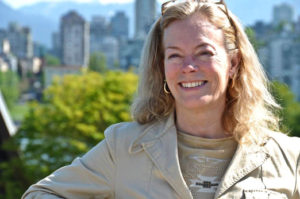
First term Vancouver City Councillor and 2022 Mayoral hopeful, Colleen Hardwick

In 2013, a group of community activists came together to Save Kits Beach, a community-led environmental response to a Vision Vancouver proposal to run a 12-foot wide asphalt bike path through Hadden and Kitsilano Beach parks.

Although I had known Colleen in the years prior to 2013 — both as an arts reporter writing about the film industry, in which she was involved, as well as working with her father, the late Dr. Walter Hardwick, in the late 1980s / early 1990s on the Livable Region Project — it was not until 2013 that Colleen and I came to know each other better, working on Save Kits Beach, when we first became true friends.
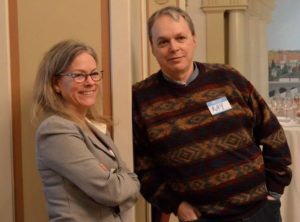
In mid-2016, when I was diagnosed with hilar cholangiocarcinoma, Colleen gave me a call one morning, and in her inimitable, straightforward manner exclaimed boldly to me over the phone, “If you’re going to beat this thing, Raymond, you’re going to need a spiritual element in your life. I’ll be picking you up this coming Sunday morning at 10 a.m. to take you to church!”

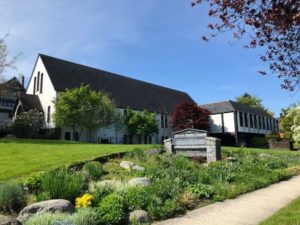
During the course of the telephone call Colleen revealed to me that she, too, had earlier been diagnosed with cancer, and that she was still in recovery, as was a good (and mutual) friend of ours, Tina Oliver — who was still receiving treatment. If you know Colleen, you know that there’s no refusing her when she has her mind set, so that next Sunday morning, I dragged myself out of my sick bed, and the two of us headed off to Fairview Baptist Church — where I gratefully attend to this day.
Quite obviously, Colleen was right — for despite my terminal cancer diagnosis, I am still here today, grateful to be alive, and thankful for Colleen’s friendship.
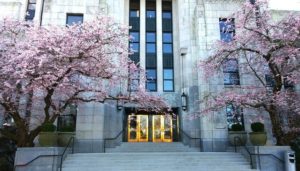
Over the years, Colleen had spoken with me about making a run for Vancouver City Council. In 2014, she created A Better City, the name of the nascent Vancouver political party since “appropriated” for the upcoming 2022 Vancouver municipal election by former Non-Partisan Association President, Peter Armstrong — without permission, of course, with not even a call, text or e-mail posted / made to Colleen.

A Better City, a political party created by City Councillor Colleen Hardwick in 2014

After much thought and discussions with friends, Colleen made the difficult decision not to make a bid for elected office in 2014, under the ABC banner.

All that changed,  however, in 2018, when Peter Armstrong approached and pleaded with Colleen to run for Vancouver civic office under the Non-Partisan Association (NPA) banner — about which she had significant misgivings, not the least of which was the lack of a nomination process.

Having run with the NPA in the 2005 Vancouver municipal election, where she placed 14th after a hard fought campaign, Colleen decided to take Peter up on his offer to fund her civic election campaign, as he all but assured Colleen of her election to Vancouver civic office on October 20.

In fact, Colleen placed a very respectable fifth place in the hard fought 2018 Vancouver civic election, where she would sit as one of five Non-Partisan Association City Councillors — all women —  the others: second term Councillor Melissa De Genova, Lisa Dominato, Rebecca Bligh, and barely squeaking onto Council, former Vancouver Park Board Chairperson, Sarah Kirby-Yung.
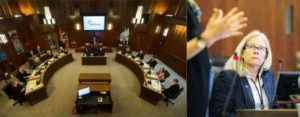

Vancouver City Councillor Colleen Hardwick looks askance at a Council colleague

In the five weeks following her election as a City Councillor, then City Manager Sadhu Johnson arranged an orientation for the newly-elected Councillors, during which time the Councillors became intimately familiar with how the city works, with visits to each of the City’s departments, from Planning to Engineering, and Transportation, and beyond, including instruction on City “processes”. During the orientation, the Councillors got to know one another well.
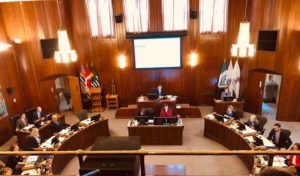
At the Council table, to Colleen’s right sat Christine Boyle, and to her left, Pete Fry. Colleen already knew Pete, but apart from what I had written about Christine during the course of the 2018 Vancouver civic election, was not all that familiar with Ms. Boyle, and what she “brought to the table.” From the outset, Christine let it be known that each and every one of us is living on the stolen lands of the Coast Salish peoples, raising issues of indigenous relations with novice Vancouver City Councillor, Colleen Hardwick.

Quite an education it proved for Ms. Hardwick, who came to like, respect and admire her principled, younger, distaff Council colleague.

As it happens, there was to be no “mutual admiration society” extant between the two nascent Vancouver City Councillors. Christine Boyle implicitly and explicitly let it be known — with a viciousness that Colleen found both perplexing and unsettling — that she despised Colleen and all that she “stood for”, that she would not work with her, had no interest in developing any kind of working relationship with her more mature Council colleague, that she considered Colleen to be a “right winger” and would set about to make Colleen’s life on Council “a living hell.”

And thus the Christine Boyle-created narrative of Colleen Hardwick as a morbid, unredeemable and entirely loathsome “right winger” was born.

As proved to be the case over the next two years, Vancouver City Council’s chief  dissembler — Christine Boyle — was more than true to her word.

Even more, when other of Colleen’s City Council seatmates saw how vicious was the treatment Colleen was being afforded by Christine Boyle, the three men on Council (Mayor Kennedy Stewart, and Green Councillors, Pete Fry and Michael Wiebe) — or as I like to refer to them, the Three Misogynist Musketeers — were only too happy to pile on the train of hate throwing rotten fruit at Colleen, with Christine Boyle handing them the fetid, putrid projectiles.

On two occasions in December 2019, at the end of our regular Sunday church service, Colleen threw herself into my arms, crying and inconsolable, that when I was able to settle her down was told by her that sitting on Council had become too much. The hateful treatment she was afforded at every Council meeting, most particularly by Christine Boyle, but also by Mayor Kennedy Stewart and Councillors Pete Fry and Michael Wiebe, was more than she could bear, it was unrelenting.

Never had she been so miserable, at any point in her life, she cried out.

As it happens, I attended the OneCity Vancouver AGM later in the month of that December, making contact with Christine, telling her how much Colleen had admired her in their early days on Council, how much she had learned from Christine, how grateful Colleen was for the humanity Christine brought to the issue of our relations and collective obligation to our Indigenous peoples.

While staring daggers at me as I made my exclamatory statement, Christine harrumphed, spitting out “I’m not interested,” then briskly walked away.

And this was at a pre-Christmas / Hannukah celebration by a whole passel of OneCity Vancouver members — just about the kindest, most welcoming, generous and socially conscious, as well as activist people you’d ever want to meet.

In March 2020, when a decision was to be made — arising from the demands of the just declared pandemic — Council decided that until further notice that Council meetings would be held virtually through WebEx. Both Councillors Boyle & Fry posted bitter tweets deriding Ms. Hardwick, with Pete tweeting, “At least I don’t have to sit next to that whack job anymore,” referring to Colleen.
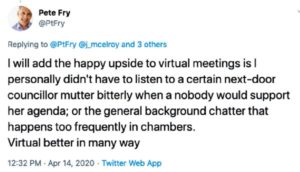
A tamped down Pete Fry tweet deriding Councillor Colleen Hardwick

That original tweet has since been deleted. The sentiment and ill-regard remains.

Later, when Christine Boyle — the Chairperson of Council’s Selection Committee — insisted that independent Councillors Melissa De Genova and Sarah Kirby-Yung resign their positions on Council Advisory Committees (which they did … to this day it befuddles me as to why Melissa, by far the toughest person on Council, puts up with Christine’s hateful nonsense, with nary a response to Ms. Boyle’s myriad provocations), and when Ms. Kirby-Yung, Ms. De Genova and Ms. Dominato recommended Councillor Hardwick for a position on the expanded Selection Committee, Christine Boyle cried long and loud that she would not sit on a Selection Committee with … well, let’s not record what the Councillor actually said, but it weren’t pretty, it weren’t kind, and it certainly wasn’t collegial, nor professional.

The Mayor finally had to intervene in response to Councillor Boyle’s childish tantrum, and appointed Councillor Hardwick to the Selection Committee.

All of the above is by way of saying that I’ve had it up to here with the ill treatment Colleen has been afforded on City Council — enough’s enough!

And, no, this is not Raymond Tomlin riding in on his white steed to rescue the damsel in distress. On her most emotionally fraught day, Councillor Colleen Hardwick is 100x tougher than I am, have ever been, or will ever be. Colleen hardly needs my “help” — my friendship and loyalty, maybe, but just that.
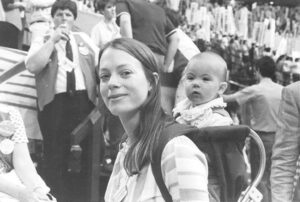

Colleen Hardwick and her daughter,  at the 1984 Liberal Party leadership convention 

Let me state for the record: Colleen Hardwick is not a right-winger — as a lifelong member of the Liberal party, and as a multi-term member of the Vancouver Centre Liberal riding executive, Colleen has always been a left-of-centre Liberal, from the time she fought for child care, when in 1984 she attended the Liberal leadership convention, when child care was hardly on anyone’s agenda, but it was on hers, Colleen has always remained a progressive, yet reasonable and centrist Liberal, very much in the mold of former Liberal Prime Minister Pierre Elliott Trudeau, a political leader she has greatly admired all of her adult life.
#VanPoli Politics | The Pending Chaos of the 2022 Vancouver Civic Election

In somewhat under a year — Saturday, October 15, 2022 to be exact — the next Vancouver municipal election will take place, when a Mayor and 10 City Councillors will be elected to civic office at Vancouver City Hall in our fair city by the sea.

Although VanRamblings will not commence intensive coverage of Vancouver’s next civic election until sometime in the spring of 2022, there is enough going on politics-wise in our city to comment on the state of municipal political affairs — which is what VanRamblings will set out to do over the next couple of weeks.

Why all the hubbub about Vancouver politics in the autumn of 2021?

When our NDP provincial government brought in legislation governing the conduct of municipal elections — limiting / eliminating third party advertising in the three months prior to the election date, while also limiting the expenditure of monies each civic party, and candidate, could spend towards the goal of achieving civic office — the doors were left wide open to spend any amount of money in the civic arena prior to the exertion of British Columbia’s civic election “restriction date”.

Thus you have A Better City mayoral candidate Ken Sim — who in the 2018 Vancouver civic election ran as Mayoral candidate for the Non-Partisan Association, coming within 1,000 votes of becoming our city’s Mayor — holding a campaign kickoff and fundraiser this past Wednesday at Chinatown’s Floata Seafood Restaurant, where all of Vancouver’s esteemed civic reporters were on hand to nosh on food, and otherwise kibbitz with one another and attendees at this swish municipal affairs soirée. That Peter Armstrong (Mr. Sim’s main financial backer, who introduced Sim to civic politics), he sure does know how to put on a feed.

Current Vancouver Mayor Kennedy Stewart has announced that he’ll seek re-election in 2022. Longtime political fixer and campaign strategist extraordinaire, Mark Marissen, has announced his bid for Mayor, as has current Park Board Commissioner John Coupar. Vancouver City Councillor Colleen Hardwick has also served notice that she will seek the Mayoral nomination with  a reinvigorated TEAM (The Electors Action Movement) civic party — that’s five mayoral candidates.

VanRamblings believes that the 2022 Vancouver municipal election will prove to be the ugliest and most divisive civic election ever waged in our west coast burgh, that there’ll be no end of bad behaviour from the myriad candidates putting their names forward in the hope of gaining office and tenure on Vancouver City Council, that OneCity Vancouver — and more particularly, OneCity Vancouver’s resident ‘mean girl’ Council mainstay, Christine Boyle — will run a vicious campaign of unrivaled and unmitigated class warfare against the parties and candidates OneCity has already successfully defined as “right wing”, with the media buying into this condemnable nonsense hook, line and sinker. Alas — it was always thus. ?

#BC Poli | BC Recovery Benefit Application Day | How to Apply

BC Recovery Benefit eligibility, the application process

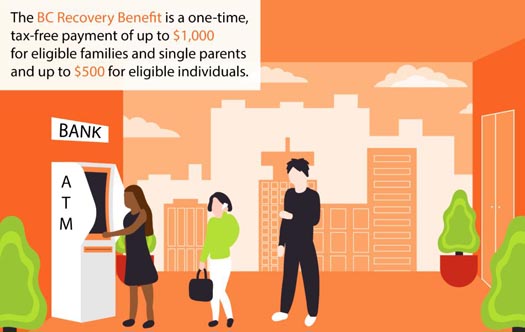
The application for the BC Recovery Benefit that will be made available as a one-time direct deposit payment for eligible families, single parents or individuals opens today. You’ll want to take advantage of this benefit.
The key aspect to be aware of: You must apply to receive the benefit.
Now, the John Horgan could very easily have foregone what will turn out for many to be an arduous application process, if they’re even aware there is a benefit for which they are eligible, and could have held off payment until January 5th, 2021, when they very easily might have included the $500 for eligible individuals, and the $1000 for couples and single parents — as they did in April, when they combined the then Climate Action Credit of $330 — with the issuance of GST cheques to households across the province.
No fuss, no muss, no application process — just a tidy sum of money deposited in every eligible adult’s bank account on the first Tuesday of 2021 — not a bad way to start the new year, don’t you think?

BC Recovery Benefit eligibility, the application process

But in a blunder of immense proportion, not to mention a disingenuous way to commence Mr. Horgan’s first real mandate, our B.C. New Democratic Party provincial government has decided that not only will eligible British Columbians have to jump through the hoops of an online application process, eligibility for the BC Recovery Benefit is dependent on what you earned in the 2019 calendar year — before COVID-19 was on anyone’s radar, before businesses shut down due to the pandemic, causing the loss of hundreds of thousands of jobs across our province — disallowing the full $500 recovery benefit to individuals who in 2019 earned more than $62,500 (with a sliding scale up to a cutoff of $87,500), with households with lower than a $125,000 combined income eligible for the full $1000 recovery benefit, decreasing that amount up to a cutoff point of $175,000.
If you lost you job or your business in 2020, and your income has plunged into the abyss in this very troubling year, you’ll be out of luck when it comes applying for the BC Recovery Benefit.

BC Recovery Benefit eligibility, the application process, covid-19, be grateful

What is that you’re saying? “Don’t look a gift horse in the mouth?”
For those who are unfamiliar with VanRamblings’ modus operandi, well … even with Hanukkah ending yesterday, we nonetheless just love to kvetch.
Okay, enough of this foofaraw, let’s get on with acquiring tax free moolah.

BC Recovery Benefit eligibility, the application process

First off, you going to have to click on this link to be taken to the British Columbia government’s BC Recovery Benefit application website.
Next, you’re going to have to get all your ducks in a row, and make sure you have the following information and documentation available in order to complete the application process …

BC Recovery Benefit eligibility, the application process

Note should be made: persons who are in receipt of the provincial Persons with Disabilities benefits are eligible to apply. The benefit will not be clawed back from existing benefits, as the recovery benefit is non-taxable.

BC Recovery Benefit eligibility, the application process, COVID-19

On Tuesday, December 8th, the BC government introduced legislation to secure funding for the BC Recovery Benefit, projected to help around 3.7 million British Columbians.

BC Recovery Benefit eligibility, the application process, covid-19, students can apply

Charlotte Aiden, a writer for The Ubyssey has written this story on student eligibility for the BC Recovery Benefit.

Students who are at least 19 years old and reside in British Columbia on December 18, filed a valid 2019 Canadian personal income tax return and have a social insurance, individual tax or temporary tax number are eligible to apply.

Unlike the Canada Emergency Student Benefit, international students are included in this benefit, given they meet the eligibility requirements.

You’ll need four things to apply on the government website: your net income from your 2019 tax return; your social insurance, individual tax or temporary tax number; your driver’s licence number if you have a BC driver’s licence (but this isn’t necessary); and your direct deposit information.

Unlike past benefits, this benefit will only be issued through direct deposit, so those who apply must have an account with a Canadian financial institution.

BC Recovery Benefit eligibility, the application process, COVID-19, telephone support

Toll free telephone support is available by phone starting Monday, December 21st, 2020.

  • Call 1-833-882-0020 (within North America);

  • Monday to Friday, 7:30 am to 5:00 pm, excluding statutory holidays;
  • You have until June 30, 2021 to apply.

The COVID-19 BC Recovery Benefit will cost as much as $1.7 billion, up from an estimate of $1.4 billion announced during the election.

#COVID19 | As The Pandemic Wends Its Glorious Way to A Close

COVID-19 vaccines are on their way, hopefully bringing to an end our current pandemic

Hope for an expeditious end to our current pandemic circumstance appears to be relatively close, with vaccines from at least four — and more probably, six — companies appear well on their way to receiving approval in the next short while, with the two-injection Pfizer vaccine appearing set for approval by Health Canada as early as this Thursday, December 10th, with Moderna, AstraZenica and Johnson & Johnson not far behind in the pipeline. Update: Health Canada approved the Pfizer/BioNTech on December 9th.

A number of announcements have been made in recent days involving the roll-out of the vaccines that will, eventually, keep us all safe …

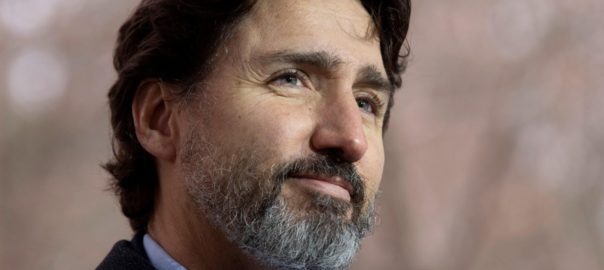
On November 27th, Prime Minister Justin Trudeau announced the appointment of former NATO commander Maj.-Gen. Dany Fortin to lead the national vaccine distribution effort, with a target of immunizing half of all Canadians — that’s 19 million of us — or more, by September, 2021;

Just yesterday, the Prime Minister told Canadians that Canada has secured an agreement to receive its first batch of Pfizer’s coronavirus vaccine before the end of the year — up to 249,000 doses. Pending Health Canada approval, “Canadians will be getting vaccinated starting next week,” Trudeau said at a news conference in Ottawa. Shipments will continue to arrive in 2021; the second batch will be reserved for the same people vaccinated in the first batch — which is to say, the elderly in long term care facilities across Canada. “We’re facing the largest immunization in the history of our country,” Trudeau said.

Canada’s National Advisory Committee on Immunization (NACI) this past Friday released its final directive addressing the prioritization of who should receive the vaccines first, and which groups would be next, right through until the late spring. By the end of March, NACI scientists said they expect 3 million Canadians will have been vaccinated with one of the three (soon to be four, or more) approved COVID-19 vaccines, that number doubling by late June, and doubling yet again by early to mid-autumn of 2021.

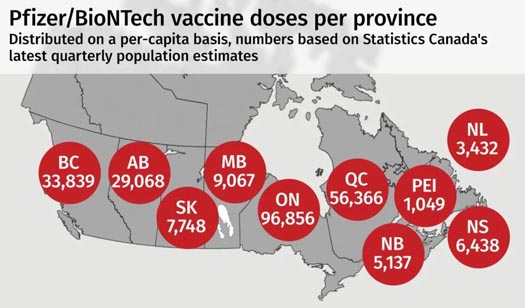
Pfizer/BioNTech roll-out of their COVID-19 vaccine to Canadian provincesThe initial batch of Pfizer/BioNTech vaccines will roll out to 249,000, or more, Canadians

NACI scientists advise the roll-out of vaccines will occur, as follows …

  • (a) Long-term care and assisted living facility residents, as well as residents in retirement homes and chronic care hospitals, who face “severe outcomes” and a much greater chance of dying from the disease than the population as a whole;

  • (b) NACI scientists said the next priority group would be “adults 80 years of age and older;”
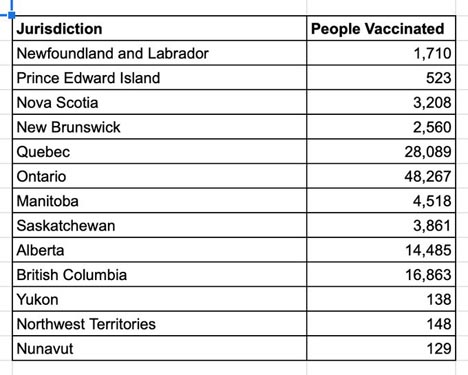
    Initial Pfizer/BioNTech vaccine roll-out in early 2021. Expected number of people in each province to be vaccinated.Number of Canadians, by province, expected to receive the initial batch of Pfizer/BioNTech vaccine in the early part of 2021, beginning in January.

    (c) NACI scientists expressed concern about Indigenous adults living in communities “where infection can have disproportionate consequences, such as those living in remote or isolated areas.” Indigenous persons will be the third group of Canadians to be vaccinated;

    Initial Pfizer/BioNTech vaccine roll-out in early 2021. Expected number of people in each province to be vaccinated.

  • (d) Adults aged 75 – 79 would be next to receive vaccinations, followed by adults aged 70 – 74 years of age.

These four groups — long-term care residents and staff, the elderly, front line health care workers and some Indigenous adults — are expected to consume all of the six million doses (the Pfizer vaccine requires two doses) to be delivered in the first three months of 2021.

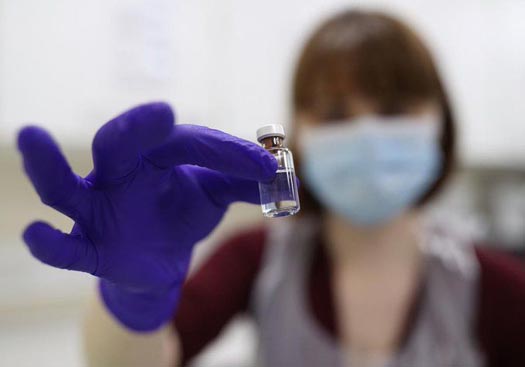
Nurse holding a small bottle containing a COVID-19 vaccine

In the second phase of the vaccine roll-out, which would begin in April 2021, as more supply comes online, other essential workers will have access. The NACI advisory committee said first responders — such as police officers, firefighters and health care workers not included in the initial rollout — would be next in line, followed by residents and staff in other “congregate settings” — such as migrant workers, prisoners in correctional facilities and people in homeless shelters.
At the end of the day, though, it is the provincial Premiers, their Health Ministers and Public Health Officers who will determine prioritization of vaccine roll-out in their jurisdictions. By late summer / early autumn, Prime Minister Trudeau has said he expects half of all Canadians would be vaccinated — that’s 19 million Canadians.
The vaccine roll-out will continue through the end of 2021, and beyond.