In advance of this upcoming 96th annual Academy Awards ceremony — which begins at 4pm this Sunday, an hour earlier than usual — please find trailers for the ten 2023 films garnering recognition in Hollywood as the best films of the year.





In advance of this upcoming 96th annual Academy Awards ceremony — which begins at 4pm this Sunday, an hour earlier than usual — please find trailers for the ten 2023 films garnering recognition in Hollywood as the best films of the year.
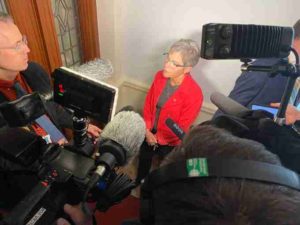
Selina Robinson announces that she is resigning from the BC NDP caucus to sit as an Independent
Age Old Maxim | A Week is a Lifetime in Politics | The Personal is Political
Yesterday afternoon — former British Columbia Finance Minister Selina Robinson in the administration of Premier John Horgan, and when removed from that post when the BC NDP caucus unanimously moved to make David Eby the leader of the party and British Columbia’s 37th Premier — resigned from the BC NDP caucus to sit as an Independent, citing anti-semitism within the BC NDP caucus.
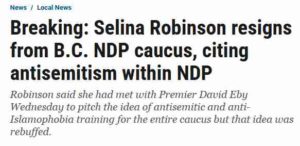
From Katie DeRosa’s story in The Vancouver Sun …
Selina Robinson, B.C.’s most prominent Jewish politician, said she’s leaving the B.C. NDP caucus over concerns it hasn’t done enough to fight antisemitism among fellow MLAs.
The bombshell announcement Wednesday comes a month after Robinson was forced to resign from cabinet after public backlash to comments that Israel was founded on a “crappy piece of land with nothing on it.”
Robinson said she talked to the NDP caucus last week and then Premier David Eby today about instituting antisemitic and anti-Islamophobia training for all MLAs and opportunities to create a dialogue between the Jewish community and Palestinian and Arab communities amid the division created by the Israel-Hamas war.
Robinson said she was rebuffed.
“That’s really the work that we should be doing. But right now, government isn’t interested in doing that work.”
That’s what led Robinson to decide she “can’t continue to be the only voice speaking up against antisemitism and hatred.” She will sit as an Independent.
Selina Robinson means to burn some bridges on the way out — as Keith Baldrey pointed out on Global BC’s Newshour at 6 — with the release of a “blistering letter” condemning her colleagues for not doing enough to combat anti-semitism.
Says Baldrey, “(Selina Robinson) calls out and names seven of her fellow NDP MLAs for either anti-semitic actions or controversial comments concerning the Jewish community. These are explosive allegations.”
Selina Robinson ends the letter [pdf] to her now former colleagues, writing …

The nine NDP colleagues Ms. Robinson names, and accuses of anti-semitism, either by commission or omission, or she deems to be otherwise unsupportive …
Make no mistake — whether Premier David Eby, his Chief of Staff, Matt Smith, or any of the Premier’s senior advisors choose to acknowledge such — less than 8 months out from the October 19th provincial election, the British Columbia New Democratic Party is in crisis, perhaps not so great as to cost them the election (although, it’s still early), but in bad enough shape with Selina Robinson’s announcement, are now set to win far fewer seats than most polls have predicted to date.
We’ll know the fall-out from the current NDP fiasco when new polling is released.

B.C. United party leader, Kevin Falcon, gleeful at the fortuitous turn of events for his party
The beneficiary of Selina Robinson’s announcement? B.C. United leader, Kevin Falcon, who with Ms. Robinson’s announcement on Wednesday effectively doubled the party’s probable seat count come election night.
Voters won’t vote for a divided party, for a party in crisis or disarray, a party focused on internal politics and not the business of the people.
Examples are legion.
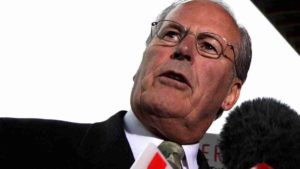
Former Social Credit party leader, and Premier of the province of British Columbia, Bill Vander Zalm
After 36 years in power, from 1952 to 1991, with a brief three-year NDP interregnum from 1972 – 1975, British Columbia’s Social Credit party held the reins of power in Victoria. When the party fell into dysfunction, disorder and vicious internal in-fighting, with the forced resignation of then Socred Premier Bill Vander Zalm mid-term, in 1991 the Socreds lost 40 out of 47 seats, the Social Credit party dying soon after, never again to be seen on the B.C. political spectrum.
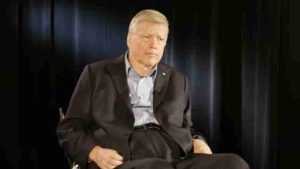
Sam Sullivan, one-term Non-Partisan Association, Mayor of the City of Vancouver, 2005 – 2008
In Vancouver, prior to the 2002 municipal election, Jennifer Clarke stole the Non-Partisan Association Mayoral nomination away from popular, sitting NPA Mayor Philip Owen. Ms. Clarke lost her bid to become Mayor in a landslide vote for novice COPE Mayoralty candidate Larry Campbell, the NPA losing 7 of their nine seats, all 7 of those seats won by COPE candidates for Council. The same thing happened to the NPA in 2008, when Peter Ladner took the NPA Mayoral nomination away from sitting Mayor Sam Sullivan. The NPA lost five of their 6 seats on Council.

Premier David Eby has to get his government’s house in order if the New Democratic Party plans on holding power post October 19, 2024.
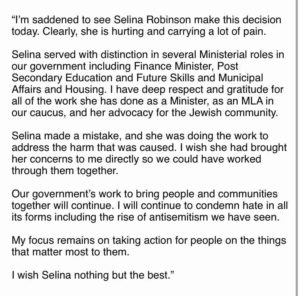
If David Eby thinks his self-serving, off-putting, scurrilous, poorly conceived “Selina made a mistake” note above will go any way to resolving his and his government’s dispute with Selina Robinson, he’s dreaming in washed out shades of grey.
Anything short of an apology to Ms. Robinson, and the province, won’t do.
Note from VanRamblings: “It’s time to be a mensch, Mr. Premier. You like women. You trust women. You’re a good man. For the sake of your government, and in the interest of the people of British Columbia, you will have to get over of your barely concealed animus for Ms. Robinson, and do right be her. Nothing less will do.”
A Litany of Self-Inflicted, Own Goal BC NDP Disasters
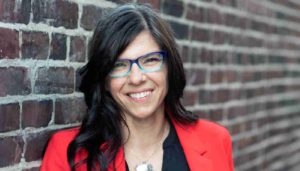
Andrea Reimer, Vancouver-Little Mountain NDP nomination candidate & future Environment Minister
The roll-out of the campaign to elect Andrea Reimer — a certain future Minister of the Environment, should the NDP be re-elected in October — was little short of a disaster, with the unexpected entry of a sitting Vancouver City Councillor in the, now, race to secure the nomination in Vancouver-Little Mountain.
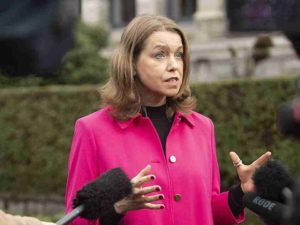
Mitzi Dean, one in a long line of failed British Columbia Ministers of Children and Family Development
Former Minister of Children and Family Development Mitzi Dean’s failure to keep an eye on her Ministry, as two Indigenous children in Chilliwack died on her watch.
The ongoing — not slated to end anytime soon — weeks’ long, badly mishandled by the Premier melodrama of former BC NDP Finance Minister Selina Robinson’s — for whom there is no love loss between the two, on either side — unfortunate and regrettable leave-taking from, first, Cabinet where she was Minister Responsible for Post Secondary Education, and now from the party itself … what a godawful, effin mess … that reflects badly on the Premier, his caucus and his government.
VanRamblings will have more to say on the matter, in the days to come.
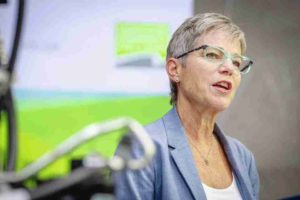
A final, kind of sad note: yesterday, March 6th was Selina Robinson’s 60th birthday.
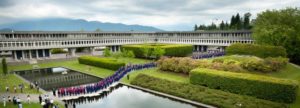
In 1979, when VanRamblings was enrolled in a Master’s Programme at Simon Fraser University (in Policy Administration, don’tcha know), Pauline Jewett — Simon Fraser University’s President, the first woman to head a major co-educational university in Canada — was approached by federal NDP leader Ed Broadbent, who asked the esteemed Dr. Jewett to consider becoming the New Democratic Party candidate in the Burnaby riding, in the upcoming federal election. With her tenure as SFU President drawing to a close, Dr. Jewett readily agreed to the proposal made by Mr. Broadbent, the deal done, the nomination sealed.
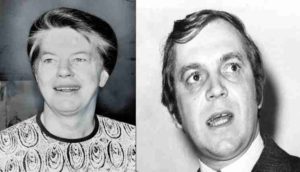
Pauline Jewett, Simon Fraser University President | Ed Broadbent, New Democratic Party federal leader
Not so fast …

Across town, there was a 26-year-old young man who had just graduated with distinction from the University of British Columbia Law School, and moved into a condominium with his boyfriend, just “down the hill” from Simon Fraser University.
Now, we’re talking 1979, when openly living with your boyfriend was not well accepted among the general population.
Even so, this brash and very bright young man made the decision to seek the federal New Democratic Party nomination in Burnaby, turning what had been planned as a New Democratic Party coronation for Pauline Jewett into a race.
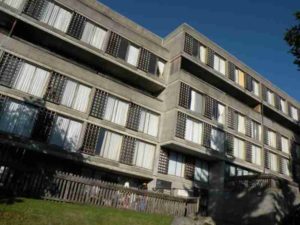
Louis Riel House, Simon Fraser University student family residence, where VanRamblings lived.
The young man had every intention of winning the nomination, and becoming the next Member of Parliament, representing the good citizens of Burnaby.
This young man made his way to Simon Fraser University, meeting with members of the Student Forum, various of the student political groups on the left of the political spectrum, staff at the student newspaper, The Peak, as well as student leaders across the university, one of whom was VanRamblings, this young man meeting with us — usually in a packed apartment full of campus activists — on several different occasions, in our student residence apartment at Louis Riel House.
In fact, this vibrant, charismatic and engaging young man made a point of introducing himself to every student in each of the student residences at SFU, often meeting with these students several times, signing them up to his campaign team.
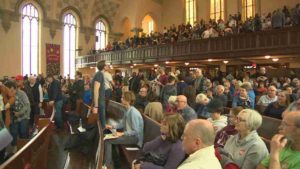
In the three months leading up to the off campus NDP Burnaby riding nomination meeting, the young man’s campaign team had signed up 3,000 new members to the Burnaby riding association, from across the demographic and cultural spectrum. Membership in the party had grown to such an extent that the riding association kept having to book larger and larger venues. On the night of the nomination meeting, more than 2,700 riding association members arrived at the hall to vote for their candidate, the majority of whom it soon became clear would cast their ballot for this charming, fascinating, almost bewitching, and intriguing young man.

Svend Robinson, 1979. New Democratic Party Member of Parliament, May 22, 1979 – June 28, 2004
Svend Robinson went on to win the federal New Democratic Party nomination to represent the citizens of Burnaby in a walk, garnering more than 90% of the ballots cast, the writ dropped by Prime Minister Pierre Elliot Trudeau within days of Mr. Robinson’s precision, near military campaign-style run to secure the nomination.
On May 22nd, 1979, Svend Robinson became the Member of Parliament for the Burnaby riding, where he was re-elected term after term for a quarter of a century.
In the years that followed Svend Robinson’s election to Ottawa, this principled New Democratic Party Member of Parliament, working locally with Gary Cristall on the Committee for the Defense of Human Rights in Latin America, and with Scott Parker and Daryl Adams on the Galindro Madrid Defense Committee — Mr. Madrid jumping ship in Vancouver, to make an application for asylum, to escape the brutal regime of Chilean dictator, Augusto Pinochet — Svend Robinson played a pivotal role in gaining citizenship for thousands of Chilean refugees fleeing the Pinochet regime, in all of our meetings, a quick study always, getting quickly to the core issues at hand, as we moved together towards remediative action and resolution.
When, over time, reflecting on his initial run for office and his work to secure the Burnaby NDP nomination in 1979, Svend passed on this piece of wisdom …
“Raymond, winning a nomination or winning election to office is always a numbers game. Planning, hard work, a first-rate campaign team, commitment, knowing why you’re running, keeping an eye on the goal, working closely with people to gain their confidence, to win them over, to assure your future voters you’re on their side, that you will do everything humanly possible to represent their interests locally, to work to resolve their individual problems, while remaining aware of the macro goals of your work — that’s the key to winning, not just for yourself, but for your constituents, for society at large, and for the world.”
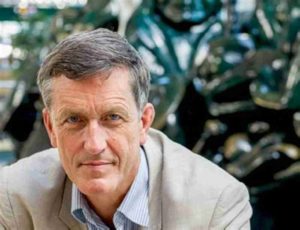
Little wonder that Svend Robinson served with distinction for a quarter century.
Coda
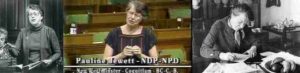
Pauline Jewett, NDP Member of Parliament, New Westminster-Coquitlam, May 22, 1979 – July 5, 1988
Having lost her bid to become the Member of Parliament to serve the residents of Burnaby, NDP leader Ed Broadbent appointed Pauline Jewett to run as the NDP candidate for New Westminster-Coquitlam, where she served with distinction in Parliament for nearly a decade, elected to office in 1979, again in 1980 and in 1984.
In 1991, Dr. Jewett was made an Officer of the Order of Canada, and in 1992, she was appointed to the Privy Council.
In 1990, Pauline Jewett was appointed Chancellor of Carleton University, serving in that role until her death from cancer on July 5, 1992.

The BC NDP being the finely-tuned machine that they are, yesterday morning following the announcement of the decision by British Columbia’s current Environment Minister George Heyman to not seek re-election in the upcoming October 19th provincial election, Mr. Heyman introduced past three-term Vancouver City Councillor Andrea Reimer as his, and the New Democratic Party’s, chosen candidate to run in the newly-created riding of Vancouver-Little Mountain.
Some big news! I am stepping up for my community and asking for your support to become Vancouver-Little Mountain’s next MLA.
Together, we can build a strong future for everyone in Vancouver-Little Mountain, and throughout our province. https://t.co/iuywHsYRPq pic.twitter.com/ewxMNHkcEc
— Andrea Reimer (she/her) (@andreareimer) March 4, 2024
This was a textbook roll-out of a campaign for a BC NDP nomination.
Andrea Reimer, NDP candidate for nomination in the newly-created riding of Vancouver-Little Mountain
Given the problems the BC NDP have suffered the past couple of months — Mitzi Dean’s removal as Minister of Children and Family Development due to incompetence, and the resignation / firing of former Finance Minister Selina Robinson, arising from recent intemperate remarks she made respecting the Hamas-Israeli war — the BC NDP were looking for an unimpeded good news announcement to get their re-election campaign underway on an upbeat note.
And all went well … for an hour.

Endorsements, clockwise: former BC NDP Minister, Melanie Mark; noted environmentalist, Tzeporah Berman; community organizer, Tessica Truong; Squamish Nation Chairperson, Khelsilem
Endorsements rolled in, the party had created a first-rate campaign video featuring Joy McPhail, an impressive ‘Andrea Reimer for Vancouver-Little Mountain’ website was up and on the web almost immediately (if faulty for part of the day), the response to Ms. Reimer’s candidacy almost universally supportive, praising, respectful and hopeful.
Here was the BC NDP with a first-rate candidate for office, a pol of the first order, and a much loved community organizer. The BC NDP and almost all of its supporters were over-the-moon. What a great and glorious day to behold!

An aside
Life in politics isn’t easy. As became abundantly clear in the first half of the video interview with Naomi Klein, on the VanRamblings post we put up yesterday, those with opinions, and those in the public eye are often the subject of vicious commentary. The press weighs in, and are often unkind in their commentary, even if not meaning to be such. Then there are ne-er-do-wells like that Raymond Tomlin character and his VanRamblings blog — well, we all know he’s a scandal and rumour-monger, and any commentary he makes is to be derided and studiously avoided.
We will say at this point that VanRamblings is the subject of an injunction which prevents us from writing about Vancouver City Councillor, Christine Boyle. Tossing caution to the wind, and despite the possibility of VanRamblings being thrown into the hoosegow, we will today write about the esteemed Ms. Boyle, despite the dire consequences it may bring to our personal safety, and freedom to move about.
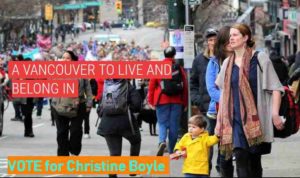
A OneCity Vancouver poster for Christine Boyle’s 2018 candidacy for Vancouver City Council
Upon being elected to Vancouver City Council in 2018, Christine Boyle found herself turning to Andrea Reimer, a successful three-term Vision Vancouver City Councillor, who mentored Ms. Boyle, and over the years became a confidante and something of a mother confessor. Both Ms. Reimer and Ms. Boyle had sat as City Councillors, both are women of some note, both are relatively young yet well-experienced, both share much in common. Ms. Reimer became a sympathetic ear for Ms. Boyle, and a source of valued input and counsel for the novice Councillor.
To say that Ms. Reimer and Ms. Boyle are close would be to understate the matter.
I’ve spent many years working on issues that matter to residents in Little Mountain, and across Vancouver and BC.
I’m grateful to the many folks who have encouraged me to put my name forward. I look forward to connecting with even more folks in the weeks and months to come. 2/
— Christine Boyle (@christineeboyle) March 4, 2024
Imagine the surprise, then — to Andrea Reimer, the BC NDP, Premier David Eby and Environment Minister George Heyman, and many others — when within an hour of the announcement of Andrea Reimer’s BC NDP-endorsed candidacy in the riding of Vancouver-Little Mountain, current Vancouver City Councillor Christine Boyle announced her candidacy to seek the Vancouver-Little Mountain BC NDP nomination!
As we wrote to friends yesterday, “There is no honour in politics.” Sadly.

VanRamblings figures that Andrea Reimer — on one of the best days of her life — must feel devastated. We figure, too, that there are those within the BC NDP — particularly those who were involved in the meticulous roll-out of Andrea Reimer’s BC NDP candidacy in the newly-created riding of Vancouver-Little Mountain — who are feeling a degree of disappointment and anger, directed at Christine Boyle.
From Katie DeRosa’s article in The Vancouver Sun, on the nomination battle …
(Andrea) Reimer has been involved with the NDP riding association for Vancouver-Fairview for years and is now on the executive of the Vancouver-Little Mountain riding.
“George asked me to consider taking it on when he stepped down,” said the 52-year-old.
Reimer said she has first-hand experiences with the gaps in the system, as she spent time as a youth living on the streets and has been renovicted from rental homes more than a dozen times. Reimer was adopted at six months old and only discovered her Cree and Métis ancestry in 2015.
“I’ve dedicated my life to closing gaps,” said Reimer, who is now an adjunct professor of practice at UBC’s school of public policy and global affairs.
Reimer said during her time on council she was able to garner support for “world-leading” policies such as renewable energy strategies and pushed for Vancouver to become one of the first local councils to back the United Nations Declaration on the Rights of Indigenous Peoples.

(Note: We were kidding about the injunction respecting writing about Vancouver City Councillor and BC NDP Vancouver-Little Mountain nominee candidate, Christine Boyle. Although, truth-to-tell, we sometimes wonder, given the vitriol to which we are subject whenever we write about the good Ms. Boyle).
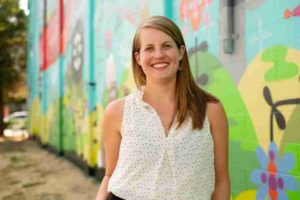
Let us state for the record: Christine Boyle has every right to seek the BC NDP Vancouver-Little Mountain nomination — and, we imagine, feels an obligation to do so, otherwise she would not have put her name forward for nomination.
Councillor Boyle has served her constituents well and with honour in her five years in elected office at Vancouver City Hall. Hers is a voice of compassion and of community, and if we might be so bold as to say so, “fighting for the little guy,” the most recent example? Her (sadly, unsuccessful) work to reinstate the Livable Wage Policy at Vancouver City Hall.
From Katie DeRosa’s article in The Vancouver Sun, on the nomination battle …
(Christine) Boyle, a United Church minister and a social justice advocate who spent years working on the Downtown Eastside, was endorsed by veteran federal NDP MP Libby Davies.
She said it was unusual that Heyman endorsed Reimer but said she doesn’t think that will be a hindrance in the nomination race. Boyle worked on Heyman’s team when he was competing against former Vancouver city councillor Geoff Meggs for the nomination in 2012.
Boyle, who considers Premier David Eby a personal friend, said she has a long history with the riding. She was born and raised in the riding, where her parents still live, and was heavily involved in advocating for those who lost their homes when the Little Mountain social housing complex was demolished.
Boyle, the most left-leaning member of Vancouver council, pushed for Vancouver council to declare a climate emergency and for the city to ramp up its emission reductions efforts. She’s also been a strong proponent for more affordable housing and higher density buildings in residential neighbourhoods.
Boyle said she and Reimer share many of the same values which is why “I do think it’s unfortunate that we’re running against each other.”
“When people look from the outside I think they see conflict,” Reimer said. “But from the inside in politics, nomination (races) between two strong candidates is a sign that your party is very healthy.”
Imagine Ms. Boyle’s desire, if you will, to be a Member of the Legislature within a BC NDP government that sets about — as has consistently proved to be the case — to implement Ms. Boyle’s most cherished personal and political goals, to be an unfettered part of change for the better, in a government that means to do well.
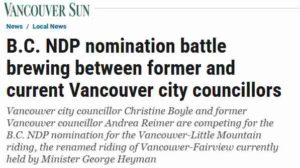
For less colourful coverage of the upcoming battle for the British Columbia New Democratic Party nomination in the Vancouver-Little Mountain riding, you’ll want to read Katie DeRosa’s thorough and even-handed coverage in The Vancouver Sun.
As Ms. DeRosa writes, “The nomination vote will take place in April.”

VanRamblings wishes Christine Boyle and Andrea Reimer the best of good fortune in their quest to secure the Vancouver-Little Mountain nomination.
History. Tomorrow on VanRamblings, a related 1979 nomination battle. You’ve got to organize to win.