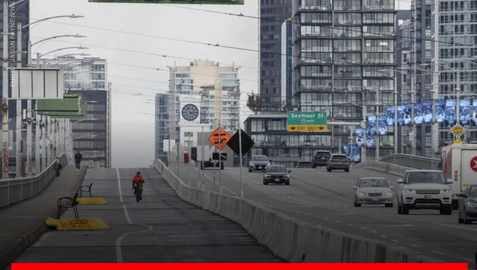
It’s time for Ken Sim to get his priorities right. Rather than spend money on suicide prevention barriers on Granville Bridge he spent $14 million on FIFA VIP tickets for his friends.
It’s time for change. pic.twitter.com/vohzzOWVfj
— Kareem Allam (@kareemformayor) August 17, 2026
There are moments in public life when a government decision tells you almost everything you need to know about its priorities.
Vancouver Mayor Ken Sim’s ABC Vancouver has provided one of those moments.
For years, the City has known that the Granville Street Bridge is a suicide hotspot.
For years, health professionals, suicide-prevention advocates, first responders and community members have urged Vancouver City Hall to install barriers that could prevent people in moments of acute crisis from making an irreversible decision.
And for years, Vancouver City Hall has delayed, deferred, postponed.
In March of this year, ABC Vancouver Councillors voted to remove funding for Granville Bridge suicide-prevention barriers from the 2027–2030 Capital Plan. The decision prompted the Crisis Centre of BC to accuse Council of failing to act on an established, evidence-based method of saving lives.
That is an astonishing decision when placed beside the City’s enthusiasm for FIFA World Cup hospitality.
Vancouver set aside $13.4 million for FIFA tickets, suites and lounges, purchased through FIFA contractor On Location. The City says the packages were intended to be resold through a commercial sponsorship programme to help offset World Cup costs.
So, to be fair, this is not literally a case of Ken Sim handing $13.4 million worth of tickets to his friends.
But the contrast is nevertheless devastating.
Ken SIm can find millions for hospitality packages whose resale prospects remain commercially confidential. Yet when the subject is installing physical barriers on a bridge where people have repeatedly died, ABC Vancouver’s City Hall answer is delay, cost-sharing and another study.
What kind of municipal government does that, makes those choices?
The health community across Metro Vancouver has been remarkably blunt.
Dr. Brandon Yau, Medical Health Officer with Vancouver Coastal Health, told Vancouver City Council that “suicide deaths from this bridge are preventable tragedies.” He described means prevention as an “established, evidence-based approach” and called the barriers “critical, life-saving infrastructure.”
The statistics are chilling.
The Crisis Centre says Granville Bridge has averaged approximately 2.6 suicide deaths a year. Since 2019, there have been more than 20 incidents involving people in distress on the bridge.
And there is something else City Hall cannot plausibly claim it does not know.
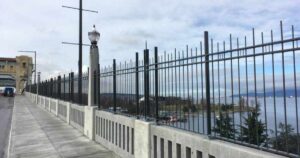 Suicide prevention barriers were installed on the Burrard Street Bridge in 2017. There have been no known deaths on the Burrard Street Bridge since the barriers were erected.
Since barriers were installed on the Burrard Street Bridge in 2017, there have been no known suicide deaths. Similar means-prevention fencing was installed on the Ironworkers Memorial Bridge in 2015, with the same striking result.
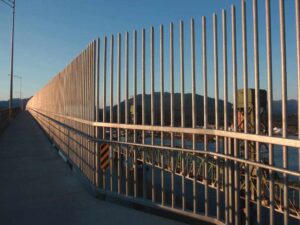 Suicide prevention barriers were installed on the Ironworkers Memorial Bridge, by the province, in 2015. There have been no deaths on the bridge since the barriers were erected.
Vancouver’s own 2024 Council documentation cited research finding that physical barriers at bridges are associated with a 93% reduction in suicide deaths.
Do the arithmetic.
If Granville Bridge continues to average roughly 2.6 suicide deaths annually, a reduction of that magnitude would translate into the potential prevention of approximately 2.4 deaths per year. Over a decade, that is roughly 24 lives.
Nobody can honestly promise that exactly 24 people would be saved.
Suicide prevention statistics do not work that way. But neither can anyone honestly pretend that the potential lifesaving effect is trivial.
This is not theoretical.
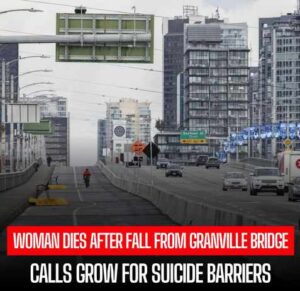
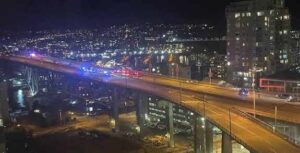
In May, a woman died after a 9-hour standoff on the Granville Bridge.
Police told media at the time, officers spent several hours trying to communicate with the woman after reports she was standing outside the bridge railing Tuesday afternoon, May 14th. She later fell from the bridge just after midnight.
Mental health advocates say the death was preventable, stepping up their campaign to have governments fund safety barriers for the bridge.
According to Vancouver Police, there were 21 incidents involving people at risk of jumping from the bridge in 2024, followed by 25 more in 2025.
Advocates also point out there have reportedly been no deaths by suicide from Burrard Street Bridge since protective fencing was installed there in 2017.
The Independent Investigations Office launched an incident investigation.
The Crisis Centre subsequently wrote to Mayor Sim and Vancouver Council that the death was preventable — and that the suffering endured by her family, first responders, nearby residents and witnesses was preventable as well.
Stacy Ashton, executive director of the Crisis Centre, has repeatedly emphasized the fundamental principle behind bridge barriers: they create time.
A person in suicidal crisis may not be making a settled, rational decision about the rest of their life. A barrier interrupts the crisis. It creates an opportunity for intervention. It gives police, firefighters, paramedics, crisis workers or members of the public time to reach the person.
Ashton put the issue bluntly:
“The importance of a suicide bridge barrier is that we know that they work and that they save lives.”
That should have been enough.
Apparently, it wasn’t.
The argument from Ken Sim’s City Hall is that the project needs more design work, that the total construction cost has not yet been confirmed and that senior governments should contribute. Those are legitimate administrative considerations.
In June, Council voted unanimously, reaffirming its commitment to barriers, asking staff to accelerate design, costing and discussions with Ottawa and Victoria.
But that only makes the March decision all that more difficult to understand.
The City of Vancouver has already spent $300,000 on conceptual design and costing. Council itself had acknowledged the urgency. The health community had supplied the evidence. The Burrard Street Bridge had supplied the real-world proof.
And still, actual construction funding was removed.
Meanwhile, Vancouver’s FIFA operation paid millions for hospitality packages.
This is where the issue ceases to be merely about infrastructure.
It becomes a question of what Ken Sims’ City Hall considers essential.
A barrier that may prevent a Vancouver resident from dying is not a luxury.
It is not an amenity.
It is not an optional beautification project.
It is public safety.
The Crisis Centre has described suicide-prevention barriers as “lifesaving.”
That is precisely what they are.
Mayor Ken Sim’s ABC administration has spent much of its political life talking about public safety. It has made public safety a central theme of its political messaging. Public safety must mean more than policing, bylaws and political slogans.
It must also mean protecting people at their most vulnerable.
A Vancouver municipal government that can find millions for the World Cup but cannot immediately find the money necessary to protect people at a known suicide hotspot has a serious problem with priorities.
This is not an argument against FIFA.
It is an argument against an inhumane municipal government with skewed priorities that appears to understand urgency when the subject is a global sporting spectacle, but discovers fiscal caution when the subject is preventing suicide.
The people contemplating suicide on Granville Bridge do not have corporate sponsors. They do not sit in hospitality suites. They do not buy VIP packages.
They are human beings in crisis.
Their families are human beings.
The firefighters and police officers rescuing vulnerable lives are human beings.
The residents watching these tragedies unfold nearby are human beings.
And they, we all, deserve a government that understands that saving even one life is worth more than any hospitality package, and any political spectacle.
Mayor Ken Sim likes to talk about Vancouver becoming a world-class city.
A world-class city is not measured by how many FIFA suites it can afford.
It is measured by how it treats people when they are most vulnerable.
On the Granville Street Bridge, Vancouver has known what needs to be done.
The evidence is overwhelming.
The health professionals have spoken.
The Crisis Centre has spoken.
The families have spoken.
The bridge itself has spoken, through the lives already lost.
Vancouver City Hall needs to listen. But will City Hall listen if Ken Sim is re-elected with a majority ABC Vancouver administration?
The question is no longer whether barriers can save lives.
The question is how many more Vancouverites must die before Mayor Ken Sim and his ABC Vancouver administration decide that saving them is an urgent enough priority for them to act?
Perhaps the answer is to …