
Cinema Without Borders
There is something wonderfully democratic about a great film festival.
For eleven days in October, Vancouver becomes a city without borders. The streets may still be wet with autumn rain, the mountains may disappear behind a curtain of cloud, and the Pacific may be doing its usual grey-and-silver impression, but inside Vancouver’s cinemas the world suddenly opens up.
That is the particular magic of the Vancouver International Film Festival.
The films in this third and final installment of VanRamblings’ look at VIFF 45’s Galas and Special Presentations, which arrive in Vancouver carrying the accumulated history of a remarkable festival year. Their passports stretch from Belgium and Austria to South Korea, Japan, Spain, Britain and the United States.
Their journeys have taken them through the great international cinematic capitals — Sundance in January, Berlin in February, Cannes in May, Telluride and Venice in late summer, Toronto in September and, as October begins, New York. Along the way, they have collected prizes, Oscar submissions, critical attention and, perhaps most importantly, the conversations that surround films before they finally reach Vancouver.
And what a collection it is.
Guy Nattiv brings The Liberation, a psychologically unsettling drama starring Carrie Coon as a woman attempting to escape the weight of her past. Lukas Dhont follows his extraordinary Girl and Close with Coward, a wartime love story whose two young stars shared Cannes’ Best Performance by an Actor prize.
Markus Schleinzer offers Rose, with Sandra Hüller — one of contemporary cinema’s most extraordinary performers — winning the Silver Bear for her astonishing central performance at Berlin.
Then there is Lee Chang-dong’s Possible Love, South Korea’s Oscar submission, a coolly devastating examination of class, labour, desire and the distance between those who have everything and those who have almost nothing.
Kore-eda Hirokazu’s Look Back turns friendship, youth, drawing and the very act of storytelling into something almost transcendent. Andrew Haigh’s A Long Winter brings the Canadian Rockies of Alberta to cinematic life, while Tony Gilroy’s Behemoth! gives Pedro Pascal one of his richest and most surprising dramatic roles.
And then there is La Bola Negra, Javier Ambrossi and Javier Calvo’s audacious Spanish-language historical melodrama, which won Best Director at Cannes and subsequently captured TIFF’s People’s Choice Award.
Finally, Martin McDonagh closes the festival with Wild Horse Nine, a darkly comic political adventure starring John Malkovich, Sam Rockwell, Steve Buscemi, Tom Waits and Parker Posey.
Nine films. Nine visions. Nine reminders that cinema is not one language, one culture or one way of seeing.
It is the world — looking back at us.
THE LIBERATION
Guy Nattiv
There are filmmakers who make movies about ideas, and there are filmmakers who make movies about wounds. Guy Nattiv belongs firmly in the second category.
His The Liberation begins with a woman named Rita, played by Carrie Coon, who has spent much of her life carrying the invisible weight of trauma. She encounters Ricki, a charismatic and manipulative spiritual leader played by Lily James, and makes the extraordinary decision to abandon her family and join an all-female commune. When Rita’s daughters, Ella and Jo — played by Bella Ramsey and Odessa Young — arrive unexpectedly, the fragile architecture of her new life begins to collapse.
What makes The Liberation especially intriguing is the deeply personal source material behind Nattiv’s film. The director has drawn upon the experiences of his grandmother, a Holocaust survivor who became involved with a cult. That autobiographical element gives the film a seriousness that extends beyond the familiar mechanics of the cult movie. This is not simply a story about manipulation. It is about what happens when a person becomes so desperate to escape one kind of suffering that they become vulnerable to another.
Nattiv knows something about cinema that begins in trauma. His Oscar-winning short Skin, which he subsequently transformed into a feature, established his interest in extremism, identity and the psychological consequences of hatred. Golda, starring Helen Mirren, brought the director into the territory of historical trauma and political responsibility. His Tatami, which premièred at Venice, extended those concerns into a remarkable collaboration across national and political boundaries.
With The Liberation, Nattiv moves inward.
Carrie Coon is the film’s great dramatic force. Rita is not presented as a monster, a fool or a victim. She is a woman trying, however imperfectly, to liberate herself. That distinction matters. The film’s question is not simply why people fall under the influence of charismatic leaders. It asks what emotional conditions make surrender feel like freedom.
Coon has always been an actor capable of suggesting enormous psychological landscapes with the smallest alteration of expression. Here, that quality appears ideally suited to Nattiv’s purposes. Rita’s transformation is frightening precisely because it is comprehensible.
The result, according to VIFF, is an unsettling but empathetic thriller about freedom, devotion and control.
And that is where Nattiv’s film becomes something more than a thriller.
Sometimes the most dangerous prison is the one we enter believing it will save us.
COWARD
Lukas Dhont
Lukas Dhont’s Girl announced the arrival of a filmmaker fascinated by identity, embodiment and the terrible vulnerability of adolescence. Close confirmed that fascination while expanding it into one of the most devastating films of recent European cinema. With Coward, Dhont moves into the First World War, but he remains interested in essentially the same question:
How does a human being find the courage to become fully themselves?
Pierre, played by Emmanuel Macchia, leaves his family farm to fight for Belgium. In the trenches he encounters Francis, portrayed by Valentin Campagne, a magnetic young soldier who stages theatrical productions for his comrades, offering them temporary escape from the carnage surrounding them. Pierre becomes part of the troupe, and the friendship between the two men slowly becomes something more dangerous, more intimate and more difficult to conceal.
The genius of the premise is the contrast between theatre and war.
The battlefield is supposedly the place where men prove their courage. Yet Dhont suggests that the greater courage may lie elsewhere — in admitting desire, in allowing tenderness, in refusing to let society dictate the boundaries of one’s identity.
The title Coward becomes an accusation without ever having to be spoken. What is cowardice? Is it fear of death? Fear of battle? Or is it the inability to acknowledge the truth about oneself because the consequences are too terrifying?
At Cannes, Macchia and Campagne shared the festival’s Best Performance by an Actor prize, an extraordinary recognition for the emotional intimacy at the centre of the film. Belgium has also selected Coward as its submission for the Academy Awards.
Dhont’s progression as a filmmaker is remarkable. Girl won the Caméra d’Or at Cannes; Close won the Grand Prix and received an Academy Award nomination for Best International Feature. With Coward, he takes a much larger canvas without abandoning the intimate emotional spaces that distinguish his work.
The wartime setting could easily have overwhelmed the love story. Instead, it intensifies it.
Every moment of tenderness becomes an act of resistance. Every theatrical performance becomes a temporary escape from death. Every glance between Pierre and Francis carries the knowledge that the world around them does not permit them the freedom they desire.
There are films about war that show us the machinery of destruction.
Coward is interested in what survives it.
Love. Desire. Performance. Friendship.
And the terrifying bravery required to say: this is who I am.
ROSE
Markus Schleinzer
Sandra Hüller is having one of those years that occasionally happen to great actors — the kind of year when it seems impossible to walk into a cinema without encountering another extraordinary performance.
In Markus Schleinzer’s Rose, she plays a disfigured soldier who arrives in a rural German community in the aftermath of the Thirty Years’ War claiming to be the rightful heir to a neglected piece of farmland. The soldier cultivates the land, adopts Protestant beliefs and takes a wife. But beneath the masculine identity is a profound secret: Rose was born a woman.
Schleinzer’s film is inspired by actual events, although, as VIFF notes, it takes liberties with the historical record. What matters is less historical reconstruction than the parable Schleinzer builds from it.
This is a film about the strange freedoms that can emerge when society’s rules are temporarily suspended.
The Thirty Years’ War has left the landscape damaged, depopulated and suspicious. Into that world comes a person who discovers that the identity society would normally deny can become a source of power. “There is freedom in trousers,” the film suggests — an idea that is simultaneously comic, tragic and politically pointed.
Hüller is extraordinary.
The actor who electrified audiences in Toni Erdmann, The Zone of Interest and Anatomy of a Fall has become one of European cinema’s most fascinating performers precisely because she never seems to be performing for us. Her characters possess an interiority that the camera discovers rather than announces.
At Berlin, that achievement was recognized with the Silver Bear for Best Lead Performance. Austria has selected Rose as its Oscar submission.
Schleinzer, whose previous films include Michael and Angelo, works here with extraordinary restraint. His compositions have the severity of religious paintings. The landscapes are austere, the faces weathered, the silences meaningful. Yet there is also a vein of dry humour running through the film, preventing Rose from becoming solemn historical pageantry.
That balance is crucial.
This is not simply a film about gender identity. It is about the arbitrary nature of the identities society constructs for us — male, female, soldier, farmer, husband, wife, outsider, citizen. Rose discovers that one can sometimes escape the boundaries of one identity only by assuming another.
The achievement of Schleinzer and Hüller is that they make the transformation feel neither miraculous nor ideological.
It feels human.
And that, ultimately, is why Rose lingers.
POSSIBLE LOVE
Lee Chang-dong
Eight years is a long time to wait for a new film from Lee Chang-dong.
The Korean master has made relatively few films — Peppermint Candy, Oasis, Secret Sunshine, Poetry and Burning among them — but almost every one has become a landmark of contemporary Asian cinema. Now, after Burning, comes Possible Love, a 164-minute drama about two married couples separated by money, class, circumstance and the invisible architecture of economic privilege.
Lee begins with the idea of “Thou shalt not covet,” drawing inspiration from the tenth episode of Krzysztof Kieślowski’s Dekalog. But Possible Love is not a conventional morality tale.
It is far more uncomfortable than that.
Ho-seok, played by Sul Kyung-gu, is a laid-off worker whose bitterness has hardened into silence. His wife Mi-ok, played by Jeon Do-yeon, possesses a warmth and resilience that initially seems almost incompatible with his withdrawal. They encounter Ye-ji, a wealthy filmmaker played by Cho Yeo-jeong, who wants to document the lives of workers displaced by a bitter strike. Her husband Sang-woo, played by Zo In-sung, belongs to an entirely different economic universe.
The film’s central irony is that Ye-ji believes she is observing inequality while simultaneously participating in it.
She has the money to make a film about people who do not. She can turn their suffering into art. They cannot escape the circumstances that created the suffering in the first place.
Lee is too sophisticated to make this a simple rich-versus-poor polemic. His characters are allowed contradictions. They behave generously and selfishly. They misunderstand one another. They desire one another’s lives while failing to understand what those lives actually contain.
Critics at Venice and Toronto have responded strongly to precisely that complexity, with Possible Love being described as an intricate examination of class, desire, labour and human connection.
South Korea has chosen the film as its Oscar submission.
That makes sense. But awards machinery is almost beside the point.
What matters is the way Lee slowly changes our understanding of his characters. What begins as a social drama becomes a psychological drama; what begins as observation becomes participation; what looks like friendship begins to acquire unsettling dimensions.
The film asks whether empathy is possible across an economic divide so enormous that the two sides effectively inhabit different worlds.
And perhaps the answer is Lee’s title.
Possible.
Not certain.
But possible.
LOOK BACK
Kore-eda Hirokazu
There are few filmmakers in the world who understand childhood as intimately as Kore-eda Hirokazu.
His films have repeatedly returned to children, families, friendships and the strange emotional territory between innocence and experience. With Look Back, however, Kore-eda turns his attention not simply to youth but to the act of creation itself.
Fujino is a talented young manga artist, confident, popular and accustomed to admiration. Then she discovers Kyomoto, a homeschooled girl whose drawing ability rivals — and perhaps exceeds — her own. What begins as rivalry becomes collaboration. Collaboration becomes friendship. Friendship becomes something much deeper. And, as happens in the most tender stories, life eventually intervenes.
Kore-eda adapts Tatsuki Fujimoto’s acclaimed manga, previously brought to the screen as an animated feature, but his version is unmistakably his own.
The extraordinary thing about Look Back is the attention paid to the physical act of making art.
Pencil scratches paper.
Pages accumulate.
Hands move.
A train rumbles somewhere in the distance.
A young artist looks at another artist’s work and realizes that the world is larger than she had imagined.
This is a film about storytelling, but also about the people who make storytelling possible.
Kore-eda has always been fascinated by the emotional architecture of relationships. Here, that architecture is built through drawings. Fujino and Kyomoto discover that they can communicate through art in ways they cannot necessarily articulate through ordinary conversation. Their manga becomes the place where their friendship lives.
The result is, in VIFF’s words, a work that is both sensually beautiful and deeply moving. Critics at Venice and Toronto have similarly responded to its tenderness, its visual delicacy and its exploration of friendship and artistic creation.
There is also something deeply personal in Kore-eda choosing this material.
A filmmaker makes films for much the same reason a child draws pictures: to understand something that cannot otherwise be understood.
Why did this happen?
Why did I meet this person?
Why did they leave?
Why does a particular moment remain with us when so many others disappear?
Look Back does not offer easy answers.
Instead, it suggests that perhaps art itself is the answer — not because art can repair the past, but because it allows us to remember what mattered.
A pencil moves across a page.
A story begins.
And for a little while, the dead, the lost and the departed remain with us.
A LONG WINTER
Andrew Haigh
Andrew Haigh has spent much of his career examining the mysteries of intimacy: what people reveal, what they conceal and what happens when the emotional structures holding a family together begin to crack.
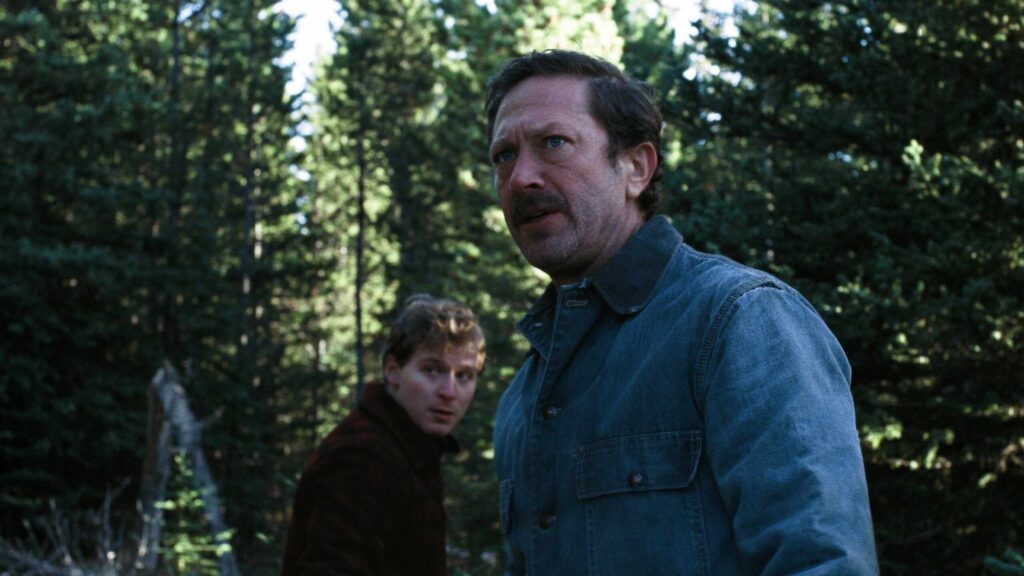
A Long Winter takes that fascination into the Colorado Rockies of the 1950s — although Vancouver audiences will recognize something closer to home in the fact that the film was shot in spectacular Alberta locations.
Fred Hechinger plays Mike, a young man living with his parents and younger brother in a remote cabin fifteen miles from town. His father, Lester, is played by Ebon Moss-Bachrach; his mother, Louise, by Caitríona Balfe; his younger brother, preparing to leave for Korea, is played by Kit Connor.
It is a family trapped not only by geography but by the emotional limitations of the world in which it lives.
Haigh adapted the film from a short story by Colm Tóibín, a project he first acquired more than a decade ago. After 45 Years and All of Us Strangers, Haigh has become one of the finest contemporary filmmakers working in the territory between love and loneliness.
Here, the landscape becomes an emotional character.
The mountains are enormous. The cabin is tiny.
Outside there is almost infinite space. Inside, four people can barely breathe.
When the family’s fragile equilibrium is shattered, Mike begins a painful journey toward adulthood. The disappearance of his mother forces him to confront truths about his father, his family and himself that have been buried beneath years of silence. Critics have noted the film’s treatment of masculinity, desire, grief and the emotional consequences of a rigid family structure.
What makes Haigh so effective is his refusal to rush.
A Long Winter understands that families rarely explode all at once. They fracture slowly. A sentence is left unfinished. A glance lasts a second too long. Someone goes outside and does not come back.
Then winter arrives.
Haigh’s use of Alberta’s vast landscapes gives the film an almost mythic quality, while the performances keep it intimate. Hechinger brings a fragile openness to Mike, while Moss-Bachrach and Balfe give the parents a complicated mixture of love, resentment, disappointment and need.
The result is a winter western without the usual mythology of the West.
No conquering hero.
No easy redemption.
Only a young man learning that becoming an adult sometimes means discovering that the people who raised you are as frightened, damaged and incomplete as you are.
And that, perhaps, is where adulthood really begins.
BEHEMOTH!
Tony Gilroy
Tony Gilroy has spent much of his career writing about people trapped inside systems — intelligence agencies, corporations, political institutions, families, professional hierarchies. His Michael Clayton remains one of the great American films about moral compromise.
With Behemoth!, Gilroy turns inward.
Pedro Pascal plays Alex, a professional cellist who walks away from the Chicago Symphony and returns to Los Angeles to care for his ailing mother. At least, that is the story he tells people. The truth is considerably messier: Alex is also escaping the consequences of his latest romantic entanglement, involving a terrifying Olivia Wilde.
Alex is a musician who should have become something larger than he is.
Instead, he has become a man permanently in retreat.
There is enormous comic potential in that premise, and Gilroy exploits it. But Behemoth! is not simply a comedy about a failed musician. It is a meditation on inheritance — artistic inheritance, familial inheritance and the emotional debts we accumulate without ever agreeing to repay them.
Making Alex a cellist is an inspired decision.
Music provides Gilroy with something that dialogue cannot. The film can move between performance and memory, between the discipline required to make beautiful music and the chaos of a man who cannot organize his own life.
Pascal is particularly well suited to the contradiction. His screen persona has increasingly become associated with warmth, vulnerability and a slightly battered charm. Alex weaponizes none of those qualities. He simply drifts through life hoping that the next problem will somehow solve the previous one.
It rarely does.
Gilroy, now 69, brings to the film the experience of a filmmaker who has spent decades watching people negotiate systems larger than themselves. His directorial début, Michael Clayton, received seven Academy Award nominations, while his later work includes Duplicity, The Bourne Legacy and Rogue One: A Star Wars Story. His television work on Andor further demonstrated his fascination with resistance, sacrifice and institutional power.
Behemoth! is considerably more personal.
It is funny, strange, melancholy and unexpectedly tender. VIFF describes it as a novelistic character study unfolding across roughly fifteen years of Alex’s life, combining humour and suspense with a deeper examination of inheritance and connection.
The title is ironic.
Alex is no behemoth.
He is a man trying to find his way home.
And discovering that home is not necessarily a place.
Sometimes it is the person you finally become willing to stay for.
LA BOLA NEGRA
Javier Ambrossi & Javier Calvo
Some films announce their ambitions immediately.
La Bola Negra simply gets on with them.
The second feature from Spanish writer-directors Javier Ambrossi and Javier Calvo — affectionately known in Spain as “Los Javis” — is an enormous historical melodrama built around three timelines, three gay protagonists and an unfinished work by Federico García Lorca.
The film moves between 1932, 1937 and 2017.
Its central wartime story follows Sebastián, played by singer Guitarricadelafuente, who is conscripted into the fascist forces during the Spanish Civil War and ordered to befriend a leftist prisoner, played by Miguel Bernardeau. Five years earlier, Carlos is rejected by his father’s club because of his sexuality. In 2017, writer-historian Alberto receives a mysterious inheritance that sends him searching through the past.
These stories eventually begin to speak to one another.
And that is where the film’s real power lies.
Ambrossi and Calvo are not merely reconstructing history. They are asking how history survives inside families, inside photographs, inside secrets, inside bodies.
Queer history is often a history of absence.
The people who came before us did not always have the luxury of leaving records behind. Sometimes they left only a rumour, a photograph, a letter, an unexplained relationship, a forbidden love.
La Bola Negra turns those fragments into cinema.
The film won the Best Director prize at Cannes for Ambrossi and Calvo, sharing the award with Paweł Pawlikowski for Fatherland. Then, at Toronto, it won the People’s Choice Award — a particularly significant honour because it represents the response of festival audiences themselves.
Its cast is extraordinary, including Penélope Cruz and Glenn Close alongside the younger ensemble.
But the real star may be the structure itself.
Three eras.
Three men.
One continuing struggle to live openly.
The title comes from Lorca’s unfinished play, and the filmmakers transform that fragment into a meditation on all the stories that history leaves unfinished.
There is something thrillingly old-fashioned about the ambition of La Bola Negra. It wants to be a great historical melodrama. It wants romance and politics, repression and desire, family secrets and national memory.
And somehow it gets away with it.
In an era when cinema often seems afraid of excess, Los Javis embrace it.
They give us colour, history, sexuality, music, grief, humour and spectacle.
Most importantly, they give us people who refuse to disappear.
WILD HORSE NINE
Martin McDonagh
And then, as the 45th Vancouver International Film Festival approaches its final curtain, Martin McDonagh arrives with Wild Horse Nine.
What better way to close a film festival than with McDonagh — a filmmaker whose cinema has always been fascinated by violence, absurdity, damaged people and the strange comedy that exists somewhere between tragedy and despair?
Wild Horse Nine takes us to Easter Island shortly before the 1973 Chilean coup. CIA agents Chris and Lee, played by John Malkovich and Sam Rockwell, are sent from Santiago by their bureau chief, MJ, played by Steve Buscemi. Among the island’s extraordinary statues, old conspiracies, old sins and new friendships begin to collide.
The cast alone is enough to make a cinephile sit up.
Malkovich.
Rockwell.
Buscemi.
Tom Waits.
Parker Posey.
And at the centre of it all, McDonagh.
The filmmaker behind In Bruges, Seven Psychopaths, Three Billboards Outside Ebbing, Missouri and The Banshees of Inisherin has perfected a peculiar cinematic language in which cruelty and comedy are never far apart. His characters are frequently wounded people who behave badly because they do not know how else to behave.
Wild Horse Nine places that sensibility inside the machinery of Cold War geopolitics.
Chris and Lee are professional conspirators, men whose careers have been built on secrets. Yet their journey to Easter Island brings them into contact with young people who possess something the agents have long since lost: the possibility of believing that the world might be changed.
That collision between youthful idealism and institutional cynicism is where McDonagh finds his drama.
And John Malkovich is perfectly cast.
McDonagh has written a role that gives Malkovich the opportunity to combine menace, melancholy, intelligence and comic absurdity. The performance has already become part of the awards-season conversation, although the Academy’s nominations, of course, remain months away.
The film premièred in competition at Venice, where its political themes immediately attracted attention. McDonagh has spoken publicly about the CIA’s history of intervention and the historical realities surrounding the 1973 Chilean coup.
Yet Wild Horse Nine is not a lecture.
It is a McDonagh film.
Which means that somewhere amid the politics, the violence and the history there will be laughter — often at exactly the moment when laughter seems least appropriate.
That is the McDonagh gift.
He reminds us that absurdity is not the opposite of tragedy.
Sometimes it is how human beings survive it.
And as VIFF 45 closes, Wild Horse Nine sends the audience back into Vancouver carrying precisely that uneasy mixture of laughter, melancholy, history and wonder that great cinema leaves behind.
Cinema has always been a way of traveling without leaving our seats.
At VIFF, the journey becomes almost impossibly vast. A Belgian soldier meets a lover in the trenches. An Austrian outsider walks into a German village. Two Korean couples discover the invisible walls separating rich from poor. Two Japanese girls discover friendship through the scratch of pencil on paper.
A family disappears into the snow. A musician returns home. Three generations in Spain inherit the secrets of those who came before them. American agents arrive on an island at the edge of the world, carrying the ghosts of a history they helped create.
And somehow, sitting in Vancouver, we recognize them all.
That is the miracle.
The people on the screen may speak French, Dutch, Korean, Japanese, Spanish or German. They may live in wartime Europe, postwar Asia, rural Alberta, contemporary Seoul or an island thousands of kilometres across the Pacific. Their politics may be different. Their histories may be different. Their religions, languages, landscapes and customs may be different.
Yet the things they want are hauntingly familiar: to be loved, to be understood, to belong, to be forgiven, to escape the mistakes of the past, to protect the people they care about, to find some small corner of freedom in a world that so often tells us who we are supposed to be.
And so, every October, Vancouver opens its doors to the world.
For eleven days, the city becomes something larger than itself.
The Vancouver International Film Festival reminds us that cinema is not merely entertainment, nor simply an industry, nor even an art form. It is a conversation — between strangers, between generations, between countries, between people who may never meet and yet somehow understand one another. The screen becomes a window. The darkness of the theatre becomes a place of connection. And when the lights come up, we return to our own lives carrying a little of someone else’s with us.
That is why VIFF matters.
Because somewhere in the darkness, in a cinema in Vancouver, a story from the other side of the planet suddenly becomes our story, too.
And for a few precious hours, the world is no longer far away.
It is sitting beside us.

VanRamblings’ Galas and Special Presentations column, Part 1
VanRamblings’ Galas and Special Presentations column, Part 2