Politics is often described as a contest for power: elections are won, governments formed, policies imposed and opponents defeated.
But beneath all the arguments about taxes, housing, policing, healthcare and the economy lies a more fundamental question — what kind of society do we want to create, and how do we treat one another while creating it?
That question has become increasingly urgent.
In an era when political discourse is dominated by divisiveness, hostility, anger and polarization, kindness can seem almost quaint. In the rough-and-tumble world of modern politics, kindness is sometimes dismissed as weakness, naiveté or an unwillingness to confront difficult realities.
But perhaps we have the question backwards.
If the foundational purpose of politics is the organization of society for the common good, then kindness is not an indulgence. It is a practical and necessary political value. It asks a fundamental question of every government and every politician: What kind of society are we trying to create, how do we treat people who have the least power within it?
Cruelty and kindness are two opposing choices in human behaviour.
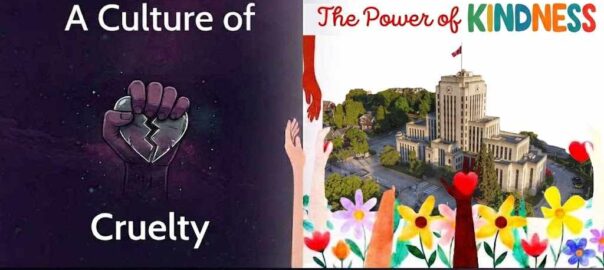
Under King Sim The-Not-So-Great, A Culture of Cruelty Has Reigned
There is at the heart of the Sim administration a Trump-like adherence to cruelty as the defining force of Vancouver’s approach to governance, since Sim and his ABC Vancouver administration first took office in November 2022.
As a first order of business, Ken Sim revoked the Livable Wage Programme requiring suppliers to the City to pay a livable wage to their workers. Next, ABC Vancouver cancelled the Renter’s Office, as if renters didn’t matter, promising to re-direct funds to a renter’s group in Vancouver — of course, that never came to pass.
Next, Ken Sim filed two formal complaints against OneCity Vancouver City Councillor Christine Boyle, requiring her to expend funds to defend herself against the baseless charges alleged by the Mayor. Next, while practicing the Politics of Cruelty, Ken Sim and fellow ABC Councillor Lenny Zhou alleged publicly in the Chinese media that opposition COPE Councillor Sean Orr had distributed illegal drugs on the DTES over Christmas 2024 — while, in point of fact, Councillor Orr was visiting friends and family on the Sunshine Coast.
Not done, yet, Mayor Sim ordered the shuttering of the Office of the Integrity Commissioner while, it should be noted, he was under investigation for wrongdoing by Lisa Southern, then the City’s Integrity Commissioner. Ken Sim was unsuccessful in that venture.
As we wrote on Monday, Ken Sim and his ABC administration chose to expend $13.4 million to purchase FIFA tickets for their ‘friends’, choosing not to act on a recommendation by several health agencies to install suicide prevention barriers on the Granville Street Bridge, going so far this past March to not even bother to include a budget for the barriers in the 2026 – 2030 Capital Expenditure question set to be placed before voters who go to the polls this October.
Earlier this month, ABC Vancouver proposed and passed a public safety plebiscite motion designed to bolster their re-election chances, and cause fear among the public on issues related to the unhoused, street entrenched members of our community who ABC said they’d ‘crack down on’ by clearing the streets, without even the barest hint of compassion and caring for this vulnerable population.
Cruelty — as can be seen from the above examples — inflicts pain, creates division and would seem to stem from Ken Sim’s fear, insecurity or a desire for power and control.
Kindness, on the other hand, offers care, builds connection and requires the conscious strength to look beyond our most primal instincts.
Cruelty can deliberately hurt people or simply disregard their well-being. Kindness acts with generosity, empathy and a genuine desire to help.
These qualities do not remain confined to our personal lives. They shape our institutions, our communities and, ultimately, our politics.
A private act of cruelty may hurt one person.
A political decision can hurt thousands — or millions

That is why the character of political leadership matters, why who we elect to hold office at Vancouver City Hall this October matters.
Across much of the democratic world, political debate has grown harsher, more personal and more contemptuous.
Opponents are portrayed not merely as people who are wrong, but as enemies who must be humiliated, silenced or destroyed. Anger has become a political commodity, and cruelty is too often mistaken for strength.
But cruelty is not strength. It is a political choice.
And kindness is not weakness. Properly understood, it is a demanding principle — one that requires us to recognize the dignity of people with whom we disagree and to judge public policy by its consequences for the whole community.
At its foundation, politics exists to organize society for the common good. Governments collect taxes, build institutions, establish laws and distribute public resources because human beings cannot flourish entirely on their own. Politics is therefore, at its best, an exercise in deciding how we will live together.
Kindness belongs at the centre of political decision-making in Vancouver
This does not mean that politics should become sentimental, conflict-free or incapable of making difficult decisions.
A kind government must sometimes say no. It must enforce laws, confront corruption, protect the vulnerable and make choices that inevitably disappoint some people. Kindness does not eliminate accountability. It changes the purpose behind accountability.
The distinction matters. Cruelty seeks punishment, humiliation or exclusion for its own sake. Kindness seeks justice while recognizing our common humanity.
Indeed, some of the cruelest political decisions are not dramatic acts of violence. They are administrative decisions that allow suffering to continue because those suffering have little political power.
When governments tolerate homelessness, inadequate mental-health services, unaffordable housing, preventable poverty or unsafe working conditions, the resulting suffering can become invisible. No one person may be responsible; rather, it is the collective decision not to act.
This is why kindness cannot simply mean being personally pleasant. Political kindness must be institutional.
Kindness asks whether our laws, budgets and public services recognize that every human being has value — including people who are poor, addicted, homeless, elderly, disabled, unpopular or politically inconvenient.
Kindness also requires justice.
Kindness without justice can become patronizing: the powerful offering charity to those whom they have helped keep powerless. A genuinely humane politics therefore seeks both compassion and equality.
Nor should kindness be confused with political weakness.
Sometimes the kindest decision is the hardest one.
Preventing an environmental catastrophe may require restrictions today to protect people tomorrow. Addressing climate change means accepting responsibilities to generations that cannot yet vote.
Building affordable housing require government to challenge powerful interests. Providing treatment to people suffering from addiction demands resources, patience and political courage long after the cameras have disappeared.
This is not an act of softness; it is an act of responsibility.
There is also a danger in turning kindness itself into a political weapon.
Politicians can perform compassion while pursuing policies that deepen inequality. They can speak warmly about community while governing indifferently. Kindness must therefore be measured not by rhetoric but by outcomes.
The ultimate test is simple.
Does a political decision reduce unnecessary suffering, expand human dignity and strengthen the capacity of people to live meaningful lives together?
If it does, it deserves to be called humane.
If it deliberately increases suffering merely to satisfy anger, revenge or political calculation, we should have the courage to call it cruel.
A healthy democracy does not require everyone to agree. It requires citizens and leaders to recognize that disagreement does not cancel our shared humanity.
That may be the most important lesson of all.
The Structural Cruelty of Life Under Ken Sim’s ABC Vancouver Regime
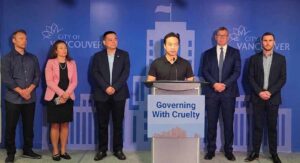 Mayor Ken Sim at the podium, and his ABC Vancouver Councillors behind him, left to right, Councillors Brian Montague, Lisa Dominato, Lenny Zhou, Mike Klassen and Peter Meiszner
Political cruelty does not always look cruel.
Sometimes there is no angry politician, no deliberate act of violence and no obvious villain. Instead, cruelty can be embedded within laws, regulations, economic systems and bureaucratic procedures.
A government can deny people access to housing, healthcare or basic social supports. Criminal justice policies can punish poverty rather than address its causes. Immigration policies can separate families. Economic policies can leave people without meaningful opportunities while political rhetoric tells them their suffering is entirely their own fault.
This is structural cruelty.
It is particularly dangerous because responsibility becomes dispersed. The politician signs the legislation. The bureaucrat administers it. The agency enforces it. The taxpayer finances it. The public becomes accustomed to it.
And the person suffering can disappear behind statistics.
Kindness requires political leaders to reverse that process — to put the human being back at the centre of political decision-making.
Kindness Could Be A Core Political Value in Vancouver Should We Choose
At its core, kindness means empathy, respect and a genuine concern for others. Woven into political practice, it fosters collaboration, promotes inclusion and creates the possibility of pursuing justice and equality without first dehumanizing those with whom we disagree.
Kindness should therefore not be viewed as a soft alternative to serious politics.
It is serious politics.
Political decision-making determines how resources, rights and opportunities are distributed throughout society.
Every budget contains moral choices. Every tax system reflects priorities. Every housing policy says something about whose needs are considered urgent. Every healthcare decision reveals how much value society places upon human well-being.
When kindness is embedded in those decisions, governments are more likely to consider the consequences for people who are most vulnerable.
Policies reflecting kindness are not acts of charity. Social justice is not simply about giving something to people who have less. It is an acknowledgment of our shared humanity and our shared dependence upon one another.
Children depend upon adults. Older people depend upon younger generations. People become sick, disabled or unemployed. Families experience poverty. Individuals encounter addiction, mental illness, grief and homelessness.
At different points in our lives, almost all of us depend upon the kindness and institutions of others.
A compassionate society recognizes this vulnerability rather than pretending that every person succeeds or fails entirely through individual effort.
Kindness, Justice and Equality Must Define Politics in Vancouver

Kindness has a particularly important role in advancing justice and equity.
Justice asks whether people are being treated fairly.
Kindness asks us to understand what those people are experiencing.
The two belong together.
A society cannot claim to be just while ignoring the suffering of people who have little political power. Nor can it create genuine equality by treating every person as though their circumstances were identical.
Kindness demands political leaders look beyond abstract statistics and consider the lived experience behind them.
What does an unemployment rate mean to the family that cannot pay its rent?
What does a housing shortage mean to the person sleeping in a shelter?
What does a healthcare waiting list mean to someone living with pain?
What does climate change mean to a community whose home, livelihood or food supply is threatened?
These are not merely economic or administrative questions. They are human questions.
Our Current Climate Emergency, and the Politics of Future Generations

Climate change, our current climate emergency, provides one of the clearest examples of why kindness must extend beyond immediate political interests.
The consequences of climate change disproportionately affect many of the world’s poorest and most vulnerable communities, despite the fact that those communities have often contributed the least to the accumulation of greenhouse-gas emissions.
A kind approach to environmental policy therefore looks beyond the next election cycle.
It considers future generations.
Political leaders who approach climate policy through empathy and equity recognize that today’s decisions will affect people who have no vote in today’s elections. Children not yet born will inherit the consequences of choices made by today’s governments.
Kindness, in this context, becomes a form of responsibility.
It means refusing to define political success solely in terms of immediate economic gain. It means considering whether our prosperity is being purchased at the expense of people elsewhere — or at the expense of generations yet to come.
Environmental justice is therefore not charity. It is an expression of shared responsibility.
The Choice Vancouver Voters Face When Going to the Polls This October

In an age of polarization, kindness may indeed appear naïve.
But perhaps what appears naïve is actually what has become radical: the belief that politics should be about improving people’s lives.
Kindness can humanize political dialogue, rebuild trust and create the conditions for co-operation. It can help repair the fractures within democratic institutions and allow leaders to confront enormous challenges — including inequality, housing, healthcare, climate change and public safety — with greater empathy and clarity.
Kindness does not mean abandoning principle.
It means pursuing principle without abandoning humanity.
Cruelty tells us that some people are disposable.
Kindness insists that every person matters.
Cruelty divides society into winners and losers, insiders and outsiders, deserving and undeserving.
Kindness asks what circumstances produced inequality and what can be done to reduce unnecessary suffering.
Cruelty governs through fear.
Kindness governs through trust.
Politics is ultimately a choice about which side of human nature we cultivate.
A society that rewards cruelty will inevitably produce more cruelty. A society that rewards empathy, responsibility and mutual care can create the conditions for more kindness.
The greatest measure of political leadership should not simply be who can command the most authority, win the most votes or dominate the political conversation.
It should be who understands the extraordinary responsibility that comes with power.
The true test of a political society is what it does with its power when nobody is powerful enough to stop it.
That is where cruelty and kindness cease to be abstract philosophical concepts.
They become the daily reality of people’s lives.
And in the political realm, choosing kindness is not merely a matter of being nice.
It is a decision about what — and whom — a society is willing to value.
We can be tough without being cruel. We can demand accountability without demanding humiliation. We can defend public safety without abandoning compassion. We can disagree passionately without deciding that our opponents are less deserving of dignity than ourselves.
Politics will always involve conflict. There will always be competing interests, limited resources and difficult choices. Kindness will never remove those realities.
But it can determine how we confront them.
The choice between cruelty and kindness is therefore not a choice between weakness and strength. It is a choice between two visions of political life.
One sees society as a battlefield in which winners triumph over losers.
The other sees society as a community where freedom and prosperity are inseparable from the well-being of others.
The first may produce fear, obedience and temporary political victories.
The second offers something far more difficult — and more enduring: a society in which power is exercised not simply to control people, but to help people flourish.
That is not naïve politics.
It is politics worthy of the name.