Tag Archives: belfast

#ArtsFriday | Streaming | The Best Police Procedural On The Planet | #Belfast


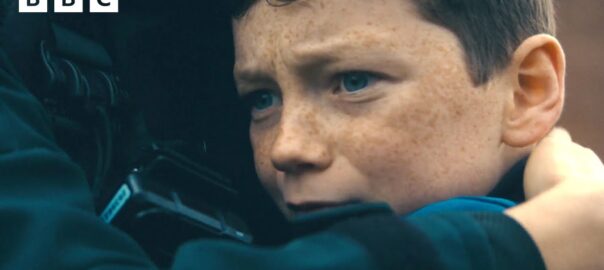
Grace (Siân Brooke) and Stevie (Martin McCann) respond to a distress call, in Blue Lights.

There is a quiet moment in Blue Lights when a patrol car glides through the rain-soaked streets of Belfast.

There are no gunshots. No dramatic chase. Just two police officers talking about life, fear, disappointment and the endless uncertainty that accompanies both policing and adulthood. Somehow, that simple conversation carries more dramatic weight than an entire season of many American crime dramas.

That is the genius of Blue Lights.

Broadcast on the BBC in Britain and streamed in North America on BritBox, the award winning Irish police procedural has become one of television’s finest achievements — and at present is VanRamblings’ favourite, most compelling and heartrending TV series — not because it reinvents the police procedural, but because it remembers something many modern dramas have forgotten.

Before police officers are heroes or villains, they are simply human beings.

Created by former journalists Declan Lawn and Adam Patterson, Blue Lights follows three probationary officers in the Police Service of Northern Ireland as they learn their profession in a city still living beneath the shadow of the Troubles.

Belfast is not merely a backdrop; it is a character unto itself, haunted by memory, divided by history and yet stubbornly determined to move forward.

The city breathes through every frame.

The comparisons with the greatest American police dramas are inevitable.

Like Hill Street Blues, Blue Lights understands that policing is messy, exhausting work carried out by imperfect people trying to make decent decisions in impossible circumstances.

Like Homicide: Life on the Street, it finds extraordinary drama in ordinary conversations, allowing silence and uncertainty to tell as much of the story as action.

And like The Wire, it recognizes that crime cannot be separated from politics, poverty, history or community. Institutions matter. History matters. Geography matters. No crime exists in isolation.

Yet Blue Lights never feels derivative. It possesses its own rhythm, quieter and more intimate than its American predecessors, less interested in spectacular violence than in the emotional toll that violence leaves behind.

The Guardian called it “one of TV’s best shows,” praising its gripping realism, nuanced writing and richly believable characters. Rather than relying on endless action, it creates tension simply by placing two officers together inside a patrol car and allowing conversation to unfold naturally.

The second season only deepened that achievement. The Guardian admired its ability to move effortlessly “between light and dark,” noting that the evolving relationship between Grace and Stevie remained one of television’s most delicately observed partnerships.


Annie (Katherine Devlin) and Aisling (Dearbháile McKinney) attend at a bar when a fight breaks out

The Independent praised the series for being inseparable from Belfast itself, observing that the city “looms as a character” and that the legacy of Northern Ireland’s divisions informs every episode. Viewers have compared it to Line of Duty, but Blue Lights possesses something even rarer: compassion.

At the heart of all of this stands Siân Brooke.

Her portrayal of Grace Ellis is the finest television performances of the past decade.

Grace arrives as an outsider — an Englishwoman, a former social worker, considerably older than the other recruits and carrying both optimism and self-doubt. She enters policing believing that kindness remains a practical tool, even in neighbourhoods where violence has become routine.

That belief should make her naïve.

Instead, it makes her courageous.


If you’re going to watch only one of the Blue Light clips, the scene above is the must watch clip.

Grace refuses to surrender her empathy simply because the job encourages emotional distance. She listens. She comforts victims after everyone else has moved on. She sees frightened children where others see future criminals. She carries the instincts of a social worker into the patrol car, reminding both colleagues and viewers that justice without compassion quickly becomes something else entirely.

She is, quite simply, the moral centre of the series.

The heart.

The soul.

Siân Brooke never overplays the role. Grace’s strength emerges not through speeches but through small gestures — a reassuring hand, a quiet conversation, a hesitant smile, a look that communicates exhaustion and hope simultaneously.

Every expression feels lived rather than performed.

Opposite her stands Martin McCann as Stevie Neil, whose weathered pragmatism forms the perfect counterpoint.

Stevie has seen too much to believe every problem can be solved. Yet beneath the dry humour and occasional cynicism lies immense decency.

The chemistry between Siân Brooke and Martin McCann is remarkable precisely because it grows so slowly.

Their partnership is built not upon television clichés but upon trust earned over countless shifts, shared danger and quiet conversations over homemade lunches eaten between emergency calls.

The Guardian beautifully described one scene in which Grace finally offers Stevie something she has baked herself — an almost wordless declaration of affection that says more than pages of dialogue ever could.

Their relationship reflects the achievement of Blue Lights. Everything is earned.

Nothing feels manufactured.

Nothing is rushed.


Aisling (Dearbháile McKinney) and Annie (Katherine Devlin) attend at a family home to report bad news

Perhaps that explains why the series has resonated so deeply with audiences on both sides of the Atlantic. At a time when television often mistakes relentless pacing for storytelling, Blue Lights has the confidence to pause, to breathe and to trust its audience.

Its extraordinary success also reminds us that police dramas need not glorify violence to explore courage.

Sometimes heroism is quieter.

Sometimes it looks like a middle-aged officer choosing compassion over anger.

Sometimes it is an experienced partner silently standing beside her.

And sometimes the brightest blue lights are not the ones flashing atop a patrol car.

They are the fragile lights of humanity that continue to flicker in people determined to believe even in wounded places, kindness remains worth defending.

#Cinema | Holiday Oscar Awards Season, Part 2 | Best Picture Contenders

With epic cinematic re-makes, like Steven Spielberg’s heartfelt and heart-breaking re-imagining of West Side Story, and ferociously inspiring biopics like King Richard in contention, Academy Awards Oscar voters have a plethora of worthy choices in a Best Picture category that has been set at full and expansive 10 slots this year.

The Academy Awards ceremony will take place on Sunday, March 27th, 2022.

In last week’s Part 1 of VanRamblings’ Oscar preview, we wrote about all of the probable Oscar contenders that are readily available to you in the comfort of your home — available on Netflix, Amazon Prime, Disney+, or Apple TV.

This week, we’ll turn our focus to the Oscar contending films that will be available exclusively as an in-cinema experience — the best way to enjoy cinema.

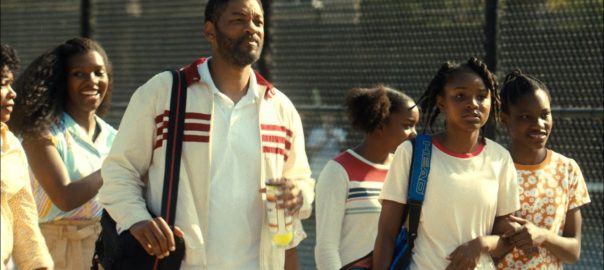
A fundamentally and marvelously old-fashioned cinematic entertainment, a working class sports drama that is so authentic, appealing and engaging that it simply pulls you right in, King Richard is the story of the dream of Richard Williams — father to future tennis phenoms, five time Wimbeldon champion, Venus, and her younger sister, Serena, winner of 23 Grand Slam tournaments — this crowd-pleasing, socially alert story of perseverance, and the up-by-the-bootstraps pursuit of excellence, is VanRamblings’ favourite Hollywood film of 2021.

Further, we believe King Richard will win the 2022 Oscar for Best Picture, while also boasting this year’s presumed Best Actor front-runner in Will Smith.

Aunjanue Ellis as Oracene  Williams, Demi Singleton as Serena Williams. Photo: Warner Bros. Pictures

Aunjanue Ellis’ richly layered performance as Venus and Serena’s mother, Oracene ‘Brandy’ Williams — who winds up stealthily stealing the movie despite her co-star, Will Smith’s gravitational charisma — is nothing short of a revelation, possessed of an unshakeable source of love and balance for her husband Richard and their five children, in a magnificent character portrayal that deserves a shower of raves.

Rush out to see King Richard because, quite simply, it is a revelation.

The reviews are in for Steven Spielberg’s re-imagining of the 1961 Best Picture Oscar winning classic musical, West Side Story — and they’re all raves!

The critics are simply waxing poetic about this big screen cinematic reverie …

  • Says The Globe and Mail’s Arts Editor and ‘professional’ movie critic, Barry Hertz, “I would accuse Spielberg of playing the romantic fool — of being convinced that his audience will fall in love with whatever he’s already become smitten with or blinded by himself — but West Side Story proves that he is as annoyingly, lovingly, dastardly whip-smart as ever. This film is the reason that we go out to the movies, and should continue to do so for as long as the opportunity is afforded to us.”;
  • Writes Robbie Collin, in his five-star review in The Telegraph … “West Side Story is, I believe, Spielberg’s finest film in 20 years, and a new milestone in the career of one of our greatest living directors. A little less than a month before his 75th birthday, he has delivered a relentlessly dazzling, swoonily beautiful reworking of the 1957 Manhattan-set musical by Arthur Laurents, Leonard Bernstein and Stephen Sondheim, which feels just as definitive and indestructible as the previous screen adaptation, directed by Robert Wise and Jerome Robbins.”

Ariana DeBose as Anita and David Alvarez as Bernardo in a scene from Spielberg’s new West Side Story

Opening a week today, on Friday, December 10th, Steven Spielberg’s heartfelt and heart-breaking adaptation of West Side Story remains faithful to its roots, and emerges for audiences today, alive to the concerns of the modern world.

Stunningly detailed, wickedly enjoyable, with an A-list cast up and down, director Guillermo del Toro’s gorgeous and fantastically sinister moral fable about freak shows, dark and stormy nights, innocent dames, morally bankrupt schemers, and a femme fatale to die for, Nightmare Alley offers a gloomy dip into the dark side, immersive and bleak from start to finish.

You know. Just standard holiday film fare.

This sordid excavation into the hollowness of a human soul is a strange fit for a director who’s spent his career searching for magic in the dark margins of our world, but del Toro’s natural empathy for the most damnable creatures sparks life into Nightmare Alley, as it narrows towards its inevitable end. (Dec. 17)

Winner of the prestigious Audience Award at this year’s Toronto International Film Festival, Kenneth Branagh’s Belfast, his semi-autobiographical account of growing up in Belfast during ‘The Troubles’, at only 97 minutes never overreaches, and could very well end up in Oscar’s top spot.

For VanRamblings, though, Belfast’s tenderly nostalgic memoir never coheres, but rather comes across as a low-rent version of Alfonso Cuarón’s personal tour de force, 2019’s Roma, which deftly captured the emotional balance of intimacy and the poetic power of a land in turmoil and transition, a necessary feat that Belfast fails to achieve.

Belfast, with its underdeveloped central characters — most especially Jamie Dornan and Catriona Balfe — is a film given to broad strokes, without ever locking the audience into an emotional perspective.

As such, Belfast emerges as only a scattershot pleaser, rendered with too little whimsy, and blarney left to spare. Still and all, film offers viewers a reflection on their own lives, a subjective and iconoclastic experience that may prove satisfactory for some viewers — as it did in Toronto this year. But, sorry to report, not for VanRamblings in any great or moving measure.

Critics who’ve seen Paul Thomas Anderson’s freewheeling, half-forgotten memoria of growing up in the golden, shimmering  suburban San Fernando Valley of the 1970s, Licorice Pizza, have found the film to be a tender, funny ramble forged in all the hope and absurdity of adolescence, the film carried on the shoulders of first-timers Alana Haim (Anderson has directed several of her band’s videos) and Cooper Hoffman (son of frequent Anderson collaborator, the late Philip Seymour Hoffman), both actors thoroughly engaging in their début performances.

Christie Lemire writes,”Haim is just a flat-out movie star. She has that “thing”: that radiant, magnetic charisma that makes it impossible to take your eyes off her.”

Clearly, Licorice Pizza is just the sort of small, under-the-radar film that audiences find, and are wowed by. An irresistible and delectably euphoric film, Licorice Pizza emerges as more than just a film, it is a playful, sentimental reminder of what it means to be young, as well as an embodiment of what it feels like to grow up.

A beyond-dazzling re-imagining of Cyrano de Bergerac, novelist Edmond Rostand’s fictionalization of the early 17th century playwright, epistolarian, and duelist Savinien de Cyrano de Bergerac, director Joe Wright’s charmingly poignant musical version of the 1897 stage play, offers vivid performances, intoxicating bravado, and a ravishing Roxanne (played by Haley Bennett, with whom Wright is besotted in real life). Cyrano took the Telluride Film Festival by storm — as may well be the case with you, and your family and friends.

Yet another true holiday film treat.

Of course, there are at least a dozen more films to sweep you off your feet this extended holiday Oscar movie season, including Joachim Trier’s revelatory The Worst Person in the World, VanRamblings’ favourite film of 2021, and a certain Oscar contender for Best International Film.

Sad to say, though, Trier’s latest film — which débuted at the Cannes Film Festival in July, winning the Best Actress prize for lead Renate Reinsve — won’t hit screens in the Metro Vancouver region until January 2022.

Dutch director Paul Verhoeven’s Benedetta — a substantial, sophisticated, yet briskly paced and always highly entertaining drama, the story of a 17th-century nun in Italy who suffers from disturbing religious and erotic visions — balances quiet scenes of shrewd backroom politicking with lurid scenes of wild religious madness. A big hit at Cannes. Set to be released on December 21st.

Sean Baker’s Red Rocket features Simon Rex as an ex-Porn star returning to his small town home. Critics at Cannes loved Red Rocket, a humane comedy, a portrait of romantic douchebaggery & an America of flailing last chances.

Recommended.

Finally, for today, we’ll leave you with Pedro Almodóvar’s Parallel Mothers, starring an Oscar-bound Penélope Cruz, in  a film of cascading twists and turns, of thickening complication, of high family drama.

Hearing that, you might imagine that it’s a movie of high comedy as well — a giddy and ironic Almodóvarian stew of maternal diva melodrama.

But Parallel Mothers, while it keeps us hooked on what’s happening with a showman’s finesse, is not a comedy. It’s not an over-the-top Pedro party. Rather, it’s an unabashedly serious movie, one so straightforwardly sculpted and emotionally down-to-earth that there’s no distance between the audience and what’s happening onscreen.

Parallel Mothers is as serious as any film Almodóvar has made, but in this case he hasn’t let go of his luminously light, beguiling, puckish side. Parallel Mothers draws you in and holds you. It’s Almodóvar’s disarming tribute to the shifting, ever-bending bonds of motherhood, and the inexorable pull of family.


New York Film Critics Circle Winners (announced Friday, December 3, 2021)

Best Film: Drive My Car, Ryusuke Hamaguchi (Sideshow and Janus Films)
Best Director: Jane Campion, The Power of the Dog (Netflix)
Best Actor: Benedict Cumberbatch, The Power of the Dog (Netflix)
Best Actress: Lady Gaga, House of Gucci (MGM/United Artists Releasing)
Best Supporting Actor: Kodi Smit-McPhee, The Power of the Dog (Netflix)
Best Supporting Actress: Kathryn Hunter, The Tragedy of Macbeth (Apple Original Films/A24)
Best Screenplay: Paul Thomas Anderson, Licorice Pizza (MGM/United Artists Releasing)
Best Animated Film: The Mitchells vs. The Machines (Netflix)
Best Cinematography: Janusz Kaminski, West Side Story (20th Century Studios)
Best First Film: Maggie Gyllenhaal, The Lost Daughter (Netflix)
Best Foreign Language Film: The Worst Person in the World (Norway)
Best Nonfiction Film: Flee (Neon)