Tag Archives: abc vancouver

#VanPoli | Vancouver Starved Its Parks — Then City Hall Declared the Park Board the Problem

There is a remarkable piece of political chutzpah unfolding at Vancouver City Hall.

For nearly two decades, successive City Councils have failed to provide Vancouver’s parks, swimming pools, community centres, playing fields and recreation facilities with the sustained investment they require.

Now, after years of deferred maintenance and inadequate capital funding — funding that was approved by voters at each election in 2008, 2011, 2014, 2018 and 2022 — Vancouver City Hall has decided that the institution responsible for those assets, the Park Board, is the problem.

It isn’t.

City Hall is, as are all the Mayors and City Councils elected since 2008.
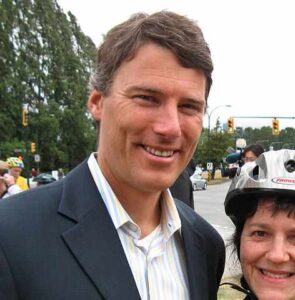
Mayor Gregor Robertson, who served as Vancouver Mayor from 2008 to 2018, cut Park Board funding

The modern history of this sorry affair begins with Mayor Gregor Robertson and Vision Vancouver, elected in 2008. Robertson’s administration inherited one of the world’s great urban parks and recreation systems.

Instead of establishing a long-term funding strategy to preserve it, the Vision Vancouver Mayor and Council imposed cuts.

In December 2010, the Vision Vancouver-led City Council approved more than $700,000 in reductions to the 2011 Park Board budget, with the consequences falling directly on parks: fewer flower beds, reduced lawn mowing and less street-tree pruning. Business in Vancouver subsequently reported that the cuts were visibly tarnishing the city’s parks.

The Park Board chairs during the opening years of the Robertson era — Raj Hundal in 2009 and Aaron Jasper in 2010–11 — were left attempting to manage an increasingly difficult financial situation. Constance Barnes chaired in 2012, Sarah Blyth from 2012 into 2013, and Jasper again in 2014.

And this is where the political responsibility becomes complicated.
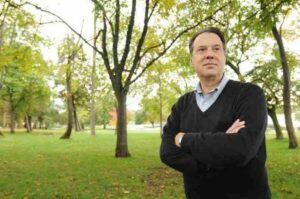
John Coupar, who served as a Vancouver Park Board Commissioner from 2011 through 2018

From 2014 to 2018, the Non-Partisan Association controlled Park Board, with John Coupar serving as chair 2014–15, followed by Sarah Kirby-Yung in 2016, Michael Wiebe in 2017 and Stuart Mackinnon in 2018.

Yet the Mayor remained Gregor Robertson and Vancouver City Council remained ultimately responsible for the municipal purse.

The NPA cannot credibly claim it was merely an innocent bystander, although it fought like hell to have funding for Vancouver’s Board of Parks and Recreation increased. While the NPA controlled the Park Board, Park Board Commissioners found themselves unable to develop the political coalition necessary to force City Hall to repair the funding model.

Vision Vancouver cannot escape responsibility for the underfunding of Park Board.

Robertson’s decade at City Hall coincided with an increasingly obvious deterioration in the city’s recreation infrastructure. By the late 2010s, the Park Board was talking not about maintaining a healthy capital system, but about catching up.

Camil Dumont, left, and Stuart Mackinnon, right, Green Party of Vancouver, former Park Board chairs

Under the 2018–22 Park Board, Green Party chairs Camil Dumont in 2020–21 and Stuart Mackinnon in 2019 and 2022 presided over a system confronting the consequences of years of inadequate renewal.
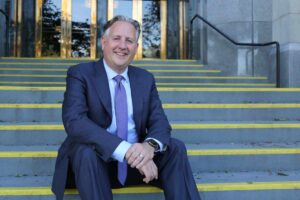
Kennedy Stewart, elected Mayor in 2018, continued to cut Park Board funding during his term in office 

When Kennedy Stewart became Mayor in 2018, the political rhetoric changed, but the underlying financial structure did not. The Park Board remained dependent on City Council for the money required to maintain its facilities, monies that were not forthcoming during Stewart’s four years in power.

The numbers tell the story.

In 2022, the Park Board approved a staggering $539-million four-year capital plan, including $140 million for the Vancouver Aquatic Centre and $49 million for RayCam Community Centre.

Vancouver Is Awesome pointed out the fundamental problem: despite being an elected body, the Park Board does not have its own separate budget. It must request allocations from City Council.

In other words, City Hall controls the money and then complains about the consequences when the money isn’t sufficient.
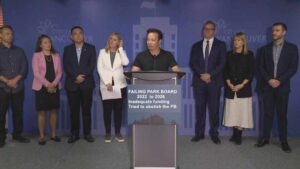
After electing a majority ABC slate Park Board, Sim and Council tried to eliminate the Park Board

Then came Ken Sim and ABC Vancouver.

Ken Sim was elected Mayor in 2022 with an overwhelming mandate.

ABC also won six of seven Park Board seats. The chairs during this period tell their own story: Scott Jensen was elected chair for the remainder of 2022 and 2023; Brennan Bastyovanszky was elected chair for 2024; Laura Christensen chaired in 2025; and Tom Digby is the current chair in 2026.
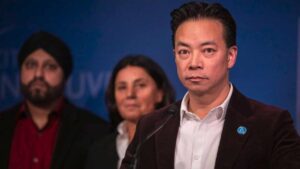

December 5, 2023 Ken Sim calls press conference, announcing his intention to abolish the Park Board

In December 2023, Ken Sim announced his intention to abolish Park Board.

And here the hypocrisy becomes almost breathtaking.

Three of Mayor Ken Sim’s own ABC Commissioners — Bastyovanszky, Christensen and Jensen — broke with the Mayor, joined forces with Green Party of Vancouver Commissioner Tom Digby and opposed the abolition plan. Vancouver Is Awesome reported Bastyovanszky’s blunt assessment: Park Board had been underfunded by City Council, which is Council’s responsibility.

Former Vision Commissioner Aaron Jasper agreed, arguing that if the issue was maintaining parks and community centres, Sim needed to look at his own actions.

Mayor Ken Sim nevertheless proceeded, despite community backlash.

Mayor Sim’s disinformation argument was that the system was “broken,” that abolition would produce efficiencies and that millions could be saved.

Sim failed to point out responsibility for the maintenance of Vancouver’s parks and recreation system was — at the insistence City Manager Penny Ballem — transferred to the City and its crews, after which Ballem and City Hall ignored the needs of the community centres for necessary upkeep and maintenance.

Former Park Board chair Jasper weighed in with another obvious point: eliminating the Commissioners would save only their salaries — roughly $140,000 annually — while the staff, planners, horticulturalists, recreation professionals and maintenance workers would still have to exist.

That is not reform.

It is political theatre.

And the bill for decades of deferred investment continues to arrive.

According to a report released by Vancouver’s Auditor General Mike Macdonell this past February, 11 of our city’s community centres are in a severe state of disrepair.

The approved 2022 $539-million capital plan made a demand for renewal.

Vancouver’s aging aquatic facilities, community centres, playgrounds, playing fields and parks require billions in investment. At the same time, City Hall continues to make budget decisions that put pressure on Park Board services.

This is not an argument that every Park Board decision has been wise. It hasn’t.

The Board has suffered from political infighting, poor governance at times, and occasionally baffling priorities. Critics have legitimate grievances.

But those failures do not justify rewriting history.

The Park Board did not independently decide how much money Vancouver’s taxpayers would provide it.

The elected Mayors since 2008, and all Vancouver City Councils since 2008 did.

Vision Vancouver under Gregor Robertson failed to establish an adequate long-term funding model. The NPA-controlled Park Board proved unsuccessful in forcing the issue. Kennedy Stewart’s administration inherited the problem without solving it. Ken Sim’s ABC administration, for the past two years, attempted to turn the accumulated consequences into an argument for abolishing the institution.

That is the ultimate political sleight of hand.

Starve an institution. Watch its infrastructure deteriorate. Declare the institution incompetent. Then seize its powers.

That is precisely what Vancouver voters should reject come October.

And there is one final irony.

After spending years attempting to abolish the elected Park Board, Ken Sim reversed course in July 2026, announcing ABC Vancouver would run a full slate of Park Board candidates in the October election.

So, apparently the institution that Ken Sim once described as fundamentally broken is now worth fighting an election to control.

Vancouver voters going to the polls in October should remember that.

The Vancouver Park Board does not need Vancouver City Hall to dismantle it.

Vancouver Park Board needs Vancouver City Hall to properly fund it.

And after eighteen years of Mayors, Councils and political parties failing to do precisely that, Vancouver’s voters should ask a very simple question this October:

Who broke the Park Board — the Commissioners who requested necessary funding, or the politicians who control monies, yet refused to provide it?
#VanPoli | The Villages Plan | An Open Letter to Vancouver City Council

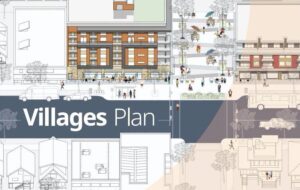
Open letter to Vancouver City Council on the “Villages Plan”
Patrick Condon, Professor Emeritus, University of British Columbia
UBC School of Architecture and Landscape Architecture

Subject: Serious Concerns with Vancouver’s Villages Plan

Dear Mayor and Council,

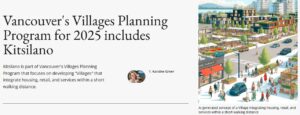
I write to challenge key elements of Vancouver’s Villages Plan Programme.

Together with the recently approved Official Development Plan and Broadway Plan, the City is now granting private owners of more than 80,000 parcels the right to build roughly 700,000 new housing units.

This represents enough capacity to house an extra 1.4 million people — more than double Vancouver’s current population of 670,000.

At today’s 1% annual population growth rate, this single decision delivers over 100 years of future housing supply. Yet even the projects already in the approval pipeline (roughly 78,000 units) would satisfy 30 years of trend growth.

Contrary to this city’s long standing policies for new density approvals, this massive landowner entitlement is being provided free of charge, with no expectation of payment for these new land rights.

These land rights are worth many billions of dollars.

The City is giving them away for free in the hope that this will somehow make housing more affordable.

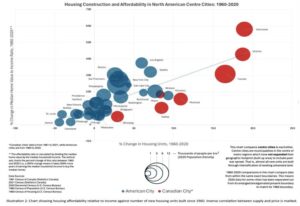
This is an odd notion for our planners to hold. If adding hundreds of thousands of new units to existing neighbourhoods truly lowered prices, Vancouver would have North America’s cheapest housing.

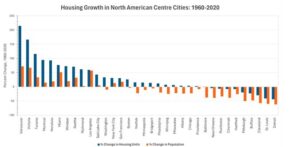
It has North America’s most expensive housing. (charts below)

It defies logic to expect an “unleashing of the housing market” — the primary justification provided for the Villages Plan — to produce affordable housing when we have spent decades trying to do just that. Vancouver has tripled its housing stock since the 1960s, all within a city where virtually every private parcel was in urban use. This is a higher percentage increase of infill development than that of any other North American centre city. If adding housing to existing city districts was the sure fire path to affordability we would have seen positive results by now.

Based on this evidence, it is clear: if affordability is the main justification for this plan, it obviously fails the test.

Massively over-zoning a city above reasonable expectations for population growth serves little purpose. The only purpose it serves is to support the false narrative that only “restrictive zoning” stands in the way of affordable housing. It doesn’t. It never has. It can’t.

The claim is false.

On the contrary, if any city proves that it is possible to use zoning as a positive public policy tool, it is the City of Vancouver. We tripled housing units city-wide. No other centre city did that — an unheard-of achievement.

While this sadly did not make the city more affordable, as we had hoped, it did make the city better. Much better.

How was this 200 percent growth accomplished? By working with residents, not against them. Community planning with local communities was the means to this achievement. Planning with communities was not an impediment, as some now claim. It was the democratic path to a better city.

But sadly it is now obvious that our decades-long effort to encourage the housing market, in the hope that housing would stay affordable, has failed us. Given this evidence, it seems foolish to upzone so aggressively, hoping against hope that, in 30 or 40 years, housing will be more affordable.

Achieving durable affordability much sooner than this requires a major change in direction. We don’t lack housing; we lack affordable housing. Given this fact, we should follow a path that other similar cities have charted — one where the bulk of new housing built is affordable to average wage earners. This can be done by reviving the Vancouver tradition of building non-market housing at scale, largely financed through “land lift” taxes as applied in Yaletown.

Our own internationally famous False Creek South serves as a storied precedent. Service workers to business owners have found homes in that lovely, self-sustaining community.

The pattern is obvious. Reuse it.

Unfortunately, the Villages Plan moves us in exactly the wrong direction. It virtually rules out any form of land value capture tax, based on the mistaken fear that it would raise home prices. It won’t — and it can’t.

A properly designed land-lift tax simply reduces the inflated “land price residual” that now funnels unearned speculative windfalls into private pockets. A properly designed “land lift” tax channels those gains into public benefit — without increasing the price buyers ultimately pay.

I urge you to revise these plans by deeply involving residents from every corner of the city in a highly collaborative, bottom-up, neighbourhood-focused planning process. One that might arrive at much stronger inclusionary zoning requirements.

The people of Vancouver would rally behind such plans — plans that ensure that their sons and daughters, and the workers who keep this city running, can afford to live in the very neighbourhoods they serve and call home.

Do not pass this plan.

Let us turn instead to plans that are sustainable in scale, equitable in outcome, and shaped not for the market alone, but for the people who live and work here.

Yours truly,

Professor Emeritus Patrick M. Condon
University of British Columbia

More voices weigh in on ABC Vancouver’s Villages Plan development proposal

Steve Jedreicich — principal of Vancouver’s SJ Development Ltd., brings over 30 years of local urban planning and real estate consulting experience to the housing discussion —  weighs in on ABC Vancouver’s contentious Villages Plan proposal.

WBN News Vancouver publisher Karalee Greer’s published article on the impact of the Villages Plan development proposal currently before Vancouver City Council, in particular its impact on Vancouver’s Kitsilano neighbourhood. At present, well more than 1000 speakers are set to address the controversial Villages Plan proposal, in meetings that thus far have lasted well into the night at Council.

Randy Helten and Steve Bohus, the good, hard working, dedicated folks behind the informative CityHallWatch website offer a backgrounder on Vancouver’s Villages Plan proposal, suggesting the plan “was born in the USA.” CityHallWatch offers six more Villages Plan articles the site published in the months of June and July. Click on the multi-coloured links below to access the articles.

Yes, there are even more Villages Plan articles available to you.

As is his wont — and thank goodness for that — The Daily Hive’s well-respected, incredibly hard working urban affairs reporter Kenneth Chan, early in July, published a thorough and well-researched article on Vancouver’s Villages Plan proposal.

Well worth a read.

The Job of a Journalist, to Comfort the Afflicted and Afflict the Comfortable

For journalists covering politics, and this very much includes VanRamblings, few tasks are more fraught than writing critically about political figures they have come to know well, respect, or even like.

In recent days, VanRamblings has been critical of Mayor Ken Sim, who we know and — to be perfectly frank, we — like (in the days to come, we will publish a supportive story of Mayor Sim). VanRamblings take no great pleasure in writing critically, or negatively, about a political figure, be it Mayor Sim, or Premier David Eby.

The above said, we acknowledge that the craft of political journalism demands objectivity, independence, and an unwavering commitment to the public interest.

Yet, the human element of this work cannot be denied. Political reporters often spend years in the company of the same politicians — interviewing them in hallways and offices, sharing off-the-record conversations, and at times even developing bonds of mutual trust. Against this backdrop, when a journalist is faced with reporting something unflattering, or deeply critical about a politician with whom they have built a rapport, the weight of the responsibility can feel crushing.

The essence of the journalist’s dilemma is a tension between personal loyalty and professional duty. On one hand, the journalist is human, and to knowingly cause another person pain — especially a hard working public figure who has chosen a career in public office — can feel cruel. On the other hand, journalism’s higher calling is to serve democracy by ensuring that those in power are held accountable.

As Finley Peter Dunne memorably wrote in his 1902 book Observations by Mr. Dooley, the role of the press is “to comfort the afflicted and afflict the comfortable.” That phrase has endured because it distills the moral purpose of journalism: to give voice to the powerless while scrutinizing the powerful. Political figures, by definition, fall into the category of the comfortable.

This mission often collides with the personal relationships that naturally develop between journalists and politicians. When a journalist covers a politician for years, the proximity can foster understanding and even admiration. A journalist may see the long hours, the sacrifices of family life, and the sincere desire by the political figure to substantively improve the lives of constituents who placed them in office.

Such observations humanize politicians, stripping away the caricatures often presented in the media. In turn, politicians may confide in journalists, trusting them with context, nuance, and moments of vulnerability that rarely make it into print, or onto your screen. Out of this closeness, empathy grows. And empathy, while essential in making reporting fair and textured, can also — from time to time — soften a journalist’s willingness to strike hard when the facts demand it.

To manage this tension, ethical journalists rely on principles that act as guardrails.

The first is the unwavering primacy of the public interest. However difficult, the journalist (and that includes VanRamblings) must remember that their ultimate loyalty is not to politicians, but to readers, viewers, and the democratic system itself. The second is transparency: by disclosing potential conflicts of interest and being open about their methods, journalists reinforce their credibility. The third is fairness. Criticism need not be cruel; it must be grounded in facts, and contextualized with nuance. In this way, the journalist can both honour their human empathy and fulfill their professional obligation.

Still, even within ethical frameworks, the emotional toll for the journalist is real.

Journalists who publish critical stories about politicians they respect may face strained relationships, loss of access, or even feelings of guilt. Yet this hardship is part of the profession. Indeed, it is in navigating these very difficulties that journalism earns its claim to being a cornerstone of democracy. If members of the press flinch from their duty, those in power would operate with impunity, and the public would be left in the dark.

The adage attributed to Dunne — “comfort the afflicted and afflict the comfortable” — serves as a guiding light precisely because it acknowledges the discomfort inherent in journalism. It is easier to flatter than to confront, easier to protect relationships than to risk them. But journalism is not meant to be easy. It is meant to be honest, courageous, and unyielding in the face of power.

For the journalist who must write critically about a political figure they admire, the pain is real, but the obligation is greater. In choosing to afflict the comfortable, even when it means hurting someone they know and admire, the journalist ultimately fulfills the noblest promise of their profession.


Kareem Allam on the Vancouver Park Board, Preserve the Elected Board

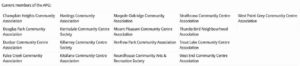
The Association Presidents Group (APG) representing 17 community centre associations across the City of Vancouver, released a statement in 2024 strongly urging Premier David Eby to “reconsider his commitment to proceeding with the elimination of the Vancouver Park Board.”

The APG says Vancouver Mayor Ken Sim’s decision is “undemocratic.”

“We do not believe 8 City Councillors can decide to abolish the Park Board elected by thousands of Vancouver citizens in October 2022,” it said, in the press release, which may be found below.

“We believe the Park Board can only be removed after a civic election in October 2026, and only if Vancouver citizens have made that choice. Neither the City nor the Province have a mandate to remove the Park Board.”

The Association Presidents Group (APG) says ABC Vancouver Mayor Ken Sim’s motion to eliminate the Vancouver Park Board was announced and passed in a week without any engagement with the APG organization and other key stakeholders.

“There was no transition plan to demonstrate the alleged benefits of such a decision. The reasons announced have been questioned by many stakeholders including dozens of former Park Board Commissioners and Community Centre Associations,” said representatives with the Association Presidents Group.

Vancouver’s independent and elected Board of Parks and Recreation has served Vancouver for over 135 years. Vancouver is the only city in Canada with an elected Park Board and is the only city in North America other than Minneapolis to place its focus on growing a vibrant parks and recreation system as a constituent element to the citizens served by the municipal governments in both cities — up until the untoward December 13, 2023 decision by Vancouver Mayor Ken Sim and his super majority team of ABC Vancouver City Councillors.

VanRamblings reader Mara writes to correct some of the information above …

MANY cities in the United States have elected park boards including: Tacoma (Washington State), Bainbridge Island (Washington state), Bend (Oregon), Willamalane (Oregon), Simi Valley (California), Three Rivers Park District (Minnesota), and over 350 cities in Illinois (Naperville, Joliet, Rockford, Springfield are the big ones, but there are 350 others), and nearly every city in North Dakota (Fargo, Bismarck, Minot, Williston, others). There are also elected park districts in northern California, Montana, Colorado, Florida, West Virginia, New York state, and Massachusetts.

In Canada, Cultus Lake in British Columbia has an elected park board.

I say this because Vancouver IS NOT an outlier. It needs to keep its independently-elected park board, but people need to realize it’s one of many. If you keep repeating Ken Sim’s lie about Vancouver being an oddity, it feeds into his narrative.”

Thank you, Mara. At the moment, for some, the Contact VanRamblings function on the site is not working. We are working on resolving that issue.


Preservation of an Elected, Independent, Responsive Vancouver Park Board 


Here’s the Association Presidents Group Press Release 

The Association Presidents Group (APG) believes Vancouver Mayor Ken Sim’s attempt to abolish the elected Vancouver Park Board is undemocratic.

We do not believe 8 City Councillors can decide to abolish the Park Board elected by thousands of Vancouver citizens in October 2022. We believe the Park Board can only be removed after a civic election in October 2026, and only if Vancouver citizens have made that choice.

Neither the City nor the Province have a mandate to remove the Park Board.

Mayor Sim’s motion was announced and then passed within one week without any engagement with the Community Centre Associations and other key stakeholders. There was no transition plan to demonstrate the alleged benefits of such a decision. The reasons announced have been questioned by many stakeholders, including dozens of former Park Board Commissioners and Community Centre Associations.

The elected Park Board has served Vancouver well for over 135 years.

Voters created an elected Park Board because they wanted parks and recreation to be a high-profile priority in Vancouver. Commissioners run for office because they are passionate about protecting and expanding our parks and recreation programmes. It is their priority concern and responsibility.

The Mayor’s proposal would have Commissioners replaced by City Councillors who have a multitude of responsibilities resulting in a less responsive and effective working relationship for community stakeholders. City parks and recreation will not be the first priority for City Councillors.

The APG rejects the Mayor’s claim that the Park Board is broken.

We believe it has been critically underfunded by City Council for several decades.

Many of the examples cited by the Mayor for the elimination of the Park Board are in fact already the City of Vancouver’s responsibility. They own and maintain the buildings and infrastructure in the Park Board system.

For example, Park Board frequently recommends renewal and expansion of Community Centres for additional space to accommodate children’s programmes but it is City Councillors who decide on the funding. Parents complain that programme spaces for their children are inadequate. Those concerns should be directed to City Hall.

A decision to eliminate the elected Park Board must be determined democratically in the next municipal election if it remains part of the ABC platform. Let the voters of Vancouver make such an important decision.

Sign the APG Petition asking the Premier not to eliminate Park Board.


For more information please contact either of the following APG members:

(copy and paste either or both of the following e-mail addresses into your e-mail programme)

Jerry Fast <jerryfast@shaw.ca>

Kathleen Bigsby <kmbigsby@gmail.com>


The Auditor General’s Report released yesterday on his audit of recreation facility asset management at the Vancouver Board of Parks and Recreation (Park Board) and City of Vancouver (City).

The Report, as submitted by Mike Macdonell, Auditor General reads in part …

“The Park Board manages 24 community centres, 14 pools and eight indoor rinks, which are owned by the City, with responsibility for maintenance shared between the Park Board and City departments. The audit determined that these facilities were not effectively managed to align with strategic goals, meet service level priorities and optimize asset lifecycles.

The 46 recreation facilities included in the audit have an estimated infrastructure funding deficit of $33 million per year, which is part of the City’s significant overall infrastructure deficit of $500 million per year.

Many of the Park Board facilities’ building systems have been extended well beyond their intended useful life. As of 2022, the City’s data showed that 72% of recreation facilities were in poor or very poor condition, from an asset management perspective, based on the cost of required repairs and maintenance relative to the facility’s replacement value. Although the lower rating does not mean that facilities are unsafe, these assets generally cost more to maintain, repair or improve and are closer to requiring renewal.

The Park Board and the City aimed to improve the condition of recreation facilities so that 70-80% were in good or fair condition by 2050. However, there were no agreed-upon facility asset management investment plans to fund such a significant increase in condition.

The audit found that the City did not have a Council-approved policy or strategy, or a formalized capital asset management framework, to guide asset management planning for recreation facilities and ensure consistent alignment between community expectations, service delivery targets, and the maintenance strategies needed to support them.

The City provided building maintenance services to the Park Board guided by an agreement created in 2014, but the audit found there was no operating level agreement that defined respective Park Board and City staff responsibilities.

The agreement also did not define accountability or reporting requirements from the City to the Park Board for its provision of asset management services. The audit found that Park Board Commissioners did not receive consolidated information on asset-related service levels, performance indicators and funding scenarios to support their responsibility to oversee recreation asset management.”

VanRamblings believes that preserving our elected Park Board is critical for the livability of our city, to continue to prioritize the high quality of service provided to us by our community centres, pools and hockey rinks, and the maintenance of Vancouver’s more than 400 parks for the ongoing enjoyment of Vancouver citizens.